Power Distribution Units (PDUs) and Stage Power Planning
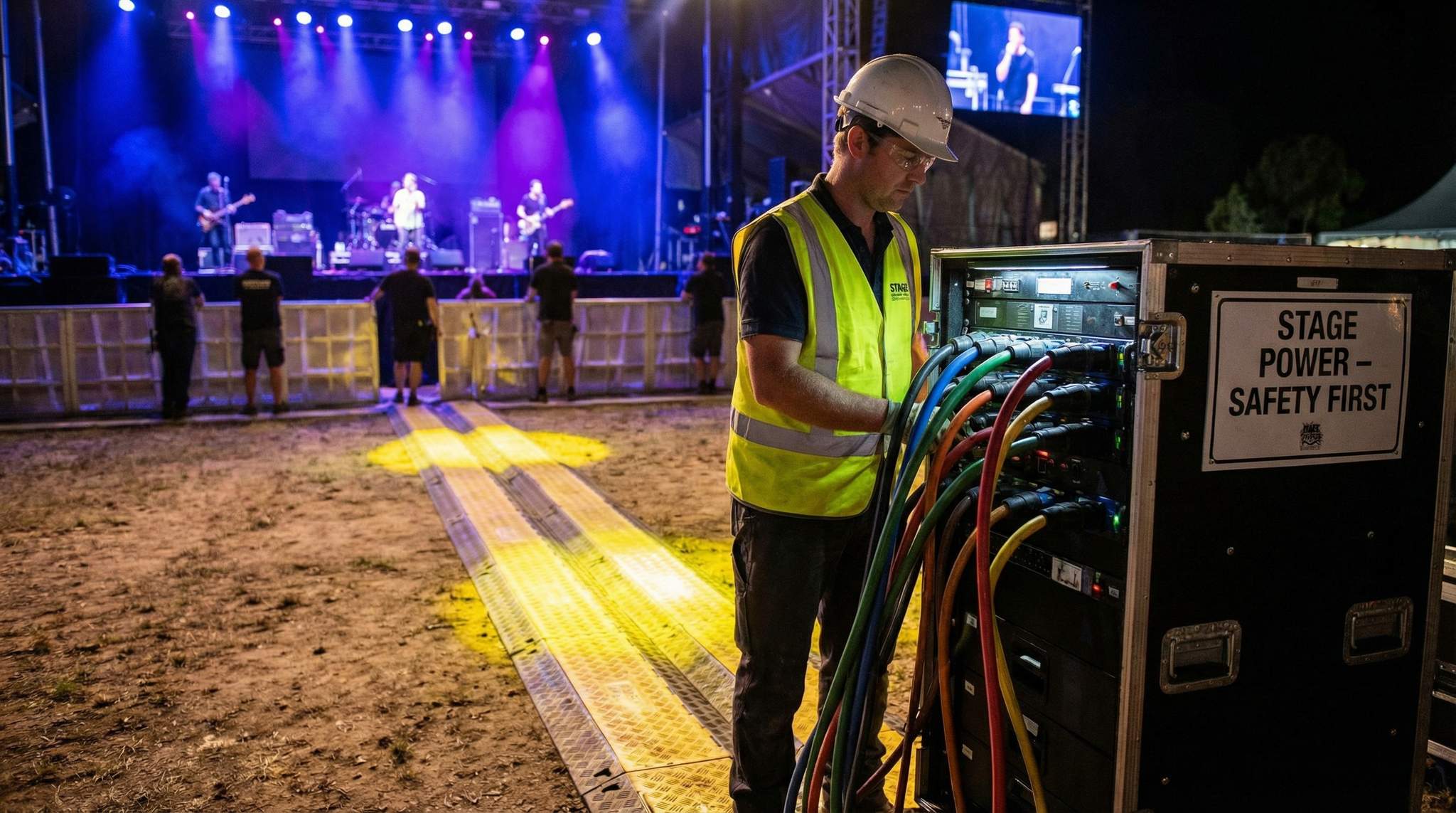
Managing electricity for a stage production starts with having the right Power Distribution Units (PDUs) and a solid plan. A PDU, often called a distro or “spider box,” safely splits a high-capacity supply (like a generator or venue mains) into usable circuits for stage gear. Experienced festival crews always involve a licensed electrician to design and set up these systems – connecting hefty three-phase feeds or generators into PDUs is not a DIY job. Planning how many circuits you need (for audio, lighting, backline, video, etc.) ahead of time prevents last-minute scrambling and dangerous daisy-chains. A well-designed distribution system ensures that every piece of equipment gets power without overloading any single source, keeping the show running smoothly.
To streamline this process, production managers should develop a comprehensive technical checklist long before the load-in begins. This document tracks every generator, PDU, and circuit requirement across the site. Reviewing stage electrical samples—such as load calculations from previous events or template distribution schematics—can help your team accurately forecast power needs and avoid overlooking critical infrastructure.
Choosing the Right Festival Power Supply
Securing a reliable festival power supply is the foundational step before any distribution network is mapped out. Depending on the venue, organizers must decide between tying into municipal grid power or deploying a fleet of synchronized towable generators. For greenfield sites, twin-pack generators running in parallel offer essential redundancy; if one engine fails, the other seamlessly picks up the load, ensuring the main stage never goes dark. Venue operators and production managers must calculate the total peak demand—factoring in audio, lighting, vendor villages, and site operations—to specify a primary energy source that provides at least 20% to 30% headroom above the maximum anticipated draw.
Designing temporary power for a music festival requires treating the site like a pop-up city. Unlike permanent venues, greenfield sites demand a completely modular approach to electricity. Production teams must map out not just the main stages, but also the sprawling infrastructure of vendor villages, VIP lounges, and perimeter lighting. A successful short-term power grid relies on strategically placed generator farms and robust distribution networks that can be rapidly deployed, safely operated for the duration of the event, and efficiently struck post-show without leaving a footprint.
Free Tool: Size Your Festival Site
Zoned capacity planning for arena, campsite, parking and entry lanes — against UK Purple Guide and NFPA density standards. Finds your bottleneck zone.
Managing the overall electricity supply during festivals requires a holistic view of the site’s energy consumption. Beyond the main stages, organizers must account for the continuous draw of food vendors, perimeter lighting, and backstage production compounds. A robust strategy often involves deploying a mix of high-capacity generators for heavy production loads and smaller, localized power units for ancillary areas, ensuring that the entire festival footprint remains energized without straining a single source.
Advanced power management for outdoor festivals now frequently incorporates smart telemetry and real-time load monitoring. By utilizing digital distribution boards, site managers can track the exact energy draw from a central dashboard, identifying phase imbalances or unexpected spikes before they trigger a breaker. This proactive approach to energy oversight allows production teams to optimize fuel consumption across generator farms and reduce the event’s overall carbon footprint.
Planning a Festival?
Ticket Fairy's festival ticketing platform handles multi-day passes, RFID wristbands, and complex festival operations.
Separate Circuits for Audio and Lighting
One golden rule is to run audio and lighting on separate circuits. Why? Lighting systems (especially older dimmers or certain LED fixtures) can introduce electrical noise and voltage fluctuations that cause a hum or buzz in sound systems. By giving audio equipment its own “clean” circuit or even a dedicated generator, you isolate sensitive mixers and amplifiers from the electrical hash generated by lights. This separation not only reduces hum, but also adds a safety margin – if a lighting circuit trips a breaker, the sound doesn’t go dead (and vice versa). Seasoned festival producers allocate distinct power feeds for audio, lighting, and video wherever possible, ensuring each has stable voltage and minimizing interference. The result is a cleaner sound for the audience and a more reliable overall system.
When designing power distribution for lighting rigs, organizers must account for the high inrush currents of moving heads and the harmonic distortion caused by massive LED walls. Dedicated distro racks for the visual department ensure that these heavy, fluctuating loads do not compromise the audio mains.
When engineering sound system power distribution, production managers must prioritize clean, uninterrupted voltage for the main PA, monitor rigs, and front-of-house (FOH) control. A dedicated audio distro should utilize isolation transformers to further protect sensitive digital mixing consoles and amplifier racks from transient voltage spikes. By isolating the audio power grid from the rest of the site’s electrical demands, organizers guarantee that the dynamic range of the performance isn’t bottlenecked by power sags during heavy bass drops.
Grounding All Equipment
Proper grounding is non-negotiable in stage power. Every piece of electrical equipment on stage – from the amplifiers and LED walls to the humble guitar amp – must be grounded to a common earth. A solid ground (earth) connection provides a safe path for fault current and prevents the metal parts of gear from giving performers an electric shock. Never remove or defeat ground pins on plugs; doing so might stop a hum momentarily, but it creates a lethal risk. All professional PDUs include grounding connectors, and when using portable generators, crews drive grounding rods or bond to venue earth according to local code.
Free Tool: Project Your Bar Revenue
Per-head spend benchmarks by event type turned into projected bar and food revenue, with a stock-mix estimate and gross-margin line. Free calculator.
Grounding not only protects people, it also helps eliminate annoying hum caused by ground loops. The best practice is to have one reference ground point for the entire stage power system, and use isolation transformers or ground-lift at audio signal level (not the mains) if hum issues persist. Remember, a quiet audio system free of buzz and a safe stage go hand-in-hand with proper grounding.
Safe Cabling for Sound and Lights
Handling stage cabling correctly is vital for both safety and performance. Use heavy-duty cables rated for the current draw of your equipment – flimsy household extension cords are accidents waiting to happen. Veteran stage electricians opt for cables with extra insulation and adequate gauge (thickness) to carry power long distances without overheating or voltage drop. When running cables, keep audio signal cables (like XLRs) away from high-voltage power cables as much as possible. If they must cross, do so at right angles to minimize electrical interference. Neatness also counts: secure loose cables with cable ties or gaffer tape and avoid creating a spaghetti mess where someone could trip or unplug the wrong lead. For example, festival crews often color-code or label power lines for different purposes (audio, lighting, etc.) to stay organized. Good cabling practice not only prevents technical issues like noise, but also reduces the chance of short circuits from damaged wires.
Need Festival Funding?
Get the capital you need to book headliners, secure venues, and scale your festival production.
Selecting the right festival power cable is just as critical as the distribution boxes themselves. Heavy-duty, multi-conductor lines like Type W or SOOW are industry standards because their thick, weather-resistant jackets withstand the physical abuse of live event environments. Whether you are running feeder lines from a generator or distributing 120V circuits across the deck, using properly rated, jacketed wiring prevents voltage drop over long runs and ensures compliance with temporary installation codes.
When mapping out sound system power distribution, organizers should also consider the logistics of cable deployment across varied terrain. High-quality temporary wiring must not only resist moisture and abrasion but also remain flexible enough to be safely routed through complex stage scaffolding. Utilizing standardized, color-coded feeder lines accelerates load-in times and ensures that local stagehands can easily identify discrete audio, lighting, and video power networks.
Preventing Overloads and Overheating
Temporary stage setups have a lot of gear hungry for power – lights, amps, video screens, you name it. To prevent overloads, always calculate your power loads during pre-production. List the wattage or amperage of each device and distribute them across circuits so no circuit carries more than about 80% of its rated capacity (leaving a safety buffer). Remember that some equipment (like large amplifiers or moving lights) draw extra current when starting up, so allow headroom. Overloading a circuit will trip breakers (or blow fuses) at the worst moments – imagine the entire stage going dark because too many fog machines and spotlights were on one feed. In practice, seasoned crews use multiple PDUs or sub-distribution boxes to spread out the load. If a single circuit is approaching its limit, move some devices to a different circuit instead of “just hoping for the best.”
Also be mindful of heat: tightly coiled cables or covered power strips can overheat under high load, so keep them ventilated and fully uncoiled. A simple example: something as small as a coffee maker or phone charger plugged into the wrong outlet can push a circuit over the edge and silence your sound system. Good producers communicate to all vendors and crew exactly which outlets they may use, guarding the stage power supply from inadvertent overload.
Data-Driven Event Marketing
Track ticket sales, demographics, marketing ROI, and social reach in real time. Exportable reports give you the insights to make smarter decisions.
When integrating emergency or theatrical alert systems, production managers often ask how many horn strobes on a circuit can be safely daisy-chained. The answer depends entirely on the specific amperage draw of the strobe units and the rating of the breaker—typically 15A or 20A. Because these devices can have high peak inrush currents when flashing simultaneously, safety engineers recommend calculating the total peak load and leaving at least a 20% buffer to prevent nuisance tripping during critical moments.
To further refine these calculations, production managers often compile a reference stage for electrical samples—a standardized portfolio of power draws for common equipment configurations. Having these baseline metrics readily available helps technical directors quickly answer granular questions and scale their infrastructure accurately, ensuring that every new stage design is backed by proven, real-world load data.
Cable Ramps and Physical Protection
Beyond electrical calculations, physical safety measures are a core part of electrical safety on stage. Cable ramps (those sturdy bridge-like covers) are used whenever cables must cross footpaths, audience areas, or vehicle routes. They protect cables from being crushed by heavy loads and prevent people from tripping. Investing in proper cable ramps (instead of hastily taping cables to the ground) is a must for any professional festival.
On stage and backstage, route cables so they’re not pinched in doorways or under roadcases. Use strain relief on connections – for instance, where a power cord plugs into a mixer or amp, ensure there’s no tension that could pull it out or fray it. During one festival setup, when a heavy amplifier rack was inadvertently rolled over an unprotected cable, it nearly shorted out the main PA feed; this close call reinforced to the crew why protecting and securing cables is taken so seriously.
Physical protection extends vertically as well. For overhead trusses, ensuring that safety cables (or tethers) are properly rigged alongside power lines prevents catastrophic falls if a primary clamp fails. Just as you wouldn’t leave trip hazards on the arena floor, you must secure all elevated cable runs and fixtures with rated steel safety bonds.
Weatherproofing and Outdoor Power
For outdoor festivals or any event subject to the elements, weatherproofing electrical connections is critical. Water and electricity are a deadly combination. All outdoor power equipment should be rated for weather resistance – commonly by IP rating (Ingress Protection). This means using connectors and distribution boxes designed to stay dry even in rain (e.g., IP44 or higher damp-rated plugs, or special rubber encased distro boxes). Never leave plug connections lying in puddles or exposed to rain; use covers or elevate them off the ground.
If rain is forecast, crew members should wrap or shield connections (without covering them in a way that traps heat) and have rain hoods for equipment. Additionally, use Ground Fault Circuit Interrupters (GFCIs) on circuits near any wet area or where performers could potentially be barefoot or touching metal. GFCIs instantly cut power if they sense any current leaking to ground, adding a crucial layer of protection. Weatherproofing isn’t just about rain – in dusty outdoor environments, keeping grit out of outlets and connectors also ensures a reliable connection. By adhering to these practices, a festival production can avoid short-circuits, electrical fires, or shocks even when Mother Nature is unpredictable.
Effective power management for outdoor festivals requires anticipating environmental shifts before they happen. Beyond just using IP-rated gear, site operations teams should elevate all distribution nodes on pallets or scaffolding to protect against sudden flooding, ensuring the show’s energy grid remains stable regardless of the forecast.
Adhering to Electrical Safety Codes
Professional festival productions treat national and local electrical safety codes as gospel. These regulations (like the National Electrical Code in the US or local authority rules) exist to keep everyone safe. Codes dictate things like proper grounding methods, the types of cables and connectors allowed, and how temporary power setups should be inspected. Following code isn’t just about legal compliance – it enforces a high standard of safety. For instance, electrical codes require sufficient spacing and guarding of electrical equipment, meaning you can’t have open live terminals anywhere a crew member might accidentally touch. They also specify using the right type of cable for the job (for example, extra-hard usage cables for heavy-duty outdoor use) and proper use of circuit breakers and fuses.
Always get your stage power distribution inspected by a qualified electrician or safety inspector before showtime. It’s far better to spend a bit more time or money on a code-compliant setup than to risk an accident. Remember that if an incident occurs, investigators will ask if you followed the rules – and as a responsible producer, you’ll want to confidently answer “yes.” Adhering to code also instills confidence in your crew and talent that the event is professionally run with safety in mind.
Safety Is Non-Negotiable
At the end of the day, electrical safety on stage is absolutely non-negotiable. The excitement of a festival shouldn’t come at the cost of anyone’s well-being. The production team must foster a culture where every crew member, from lighting techs to audio engineers, respects the power of electricity and follows protocols. Double-check all connections, keep liquids away from electrical gear, and have emergency shut-off switches accessible. Remember that performers often interact directly with electrical equipment (holding microphones, guitars, etc.), so their lives literally depend on the electrical system being safe.
Stories of singers receiving shocks or worse are grim reminders that one loose wire or ungrounded amp can be deadly. By taking every precaution – separate circuits, proper grounding, load balancing, and abiding by safety standards – festival organizers ensure that the show not only goes on, but goes on safely. In the high-pressure moments before a headline act starts, a producer can have peace of mind knowing that the power setup is sound and no one is at risk from it. Ultimately, no shortcut or cost saving is worth endangering lives – electrical safety is one area where doing it right is the only option.
Frequently Asked Questions
Why should audio and lighting be on separate circuits?
Running audio and lighting on separate circuits prevents electrical noise and voltage fluctuations caused by dimmers or LED fixtures from creating hum in sound systems. This separation also adds a safety margin, ensuring that if a lighting circuit trips a breaker, the audio equipment remains powered and operational.
How can festival crews prevent electrical circuit overloads?
Crews prevent overloads by calculating power loads during pre-production and distributing devices so no single circuit exceeds 80% of its rated capacity. This buffer accounts for startup current spikes from amplifiers or moving lights. Using multiple Power Distribution Units (PDUs) helps spread the load across different feeds.
Why is grounding important for stage equipment?
Proper grounding provides a safe path for fault current, preventing metal gear parts from shocking performers. It also eliminates audio hum caused by ground loops. Professional crews establish a single reference ground point and never remove ground pins, as doing so creates lethal risks while only momentarily stopping noise.
How should power and audio cables be routed on stage?
Audio signal cables, such as XLRs, should be kept away from high-voltage power lines to minimize electrical interference. If cables must cross, they should do so at right angles. Veteran electricians use heavy-duty cables with adequate gauge to prevent overheating and secure loose wires with cable ties or tape.
What are the requirements for outdoor festival power setups?
Outdoor power equipment must be rated for weather resistance, typically using IP44 or higher connectors and rubber-encased distribution boxes. Crews should use Ground Fault Circuit Interrupters (GFCIs) near wet areas to cut power if leakage occurs. Connections must be elevated or covered to protect against rain and ground moisture.
When are cable ramps necessary at festivals?
Cable ramps are necessary whenever electrical cables cross footpaths, audience areas, or vehicle routes. These sturdy covers protect cables from being crushed by heavy loads and prevent attendees or crew from tripping. Using ramps ensures physical safety and prevents damage that could lead to short circuits or signal loss.
What is the best type of festival power cable to use?
For live events, heavy-duty cables like Type W or SOOW are recommended. These feature thick, weather-resistant jackets that protect against physical damage, moisture, and heavy foot traffic, ensuring safe and reliable power delivery across the site.
How do you handle power management for outdoor festivals?
Effective outdoor power management involves using IP-rated, weather-resistant distribution boxes, elevating connections above potential flood levels, and utilizing GFCIs near wet areas. A thorough technical checklist should also be used to track all generator loads and environmental protections.
What is the most reliable festival power supply for greenfield sites?
For greenfield sites without municipal grid access, the most reliable festival power supply is a twin-pack generator system. These units run two synchronized engines in parallel, providing built-in redundancy so that if one generator experiences a fault, the other sustains the critical production load without interrupting the event.
What are the key considerations when setting up temporary power for a music festival?
Setting up temporary power for a music festival requires comprehensive load forecasting, strategic generator placement, and strict adherence to safety codes. Organizers must design a modular grid that supports stages, vendor areas, and site lighting while ensuring redundancy—such as twin-pack generators—to prevent outages. Weatherproofing and proper cable management are also critical for maintaining a safe, reliable short-term electrical system.
How do you manage the overall electricity supply during festivals?
Managing the electricity supply during festivals involves calculating the total peak demand across all site areas, including stages, vendor villages, and operations. Organizers typically deploy a combination of synchronized twin-pack generators for critical stage loads and localized power units for ancillary zones, ensuring redundancy and preventing any single source from being overloaded.
How many horn strobes can you safely put on a single circuit?
The number of horn strobes you can safely put on a circuit depends on the total amperage draw of the units and the breaker’s capacity (usually 15A or 20A). Because strobes generate high inrush currents when flashing, production electricians calculate the peak load and maintain a strict 20% safety buffer to prevent the circuit from tripping.
What are the best practices for sound system power distribution at a festival?
Effective sound system power distribution requires dedicating a completely isolated power feed or generator specifically for audio equipment. Production teams should use dedicated audio distros with isolation transformers to protect sensitive digital consoles and amplifiers from voltage spikes, ensuring clean power delivery and preventing audio dropouts during high-demand moments.