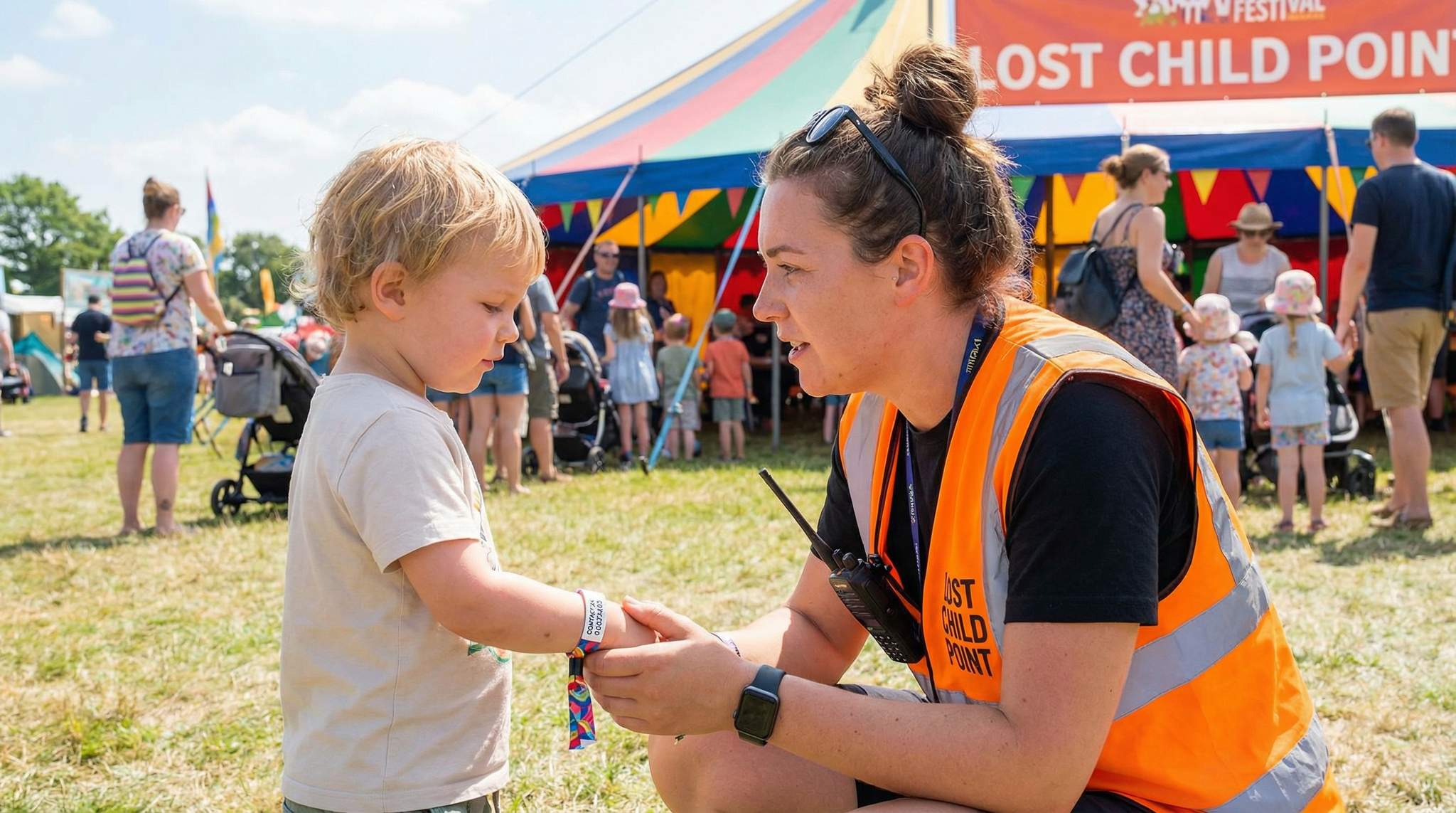
Large festivals and community events around the world often attract families with children. Amid the excitement and crowds, it’s surprisingly easy for a child to wander off or get separated from their guardians. For festival producers, preventing and handling lost-child incidents swiftly is not just a safety imperative but also a matter of trust and reputation. A well-crafted reunification plan – covering everything from preventive ID wristbands to detailed incident logs – can turn a moment of panic into a brief hiccup, ensuring families feel safe and cared for. The following strategies draw on real festival experiences to help organizers create a family-friendly environment where every lost child finds their way back quickly.
Implement Child ID Wristbands (Guardian Contact & Language)
One of the simplest proactive measures is to equip every child at the festival with an identification wristband. At the gate or family check-in, provide robust wristbands where guardians can write their phone number and the child’s or guardian’s preferred language. Should a child become lost, any staff member or attendee can immediately contact the number on the wristband and know if language assistance is needed. This simple step can shave crucial minutes off the reunification time by providing immediate contact information. Many festivals worldwide have adopted such child registration schemes – for example, authorities in Durban, South Africa recently prepared 200,000 wristbands to tag children on packed beaches, ensuring quick reunifications in hundreds of potential lost-child cases.
The key is making sure parents actually use the wristbands: remind them at entry to fill them out and secure them on their children’s wrists. Design the bands with comfort and security in mind (waterproof and difficult for a toddler to peel off). For international events or in multilingual countries (think of festivals in Singapore, India, or Canada, for example), including the language preference on the band (or using a little flag icon) is a thoughtful touch that can help staff find the right translator or approach. And for privacy, it’s usually best to list a first name and contact number – avoid putting a child’s full name where strangers can see it. With a clearly labeled wristband, a lost child can be identified and reunited with their family far more quickly, no matter where they might wander.
As events scale, many organizers are upgrading from traditional write-on markers to digital solutions. Evaluating smart ID band options for child safety—such as RFID-enabled bracelets or QR-coded “safe save” style wristbands—allows event control to scan a found child’s tag and instantly pull up encrypted guardian data. Furthermore, integrating a dedicated reunite app for kids’ safety into your event management software empowers roaming ground teams to log a found child digitally, instantly syncing the profile across all security zones without broadcasting sensitive details over open radio channels.
Smooth Entry With Mobile Check-In
Scan tickets and manage entry with our mobile check-in app. Supports photo ID verification, real-time capacity tracking, and multi-gate coordination.
When deploying these secure data-storing wearables—often referred to in the industry as safe save wristbands—producers must ensure the technology integrates seamlessly with existing access control hardware. A robust safe-save system allows parents to link their child’s band to their own ticketing profile during the initial purchase or at the box office. If a separation occurs, scanning the child’s band instantly retrieves the parent’s emergency contact details, seat location, and even authorized secondary guardians, creating a closed-loop security environment that prioritizes data privacy while expediting the reunification process.
Clearly Mark Meeting Points and Lost-Child Centers
Even with ID bands, you need a physical plan for reunification. Establish clearly marked meeting points or a dedicated Lost Child Center on-site – and communicate its location widely. On your festival maps (both the printed map and the map in your mobile app or website), highlight the family reunification point with a special icon or bright color. Don’t bury it in fine print; make it as prominent as the food court or first aid station. Additionally, use on-site signage and digital screens to point people to this location. Many festivals hang banners or balloons labeled “Lost Child Point” above the tent to make it visible from afar.
Planning a Festival?
Ticket Fairy's festival ticketing platform handles multi-day passes, RFID wristbands, and complex festival operations.
The goal is that if a child is found by a festival-goer or staff member, they know exactly where to bring them, and if a parent is searching, they know where to go immediately. These meeting points should be staffed with trained personnel (more on training below) and ideally equipped with comforts for kids – water, a chair or shade, perhaps some stuffed toys – anything to help calm a frightened child. By prominently designating reunification points on maps and around the venue, you eliminate confusion and minimize the time a child and parent are separated. In fact, industry safety guidelines list designated meeting points as a critical component of lost-child plans. Everyone from security guards to food vendors should be aware of the nearest lost child station’s location, so they can direct a distressed parent or escort a found child there without delay.
When producing a massive event, operators often ask what a strong lost-child protocol looks like at a park the size of Hersheypark or a sprawling 100,000-capacity mega-event. For these massive venues, a single lost-child tent is insufficient. Instead, organizers must implement a zone-based grid system. Each distinct area or stage should feature its own localized family reunification point, acting as a primary triage center. If a separation occurs at a sprawling music festival with kids in attendance, ground teams can lock down the immediate zone and coordinate with central dispatch, preventing the child from wandering into a completely different sector of the site.
Train Staff with Calm, Privacy-First Protocols
All the best plans on paper mean little without competent execution – which is why staff training is paramount. Every festival staff member, from security and volunteers to information booth personnel, should know the procedure for handling a lost child incident. Develop a clear protocol and script, and train the team on it before the festival. Key elements include keeping everyone calm, ensuring the lost child is comforted and safe, and maintaining privacy throughout the process. For example, when a staffer finds a missing child (or a child approaches them for help), they should speak gently at the child’s eye level, introduce themselves as a helper, and avoid alarming the child with loud or hurried behavior. If a parent approaches staff frantic about a missing kid, the staff should use a reassuring tone, get a description of the child and where they were last seen, and immediately relay that to the central control or security team per protocol (often via radio, using a code to avoid broadcasting the child’s personal details to the whole crowd).
Privacy-respectful procedures mean you do not make loud public announcements using the child’s name or identifying details. Instead, share information only with the teams who need to know – security, the lost-child center staff, event control, and so on. Many festivals use a predefined code name for a lost child case to keep it discreet. For instance, some events might radio, “Code Adam at Area B” or give a brief description like “Lost child, age 5, blue shirt, last seen by the Ferris wheel,” without using the child’s name. This avoids frightening other attendees or violating the family’s privacy, while still mobilizing the team. Staff should also be trained to never blame or scold anyone in these scenarios – neither the parent nor the child – and to focus solely on solving the situation.
Go Cashless With RFID Technology
Enable contactless payments, faster entry, and real-time spending analytics with RFID wristbands and NFC-enabled ticketing for your events.
Another critical training point is verifying identities upon reunification. When a guardian arrives to claim a lost child, staff must confirm that this person is indeed the rightful parent or guardian before handing over the child. This can be as simple as checking a photo ID or confirming the phone number on the child’s wristband matches the guardian’s phone. It might feel like an awkward formality in the moment, but it is a vital safety step. Imagine the horror if a child were handed to the wrong person due to a mix-up – that kind of mistake has happened in the past and must be avoided at all costs. Training should reinforce that no child leaves the lost-child area until official verification is done.
Additionally, consider the diverse needs of children in your audience. A good training program covers how to approach children who might have disabilities or communication differences. For example, a non-verbal autistic child may not respond to questions and could be extra sensitive to noise and touch – staff should know to approach more gently, perhaps offer noise-cancelling headphones or a quiet space, and use visual cues or a caregiver to help communicate. Likewise, if your event draws many international visitors, have staff or volunteers who can speak common languages (or quick access to translation services) to bridge any language gap with a lost child or parent.
Need Festival Funding?
Get the capital you need to book headliners, secure venues, and scale your festival production.
With thorough training and clear protocols, your team will act like a well-oiled machine in an emergency. In fact, at many family-focused festivals, reunifications happen so efficiently that children often don’t even realize they were “lost” – they’re found and guided to safety so quickly, and kept happily distracted at the lost child tent, that panic never gets a chance to set in (the parents are usually more shaken than the kids!). That level of smooth operation comes directly from solid preparation and a staff that knows exactly how to handle these situations.
When establishing these procedures, organizers must clearly delineate between two primary scenarios: what to do if a child is missing (a guardian reports a separation) versus what to do if you find an abandoned child or unattended minor on the festival grounds. If a parent reports a missing child, the immediate protocol involves locking down the gates, broadcasting a discreet description to all security zones, and deploying roaming teams to the last known location. Conversely, if staff discover a child wandering alone, the priority shifts to securing the child in place, keeping them calm, and notifying event control to cross-reference any incoming missing-person reports. Both scenarios require distinct, rehearsed responses to ensure rapid resolution.
Log Every Incident (Time, Location, Outcome)
Every lost-child incident – no matter how minor or quickly resolved – should be documented. Keeping a log not only enforces discipline in following the procedure, it also provides valuable data for later analysis and a record in case details are needed after the festival. At your Lost Child Center (or event control office), have a simple incident form or logbook ready to fill out for each case. Note the time the child was reported missing (or found), the location or area where they were last seen or found, a description of the child (approximate age, gender, clothing), and the guardian’s name and contact information. Also record the time of reunification and how the child was found (e.g., “located by Stage 2 security after radio alert”). Include any noteworthy details – perhaps the child was looking for the parent at the ice cream stand, or a public attendee brought the child to the tent. Finally, record the names of the staff members involved in handling the incident. If possible, have the guardian sign or initial when they retrieve their child, to confirm hand-over. This paperwork may seem tedious in the moment, but it creates an important paper trail and reinforces that the situation was handled correctly.
Logging incidents serves multiple purposes. First, it ensures the team follows through fully on each case – no lost child should be handled informally and then forgotten without record. Second, it protects the festival and the attendees: if there is any dispute or question later (for example, a guardian feels the search took too long), you have an official timeline and details to refer to. Third, reviewing these logs post-event helps improve your plan for next time. You might discover patterns, like multiple children wandering off near a particular attraction or during a certain time of day, which you can address by adding more signage or staff in those areas. Or you may find that one incident took longer to resolve because staff had trouble reaching the parent by phone – insight that could lead you to implement a backup communication method or ensure better cell coverage. In essence, these records turn individual incidents into lessons for the future.
Free Tool: Size Your Festival Site
Zoned capacity planning for arena, campsite, parking and entry lanes — against UK Purple Guide and NFPA density standards. Finds your bottleneck zone.
Proper documentation is also part of your duty of care when working with minors. Consider a cautionary tale: at one event, staff found a lost three-year-old and misguidedly paraded the child around trying to locate the parent, then handed the child over to an adult without any ID check or paperwork. This breach of protocol not only endangered the child but left the organizers with no documented account of what happened – a serious liability. No festival organizer wants to face that scenario. By diligently logging every lost-child case and adhering to procedure, you create a culture of accountability and safety. In many jurisdictions, having these records also means you can readily provide information to authorities if ever required (for instance, if an issue were escalated), demonstrating that your team handled everything properly.
To streamline this documentation, many modern festivals deploy specialized software. Utilizing a digital reunite app for kids safety allows ground teams to input descriptions, upload secure photos, and log timestamps directly from their mobile devices. This real-time data syncs instantly with the central command center, eliminating the delays and miscommunications often associated with paper logs and radio chatter.
Sample Family Reunification Plan Framework
To move from theory to practice, it helps to review a concrete family reunification plan example. When drafting your event’s operational documents, your standard operating procedure (SOP) should clearly define roles, communication channels, and step-by-step actions. Below is a foundational template that producers can adapt for their specific site layouts and crowd sizes.
- Phase 1: Prevention & Intake: Mandate child ID wristband distribution at all main gates. Ensure box office staff are trained to prompt families during ticket scanning.
- Phase 2: Initial Report (Code Adam): If a guardian reports a missing minor, the nearest staff member radios event control with a predefined code, providing the child’s description and last known location. Gate security temporarily pauses exits in the immediate zone.
- Phase 3: Securing an Unattended Minor: If a roaming team member discovers a separated child, they secure the area, comfort the minor, and notify central dispatch. The child is then escorted by two vetted staff members to the primary Lost Child Center.
- Phase 4: Verification & Handover: At the reunification point, the supervisor cross-references the guardian’s photo ID or wristband data against the digital incident log before releasing the child.
Using a structured template like this ensures that every stakeholder—from volunteer ushers to local law enforcement—understands their exact responsibilities during a high-stress situation.
Share Improvements Post-Festival to Build Trust
Your responsibility to attendees doesn’t end when the festival is over. After each event, take time to evaluate how your lost-child reunification plan worked and then communicate any improvements to your audience – especially the parents who trusted you with their kids. Start with an internal debrief: gather your team (security, volunteers, customer service, medical staff – anyone who played a role) and review the lost-child incident log and anecdotes. What went well? What could be improved? Perhaps you discover that the wristbands ran out too quickly on the first day, or that the Lost Child Center could be in a more central location. Maybe communication between the security team and the lost-child tent had a hiccup that delayed one reunion. Use these insights to develop concrete fixes and updates to your plan.
Next, be transparent with your festival community about child safety. In a post-event email newsletter or social media post, share a summary of how things went and what you’ll do better. For example, you might write: “Thanks to our preparation, we safely reunited 5 lost children with their families this weekend – with an average separation time of only 10 minutes. We also learned a few ways to improve: next year we’ll have multi-language child ID wristbands and double the signage for our Lost Child points, making it even easier to find help when needed.” By openly highlighting both successes and planned improvements, you reassure parents that you’re proactive and honest. Instead of brushing incidents under the rug, you’re showing that you handled them responsibly and are always striving to enhance safety.
Free Tool: Project Your Bar Revenue
Per-head spend benchmarks by event type turned into projected bar and food revenue, with a stock-mix estimate and gross-margin line. Free calculator.
This level of transparency goes a long way toward building trust. Parents and guardians will feel more confident returning to your “family-friendly” festival year after year, knowing that even if something goes wrong, you have a robust system to handle it. A great reputation on safety can also spread by word of mouth – one positive story about a well-handled lost child incident can turn concerned families into future attendees. Conversely, a poorly handled incident can become the stuff of local news or viral social media, so putting the effort into improvement and communication is well worth it. In some cases, festivals even share their best practices with each other at industry conferences or forums, collectively raising the standard for child safety at events. Regardless, always celebrate your team for successful reunifications and improvements made – recognizing their good work reinforces the culture of safety and attentiveness that you want every staff member to uphold.
Key Takeaways:
* Use ID wristbands for kids: Provide children with wristbands displaying their guardian’s phone number (and a language preference if relevant) so you can contact parents immediately if a child is found lost.
* Clear meeting points: Establish a well-marked Lost Child Center or meeting point visible on maps, apps, and on-site signage, so everyone knows where to go if a separation occurs.
* Trained, calm staff: Ensure your festival team is trained with a clear reunification protocol – staying calm, keeping communication discreet, comforting the child, and verifying the guardian’s identity before reunification.
* Document every incident: Log each lost-child case with time, location, and outcome, and have guardians sign off. Detailed records help improve your procedures and protect your event by providing an accountable history of what happened.
* Post-festival transparency: After the event, communicate how all lost children were safely reunited and explain any new safety measures you’ll implement next time. Being open about your process and improvements builds trust with parents and shows your festival is truly family-friendly.
Frequently Asked Questions
How do child ID wristbands help at festivals?
Child ID wristbands accelerate reunification by providing immediate access to a guardian’s phone number and language preference. Staff can contact parents instantly without waiting for a translator. For privacy, festivals should list only the child’s first name and the contact number, ensuring quick identification while keeping personal details secure from strangers.
How should festival staff handle a lost child incident?
Staff must remain calm, speak gently at eye level, and avoid making loud public announcements with the child’s name. Instead, they should use radio codes or discreet descriptions to alert security. Before releasing a child, staff must verify the guardian’s identity by checking ID or matching the phone number on the child’s wristband.
Where should lost child meeting points be located at events?
Lost child meeting points must be clearly marked on festival maps, apps, and on-site signage using prominent icons or bright colors. Locations should be as visible as food courts, often using high-flying banners or balloons labeled “Lost Child Point” so children and searching parents can spot them easily from a distance.
Why is it important to log lost child incidents at festivals?
Logging every incident creates a crucial paper trail for accountability and future safety improvements. Records should include the time, location, child’s description, and reunification outcome. This documentation protects the event against liability disputes and helps organizers identify patterns, such as high-risk areas, to enhance security measures for future events.
What is the procedure for verifying a guardian before releasing a lost child?
Staff must confirm the adult is the rightful guardian before handing over a child. This involves checking a photo ID or verifying that the phone number on the child’s wristband matches the guardian’s device. No child should leave the designated safety area until this official verification is complete to prevent dangerous mix-ups.
How can festivals build trust with parents after an event?
Festivals build trust by transparently sharing post-event summaries of safety successes and planned improvements. Communicating statistics, such as average reunification times, and openly discussing new measures like multi-language wristbands reassures parents. This honesty demonstrates a proactive commitment to family safety, encouraging families to return and fostering a positive reputation.
How do you scale a lost-child protocol for massive venues or theme parks?
For sprawling footprints—such as a mega-festival or a park the size of Hersheypark—a strong protocol relies on a zone-based grid system. Instead of one central tent, organizers deploy localized reunification points in every major sector, allowing rapid response teams to secure the immediate area and coordinate digitally with central event control.
Should festivals use smart ID bands or reunification apps?
Upgrading to smart ID bands, such as RFID or QR-coded safe save wristbands, enhances child safety by encrypting guardian contact data. Pairing these wearables with a dedicated reunite app allows security teams to instantly scan, log, and sync a lost child’s status across the entire venue’s communication network without using open radio channels.
What should event staff do if a child is reported missing?
When a guardian reports a missing child, event staff should immediately gather a detailed description, including clothing and last known location. This information must be relayed discreetly to event control and security teams using predefined radio codes. Ground teams should then monitor exit gates and search the immediate vicinity while keeping the guardian calm at a designated meeting point.
What is the protocol if event staff find an abandoned or unattended child?
If staff find an abandoned or unattended child wandering the festival grounds, they should first secure the area and comfort the minor without causing alarm. Staff must immediately notify event control with the child’s description and location, then safely escort them to the nearest official lost-child center to await reunification, ensuring the child is never left alone.
How do organizers implement secure data-storing wristbands for child safety?
To deploy secure data-storing wearables, often known as safe save wristbands, organizers integrate the bands with their primary ticketing and access control systems. Parents register their contact details and link them to the child’s band at the box office or during ticket purchase. If the child is found wandering, authorized security personnel can scan the band to instantly access the encrypted emergency contact information, ensuring a rapid and private reunification.
What should a standard family reunification plan example include?
A comprehensive template should outline four main phases: prevention (distributing ID wristbands at gates), initial reporting protocols (using radio codes for missing or found minors), secure transport to designated meeting points, and strict identity verification procedures before handing the child back to their guardian. This framework ensures all event staff follow a unified, predictable response.