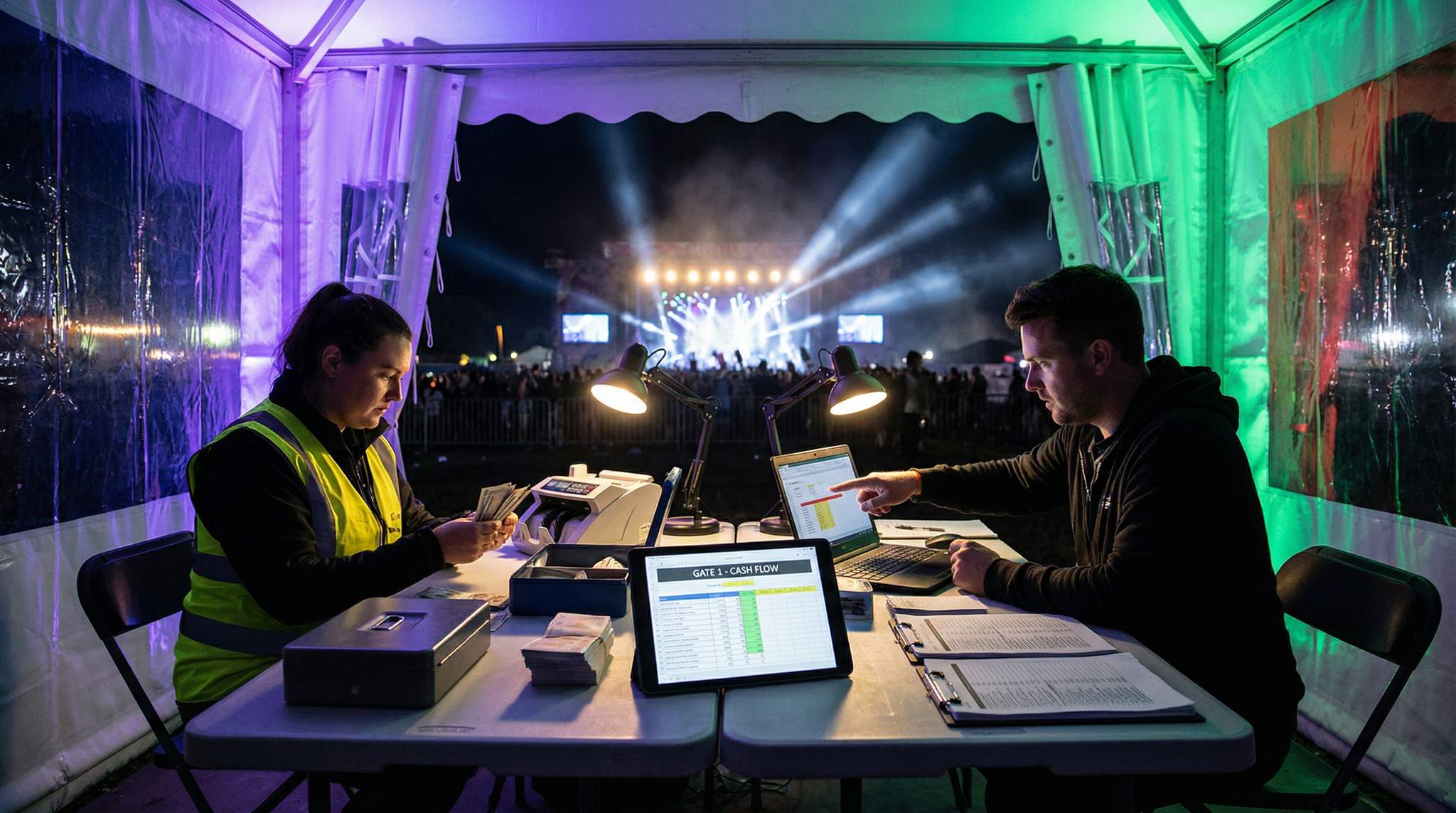
Focusing on Income but Overlooking Security: A Common Mistake
The Allure of Sales vs. the Reality of Leaks
Many festivals pour their energy into selling tickets and landing sponsors – the sexy side of revenue – while neglecting the less glamorous task of guarding that income. Event organizers celebrate each ticket sold and each drink poured, yet money can slip away behind the scenes if proper controls aren’t in place. In fact, industry veterans warn that most festivals inadvertently bleed money by overlooking financial safeguards. The hard truth is that chasing revenue means little if leaks in cash handling, inventory, or record-keeping silently drain profits. A festival might boast a sell-out crowd and still end up in the red due to lax financial controls.
Hard Lessons from Past Festivals
Real-world examples illustrate why oversight is vital. A large California music festival learned this the hard way when hundreds of unlogged on-site purchases – for items like batteries and extra meals – added up to a surprise $20,000 budget overrun. Staff were making well-meaning buys during the event chaos but failing to track them, revealing how easily small leaks compound into major losses. Another cautionary tale comes from Glastonbury Festival in the UK: amid 200,000 attendees, 109 crimes were reported one year and 44 people were arrested – many for theft, including a group caught using counterfeit £20 notes at vendor stalls. Even a world-famous festival wasn’t immune to money mishandling and fraud attempts. These cases show that whether it’s unrecorded spending or outright theft, poor financial controls can wipe out hard-earned revenue.
Why Strong Financial Controls Matter
Every dollar (or pound, euro, or rupee) counts in the festival business. Margins are often slim, and internal losses directly threaten an event’s viability. Occupational fraud – internal theft by employees or volunteers – is a widespread problem across industries, with studies estimating the typical organization loses about 5% of its revenue to fraud each year. Live events are especially vulnerable: the fast-paced, sometimes chaotic festival environment with temporary staff and high cash volumes creates opportunities for skimming, unreported sales, or misuse of funds. Strong financial controls act as a safety net, catching errors or malfeasance early and deterring would-be thieves. They protect the investment of organizers and sponsors, ensure vendors and artists get accurately paid, and help maintain trust with all stakeholders. In short, robust controls and oversight are just as important to a festival’s success as a sold-out show – they ensure that the money earned actually makes it to the bank.
Where the Money Slips Away: Common Leak Points
Gate and Ticketing Cash Vulnerabilities
The festival gate is the first point where money can leak. At smaller events that sell tickets for cash on the door or parking lots, it’s all too easy for a staffer to miscount change or even pocket cash if they think no one’s watching. In some cases, friends of staff might be let in without paying, or counterfeit tickets might be accepted if validation is lax. Without tight procedures, cash collected at entry can “disappear” before it’s ever recorded. Festivals that rely on physical tickets or wristbands must also guard against fraud – such as unauthorized re-entry wristbands or duplicated tickets – which equates to revenue loss. The lack of separation between selling and cash reconciliation at gates is a common weak spot. Tip: Use a numbered ticket or wristband system, and require gate cashiers to maintain a log of tickets sold versus cash collected. Have supervisors do spot counts of cash drawers and entrance counts during the event. For example, a 5,000-person community festival introduced daily gate audits after discovering their door takings were off by several hundred dollars one year. By having a second manager count the gate cash mid-day and at close, they caught discrepancies immediately and curbed volunteer skimming going forward.
Go Cashless With RFID Technology
Enable contactless payments, faster entry, and real-time spending analytics with RFID wristbands and NFC-enabled ticketing for your events.
Bar and Beverage Sales: Shrinkage Risks
For many festivals, the bar is a cash cow – and a hotbed for shrinkage. Busy beer tents and cocktail bars handle huge volumes of cash and product, creating ample opportunities for losses. A bartender might slip a $20 bill from the till during a rush or give generous “on the house” drinks to friends, resulting in missing inventory with no revenue to show. Overpouring (heavy-handed free pours) also cuts into profits by depleting stock faster than sales indicate. Without inventory tracking and sales monitoring, these leaks often go unnoticed. Industry research shows beverage operations can lose 20% or more of potential revenue through shrinkage when controls are weak (via spillage, theft, or unrecorded comps). The festival environment – loud, crowded, and often staffed by seasonal workers – exacerbates these challenges. To combat this, successful events implement strict inventory controls and cashier oversight at bars. For instance, at one regional music festival, bar managers began issuing measured pour spouts and requiring bartenders to reconcile their cash and remaining stock at shift changes. The result was a significant drop in variance between expected sales and actual cash – what had been a 10% discrepancy (money missing relative to drinks used) shrank to under 2% once controls and accountability were in place.
Vendor and Concession Sales Tracking Gaps
Festivals rely on dozens or hundreds of vendors – from food trucks to craft stalls – to serve attendees. Often these vendors either pay a flat fee or owe the festival a percentage of their sales (a revenue share). Tracking those sales accurately is critical: if a vendor under-reports their earnings, the festival’s cut takes a hit. Yet without the right systems, organizers might be flying blind. At small events, it’s common to simply trust vendors’ self-reported sales at settlement, which can invite underpayment. Even well-meaning vendors can make mistakes in the frenzy of serving crowds. For example, if a food stall has long lines, they might skip logging some sales to keep the queue moving, unintentionally under-counting revenue. Cash-based sales further complicate oversight, since there’s no automatic record. This is why many modern festivals mandate that vendors use event-issued POS systems or token systems – any method that creates a digital paper trail. A case in point: a large Australian festival provided all food vendors with a unified POS app linked to the festival’s network. This let organizers see real-time sales data for each booth and flag anomalies (like one stall reporting far lower sales than similar stalls). By catching one vendor who was incorrectly logging items (and possibly skimming cash), they not only recovered lost revenue but also coached the vendor on proper procedure moving forward. The lesson: integrated sales tracking helps ensure the festival gets every dollar it’s owed and deters anyone tempted to cheat the system.
Planning a Festival?
Ticket Fairy's festival ticketing platform handles multi-day passes, RFID wristbands, and complex festival operations.
In my decades of producing everything from boutique gatherings to massive agricultural shows, a recurring challenge is scaling this vendor oversight. Organizers frequently ask how to choose the right financial accounting system (FAS) for a county fair with 50+ vendors or a mid-sized food festival. At this volume, relying on self-reported Z-reads or manual cash collection is a recipe for massive revenue leakage. The ideal system must offer multi-vendor architecture, allowing each concessionaire to operate their own sub-account while feeding real-time gross sales data directly to the promoter’s master dashboard. Look for a platform that automates revenue-share splits, supports offline mode for rural fairgrounds with spotty Wi-Fi, and integrates seamlessly with your main ticketing and cashless infrastructure. By deploying a unified FAS, you eliminate the guesswork at settlement and ensure every funnel cake and craft beer sold contributes accurately to your bottom line.
Merchandise and Unauthorized Sales
Festival merchandise – official t-shirts, posters, and souvenirs – is both a revenue source and a potential leak area. If you run your own merch booths, the risks resemble those at the bar: cash handling errors, theft from the till, or “friends and family discounts” that weren’t authorized. Even when an outside company is contracted to sell merch, festivals need oversight to verify sales numbers for royalty splits. A common leak that many festivals overlook comes from bootleg merchandise. Just outside the venue (or even sneaking inside), unauthorized vendors might hawk fake festival shirts and gear, siphoning off money that would otherwise go to the event. Major festivals like Coachella and Glastonbury have long battled bootleggers who piggyback on their brand. These illicit sales not only steal revenue but can also hurt the festival’s reputation if the knock-off products are poor quality. Prevention requires a multi-pronged approach: legal action (trademark enforcement) to seize counterfeit goods, on-site policing to catch unlicensed vendors, and fan education to encourage buying only from official merch stands. On the official merch front, strong financial control means tracking each item sold. Festivals often use inventory sheets that start with opening stock and end with closing stock each day, reconciling against cash in the register and credit card receipts. Any mismatch (beyond a very small error margin) prompts an investigation. By treating merch with the same rigor as any retail operation – barcode scanners, inventory counts, and secure cash handling – festivals can prevent one of the last big leak points where money can vanish unnoticed.
Common Financial Leak Points and Safeguards:
Here are some of the most frequent festival money leak points and how seasoned producers plug them:
| Leak Point | How Money Leaks | Safeguard to Plug the Leak |
|---|---|---|
| Gate Cash Sales | Cash from door ticket sales can be skimmed or untracked. | Use numbered tickets/wristbands; log each sale; dual-count cash at shift changes; deploy supervisors for surprise cash counts. |
| Entrance Fraud | Unchecked entry (fake or reused tickets, friends sneaking in). | Train staff to validate tickets (scanning systems); different staff at scanning vs. security; colored wristbands for each day to prevent reuse. |
| Bar/Concession Tills | Cashiers pocketing cash; giving free drinks/food unrecorded. | Install CCTV over bars; inventory controls (measure pours, count stock); require manager approval for any comped items and document them. |
| Vendor Sales Under-reporting | Vendors understate sales to reduce revenue share owed. | Mandate use of festival-provided POS that reports sales centrally; audit vendor sales against foot traffic or average transaction size; settle daily to catch discrepancies early. |
| Merchandise Booths | Cash theft or missing stock at merch stand. | Use POS for all sales; daily inventory reconciliation (items sold should match stock minus remaining); have two staff present for cash counts. |
| Bootleg Merchandise (External) | Unlicensed vendors sell fake goods, diverting revenue. | Employ roaming security to spot bootleg sellers; work with local authorities to seize counterfeit merch; educate attendees via social media and signage to buy official merch only. |
| Petty Cash & Misc. Purchases | Untracked small expenses add up (staff buys fuel, supplies with cash without receipts). | Implement a petty cash log and receipt requirement; one manager oversees petty cash fund; reconcile petty cash daily (start balance plus receipts equals end cash on hand) to ensure hundreds of minor unlogged expenses don’t add up. |
This table highlights how every stage – from front gate to back-office expenses – needs oversight. The specific solutions may vary by festival size and resources, but the goal is the same: close every gap where money could leak.
Free Tool: Project Your Bar Revenue
Per-head spend benchmarks by event type turned into projected bar and food revenue, with a stock-mix estimate and gross-margin line. Free calculator.
Implementing Separation of Duties On-Site
No One Person Should Control the Cash
A cornerstone of strong financial control is separation of duties. In practice, this means structuring roles so that no single individual has end-to-end control over a financial process. Why? Because when one person alone sells tickets, collects cash, and records the sales, it becomes far easier for errors or intentional skimming to go undetected. Festivals must divide critical tasks among multiple people to create natural checks and balances. For example, if one staff member handles counting the cash from the gate, have a different person responsible for verifying those counts against ticket scans or stub counts. Similarly, the person ordering inventory (like beer kegs or merch items) shouldn’t be the only one tracking the sales or doing the cash deposits – otherwise a discrepancy could be hidden by falsifying records. Even in a small festival team, organizers can implement “dual control” steps. One technique is the two-person rule: always have two people present for cash handling activities such as emptying cash boxes or safes. This reduces the temptation for theft since each person knows the other is a witness. At a multi-day camping festival in the UK, management noticed that when a single volunteer was left to close out a merch tent, the cash didn’t always add up. They changed policy so that every night, two volunteers (from different departments) would count the merch cash together and co-sign the count sheet. The result was zero cash shortages for the rest of the event – transparency and accountability went up immediately when duties were separated.
Adopting the “two person rule” cash handling retail standard is one of the most effective ways to import corporate-level security into a temporary event space. In traditional retail, this rule dictates that no single employee is ever left alone with an open safe, a large cash transfer, or the final end-of-day deposit preparation. Festivals should enforce this exact same protocol. Whether it is moving funds from a busy beer tent to the central vault or verifying the starting floats before gates open, requiring two signatures and two sets of eyes eliminates the opportunity for opportunistic theft and protects staff from false accusations if a discrepancy does occur.
Need Festival Funding?
Get the capital you need to book headliners, secure venues, and scale your festival production.
Dividing Responsibilities at Gates and Bars
Applying separation of duties at high-cash areas like gates and bars can significantly tighten financial security. At the gate, divide tasks such that one team member scans or validates tickets and another handles the cash or payment. This way, no one person can let someone in free and pocket the payment without the other noticing. Some festivals deploy a “cash handler” and “ticket taker” duo at each entrance lane. The ticket taker confirms the ticket or wristband, then sends the attendee to a cashier if payment is needed. This not only speeds up processing but also ensures a single staffer can’t quietly both approve entry and take cash on the side. At bars and food stalls, a common best practice is to separate the roles of taking orders and handling money. Many large events have one staffer pour or prepare the drinks while a dedicated cashier handles all transactions. Smaller festivals might not have the luxury of extra staff, but they can rotate people or use a mobile cashier supervisor who periodically takes over cash duties to give the primary bartender a break (and simultaneously perform a subtle audit). Crucially, cash register drawers should be assigned to specific people and not shared blindly – this way, if there’s a discrepancy in that till, accountability is clear. When multiple people must share a register, have each count and sign off on the starting cash float and ending total together. These tactics create transparency: everyone has a defined role and oversight becomes built-in, drastically reducing opportunities for collusion or unnoticed theft.
Avoiding Collusion with Role Rotation
Even well-planned duty separation can be undermined if employees collude (e.g., a ticket taker and cashier teaming up to skim off gate fees). To counter this, festivals can introduce role rotation and surprise reassignments. Switching up which staff work together or which stations they man – especially on multi-day events – prevents cozy arrangements that could facilitate theft. At one three-day EDM festival, for example, the front gate crews were shuffled into new pairings each day and rotated to different entry points. This simple change meant no ticketing duo stayed constant long enough to scheme, and each day fresh eyes noticed if anything was amiss. Rotation also applies to higher-level oversight: if you have multiple managers or board members, consider rotating who reviews the financials or who has signing authority for on-site expenses each day. Additionally, emphasize mandatory vacations or day-off shifts for staff in critical finance roles (a technique borrowed from banking): if someone is embezzling and never takes a day off, requiring them to step away can expose irregularities when a fill-in discovers things aren’t adding up. While festivals are short-term operations, some larger events now bring in independent auditors or senior volunteers to randomly spot-check one area (like a bar cash count or ticket booth) without prior notice. These independent checks make collusion much harder. The overarching principle is clear – keep people moving and watching each other’s work. By preventing static silos of control, festivals close the door on collusion and keep everyone honest.
Mastering Cash Handling and Reconciliation
Embrace Cashless Payments to Reduce Risk
One of the most powerful ways to secure festival finances is by reducing the amount of physical cash on-site. Cash is anonymous, hard to trace, and easy to misappropriate. In contrast, digital transactions leave an electronic trail and go straight into bank accounts. It’s no wonder many festivals worldwide have moved toward cashless payment systems – whether via RFID wristbands, festival-specific prepaid cards, or standard credit/debit card acceptance. Going cashless not only cuts theft risk, it also boosts efficiency and spending. Studies have found that when events switch to cashless, attendee spending typically jumps (since buying becomes frictionless) while theft and shrinkage plummet. For instance, one UK festival saw bar sales per head rise ~24% the first year they went fully cashless, and many organizers report 15–30% higher on-site revenue after adopting tap-and-go systems. The security benefits are equally compelling: with no physical cash to lose or steal, internal theft opportunities drop to near zero. Digital payments also create an audit trail for every sale, making it far easier to reconcile vendor reports and catch any discrepancies. Of course, not every festival demographic or location may be ready for fully cashless operation, but even encouraging card and mobile payments over cash can shrink the cash float. Festivals can also implement hybrid systems – for example, cashless wristbands for food and drink purchases, while still accepting cash at a couple of central “top-up stations” – to ease the transition. The key is to treat moving cashless as an investment in both higher revenue and tighter financial control. (For organizers weighing this move, check out our in-depth guide on implementing cashless payment systems at festivals for best practices and tips.)
Securing Cash Collection and Storage
Despite the growth of cashless systems, cash will likely always be part of festivals – whether for older attendees who prefer it, or in regions with limited digital uptake. Thus, handling physical cash securely remains a must. Festivals that excel in financial control treat cash with the same care a bank does. Procedures for cash transport and storage are established well before gates open. A crucial step is to get cash out of vendor tills and into a safe environment regularly. Many large festivals schedule multiple cash pickups throughout the day: security personnel (in pairs) collect excess cash from bars, vendors, and ticket booths every few hours and escort it to a secure counting room or onsite vault. This limits the amount of cash any one staffer handles and reduces risk of a large loss in case of theft or robbery. Organizers should designate a secure cash office or trailer on-site – off-limits to general staff – for counting and storing money. Access to this area must be restricted to trusted financial managers and security, with a sign-in/sign-out log at the door. Inside the cash office, use tools like drop safes (which allow cash deposits through a one-way slot but require dual keys to open) to hold funds until they can be fully counted. By design, drop safes prevent one person alone from accessing the contents, again enforcing dual control. For multi-day events, never leave large amounts of cash on-site overnight. Each day’s takings should be moved off-site – ideally by using a professional cash-in-transit service. Hiring an armored van service (e.g., Brink’s, G4S, or similar) might seem like overkill for a smaller festival, but it greatly reduces risk and stress. These companies send trained guards and secure vehicles to pick up your event’s cash and deposit it safely. At the 50,000-person “Taste of Chicago” food festival, organizers famously coordinate end-of-day cash pickups with police escorts to ensure deposits make it to the bank securely. Smaller festivals can adapt these ideas: even using two-person teams to drive cash to a night drop box at a bank is better than one person alone with a car full of money. The overarching aim is that cash should never sit unattended or in one person’s sole custody for long.
Data-Driven Event Marketing
Track ticket sales, demographics, marketing ROI, and social reach in real time. Exportable reports give you the insights to make smarter decisions.
Frequent Reconciliation and Cash Audits
Collecting cash safely is step one – counting and reconciling it correctly is step two. Rigorous reconciliation means comparing what should be in the cash till versus what is actually there, and doing this frequently (at least daily) during the festival. Leaving reconciliation until after the event is a recipe for missed discrepancies and irrecoverable losses. Instead, festival finance teams should conduct end-of-day (or even mid-day) cash counts for each revenue center: every ticket booth, bar, vendor (if collecting their cash), merch stand, etc. Dual staff counts are the gold standard – two people count the cash independently, then reconcile any difference and both sign the count sheet. Immediately, those totals should be matched against the sales records (from POS reports or manual logs). Any variance beyond a tiny threshold (e.g., a cash drawer might be a few cents off due to making change) should raise a flag for investigation. By reconciling daily, you accomplish two things: 1) Catch Errors or Theft Early – If a register was $50 short on Friday, you can address it with that team on Saturday when memories are fresh, rather than puzzling over it weeks later. 2) Deter theft – Staff know that sales and cash will be checked at day’s end, so there’s less temptation to steal during the day. One festival accountant put it simply: “If people know the money will be counted and compared every night, funny business tends to disappear.” To streamline this process, many events use standardized cash reconciliation sheets. Here’s an example of what a single cash register recon might look like:
| Cash Point | Starting Float | Sales Recorded (POS) | Cash Should Be | Cash Counted | Variance |
|---|---|---|---|---|---|
| Beer Tent #3 | $200.00 | $4,750.00 | $4,950.00 | $4,945.00 | -$5.00 |
In this sample, the Beer Tent #3 register started with $200 and recorded $4,750 in sales, so they should have $4,950 total. The actual count came to $4,945, a shortage of $5. A $5 difference on nearly $5k of sales (0.1%) is minor – possibly a mis-made change – but it’s documented and noted. If it were $50 short, management would dig in: Was there an accounting mistake? A security issue? Repeated daily audits like this not only find discrepancies but also provide data to spot patterns. If Beer Tent #3 is short $5 daily, that might be acceptable loss. But if Beer Tent #3 is consistently short $50 while others are even, that signals a specific staffing or theft problem at that tent.
It’s also important to reconcile non-cash payment records. For instance, credit card receipts or token redemptions should be matched to POS totals and eventually to deposits in the bank account. And don’t forget petty cash: as mentioned earlier, a petty cash fund for on-site emergency buys must be balanced each day. Every receipt collected and remaining cash on hand must equal the starting amount – otherwise someone is dipping or forgetting to log expenses. The festival Counting Room or finance team plays a critical role here. They need a methodical system to handle loads of cash and paperwork under time pressure. Many invest in tools like money counting machines (to quickly count notes and coins) and counterfeit detection devices to spot fake currency. By the time the sun rises on the next festival day, all the previous day’s money should be accounted for and ideally deposited or locked in the vault, with reports ready for management. Such diligence can be the difference between meeting your budget or facing an unexplained shortfall at the end of the event.
For smaller events or specific departments like the production office, knowing how to maintain a cash book register is a fundamental skill that prevents minor leaks. A proper cash book should record every single transaction chronologically, noting the date, description of the expense or income, the amount, and the running balance. Every entry must be backed by a physical receipt or a signed voucher. During the festival, the finance manager should review this register daily, ensuring the physical cash in the lockbox matches the final line item in the book. This disciplined approach to manual logging is the ultimate backstop against the “death by a thousand cuts” that plagues disorganized production teams.
Tight Inventory and Sales Tracking Controls
Monitoring Stock Levels vs. Sales
Money isn’t the only thing that needs tracking – the goods you sell (drinks, food, merch) are essentially money in another form. Weak inventory control is a major reason festivals “leak” finances, because stolen or wasted product is lost revenue. The simplest way to catch this is to meticulously track inventory in vs. inventory out vs. sales. Every bar manager and vendor coordinator should know exactly how much stock is delivered to each stand and have a system to measure what’s left. For example, if 30 cases of beer (at 24 cans each) were stocked at a beer tent at the start of Day 1, that’s 720 beers. If 100 remain at closing, that means 620 beers were used. If the POS says only 600 beers were sold, there’s a 20 beer discrepancy – those could have been given away or pocketed as cash without ringing up. By identifying that variance, management can investigate: maybe staff were allowed two free drinks each (documented comps), accounting for 10 beers, but the other 10 are unaccounted – possibly miscounted or stolen. Without measuring inventory, those 20 missing beers (and the cash value they represent) would fly under the radar. Festivals should implement end-of-day (or even mid-day) inventory logs for key items: cups or servings of beer, bottles of liquor, merchandise counts, even parking tickets or RFID wristbands used. Modern POS systems help by decrementing inventory with each sale, but physical counts are still critical as a cross-check. Some festivals use tech like smart taps or IoT-connected coolers that report exactly how much beer was poured – allowing real-time comparison to sales data. But even low-tech solutions (counting remaining stock manually and subtracting from deliveries) work if done consistently.
POS Systems and Real-Time Data
An effective Point-of-Sale system is a festival’s ally for financial control. Modern event POS systems track every transaction, whether cash or card, and often tie into inventory management. By using a unified POS across all bars and vendors (or at least requiring vendors to submit sales data in a standard format), organizers gain a real-time window into sales across the venue. This data is gold for both operations and oversight. First, it lets you respond operationally – shifting staffing if one bar is slammed or restocking supplies where they’re selling out. But from a finance security perspective, real-time sales data lets you spot anomalies as they happen. If one food stall shows significantly lower average transaction values than similar stalls, it could mean someone isn’t ringing up all sales. If one merch tent’s sales suddenly drop off while the crowd there is still thick, maybe a network device failed or a seller started doing cash under the table – either way, you can dispatch someone to check. Many festivals now set up a “Sales Dashboard” in the production office, monitored by a finance or ops team member during the event. They look for red flags like a stall reporting no sales for an hour (could indicate a POS issue or maybe the vendor closed early without notice) or unusual patterns like a bar that consistently voids a high number of transactions (might indicate the cashier is opening the register without a sale to pilfer cash). By leveraging event POS systems that provide real-time insights, producers get both better customer service and tighter financial control. Discipline with the POS is key: train all staff and vendors to use it properly and never bypass it for convenience. At a large country music festival, organizers even standardized menu item codes and trained vendors pre-event on the POS, which led to faster, more accurate transactions and easier tracking, such as standardizing menu item codes. The more that sales flow through an accountable system, the less room there is for the kind of “black box” sales that lead to money leaks.
Smooth Entry With Mobile Check-In
Scan tickets and manage entry with our mobile check-in app. Supports photo ID verification, real-time capacity tracking, and multi-gate coordination.
Spotting Red Flags in Inventory Variance
Inventory management and POS data together allow festivals to perform powerful analysis to spot red flags. During and after the event, it’s wise to generate variance reports: compare what was expected (or delivered) versus what was actually sold or leftover. Significant variances are your investigative leads. Common red flags include:
– High Product Waste: If a bar reports a large number of spilled kegs or ruined product, much higher than others, it could mask theft (ex: marking beers as “spilled” but actually pocketing cash for them).
– Unbalanced Sales Mix: If one vendor sells far fewer of a high-priced item than similar vendors, are they possibly selling it off-record? Or if a merch stand has far less stock remaining than sales recorded, did some shirts “walk away” without payment?
– Frequent Manual Adjustments: Many voided sales, reopened registers, or manual inventory adjustments might indicate someone manipulating records. For instance, a cashier could void a sale after taking cash, hoping the system deletes the record. Tight controls should require supervisor approval for such actions, and logs must be reviewed.
– Odd Timing Patterns: Does one cashier’s money only ever come up short during the late-night shift when a certain supervisor isn’t around? Does stock only go missing on the day a particular volunteer worked? These correlations can point to specific bad actors or weak oversight windows.
A practical example of action on variances: at a 15,000-attendee food festival, organizers noticed one vendor’s beverage sales seemed low relative to their inventory usage. On day two, they sent a secret shopper to buy from that vendor – lo and behold, the staff served two sodas but rang up only one. Caught early, the issue was addressed (the vendor’s employees were warned and one was replaced), and settlement on the final day included the estimated unreported sales. The careful eye on data prevented what might have been thousands in lost revenue. Festivals can even incentivize honesty by sharing reports with vendors: show them that “we’re tracking and will notice if things don’t line up.” Reputable vendors will appreciate the professionalism, and unscrupulous ones will realize they can’t get away with cheating. Ultimately, numbers don’t lie – by rigorously reviewing inventory and sales data, festival producers shine a light on any dark corners where money could hide.
Sample Inventory Reconciliation:
To illustrate how careful inventory tracking can catch revenue leaks, consider this simplified example of a festival bar’s key stock item:
| Item | Opening Stock | Closing Stock | Sales Recorded | Unaccounted Units | Potential Loss |
|---|---|---|---|---|---|
| Beer (cans) | 1,000 cans | 200 cans | 750 cans | 50 cans | ~$250 (50×$5 each) |
In this scenario, the bar started with 1,000 cans of beer and ended with 200, meaning 800 cans were used. However, the POS only recorded 750 sold. 50 beers are unaccounted for – which could equate to roughly $250 in lost revenue (assuming $5 per beer). This 6.25% shrinkage is a red flag. It might be explained by legitimate comped drinks (if documented) or minor waste, but more likely it signals a problem (the bar may have given out freebies or an employee pocketed cash for those beers without recording sales). By identifying this variance, management knows to dig in and address the cause. The goal is always to minimize that “Unaccounted” number through better controls or staff training.
Oversight, Audits, and Accountability
Management Oversight & Daily Sign-Offs
All the procedures in the world won’t help if management isn’t actively overseeing compliance. Festival directors and finance managers must set the tone that money matters are taken seriously from top to bottom. A proven tactic is implementing daily sign-offs and check-ins for financial matters. For example, each area manager (bar manager, merch coordinator, gate supervisor) could be required to sign off on a daily reconciliation report for their area, confirming they reviewed the figures and that cash and inventory were handled properly. Knowing that these reports go to the festival’s executive producer or finance head creates accountability; area leads won’t want variances on their watch. At the end of each night, hold a short meeting (or group call) with these managers to summarize the day’s financial outcomes – “Bar A was balanced, Bar B was $10 over, Merch was spot on, Box Office had a $50 shortage we’re investigating.” This routine forces a daily moment of truth and keeps everyone on their toes. Many experienced festival organizers also involve a neutral party in oversight – for instance, having a board member or someone not involved in cash handling review the reconciliation sheets. A fresh set of eyes might spot something others overlooked, and it underscores that management double-checks everything. Transparency up the chain is key: if a problem arises (e.g., a significant cash shortfall at a gate), it should be escalated immediately, not swept under the rug. The sooner leadership knows, the sooner they can act – whether that means firing a dishonest cashier mid-festival or adjusting processes before the next day’s crowd arrives. In essence, active oversight turns financial control into a team responsibility rather than a back-office concern. Frontline managers feel held to a standard, and senior leaders gain confidence that controls are actually being followed in the field.
Surprise Audits During the Event
One of the strongest deterrents against internal theft is the possibility of surprise audits. If staff and vendors know that at any moment their cash box or inventory might be checked by a supervisor, they’re far less likely to attempt skimming. Festivals can employ roaming “audit teams” – perhaps composed of off-shift finance staff or trusted volunteers – to conduct random checks. For example, a two-person team might walk up to a random merchandise booth at 8 PM and say, “Hi, we’re doing a cash check – please pause sales for a moment.” They’ll then count the cash in the register and the inventory sold so far, and cross-verify with the POS reports. If everything aligns, the audit is quickly done and the booth resumes business (with praises to staff for being spot-on). If there’s a discrepancy, it’s addressed on the spot. While this might sound invasive, it can be done cordially and quickly if planned. In fact, many festivals include the right to audit in vendor agreements and staff training so it doesn’t come as a shock. Unexpected spot-checks have an outsized psychological impact: people are less likely to steal when they know someone could pop by unannounced to inspect the books. Another area for surprise audits is expenses – for instance, examining the receipts and logs of the production team’s petty cash halfway through the festival. If someone decided to quietly misuse petty cash, a mid-event audit will catch it before more damage is done. It’s also wise to do a thorough walkthrough of vendor stalls after closing each night to ensure no one stashed away cash or product intending to remove it later. Some events even deploy undercover staff (or hire secret shopper services) to test vendors – e.g., paying cash for an item and seeing if they get a receipt or if it’s logged properly. Any irregularities are then raised in the end-of-day vendor meeting. The message is clear: trust, but verify. Honest staff and vendors won’t mind a bit of scrutiny when it’s applied fairly to all. And those with ill intent will think twice when they realize anomalies will likely be noticed in real time. By weaving surprise audits into operations, festivals bolster their defenses and demonstrate a commitment to integrity.
Free Tool: Size Your Festival Site
Zoned capacity planning for arena, campsite, parking and entry lanes — against UK Purple Guide and NFPA density standards. Finds your bottleneck zone.
Post-Event Financial Review and External Audits
When the final encore has ended and attendees head home, the work isn’t over for the festival finance team. Post-event financial reconciliation is where every dollar is finalized – and where any remaining mysteries must be resolved. In the days immediately following the festival, organizers should reconcile all accounts: ticketing income (online presales should match the payout reports from the ticketing platform), on-site sales (tally up all the daily reports from each stand), sponsorship payments, vendor fee collections, etc. This is when you might discover, for example, that a vendor owes an extra payment because their percentage deal yielded more than their advance fee, or perhaps a catering contractor over-billed. It’s imperative to square these while the event is fresh on everyone’s mind and before contracts are fully closed out. Equally important, compare the actual figures against the budget. Were there areas where cash losses occurred beyond what was caught during the festival? If the beer stock variance was 2% each day, you can now calculate how many dollars that meant and decide if that loss rate is acceptable or needs addressing next time. Smart festival producers treat the post-event reconciliation like an audit of their own performance – it’s a chance to improve. Many will compile a brief report highlighting any financial control issues encountered (e.g., “$500 in counterfeit bills were identified across vendors” or “merch cash was short by 3% on Day 1 until we added a second cashier”). These notes feed into the planning for next year, so mistakes aren’t repeated.
For larger festivals or those with complex finances, consider engaging an external auditor or accountant to review the books. An outside professional can verify that all income and expense are properly accounted and might spot control weaknesses that insiders miss. For example, after a multi-city EDM festival had an external audit, the accountants recommended a new process for tracking artist payout cash advances, noticing that the previous method could be abused. External audits also boost trust, especially if you have investors, sponsors, or a board to report to – it’s proof that funds were handled correctly and that you have properly accounted for those expenses in the books. Even if a full audit isn’t in the budget, having an experienced CPA friend or a retired festival finance manager do a quick sanity check on your reconciliations can add assurance. Transparency here builds credibility: some festivals even share key financial outcomes with their community (e.g., a nonprofit festival might publish that all proceeds went to charity after costs). One more post-event step not to overlook is a team debrief focused on finance. Gather the staff who handled money and ask candidly: what worked well in our controls, what didn’t, where did they feel risk or stress? The on-the-ground perspective is invaluable. Perhaps cash collection timing was off and booths had too much cash at once, or volunteers felt uncomfortable confronting a possible thief. Use this feedback to refine procedures. Remember, financial control is an evolving practice, especially as festivals scale up. Each year’s audit and review should strengthen the next year’s plan. By rigorously closing the loop – through reconciliation, analysis, and external input – you ensure that all revenue is accounted for and that any weak links in your financial chain are identified and fixed.
Technology as a Financial Safeguard
Cashless Systems and RFID Tracking
Technology offers some of the most potent tools to secure festival finances. Moving to cashless payment systems is a prime example (as discussed earlier, it reduces theft and makes spending easier to track). RFID wristbands, NFC cards, or mobile payment apps allow attendees to pay with a tap, while back-end systems log every sale. Beyond the convenience, this tech dramatically improves financial control: you can see exactly how money flows through the event in real time, and there’s virtually no opportunity for staff to divert funds without leaving a digital trace. For instance, if every beer is bought by scanning an RFID wristband linked to a cashless account, the system will know how many beers were sold at each bar and for how much. It becomes immediately apparent if cash was taken off-system because the inventory usage wouldn’t match the digital sales records. Many festivals using RFID cashless solutions report near-perfect reconciliation of sales, since the human element of handling cash is removed. There’s also an uptick in revenue – as noted, people spend more when it’s just a tap and not handing over bills. One Southeast Asian EDM festival that adopted RFID payments found not only did their bar revenue jump by 20%, but instances of suspected theft by temporary staff dropped to zero, versus a few cases they’d quietly dealt with in prior years when cash was prevalent. However, going fully cashless does require upfront investment in infrastructure and planning for contingencies (like what if the network goes down). Organizers should ensure they choose battle-tested cashless tech and have robust offline modes (so that if connectivity fails, the system can still record transactions and sync later). RFID can also aid inventory control – for example, some festivals use RFID chips on staff badges or vendor vehicles to track deliveries of stock to each bar, automatically logging when and where inventory is dropped off. This builds a data picture connecting inventory distribution to sales outcomes. In short, technology like RFID and cashless payments transforms financial management from a manual, error-prone process into an automated, data-rich operation – greatly enhancing security and insight.
However, the financial benefits of going digital must be weighed against the costs of the technology itself. When comparing cashless systems based on transaction fees for festivals, organizers need to look beyond the headline processing rate. Some providers charge a lower percentage per tap but add hefty hardware rental fees for the RFID scanners, while others might take a larger cut of top-up revenue but provide the infrastructure at no upfront cost. You must also factor in Wi-Fi or cellular deployment costs if the system requires constant cloud connectivity. A thorough cost-benefit analysis should calculate the projected increase in per-head spending and the reduction in cash-handling expenses (like armored trucks and counting room labor) against the vendor’s total fee structure. By carefully evaluating these payment gateways and hardware providers, producers can ensure the switch to digital payments genuinely protects and grows the bottom line.
Integrated Ticketing and Sales Platforms
Using an integrated event management platform can further safeguard festival finances. Integration means your ticketing system, POS systems, vendor management, and perhaps even payroll or accounting software all talk to each other (or at least consolidate data centrally). Why is this a boon for financial control? Because it closes the gaps where discrepancies can hide. If your online ticketing data feeds directly into the same dashboard as your on-site sales, you get a full 360° view of revenue. Platforms like Ticket Fairy (to give an example) offer event organizers unified tools – from ticket presales to on-site RFID to post-event reporting – which minimizes the chance of data getting lost in translation. Having all financial data in one place allows for easy cross-verification. You can ensure that the number of wristbands activated equals the number of tickets scanned at the gate, or that the total token top-ups purchased equals the amount in the cashless account at end. Some festivals also integrate staff access control with financial systems: for instance, a staffer might need to log in to the POS with their personal RFID staff badge, so every transaction is tied to a user. This not only helps manage permissions (e.g., only managers can issue refunds or voids), but also means if irregular transactions happen, you know exactly who was logged in. Integration reduces human error as well – less manual exporting and importing of CSV files or hand-keying numbers from one system to another. Consider also integrating your accounting software with these systems. When a sale happens or an invoice is paid, it can automatically reflect in QuickBooks or Xero. The more automatic the flow, the less opportunity for someone to manipulate or “forget” a piece of the puzzle. When evaluating festival management software, look for features like real-time dashboards, alerts for unusual activity, and role-based access (so people only see what they need to). For example, the Ticket Fairy event management platform provides promoters with real-time analytics on ticket sales and on-site revenue, plus the ability to set permissions for different team members – ensuring data transparency with control. By investing in integrated systems, festivals essentially hard-code their financial controls into the technology – making it far easier to monitor and enforce good practices at scale.
Data Analytics for Fraud Detection
Big festivals increasingly turn to data analytics and even AI to protect their finances. The idea is to let algorithms crunch the numbers to find patterns or outliers humans might miss. For instance, machine-learning models can analyze all the transactions of a festival and flag things that don’t fit – much like a bank’s fraud system flags a suspicious charge on your credit card. In a festival context, an analytics tool might identify that one concession stand’s pattern of sales dips every time a certain employee is working (suggesting possible theft when that person is on shift), or that an unusual number of refunds were processed in the last hour of the last day (which could indicate fake refunds to siphon cash). Analytics can also help in forecasting and budgeting more accurately, which indirectly tightens financial control by reducing unexpected situations. If you know from data that a certain bar should be making $10,000 in sales but is only showing $7,000, you can act immediately. Some events have experimented with AI cameras to count crowds in front of stages or booths and correlate that to sales – if 500 people are standing in line at food trucks but POS sales show very few transactions, something’s off (perhaps systems are down or someone is dealing under the table). While these kinds of high-tech solutions are still emerging, they represent the future of safeguarding festival finances: proactive monitoring that can catch issues in real time. Even simpler, data analysis of past festivals can highlight where to put your efforts. If last year’s analysis shows that 80% of your financial discrepancies came from beverage operations and only 5% from merch, you know to focus control measures more on the bars next time. Additionally, analyzing data across festivals can identify systemic issues – for example, if multiple events consistently see 2-3% cash overs (too much cash compared to sales), it might indicate that staff are regularly forgetting to record some sales (or the pricing/tax setup in the system is causing rounding differences). By addressing that root cause (through training or system fixes), you tighten finances across the board. The takeaway is that good record-keeping yields a treasure trove of information. Festivals that leverage sophisticated data analysis become significantly better at spotting and stopping fraud or loss. This level of insight might sound like overkill for a modest festival, but even basic Excel analysis of sales vs. inventory or per-capita spending can reveal where money is falling through the cracks. And as events grow, those cracks only widen – unless you have the data to seal them.
Turn Fans Into Your Marketing Team
Ticket Fairy's built-in referral rewards system incentivizes attendees to share your event, delivering 15-25% sales boosts and 30x ROI vs paid ads.
Training Staff and Building a Trustworthy Culture
Hiring and Training for Integrity
Financial controls aren’t solely about systems – they’re also about people. Hiring trustworthy staff and volunteers, and training them in proper procedures, is fundamental to safeguarding festival finances. Start with the selection process: whenever possible, background-check those in sensitive financial roles (such as accountants, cash room staff, or anyone handling large sums). While you might not background check every volunteer, you can still vet people by requiring references or only selecting returnees who have proven reliable for cash-handling positions. When staff come on board, set clear expectations about honesty and oversight. Let them know from day one that the festival has strict financial protocols and that any theft or fraud will result in immediate removal and possible legal action. Sometimes just knowing they’re being watched is enough deterrent. Next comes training. Even honest staff can make costly mistakes if they aren’t taught the right procedures. Conduct training sessions for gate teams on how to spot counterfeit tickets or currency. Train bartenders on the importance of ringing every sale (perhaps by showing how a few “missing” dollars here and there add up to thousands in losses – make it real for them). For volunteers, provide simple written instructions for their roles, especially if they’re manning something like a parking lot cash box. Walk through scenarios: “What do you do if your cash box gets full? What if someone offers a bribe to get in without a ticket? What if a friend asks for free beer?” Giving people approved methods to handle these situations ensures consistency and reduces on-the-spot bad decisions. Emphasize that financial integrity is a team effort – as the old saying goes, “see something, say something.” If a staffer notices a colleague doing something fishy, they should feel empowered (and safe) to report it to a manager. Make it clear that whistleblowers will be protected and thanked, not punished. Some festivals even set up an anonymous tip line (using a Google Voice number or text) during the event for staff to report concerns confidentially.
Clear Policies on Comping and Freebies
A frequent gray area at festivals is the giving of free items – be it free tickets, free drinks, or free merch. Without clear policies, these “comps” can become a huge financial leak and a source of fraud (like volunteers giving out handfuls of drink tokens to their friends). It’s essential to define who can authorize freebies and how they are accounted for. For instance, your policy might be: only the bar manager can comp a drink for a VIP or special guest, and they must log it (some POS systems allow you to press a “comp” button that records the free item). Or you may decide staff get one free meal per day – fine, but then issue meal vouchers or have a staff meal account to track it, rather than leaving it informal. Every freebie is effectively an expense (or lost revenue), so it should be budgeted and recorded. Festivals that handle this well treat comps like a line item: they might allocate, say, $5,000 worth of drink tickets for artists and staff as part of hospitality costs – and after the event, they count how many were actually redeemed to see if it matches up. By contrast, festivals that don’t track freebies often find way more product “walked away” than expected. As an example, one mid-sized festival discovered they had lost track of hundreds of backstage drink tokens; these likely ended up in the hands of friends of friends, costing the event thousands in sales. Post-event, those numbers forced a change: the next year they used unique QR-coded drink tickets that could be scanned and tallied, and any drink not scanned by the end had to be turned back in. Additionally, set a tone about not abusing privileges. Staff and vendors should know that sneaking extra freebies is a breach of trust. Make them stakeholders: explain that “if we give away too much, the festival might lose money and not be able to come back next year or pay bonuses.” When people understand the impact, they’re less likely to think of it as a victimless act. Importantly, enforce the policies consistently. If a popular DJ keeps asking the beer tent for cases of free beer to take back to their hotel, someone in management needs the spine to say no (or charge it against their hospitality allowance). If volunteers are caught giving free merch to buddies, there should be consequences. A culture where rules are enforced fairly will dissuade freeloading. Clarity and consistency here prevent the excuse of “Oh, I didn’t know I wasn’t allowed to do that.” Everyone should know exactly how comps work and that they’re accounted for to the penny.
To enforce these policies on the ground, seasoned producers often conduct a freeloading family walkthrough—a targeted sweep of backstage, VIP, and vendor areas to identify unauthorized guests. It is incredibly common for staff, artists, or vendors to sneak in friends and relatives who then consume catered food, grab free drinks, or take up premium viewing space without contributing to the event’s revenue. By having security and management periodically walk through these restricted zones to check credentials, you send a clear message that the festival’s hospitality budget is strictly monitored. Anyone without the proper wristband or laminate is escorted back to the general admission area or asked to leave, instantly plugging a major drain on your resources.
Incentives and Whistleblower Mechanisms
Beyond policies and training, festivals can foster a culture of financial responsibility by using incentives and easy reporting channels. One idea some events use is a performance bonus tied to financial outcomes: for example, if the cash tallies from a bar match 100% to sales with no shortages all weekend, the bar staff get a small bonus or an appreciation party afterwards. This creates a positive peer pressure to follow procedures – colleagues will remind each other to stay honest and diligent because they all want that bonus. Even a friendly competition between teams (like a prize for the most accurate vendor or the gate team with zero errors) can gamify good behavior. Another approach is to explicitly recognize and reward integrity. If a staff member finds a discrepancy or catches a fraud and reports it in good faith, call them out as a hero (at least internally, if not publicly). People often hide problems for fear of being blamed; by rewarding transparency, you flip that script. On the flip side, ensure your team knows that whistleblowers are protected. If someone sees theft or wrongdoing, they need a safe way to report it without fear of retaliation – especially if the person they suspect is higher up. Establish at least one confidential channel: it could be giving out the festival director’s personal email/cell for direct tips, or using an anonymous form. During staff orientation, communicate that “If you notice any money handling issues or concerning behavior, please speak to [Name/Role] or leave a note at the office drop-box, no questions asked.” Big companies have ethics hotlines; a festival can use a simpler but analogous method for a short period. In instances where a tip did expose a problem, consider sharing that story (without naming names) in the post-mortem: e.g., “Thanks to someone speaking up, we caught that some parking fees were going astray on Day 1 and fixed it for the rest of the weekend, saving a lot of potential loss.” This reinforces that speaking up is valued. Finally, lead by example. Festival leadership should demonstrate frugal and honest behavior – if crew see the festival owner constantly taking liberties (like walking off with a case of liquor from the stock without accounting for it), they’ll assume it’s fine to fudge things too. But if leadership is seen counting every dollar of their own buyouts or waiting in line and paying for drinks like everyone else, it sets a powerful tone of integrity. In summary, build a community of trust but verify: make it rewarding to do the right thing and easy to call out the wrong, and people will rise to the expectation.
Case Studies: Safeguards in Action
Small Festival (500 Attendees): Plugging Leaks Early
Even a boutique 500-person festival can face significant financial leaks. Consider a fictional case study of “Sunset Folk Fest,” a two-day event with local bands. In its first year, Sunset Folk Fest operated on a shoestring budget – the organizers were busy booking talent and selling tickets, and they paid less attention to on-site financial controls. After the event, they found the numbers didn’t add up: the gate cash was about $300 short of what their ticket stubs indicated it should be, and one food vendor never paid their agreed 10% commission (they vanished after closing up Sunday). These losses were painful for such a small event, essentially wiping out any profit. The next year, the organizers implemented several safeguards: First, they required all vendors to sign a simple on-site contract and check out with the festival office before leaving (ensuring the commission was settled). Second, they put two volunteers (one from ticketing, one from admin) in charge of the gate cash, creating a double-count system – one sold tickets and one managed the cash box, swapping roles every hour. They also used pre-numbered wristbands and at the end of each day, they reconciled wristbands used with cash in hand. The result? Gate receipts balanced to the dollar, and every vendor paid up what they owed. One vendor did try to under-report sales, but because the organizers did random check-ins (and had seen that vendor’s long lines), they challenged the report. When asked politely to review their numbers, the vendor “found” the missing sales and paid the correct fee, likely realizing the festival was keeping a close eye. Sunset Folk Fest’s story shows that small events must be vigilant too, and that simple measures – contracts, dual cash handlers, daily reconciliation – can dramatically improve financial outcomes. By plugging those leaks, the festival turned a modest profit in year two, which they could reinvest in better stage equipment and marketing for year three. The lesson for small festivals: you might think “we’re all friends here, trust everyone,” but even inadvertently, money can go missing. Putting controls in early not only saves money but also sets a professional tone as the event grows.
Large Festival (100,000+): Managing Millions Securely
Now consider the scale of a mega-festival, 100,000+ attendees like a weekend EDM carnival or a multi-stage rock festival. Here, cash flows in the millions, and the stakes are enormous. Let’s look at “Electric Plains Festival” (a hypothetical composite of several major events). Electric Plains sells roughly $25 million in tickets and expects around $8 million in on-site spending (food, drink, merch) over 3 days. With that kind of volume, even a small percentage lost to leakage could mean hundreds of thousands of dollars. The producers of Electric Plains operate almost like a city government when it comes to finances: they hire a dedicated finance team and on-site accountants who run a behind-the-scenes operation throughout the festival. Key measures in place:
– Comprehensive Cashless System: The festival is entirely cashless for attendee spending – RFID wristbands handle all purchases. This eliminates cash theft at point-of-sale and vastly simplifies settlement with vendors (the system automatically tallies each vendor’s sales). As mentioned earlier, going cashless also boosted their per capita spending by double digits.
– Secure Vault and Cash Logistics: Despite attendee spending being cashless, Electric Plains still deals with cash for some internal purposes and contingencies. They have a professional cash vault set up in a fortified shipping container on-site. It’s managed by a third-party cash logistics firm that handles major sports events. Only vetted personnel with armed security can approach the vault. Cash from merchandise (some merch was still sold via cash) and other sources is picked up by armored truck each night. Essentially, they treat cash like a high-risk asset – constant surveillance and swift removal from the grounds.
– Real-Time Monitoring War Room: In the production compound, Electric Plains has a “war room” where along one wall are screens showing live dashboards: ticket scans count, total spend, top 10 vendor sales, bar sales by hour, etc. A team of analysts (with representatives from finance, operations, and security) watch for anomalies. During one edition, this system paid off when they noticed one beer tent’s sales were inexplicably 30% lower than a twin tent in a similarly busy area. They dispatched a manager to investigate – it turned out the staff at that tent had set aside an unofficial tip jar and were pouring drinks for cash “tips” outside of the system. The manager shut that down and retrained the staff on the spot, preventing further losses (and actually recuperating some of the cash they had collected).
– Vendor Settlement Procedures: With hundreds of vendors, Electric Plains schedules daily settlements for each. Vendors are not allowed to just pack up and leave. Each night or early morning, they meet with festival finance reps to go over that day’s sales (pulled from the cashless system) and any issues. If there are charges (like power or water fees, or penalties for breaking rules), those are deducted, and the vendor signs off on the numbers. At the end of the festival, a final settlement is done quickly – usually within hours – so no money is left dangling. This discipline ensures everyone is paid what they are due, and the festival immediately collects any receivables.
– Audit and Compliance Teams: Electric Plains employs internal auditors who roam around, and also must comply with external auditors because of insurance and investors. They even invite the city’s tax officers to observe transactions to certify tax compliance, leaving no suggestion of under-the-table dealings. By being proactive in compliance, they prevent after-the-fact legal or financial penalties.
Through these measures (and many more granular SOPs), Electric Plains manages to keep its financial leakage to an impressively low level – in the order of <1% variance on cash reconciliations. The CFO of the festival likes to brag that their operations “could satisfy a Big Four accounting firm.” More tangibly, this rigorous approach means the festival can confidently report outcomes to stakeholders and reinvest profits in expansion, instead of scrambling to figure out why they came up short. The big takeaway from the big-fest example is scale up your controls as you scale up your event. A large festival needs a small army attending to finances in real time. It’s an investment – in staff, technology, and process – but when you’re dealing with millions, even a 2–3% improvement in capture (or prevention of loss) means hundreds of thousands saved. That could be the difference between profit and loss for the year.
Learning from Failures: Preventing the Next Fiasco
Sometimes the most instructive case studies are the failures – the festivals that didn’t safeguard their finances and paid the price. One infamous example was the fictitious (but all-too-real) scenario of “AuroraFest,” which we’ll use as a cautionary tale. AuroraFest was a new 10,000-capacity event that sold out its first year. It should have been a success story, but due to poor financial control, it turned into a nightmare. The problems were manifold: the festival directors were so focused on the show that they gave a volunteer free rein over merchandise sales without oversight. That person ended up running off with a large chunk of merch cash – and because inventory wasn’t tracked, they only realized weeks later that thousands of dollars in T-shirts were unaccounted for. At the bars, there was no system for monitoring usage, and it turned out one of the bar managers had been ordering far more stock than needed and siphoning the extra cases to sell privately after the event (effectively stealing inventory). The gate had issues too: staff were found to be taking bribes from people without tickets at the gate – letting them in for cash in hand that went straight into those staff pockets. With no ticket scanning or even reliable clicker counts of entrants, the organizers had no idea how many people actually entered or how much money should have been collected – a recipe for fraud. In the end, AuroraFest lost so much money to these leaks that they couldn’t pay all their suppliers, and the festival dissolved with lawsuits and a damaged reputation.
The post-mortem of AuroraFest (pieced together from accounts by crew and vendors) highlights what not to do. But it also serves as a stark lesson that aligns with everything we’ve covered in this article:
– Lack of Separation: One person had total control of merch with no checks – a single point of failure.
– No Reconciliation: They didn’t reconcile ticket sales or inventory, so they were effectively blind to problems.
– No Oversight: Volunteers and staff weren’t supervised or audited; some took advantage of the trust.
– No Systems: Without ticket scanning or POS tracking, data was missing, and theft was easy to hide.
The failure of a festival like AuroraFest can be prevented by the very safeguards we’ve discussed: never leave one person alone with large sums, always cross-verify sales and stock, supervise your money-makers, and use technology to your advantage. It’s also a reminder that fraud can happen to anyone if given the opportunity – fraud isn’t always malicious either; sometimes it’s “good people” under financial pressure who can’t resist easy cash in an uncontrolled environment. By removing the easy opportunity, you protect not only the festival but also the people from being tempted or accused. Ultimately, learning from others’ failures is cheaper and kinder than learning from your own. Many veteran festival producers swap war stories at conferences about such mishaps – not to revel in drama, but to ensure the next generation doesn’t repeat those mistakes. As the saying goes, “trust in God, but lock your cash box.” Every festival that heeds that advice stands a much better chance of longevity and success.