Selecting the right venues for an artist’s tour is one of the most critical decisions in modern artist management. The venues you choose can make or break a tour’s success – affecting everything from financial outcomes to audience satisfaction and the artist’s growing reputation, especially for independent acts. In the streaming era, live performances constitute a major portion of most artists’ revenue and branding. This means strategic venue selection is more important than ever, as tours in 2026 are bigger, more ambitious, and more competitive. Understanding how to match an artist with the optimal venues will set the stage (literally) for a successful tour.
Today’s concert industry is booming at the top end yet challenging in the middle. 2022 was a record-setting rebound year, and 2023 completely blew it out of the water with double-digit growth in ticket sales as reported by Pollstar’s year-end analysis. Pollstar reported that the top 100 worldwide tours in 2023 grossed $9.17 billion (up 46% from the prior year) with over 70 million tickets sold according to global touring data – unprecedented numbers driven by blockbuster tours from artists like Taylor Swift and Beyoncé. Major promoters such as Live Nation also hit all-time highs, with 2023 concert revenues climbing 23% to $22.7 billion amid over 145 million tickets sold globally. Yet beneath these headline stats, many mid-level artists are feeling a squeeze. A 2024 industry survey by Chartmetric revealed that the proportion of mid-range musicians who toured dropped from 19% in 2022 to just 12% in 2024 based on recent industry surveys. In other words, fewer developing artists are touring, partly due to rising costs, saturated calendars, and competition from superstar tours. This dichotomy underscores why smart venue selection and planning are so crucial – emerging artists must be strategic to thrive in a crowded market, while even established acts need to choose venues wisely to meet fan expectations and financial goals.
Selecting the right venues for an artist’s tour is one of the most critical decisions in modern artist management. The venues you choose can make or break a tour’s success – affecting everything from financial outcomes to audience satisfaction and the artist’s growing reputation, especially for independent acts. In the streaming era, live performances constitute a major portion of most artists’ revenue and branding. This means strategic venue selection is more important than ever, as tours in 2026 are bigger, more ambitious, and more competitive. Understanding how to match an artist with the optimal venues will set the stage (literally) for a successful tour.
Grow Your Social Following With Every Sale
Require social media follows, shares, or playlist adds to unlock presale access or special pricing. Turn every ticket purchase into audience growth.
Selecting the right venues for an artist’s tour is one of the most critical decisions in modern artist management. The venues you choose can make or break a tour’s success – affecting everything from financial outcomes to audience satisfaction and the artist’s growing reputation, especially for independent acts. In the streaming era, live performances constitute a major portion of most artists’ revenue and branding. This means strategic venue selection is more important than ever, as tours in 2026 are bigger, more ambitious, and more competitive. Understanding how to match an artist with the optimal venues will set the stage (literally) for a successful tour.
Today’s concert industry is booming at the top end yet challenging in the middle. 2022 was a record-setting rebound year, and 2023 completely blew it out of the water with double-digit growth in ticket sales as reported by Pollstar’s year-end analysis. Pollstar reported that the top 100 worldwide tours in 2023 grossed $9.17 billion (up 46% from the prior year) with over 70 million tickets sold according to global touring data – unprecedented numbers driven by blockbuster tours from artists like Taylor Swift and Beyoncé. Major promoters such as Live Nation also hit all-time highs, with 2023 concert revenues climbing 23% to $22.7 billion amid over 145 million tickets sold globally. Yet beneath these headline stats, many mid-level artists are feeling a squeeze. A 2024 industry survey by Chartmetric revealed that the proportion of mid-range musicians who toured dropped from 19% in 2022 to just 12% in 2024 based on recent industry surveys. In other words, fewer developing artists are touring, partly due to rising costs and funding challenges, saturated calendars, and competition from superstar tours. This dichotomy underscores why smart venue selection and planning are so crucial – emerging artists must be strategic to thrive in a crowded market, while even established acts need to choose venues wisely to meet fan expectations and financial goals.
Ready to Sell Tickets?
Create professional event pages with built-in payment processing, marketing tools, and real-time analytics.
At its core, the live music industry is about creating memorable experiences through concerts, tours, and festivals. Achieving this requires meticulous planning, coordination, and execution among a diverse array of stakeholders. Artists, tour managers, booking agents, local promoters, venues, production crews, and dedicated event ticketing platforms all work in concert (pun intended) to bring live shows to life. The industry still runs on personal relationships – for example, a booking agent’s network of local promoters can open doors to the best venue opportunities – but data-driven strategy has become equally important. Successful tour planners today leverage streaming and social media analytics to complement their industry contacts. They must also stay agile and adapt to changing realities: fan behavior has evolved post-pandemic (many fans now buy tickets last-minute or demand enhanced safety measures), technology is redefining live shows (from cashless entry to AR/VR effects, often powered by a modern event ticketing platform), and economic swings or global events can impact touring (as seen with 2022’s inflation spike and the scheduling crunch of 2026’s concert boom with overlapping festivals). Staying ahead of these trends and being ready to pivot are now part of the job.
In this comprehensive guide, we’ll delve into the intricacies of choosing optimal performance spaces for tours. Whether you manage an emerging artist plotting their first club circuit or an established act scaling up to arenas, the principles remain similar: know your audience, assess each venue’s fit, and balance artistic vision with practical logistics. Let’s explore how to select venues that set your artist up for success at every stop of the tour. For a broader perspective on management strategies, read our essential guide for touring artist managers.
Understanding the Live Music Industry
The live music industry is a dynamic, multifaceted ecosystem that plays a pivotal role in an artist’s career. It encompasses everything from intimate club gigs and theater concerts to massive festival appearances and stadium tours. Each show requires coordination between artists, booking agents, promoters, production crews, venue staff, and often sponsors or reliable ticketing partners. In financial terms, the live sector has largely rebounded from the shutdowns of 2020–2021 and is now reaching new heights. Global concert revenues hit record levels by 2023, signaling that fans are eager as ever to attend live shows driving global concert revenues to record levels. For perspective, Live Nation – the world’s largest concert promoter – reported over 145 million attendees in 2023 and double-digit revenue growth alongside massive attendance figures. At the same time, the rush of rescheduled tours and post-pandemic comebacks created a highly competitive environment, with multiple A-list artists touring concurrently. This “golden age” of touring at the top means greater competition for ticket sales and venue availabilities across the board.
Looking back at recent historical data provides crucial context for today’s touring strategies. For instance, reviewing the Pollstar year-end top 100 worldwide tours 2021 reveals the initial blueprint of the post-pandemic recovery, where outdoor amphitheaters and flexible-capacity rooms dominated the routing. Understanding that transitional period helps modern promoters recognize why certain venue partnerships forged during those uncertain times remain incredibly strong today.
Automated Waiting Lists for Sold-Out Events
Capture demand when tickets sell out and automatically notify waitlisted buyers when tickets become available through cancellations or resale.
Yet, not every segment is sharing equally in the boom. Mid-sized and independent artists often face tight margins and production costs due to crowded tour calendars. One recent analysis found far fewer mid-level artists touring in 2024 than in 2022, suggesting that many are being priced out or struggling to sell tickets in saturated markets, highlighting the need for effective event ticketing software as fewer mid-level artists toured in 2024. For those working in tour planning, this dichotomy means you must plan carefully and pick your venues shrewdly. Large, established acts may have the clout to sell out big venues (or absorb losses if they don’t), but developing artists need to be extra strategic. Booking a venue that’s the “wrong” size or fit can be a costly misstep (more on that later in this guide). On the positive side, live music remains a cornerstone of fan engagement and artist income. In fact, for many artists, touring and live appearances now account for the majority of their income and offer promotional opportunities that streaming alone cannot provide. A well-executed tour can significantly boost an artist’s profile, merchandise sales, and streaming numbers in each city by converting casual listeners into loyal fans.
Understanding the Live Music Industry
Yet, not every segment is sharing equally in the boom. Mid-sized and independent artists often face tight margins due to rising production costs and crowded tour calendars. One recent analysis found far fewer mid-level artists touring in 2024 than in 2022, suggesting that many are being priced out or struggling to sell tickets in saturated markets as fewer mid-level artists toured in 2024. For those working in tour planning, this dichotomy means you must plan carefully and pick your venues shrewdly. Large, established acts may have the clout to sell out big venues (or absorb losses if they don’t), but developing artists need to be extra strategic. Booking a venue that’s the “wrong” size or fit can be a costly misstep (more on that later in this guide). On the positive side, live music remains a cornerstone of fan engagement and artist income. In fact, for many artists, touring and live appearances now account for the majority of their income and offer promotional opportunities that streaming alone cannot provide. A well-executed tour can significantly boost an artist’s profile, merchandise sales, and streaming numbers in each city by converting casual listeners into loyal fans.
Grow Your Events
Leverage referral marketing, social sharing incentives, and audience insights to sell more tickets.
Working in this industry also means contending with constant change. Consumer behaviors have shifted – for example, many fans increasingly purchase tickets closer to the event date, which affects marketing strategies and cash flow planning. Technology is rapidly influencing live events as well, with innovations like cashless payments, mobile ticketing, and even live-streamed concerts becoming common. Economic factors (like fuel prices affecting tour transportation costs, or currency exchange rates on international tours) are ever-present variables. And of course, health and safety concerns have evolved, with post-2020 audiences expecting robust measures at venues. Savvy tour managers and promoters stay educated on the latest trends (from stage production innovations to local event regulations) to navigate this landscape effectively. By understanding the complexities and nuances of the live music sector, you can better negotiate with venues, schedule optimally, and sidestep pitfalls – ultimately ensuring successful tours for your artists even as the industry evolves. Stay ahead of the curve by exploring live music event trends in 2025 that organizers should know about.
Understanding Your Artist’s Fanbase and Brand Identity
The foundation of successful venue selection lies in a deep understanding of your artist’s fanbase and brand identity. This goes far beyond basic demographics – it’s about knowing who your fans are, what they value, and how your artist’s image and music align with those values. Modern audiences seek more than just a performance; they crave an experience that resonates with their lifestyle and expectations. When choosing venues, you should aim to meet (and exceed) those fan expectations.
Start with data-driven research on your audience. Analyze streaming analytics, social media insights, and past concert data to paint a picture of where your fans are and how they behave. Tools like Spotify for Artists, Apple Music analytics, and social media geo-insights can show you concentrations of listeners by city and country. For example, if Spotify data reveals that a huge segment of your monthly listeners are in Sydney, Australia, that city probably merits a tour stop even if your act is based in the US. A 2025 analysis by one music group noted that streaming platforms have become “the new tour manager,” quietly shaping where artists perform live as highlighted by AMG Music’s analysis on how data impacts tour routing. In practice, this means if streaming or YouTube numbers show an unexpected pocket of popularity in a certain region, you should consider booking a venue there – even if that market wasn’t originally on your radar.
Beyond geography, dig into fan behavior. Do your fans snatch up tickets the moment they go on sale, or do they tend to decide last-minute? What price points have worked for similar acts in those markets? Understanding purchasing habits will help in setting venue capacities and ticket prices. Consider your fans’ age range as well. If the artist appeals to teenagers or families, choosing all-ages venues (or those with 18+ restrictions rather than 21+) will be important to maximize attendance. An artist with a significant under-21 fanbase might need to avoid 21+ nightclub venues or work with promoters to arrange earlier showtimes that younger fans can attend. Accessibility is another factor – if your core audience includes older fans or people with disabilities, ensure the venue has adequate seating options, ramps/elevators, and accessible viewing areas. These practical details greatly influence a fan’s experience and willingness to attend a show.
Free Tool: Split Tickets for Max Gross
Given capacity and a target price, the optimizer proposes Early Bird / GA / VIP allocations and prices — with projected gross at 100%, 80% and 60% sell-through.
It’s also essential to consider how the venue reflects on the artist’s brand. Every artist has a narrative or image, and the spaces they perform in should align with that image. For example, an indie folk singer-songwriter known for intimate, heartfelt performances might thrive in cozy listening rooms, small theaters, or acoustic-friendly churches – venues that match the intimate vibe of the music. On the other hand, an emerging EDM DJ with a party-centric brand might be better off in a packed club with a great sound system and lighting rig, rather than a sterile concert hall. Think about the ambiance: Does the venue’s atmosphere sync with the artist’s aesthetic? If your artist promotes sustainability and eco-conscious values, you might favor venues with green initiatives or partnerships (such as venues that are carbon-neutral or provide recycling and reusable cups), which can reinforce the authenticity of the artist’s message. As another example, a K-pop act with a high-tech, cutting-edge image would likely prefer modern arenas with top-notch LED screens and stage capabilities to deliver a wow-factor show that fans expect.
Equally important, consider the evolution of the artist’s career. The venues an artist starts with may not be the same ones they play as they grow. An electronic music producer might begin by selling out 200-capacity underground club nights. As their sound and following expand into the mainstream, the next tour could move up to 1000-capacity theaters or big-city dance clubs, and eventually to festival stages or large concert halls. This progression should feel natural and authentic. Fans often enjoy seeing an artist “graduate” to bigger venues, but only if the artist’s popularity supports it and the show production scales accordingly. Sudden jumps to an out-of-character venue can alienate fans – imagine a punk band known for rowdy mosh pits suddenly playing a black-tie theater with assigned seating. The key is to match the venue to the artist’s current chapter: maintain the artist’s core identity while accommodating a growing audience. As a tour manager or promoter, you should regularly reassess whether the venues on a tour reflect where the artist stands in their career and where they aim to go next.
Finally, don’t overlook direct fan feedback. Pay attention to fan comments on social media or forums about past shows – they might rave about the great sound at Venue X, or complain that Venue Y was too far away or had poor lighting. These anecdotal insights can be gold. You could even poll fans on where they’d like to see the artist perform (for instance, via Instagram story questions or email newsletters). Fans appreciate feeling heard, and their input can guide you to the types of venues that will excite them most. The more your venue choices align with your artist’s fanbase and brand, the more you set the stage for a successful, buzzworthy tour.
Promoting tour dates to the fanbase is crucial as well – even the perfect venue won’t fill up if fans aren’t informed and excited. Make sure you’re using all channels to announce and hype each show. Using ticketing platforms like Ticket Fairy can streamline the process of updating fans and selling tickets. These platforms allow you to easily manage tour date announcements, send reminder emails, and track ticket sales in real time, freeing you and your team to focus on more hands-on tasks (like rehearsals and day-of-show logistics). By fully understanding your audience and leveraging modern tools to engage them, you create a fan-centric tour schedule – one where each venue feels hand-picked for an optimal experience. Compare your options with our review of the top event ticketing platforms in 2024.
The Role of a Booking Agent
Booking agents are the linchpins of the live music touring business, acting as the bridge between artists and the venues or promoters who host shows. A good booking agent uses their expertise and connections to craft a tour that aligns with the artist’s goals and fanbase, while also maximizing exposure and financial return. The agent’s primary responsibility is to secure concert dates – in other words, to book the tour – by pitching the artist to local talent buyers and promoters in each city. This involves negotiating performance fees, choosing appropriate venues, routing the tour geographically, and locking in dates well in advance.
For established acts, a booking agent’s role includes negotiating lucrative guarantees or door deals, ensuring venue availability on preferred dates, and coordinating all the logistical requirements that will be written into the performance contract or “rider.” Agents will discuss and confirm details like ticket pricing, set length, curfews, catering, lodging, and technical needs as part of the booking. They might say, “We’ll book Arena A on June 10th for $50,000 versus 90% of the gross (after expenses), with a soundcheck at 3pm and the promoter covering local ground transport,” as an example of the level of detail involved. Top agents leverage their networks of national promoters (for example, AEG Presents or Live Nation affiliates) to secure the best deals and will even coordinate holds and backup dates. They also often provide proof of the artist’s past ticket sales and current fan metrics to convince promoters and venue owners that the show will be a success. Essentially, they act as both salesperson and strategist for the artist’s live career.
Data-Driven Event Marketing
Track ticket sales, demographics, marketing ROI, and social reach in real time. Exportable reports give you the insights to make smarter decisions.
Emerging artists, on the other hand, rely on booking agents not just for negotiation, but for opportunity creation. A new artist may not have a proven track record in many cities, so a big part of the agent’s job is to sell the artist’s potential. This could mean convincing a local promoter to give the artist a support slot (opening for a bigger act) or to book them into a small venue on an off-night to test their draw. Often, a developing artist will start in very small local venues – even playing free shows or open mics – and then build up to ticketed club gigs once they’ve proven they can draw an audience. A diligent booking agent will map out a ladder of venue sizes: for instance, a 100-capacity club on the first tour, 300-capacity venue on the next if the first goes well, and so on. They aim to incrementally grow the artist’s live following. They also coordinate with the artist’s manager and label (if applicable) to time tours around album releases or other promotional cycles. The booking agent’s industry relationships are crucial here: they know which promoters in each city are friendly to new talent, which festivals might be looking for fresh acts, and how to piggyback an emerging artist as a support act on a more established artist’s tour.
One cannot overstate how vital a good booking agent is to a touring artist’s success. They wear many hats – negotiator, networker, and sometimes even tour planner. Agents typically earn a commission (often around 10%) of the artist’s performance fees, which means their incentives align with the artist making more money and playing to bigger audiences. A dedicated agent will be proactive in finding new markets and opportunities. For example, they might notice that an artist’s songs are trending on Brazilian Spotify charts and then reach out to promoters in São Paulo or Rio de Janeiro to arrange the artist’s first South American shows. Or if an artist has a gap in their schedule, a great agent might fill it with a festival slot that not only pays well but also offers exposure to tens of thousands of potential new fans.
It’s worth noting that not every artist immediately has a booking agent – many start off DIY, with the artist or their manager handling booking inquiries. In those early stages, understanding the basics of what booking agents do can help an independent artist mimic the process: contacting venue promoters, pitching the act (with a press kit and music samples), and securing dates. However, as soon as an artist gains some momentum, having a professional agent becomes invaluable. The agent will take on the heavy lifting of outreach and negotiation, allowing the artist and manager to focus on performance and promotion. They also bring a level of industry credibility; venues are often more responsive when an established agent vouches for an artist. In summary, the booking agent is a key partner in executing a successful tour, ensuring that every show on the schedule is the right fit in terms of timing, venue, and deal – all aligned with the artist’s broader career strategy. Ensure you cover all bases by reviewing 10 aspects of event planning every promoter should check.
For venue operators and independent promoters wondering exactly how to book an artist at a venue, the process begins with submitting a formal offer to the artist’s booking agent. This offer sheet outlines the proposed date, financial guarantee, ticket scaling, and production terms. Agents review these offers against the artist’s routing strategy. Understanding how artists book venues for their tour is crucial here; agents aren’t just looking for a single payday, they are piecing together a logical geographic sequence. If your room fits their timeline and offers competitive terms, the agent will issue a contract to lock in the date.
For independent talent buyers or developing artist managers wondering how to ask a venue for a gig, the approach must be highly professional and data-backed. Venue operators receive countless booking inquiries daily, so a successful pitch needs to stand out. When reaching out to secure a tour venue, provide a concise press kit, links to live performance footage, and, most importantly, realistic ticket sales projections based on local streaming data or past shows in the market. Clearly state the proposed date, the expected draw, and the marketing plan you will execute to fill the room. By demonstrating that you understand the business side of the event, you transition from simply asking for a favor to presenting a viable, profitable partnership to the venue manager.
Strategic Location Planning and Tour Itinerary Optimization
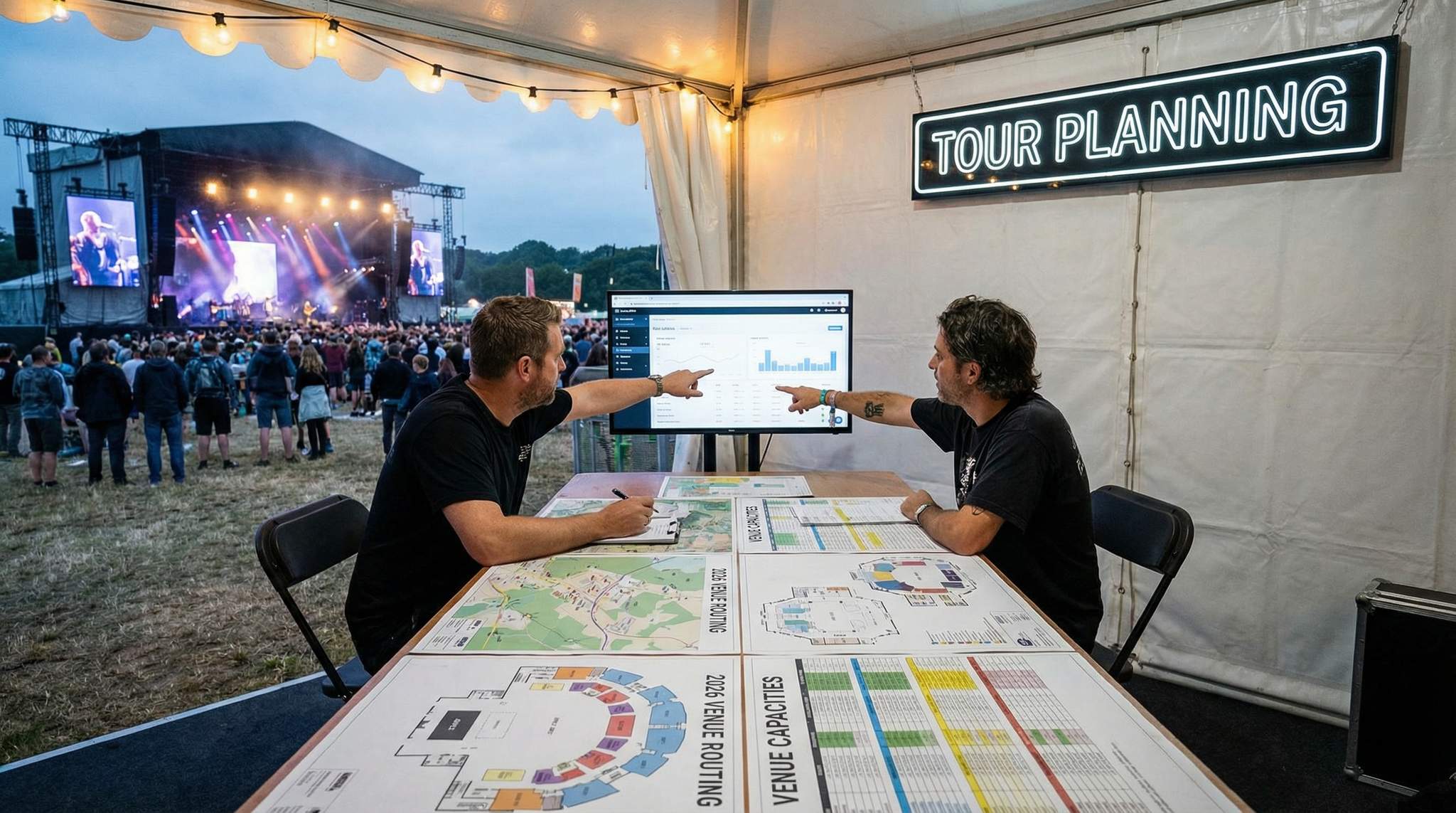
Tour routing is far more complex than drawing lines on a map. Strategic location planning means designing an itinerary that maximizes an artist’s reach and revenue while minimizing travel costs, time, and exhaustion. In an era where fuel prices and travel expenses are high, and fans’ attention is split among countless events, a well-optimized tour route is a competitive advantage. The goal is to hit all key markets where demand exists, avoid dead zones where it doesn’t, and do so in an order that makes logistical and financial sense.
Free Tool: Model Promoter Payouts
Flat-percentage, flat-per-ticket, or tiered-bonus commission structures — get per-promoter payouts and total commission as % of gross. Free calculator.
A smart starting point is to map out where the artist’s fans are concentrated. As mentioned earlier, streaming and social media data can reveal fan hotspots. You might build a heat map highlighting cities or regions with the highest number of listeners/followers. If an indie rock band sees huge Spotify followings in college towns and a dip in big metro areas, the tour might prioritize those college towns during the school year. On the flip side, if a DJ has gone viral in multiple European countries, you’d consider a European leg. Once you have a list of prospective cities, overlay practical considerations: distances, regional groupings, and transportation hubs. It’s often efficient to schedule tour dates in clusters – for example, tackling the U.S. West Coast (San Diego, Los Angeles, San Francisco, Seattle) in one continuous loop, rather than ping-ponging between coasts. Not only does this save travel time and money, but it also allows you to consolidate some resources (you might rent a single tour bus for that entire West Coast leg, for instance).
Seasonality is another crucial factor. Be mindful of weather and local event calendars. A summer outdoor show in Phoenix, Arizona, might not be ideal due to extreme heat – whereas Phoenix in spring or fall is great. Northern tours might avoid deep winter when snowstorms could cause travel delays or keep fans at home. Also, research what else is happening in each city around your target date. Avoid competing with major events that could siphon off your potential attendees. For example, scheduling a concert in a city on the same night its home team is playing in a championship game might hurt your turnout. Or booking a show in a small town during a big annual festival (when many locals leave town) could be problematic. Conversely, sometimes you can piggyback on events – like playing a show in Austin, Texas, during SXSW (South by Southwest) to capitalize on the influx of music fans, although venue availability will be tight. In short, know the local calendar: check for holidays, school breaks, sporting events, and other concerts or festivals that might conflict.
Route optimization software and good old-fashioned spreadsheets can both be used to plan the most efficient path. Professional tour managers often use routing tools or even consult with specialized logistics companies, especially for large tours. These tools account for drive times, trying to keep them reasonable between consecutive shows (a general rule of thumb is to keep drives under 8 hours whenever possible so that the crew can travel, load in, and you can still do a soundcheck the next day). They’ll factor in load-in and load-out times – for instance, if it takes 4 hours to tear down after a show, you don’t want a super long overnight drive to the next city unless you have a day off. Speaking of days off, build them into the itinerary regularly. A common pattern is something like 3 shows on, 1 day off, to give the artist and crew rest. Many veteran tour managers stress the importance of rest days to avoid burnout – an exhausted artist or crew is more prone to mistakes and illness, which can jeopardize the tour.
Another layer to consider is routing by demand. If you have hard data from ticket presales or prior tours, use that to adjust your path. For instance, if Chicago sold out last tour while nearby Milwaukee was only half full, you might play two nights in Chicago this time and skip Milwaukee – but perhaps invite Milwaukee fans to travel by making one of the Chicago shows an all-ages weekend gig. Or if you know you have a devoted pocket of fans in secondary markets (say, Boise, Idaho) even though it’s smaller, it might be worth including Boise on the route to build goodwill and a grassroots following there, rather than only hitting the usual big cities. Pro Tip: Anchor international tours around one or two high-impact events. For example, if your artist gets booked at a major European festival or earns an opening slot for a big act in London, build the rest of the European tour dates around that anchor date. This way, you leverage the festival’s buzz to promote your side shows and also cover travel costs with the well-paid festival slot.
Keep in mind, optimization is not purely about geography – it’s a balancing act with financial and personal factors. Experienced tour planners do “budget routing,” meaning they consider how each routing choice affects the budget. A straight shot across the Midwest by van might be cheap, but perhaps flying between a couple of far-apart lucrative dates allows you to squeeze in an extra show. Sometimes spending a bit more on a flight or extra day of crew labor can enable you to add a profitable stop that would otherwise be unreachably out of the way. Conversely, there are times you might skip a market because the added cost to detour there isn’t justified by the fee you’d get – especially if it wears everyone out before a major show. The bottom line is to see the big picture: plot your tour like a puzzle, where each piece (each show) fits into an efficient, fan-friendly, and financially sound whole. And always have contingency plans – know which shows you could afford to drop or reroute if something unexpected happens (like a venue cancellation or illness). With thorough location planning, you set your tour up for maximum impact and minimum headaches down the road. Learn more about crafting the perfect schedule in our post on the essentials of planning an enticing event itinerary.
When considering how do artists decide where to tour, it ultimately comes down to a mix of streaming data, historical ticket sales, and strategic market development. Promoters pitching their venues for artists must understand this calculus. An act might bypass a major market if they recently played a festival there, opting instead for secondary markets where pent-up demand guarantees a sell-out. By aligning your venue’s availability with these routing realities, you become a problem-solver for the agent rather than just another room for rent.
No Hidden Fees, Just Honest Pricing
One all-inclusive fee covers the platform, payment processing, support, and every feature. Free events are always free. No setup costs, no surprises.
Similarly, understanding exactly how do bands decide where to tour helps independent talent buyers anticipate routing needs. Bands often look for logical geographic stepping stones between major anchor dates. If you operate a mid-sized tour venue situated between two major metropolitan hubs, you can proactively pitch your room as the perfect routing filler, reducing their travel days and maximizing their weekly gross.
For promoters and tour managers looking to streamline this process, mastering a few core tips for effective venue sourcing can save both time and money. Start by building a centralized database of regional facilities, noting their historical availability patterns, preferred booking windows, and standard deal structures. When sourcing spaces, always request the venue’s tech pack and CAD drawings before initiating formal negotiations to ensure the room can physically accommodate your production. Additionally, leveraging industry networks and reading comprehensive resources like The Business of Live Concert Touring: From the Artist to the Fans (available to read online or in print) can provide invaluable insights into which independent rooms are currently offering the most competitive door splits.
Maximizing Venue Size and Capacity Potential
Choosing the right size venue in each market is a nuanced art. While it might be tempting to always go for the biggest venue available (more tickets equals more potential revenue), in practice this can backfire if you overestimate demand. On the other hand, consistently selling out extremely small venues could mean you’re leaving opportunity (and money) on the table and not accommodating all the fans who want to see the show. The goal is to match an artist’s draw to a venue’s capacity as closely as possible, with a slight bias toward under-shooting capacity for excitement’s sake.
Start by looking at hard numbers: What’s the artist’s recent history in that market (if any)? How many people came out to their last show in the city? If they’re a new artist, how have comparable artists (similar genre/level) been selling in that city? If a similar band is drawing 300 people, and your act is a little smaller, maybe aim for a ~200 capacity venue rather than a 500. It’s usually better to err on the side of a too-small venue that sells out quickly – you can often add a second show or upgrade to a larger room if demand is through the roof – than to play a cavernous hall that ends up half-empty. Nothing kills an atmosphere faster than a half-full venue, and nothing looks better in press and social media than a “Sold Out” banner on the tour poster. The psychology of scarcity is real: fans are more excited to snag a ticket when they know tickets are limited and in demand.
To help conceptualize venue sizing, here’s a rough breakdown of venue categories and their typical capacities, along with pros and cons of each:
| Venue Scale | Typical Capacity | Pros | Cons |
|---|---|---|---|
| Intimate Club | < 500 people | High-energy, up-close vibe; easy to sell out; lower costs. | Limited production capabilities; lower potential revenue; often 21+ age limits. |
| Mid-Size Theater | 500 – 2,000 | Good sound and lighting systems; can accommodate larger audiences while retaining some intimacy. | Requires a solid fanbase to fill; higher costs for rent and crew; might have seated arrangements that not all crowds prefer. |
| Concert Hall / Arena | 5,000 – 15,000 | Major production value (big stage, pro lights & sound); prestige of playing a known big venue; high ticket revenue potential. | Very high expenses (venue rent, staffing); tough to draw enough audience unless artist is very popular; an empty section or two is very noticeable. |
| Stadium | 20,000+ | Massive exposure; potential for huge profits; often newsworthy (press coverage) when artists play stadiums. | Only feasible for top-tier acts due to enormous demand needed; extremely costly production; often weather-dependent (if open air). |
Most touring artists will spend the majority of their careers in the first two or three categories, with only global superstars venturing into stadium territory. It’s important to note that venue size isn’t just about capacity – it shapes the whole fan experience. A crowd of 300 in a 300-cap club will feel electric, with fans pressed up to the stage, singing along and feeding off each other’s energy. That same 300 people in a 1,500-seat theater would feel sparse and subdued, with scattered applause echoing in the empty space. So, perception matters. If you anticipate 300 attendees, it’s usually best to book a 300- or 400-cap room and pack it out.
When evaluating these spaces, promoters and producers must adhere to strict venue capacity guidelines for concerts to ensure both profitability and safety. Standard industry metrics typically allocate between 5 to 7 square feet per person for standing-room general admission, while seated configurations require significantly more footprint per attendee. Fire marshals and local municipalities dictate the absolute legal maximums, but your operational capacity—the number of tickets you should actually sell to maintain a comfortable, safe fan experience—is often 5% to 10% lower than the legal cap. The best concert venues in the US master this balance, offering scalable rooms where sightlines, HVAC systems, and crowd flow remain optimal even when the room is pushed to its limit. Understanding these concert venue density formulas prevents dangerous overcrowding and ensures your bar, restroom, and merchandise lines remain functional throughout the night.
On a related note, consider the configuration of the venue. Many modern venues offer flexible layouts or scaling options. For instance, some theaters have an orchestra level and a balcony that can be closed off to scale down the capacity if needed. Some venues have moveable walls or curtains to make a large room feel smaller for lightly sold shows. If you’re unsure about draw, working with venues that have this flexibility is a great safety net. For example, you might book a 1,000-capacity hall but arrange with the venue that if ticket sales only justify 600, they’ll curtain off the balcony and make it a cozier 600-cap show. This way, the crowd won’t feel lost in the space and production costs (like security and staffing) can sometimes be adjusted down too.
Another strategy artists and promoters use is to create a bit of artificial scarcity. If an artist could probably draw around 800 people, they might intentionally book a 500-cap venue. The show will likely sell out in advance, causing a buzz and maybe a waiting list. This buzz can fuel demand for the next time (fans who missed out will be eager to grab tickets) or even allow you to add a second show in the same city. We saw some artists in 2022–2023 do this coming out of the pandemic – rather than immediately return to large halls, they did undersized club shows, which all sold out and generated hype that helped when they scaled back up to bigger venues later. It’s a calculated gamble: you trade some immediate revenue for long-term fan excitement and media attention (“Artist X sells out 3 nights at Y Club in minutes!” is a nice headline to have). Of course, this works only if the demand truly is there.
On the flip side, avoid the ego-driven mistake of booking a venue far larger than your realistic draw. Warning: One veteran tour promoter recounts a hard lesson when an up-and-coming band insisted on playing a 1,500-capacity hall despite only drawing around 400 fans in that city the year before. They hoped their popularity had exploded, but it hadn’t – only ~500 showed up. The result was a half-empty venue that felt flat, and local media even mentioned the low turnout in reviews. The morale hit to the band was significant. The lesson: it’s far better for an artist’s reputation to sell out a 500-cap room and have people begging for more than to have empty space at a bigger venue. Always be realistic (even slightly conservative) in estimating how many tickets you can move in a given market.
Lastly, local venue choices can help build momentum. Playing a beloved local venue with history and a built-in crowd can give an artist a boost in that city. Smaller venues, in particular, often have dedicated regulars. Many legendary bands built their followings by repeatedly selling out their hometown 200-cap room, which created a loyal community that grew with them. So when selecting venues, think about the context: are you the new act in town that might benefit from the venue’s own crowd? Or are you a big name where you will be the one drawing people in? Use that to guide your picks. An emerging artist might prefer the popular indie club in town (where live music fans go regardless of who’s playing), whereas a bigger act will focus on what capacity and facilities they need since fans will follow them anywhere. By maximizing venue size appropriately and leveraging the unique traits of each venue, you set each show up for success and keep your artist’s trajectory on the rise.
Technical Specifications and Venue Infrastructure
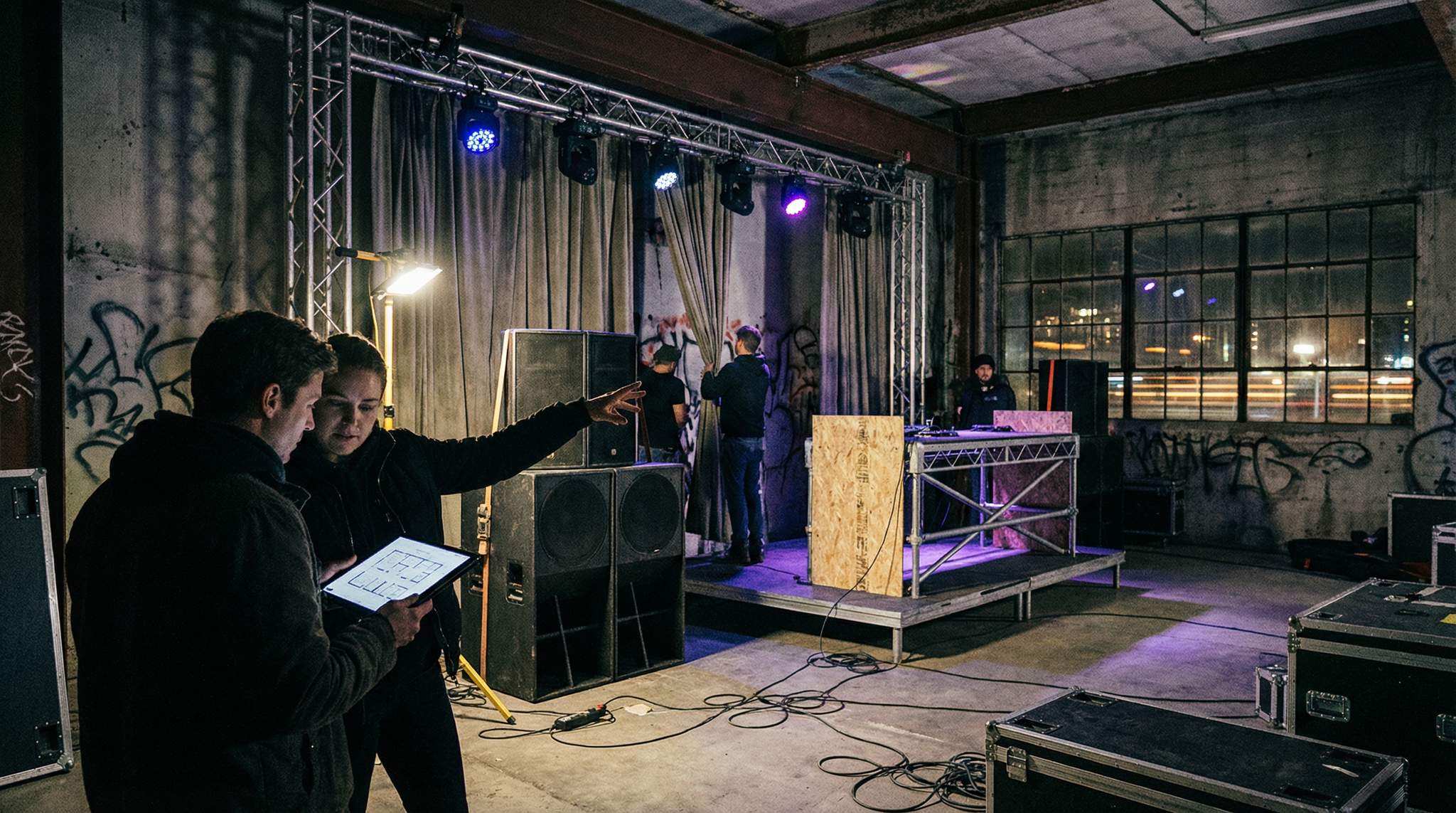
The technical capabilities of a venue directly impact the quality of each performance – and by extension, the audience’s experience and the artist’s comfort on stage. In today’s era of high-production concerts, it’s essential to ensure that a venue can meet the technical rider requirements of your show or can at least accommodate additional rented equipment to do so. When evaluating a venue, both its permanent infrastructure and its flexibility to support your production should be assessed.
Sound is paramount. A venue might have an in-house PA (sound system) and monitoring setup – but are they sufficient for your artist’s needs? Check the specifications: speaker quality, mixer channels available, monitor wedges, subwoofers, and so on. If your artist’s show relies on pristine audio (for example, a vocalist with delicate harmonies, or a DJ needing powerful bass), a top-notch sound system and good acoustics are non-negotiable. If the in-house system is lacking, you may need to budget for bringing in supplemental sound equipment. Additionally, inquire if the venue has an experienced sound engineer on staff who is familiar with the room’s acoustics. A skilled house engineer who knows the “sweet spots” of a venue can be a huge asset during soundcheck and the show. High-quality acoustics (or lack thereof) often come up in venue reviews, so it’s worth looking into past performers’ opinions on the sound.
Next, consider lighting and visuals. Does the venue have a lighting rig, and if so, how extensive? Small clubs might have a basic setup (a few LED par cans and a spotlight), whereas theaters and arenas can have programmable moving lights, strobes, and LED walls. If your artist’s show is heavy on visual effects – say, an electronic act with synchronized light shows or a rock band with a video backdrop – you need to ensure the venue can support it. This might involve checking the rigging points in the ceiling (for hanging trusses, screens, or special effects). Some mid-sized venues have weight limits on what can be hung from the rafters; you don’t want to discover on the day that the LED wall you brought can’t be mounted. Power supply is another critical factor: high-powered lights, amplifiers, and especially elements like laser projectors or pyrotechnics demand significant electricity. Confirm the venue’s power capabilities (e.g., do they have 400A three-phase power drops available?). If the artist uses special effects – fog machines, CO2 cannons, confetti, pyrotechnics – verify venue policies and infrastructure (for instance, some venues have strict rules or require you to hire the venue’s certified pyro technician). Many historic venues won’t allow open flame or pyro at all, so plan accordingly.
Your tour might carry its own production – sound console, lighting desk, even staging – in which case the venue needs to accommodate load-in and setup. Assess the stage size and layout against your needs. How many band members and instruments need to fit? Is there space for the drum riser, the keyboard stand, the dancer troupe, etc.? If the stage is too small or oddly shaped (some older venues have narrow or curved stages), it could force you to simplify the show. Check stage dimensions and even the height (low ceilings can be a problem for tall backdrops or jumping performers). Also evaluate the backstage facilities. Adequate backstage space is necessary for equipment storage (road cases, spare instruments), and quick costume changes if the artist has them. Are there dressing rooms, and are they sufficient in number and quality? At minimum, you’ll want a secure, clean room for the artist to relax and prepare, with mirrors, lights, and restrooms. It’s a plus if there’s a private shower for after the show, especially on a long tour.
One often overlooked aspect is load-in logistics. How easy or hard is it to get your gear from the truck into the venue? Some venues have loading docks at stage level – ideal. Others might require using a freight elevator or even hauling gear upstairs (think of those second-story clubs in city centers). If you have heavy equipment, check if there’s a ramp or at least no narrow, winding staircases involved. Also find out if the venue provides any crew for load-in/load-out or if you need to arrange all hands on deck. Many venues have a couple of stagehands included or available for hire, which can greatly speed up the process and spare your traveling crew. Time is money on tour, and hours lost to a tricky load-in could affect your schedule for that day or your travel to the next city.
In terms of modern infrastructure, consider connectivity: Does the venue offer reliable high-speed internet or dedicated Wi-Fi? This is increasingly important if the artist plans to live-stream part of the show, do a quick post-show Zoom with media, or even just for the crew to handle digital work. Fans too will be Snapchatting and Instagramming the show; some venues promote a unique hashtag and encourage social sharing. Venues with poor connectivity might hinder those real-time interactions (though some artists prefer fans to be offline and in the moment – it depends on the philosophy). Still, having the option of good internet is a plus for many tours in 2026, as live content and digital engagement are part of the package.
Don’t forget the crew’s needs: Tour managers, techs, and band members will all function better when a venue has certain amenities. Simple things like clean, accessible green rooms, a safe and convenient parking area for the tour van/bus, and nearby food options can make a big difference in morale and logistics. For example, if your bus can’t park near the venue and has to park blocks away, that complicates unloading and security. Or if the only way to power your tour bus overnight is by running a noisy generator because the venue lacks shore power (a power hookup for buses), that’s something to be aware of ahead of time. Communication with venue management about these details is key. Get a copy of the venue’s tech pack in advance – this is typically a document that lists all their specs: stage dimensions, sound and light inventory, power info, loading info, etc. Review it carefully and confirm any potential issues well before the show.
In short, a venue might have the right location and capacity, but if it can’t support the technical requirements of your show, it’s not the right fit. Prioritize sound and stage – because a show that sounds bad or is under-lit will disappoint fans – then ensure all other infrastructure aligns with delivering the performance the artist intends. Putting in the work upfront to vet technical specs will save you from headaches on show day, and it will ensure your artist can deliver a performance that meets their (and their fans’) expectations every night.
Health, Safety, and Security Protocols
The health and safety of both the audience and the artist/crew are paramount considerations when selecting a venue. In the post-pandemic era, these factors carry even more weight, as venues must be prepared not only for traditional safety concerns (like crowd control and fire safety) but also for health protocols and emergency responses to a wider range of scenarios. Choosing a venue with robust health and security measures protects everyone involved and also reflects positively on the event’s professionalism.
First, basic safety infrastructure: any venue you consider should meet all local fire and building codes. This means adequate emergency exits (unobstructed and clearly marked), fire extinguishers and sprinklers up to date on inspections, and no obvious hazards like loose wiring or unstable structures. It sounds obvious, but there have been tragic incidents in the past (from nightclub fires to crowd crushes) that were exacerbated by code violations or negligence. Check if the venue has a valid capacity certificate and that they are strict about not exceeding that capacity. Overselling a venue can lead to dangerous overcrowding – ensure your promoter partners and the venue are aligned on keeping things within safe limits.
Evaluate the venue’s security apparatus. Are there trained security personnel on staff for events? In a perfect scenario, the venue should have a mix of security measures: bag checks or metal detectors at entry (common now at larger venues for weapons and contraband screening), roaming security inside to monitor the crowd, and a plan for stage security (e.g., barrier and guards if it’s a high-risk show for stage rushes). Ask about the ratio of security guards to attendees – high-capacity shows should have a significant presence. It’s a good sign if a venue’s security staff have certifications or are off-duty police for bigger events, as it shows professionalism. Also, does the venue use surveillance cameras throughout the premises? Modern CCTV systems not only deter bad behavior but can also be critical in responding to incidents or identifying problem areas in a crowd.
Furthermore, the integration between a venue’s physical security and its digital infrastructure is heavily scrutinized by top-tier touring camps. Major industry players, such as AEG Presents, often evaluate whether a facility has weak security features or if it is inconveniently located before routing a high-profile act there. They also look closely at the venue’s chosen ticketing platforms. A robust ticketing partner ensures that the venue has ample inventory management capabilities, preventing overselling and mitigating scalper bot attacks, which directly ties back to maintaining a safe, controlled environment on show day.
Health protocols have become a permanent part of the conversation. While the intensity of pandemic measures (like vaccine checks or mask mandates) may wax and wane depending on current public health conditions, a venue that has good ventilation and sanitation practices is always preferable. Inquire if the venue upgraded its HVAC systems with high-grade filters (such as MERV-13 or HEPA filters) or increased fresh air intake – many venues did so in 2021-2022. Proper ventilation isn’t just about disease mitigation; it also affects how comfortable the environment is, especially in a packed club. Nobody likes a stuffy, overly hot concert hall – good airflow can improve attendee comfort and safety (preventing issues like fainting from heat). Also ask about sanitation: do they regularly clean high-touch surfaces, provide hand sanitizer stations, and have restrooms that are kept clean throughout the event? These are small things that reflect a venue’s overall approach to guest well-being. Some venues as of 2026 still have “touchless” systems in place (like touchless faucets, paper towel dispensers, etc.) that came out of pandemic investments, which is nice.
Prepare for medical emergencies. An ideal venue has a plan for handling medical issues: e.g., a first aid room or area, basic medical supplies like AEDs (Automated External Defibrillators) on site, and staff trained in CPR and first response. Many large venues hire EMTs or have an ambulance on standby for big shows. While that level of preparedness may not be feasible at a small bar show, at minimum the venue staff should know how to quickly contact emergency services and have clear access routes to get a patient out or paramedics in. You might ask: “What’s your protocol if an audience member gets injured or ill during a show?” A competent venue will explain their process (like contacting on-site medics or calling 911, stopping the show if needed, etc.). It’s also wise to identify the nearest hospital to the venue beforehand, just in case (especially for tour managers concerned about band/crew health on the road).
Crowd management is a big part of safety. Consider how the venue manages entry and exit to avoid dangerous bottlenecks or stampedes. Are tickets scanned in an orderly line? Do they have crowd control barriers outside if the line gets long? What about at the end of the night – do all the exits dump into a narrow alley, or is there a big open area for people to disperse? You want to avoid scenarios where large crowds push through a small choke point. Inside, if the show is general admission (GA), is there a barrier separating the crowd from the stage? For small venues it might not be necessary, but for any sizable GA show, a barricade with security posted at the front is important to prevent crowd surges onto the stage or crushing at the front row. Post-Astroworld (the 2021 festival tragedy), the industry has been especially sensitive to crowd surge risks. As a tour planner, it’s prudent to discuss with the venue how they handle packed GA crowds – do they have a pit safety team, do they provide water to front-row fans if it’s hot, etc. These little things can prevent big problems.
It’s also smart to look at a venue’s track record. Have they had any notable safety incidents in the past? If a quick news search shows that the venue had multiple violations or a history of fights or injuries, that’s a red flag. Many venues will proudly share safety accolades (like being recognized by local authorities for safe operations) – those are green flags. And consider the neighborhood and external security: is the venue in a safe area, and do they protect attendees outside? Venues often coordinate with local police for large events to manage traffic and have a presence outside at closing time. If your show ends late at night, you want fans to feel safe walking back to cars or public transit. Lighting in the parking lot and streets around the venue is an often overlooked detail but contributes to safety and comfort.
Insurance and liability are the final pieces of the puzzle. Any reputable venue will carry general liability insurance and likely require the artist or promoter to carry insurance as well (often a specific amount like $1 million coverage). They should be able to provide a certificate of insurance if asked, and you should do the same. Be clear on who is liable for what in the contract. For instance, if a fan gets hurt by a stage prop, is that on the venue’s insurance or yours? These details should be outlined in the agreement. Also, clarify what happens if a show must be canceled for safety reasons (for example, the city declares a weather emergency or there’s a power outage). Is there a plan to reschedule, and how are refunds handled? Clarity on these fronts will help avoid disputes and build trust with the venue.
In summary, prioritize venues that treat health and safety as top priorities, not afterthoughts. A safe show is the baseline for a great show – when fans and artists feel secure, they can focus on the music and the moment. As an event organizer or tour manager, doing due diligence on safety protocols is part of providing a professional, trustworthy experience. It’s one of those behind-the-scenes factors that, when done right, no one notices – but if done poorly, it can overshadow everything else. Choose your venues accordingly, and don’t hesitate to walk away from one that raises safety concerns. There’s always another venue, but you only get one reputation for running a safe tour.
Creating Optimal Fan Experiences with Local Promoters
In the modern concert landscape, the show is not just what happens on stage for 90 minutes – it’s the entire journey that fans go through, from the moment they hear about the tour until the lights come up at the end of the night. To create an optimal fan experience, it helps immensely to collaborate with local promoters and venue partners who understand the audience in their city. These partners can provide on-the-ground insights and enhance the concert in ways that touring personnel alone might miss.
When evaluating venues, consider what additional experiences they can facilitate. Many fans love when concerts offer a little something extra. This could be as simple as a well-organized merch area where they can comfortably browse and buy souvenirs, or as elaborate as interactive installations in the lobby (like a photo booth with the artist’s branding, or an exhibit of the artist’s memorabilia). Some venues are more equipped for these extras than others. For instance, does the venue have ample lobby or courtyard space for a fan zone? Festivals and larger shows often set up sponsor booths, meet-and-greet tents, and more – some forward-thinking venues now incorporate mini “festival” elements even for single concerts. While that level might not apply to every club gig, the principle remains: a venue that provides room and support for fan engagement (instead of just shuttling people in and out) can create a more immersive experience.
Local promoters are key allies. They know the community and can help tailor the event to local tastes. For example, a local promoter might suggest bringing in a popular local band as an opener to boost ticket sales and get the crowd warmed up. This not only supports the local music scene (which fans appreciate) but also increases draw because the opener’s friends, family, and fans will attend. They can also advise on the best local media to target for promotions – whether that’s the alternative weekly newspaper, a trending local Instagram account, or a rock radio station that often sponsors shows. Many promoters will handle press outreach for you as part of their job: sending press releases to local entertainment journalists, arranging morning show appearances on local radio, or inviting influencers to the concert. These local touches can noticeably increase awareness and excitement in the city.
The physical fan experience at the venue is another aspect to plan with the venue’s team. Think about the flow and comfort for attendees. Are there enough restrooms to serve the crowd without massive lines? Nothing sours an experience like missing half the show because you were stuck in a bathroom queue. Venues that recently renovated or have good facilities (clean, sufficient toilets, etc.) will advertise that, because they know it matters to people. Concessions are similar – can fans grab a drink or a snack without an ordeal? Some venues have adopted modern solutions like mobile ordering where you order from an app and just pick up when ready, which can be a perk. Also, consider the sightlines and sound throughout the venue. If the venue has obstructed-view areas (columns or awkward corners), maybe avoid selling those or at least price them lower and label them as such to manage expectations. Fans remember if they paid full price and then had a terrible view.
Increasingly, digital integration plays a role in fan experience. Many venues now use electronic ticketing which can double as a platform for fan engagement. For instance, the ticket QR code scanned at entry might trigger a follow-up survey or a link to exclusive content from the artist after the show. Some artists set up tour apps or sections on their website where attendees can check into the show, find the setlist, or buy merch for pickup. If you have such plans, make sure the venue’s Wi-Fi can handle a large number of users (to prevent network crashes if 500 people try to use an app at once). Additionally, consider setting up an official hashtag for the show or tour and collaborate with the venue and promoter to promote it. This encourages fans to share their photos and videos, effectively crowdsourcing your marketing. I’ve seen venues put the official hashtag on video screens before the show or have it printed on signage, which definitely boosts usage. It’s all part of blurring the line between the live and online experience – fans love to feel like they’re part of something larger, and when they post “#ArtistTour2026 @ VenueName was amazing!”, it amplifies the reach.
Venue location and surroundings can also enhance the fan experience. If a venue is in a cool part of town (say, an arts district or near downtown nightlife), fans often make a whole evening of the event – grabbing dinner or drinks nearby before the show, etc. As a promoter, you can sometimes partner with local businesses (perhaps a nearby bar offers a pre-show special for ticket holders, or a café hosts an acoustic pop-up by the opener in the afternoon). These kinds of local tie-ins make the concert feel like an event that the whole community is part of, rather than just an isolated show. A local promoter with strong community ties can orchestrate these extras, like arranging for a food truck they know to park outside the venue or coordinating a post-show DJ afterparty at a partner club.
Finally, consider VIP experiences. If your artist offers meet-and-greets, acoustic soundcheck sessions, or merch bundle packages for super-fans, ensure the venue has the means to host those. This could mean a small separate room for a meet-and-greet or early entry for VIP ticket holders with a special section to watch soundcheck. Work with the venue on how to smoothly execute these without disrupting the main show operations. Many venues have experience with VIP programs and can provide staff to manage check-ins and lineups for these premium offerings. When done well, VIP add-ons can be very lucrative and also deepen fan loyalty (imagine a fan who got to take a photo with the artist pre-show – they’re likely to share that excitement and stay a fan for life).
In summary, creating an optimal fan experience is about sweating the details of the attendee journey and using local expertise to add a personal touch. The best tours not only deliver a great performance but also make every fan feel like they were part of something special that night. By working closely with local promoters and venue staff – the people who know the fans and the facility best – you can unlock opportunities to elevate the concert from just another tour stop into a memorable event. Happy fans become repeat ticket-buyers and your strongest word-of-mouth marketers, so these efforts pay off in both the short and long run. Discover strategies on how to cultivate a loyal fan community and reap the ongoing benefits.
Financial Planning, Ticket Sales, and Profitability Analysis
Rocking a sold-out show is fantastic, but at the end of the day, a tour must also make financial sense. That’s where robust financial planning and careful analysis of each venue’s economics come into play. Touring can be a costly endeavor – and without a clear budget and an eye on the bottom line, even a series of well-attended shows could end up losing money. Here’s how to ensure your tour stays in the black.
Establish a Tour Budget
Before any tickets go on sale, sit down and map out a detailed tour budget. This means accounting for every expected expense and revenue source. On the expense side, list out travel (flights, gas for vans or buses, driver fees, vehicle rentals), accommodations (hotels or sleeper bus rental, plus per diems for crew meals), production costs (gear rental, lighting, sound, stage props, technicians’ fees), salaries/payments (band members, crew wages, tour manager fee, etc.), marketing (posters, online ads, PR costs), insurance, visas (if touring abroad), and so on. Also factor in the merchandise production cost if you plan to sell merch – t-shirts, posters, etc. On the income side, the primary source will be ticket sales (minus any fees or splits that go to the venue or promoter). Other income can include merchandise sales, sponsorships, guarantees, and any secondary revenue sharing. For example, some venues might give the artist a cut of parking or bar sales if negotiated (more on that shortly). By laying this all out, you can see how many tickets you need to sell at what average price just to break even, and what the profit margin could be if things go well.
A budget also helps identify how cash flows through the tour. Perhaps you have to pay a big deposit to the tour bus company upfront, but you won’t see ticket revenue until after each show – that means you need starting capital or label tour support to cover early costs. Knowing the timeline of payables and receivables will help you avoid cash crunches mid-tour. Many experienced tour managers build in a contingency line in the budget, usually 10-15% of total costs, as a buffer for the unexpected. Because in live events, something unexpected always happens – whether it’s an amp blowing that you have to replace or an extra night of hotel due to a cancellation. Having a contingency fund keeps those surprises from sinking your profitability.
Conduct Adequate Research
Not all venues (or markets) are financially equal. It’s crucial to research the economic quirks of each tour stop. Start with the deal structure at each venue: are you paying a flat rental fee to use the venue, or is it a door deal where the venue/promoter takes a percentage of ticket sales? Perhaps it’s a guarantee versus percentage deal – for instance, you get a guaranteed $1000 or 85% of ticket sales after costs, whichever is higher. These terms significantly affect your risk and upside. Typically, smaller club shows might be a door split (the promoter might take 20-30% of gross ticket sales, plus maybe charge certain production fees), whereas larger venues often work on fixed rental or guarantee models. Always clarify these terms and run the numbers. If a venue wants $2000 rent and you plan to sell 300 tickets at $20 each ($6000 gross), you need to weigh that $2000 rent and other expenses against the potential profit – is it worth it? If you only sell 150 tickets, you’d still owe that $2000, so what’s your downside? These are the scenarios to examine.
Also, investigate each venue’s ancillary revenue opportunities or pitfalls. For example, merchandise sales can be a huge revenue stream for artists on tour – but many venues take a cut of merch sales, often in the range of 10-25%. If you’re expecting to sell $1000 of merch per night and the venue takes 20%, that’s $200 off your bottom line per show. It’s a negotiable point in some cases, but you need to know beforehand what their policy is. Similarly, some venues charge additional fees for using their in-house equipment or personnel – perhaps you have to use their union stagehands or pay extra if the show runs past a certain hour (overtime charges). On the flip side, a few venues or promoters might share in additional income: for instance, a promoter might offer a bonus if a show sells out quickly, or as mentioned earlier, a cut of bar sales if the artist is a big draw who boosts the venue’s alcohol revenue. These arrangements are less common, but if they exist, factor them in.
Pricing strategy per market is another research area. Not every city can support the same ticket price for your artist. Fans in major cities might be accustomed to paying $30-50 for a club show, whereas in a smaller town, even $20 might be a stretch. Look at what similar artists are charging in each market – you can often find this out by checking online ticketing sites or asking the local promoter. Also consider currency differences and economic conditions if touring internationally; for example, $25 USD might be fine in the States, but in some countries that could be comparatively expensive, adjusting for local incomes. Finding the sweet spot on ticket price can maximize revenue without pricing out fans. A common tactic is to slightly underprice the tickets relative to perceived value to ensure a full house (concessions and merch sales often make up the difference when more bodies are present). In 2026, dynamic pricing is a buzzword – some larger tours use algorithms to adjust ticket prices based on demand (like airline tickets). If you have the ability and appetite for that, it can increase take, but it comes with PR considerations (some fans dislike surge pricing models). That’s more common at the arena level, though.
By researching and planning these financial angles for each show, you can also perform a profitability analysis per venue. Perhaps you project that City A’s show will net a $5k profit, City B will break even, and City C might lose $1k (maybe it’s a small-capacity venue in a new market you’re seeding for future growth). Having that overview allows you to decide if the overall tour is worthwhile and where you might need to economize or push more marketing to sell extra tickets. It also lets you set expectations with the artist/management ahead of time – for instance, “We’re investing in these two markets this run knowing they might be under water, but we’ll make up for it with the big LA and NYC shows.” That kind of transparency is important for decision-making.
Plan Your Negotiations
Armed with your budget and research, you’re ready to negotiate with venues and promoters from a position of knowledge. Negotiation isn’t just about haggling over dollars – it’s ensuring a fair deal structure and clarity on all terms so there are no surprises. Key points to negotiate (or at least clarify) include:
- Financial Split: If it’s a door deal, confirm the exact percentage split and what expenses are deducted before the split (common deductible expenses might include credit card fees, local advertising, or venue insurance fees).
- Guarantee vs. Percentage: For larger deals, if you have a guaranteed payout, understand any conditions. For example, is there a minimum ticket threshold you must hit? Or if it’s a versus deal, know when the percentage kicks in (e.g., after covering venue costs).
- Merchandise Cut: As mentioned, try to negotiate the merch rate. Some artists successfully negotiate zero merch fee at small venues (especially if they’re bringing in their own seller), but if not, ensure you know the cut and if the venue provides a seller or you need to. If the artist’s merch sales are significant, consider building that into the deal (“we need an 85/15 split on merch in our favor, otherwise we require a higher guarantee”).
- Ancillary Revenue: Discuss any revenue sharing on parking or bar sales if the artist is a big draw. While not always granted, it doesn’t hurt to ask, particularly if the artist expects fans to spend big at the bar.
- Expenses and Billing: Clarify which party is responsible for various expenses. Who pays for security staff? Who covers hospitality (backstage food and drinks)? If the venue provides catering or buyouts for meals, is there a cap per person? Are you renting any gear from the venue and what is that cost? These should be either included in the deal or spelled out as additional costs.
- Payment Terms: Ensure you understand when and how you get paid. Most of the time, settlement (reconciling tickets sold, subtracting expenses, and paying the artist the remainder) happens the night of the show, immediately after the performance. Typically, the promoter or venue cuts a check or does a wire transfer that night. But I’ve seen cases where payment was net 5 or 10 days – not ideal, but know it in advance. Also, if there’s a deposit required (for example, sometimes promoters ask new artists for a small guarantee deposit to hold the date, or conversely, big artists ask promoters for an advance), get that schedule in writing.
- Cancellation Policies: Discuss what happens if the show is canceled or rescheduled. Is the artist’s guarantee still owed (usually not if they cancel, but yes if the promoter/venue cancels without cause)? How far in advance can either party cancel without penalty? And what about force majeure events (acts of God, like major storms or public emergencies) – do you both agree to just cancel with no one owing, or roll the show to a new date? These clauses became hot topics during the pandemic and are standard now.
- Insurance & Liability: Confirm who covers liability insurance and if the venue needs to be named as additional insured on your policy (common requirement). Also confirm that the venue indemnifies the artist/producer for issues under their control and vice versa – basically, each party is responsible for their own negligence.
- Special Provisions: If you want the option to record the show (audio or video) or live-stream it, make sure it’s allowed in the contract. Some venues have exclusive rights deals with certain recording companies or might charge a fee to use their infrastructure for recording. Same with live broadcast – ensure that doing an online stream (if planned) won’t conflict with venue rules. If the artist is planning something unusual (bringing in outside food for fans, doing a pop-up meet & greet outside, etc.), mention it in advance and get it okayed.
- Hidden Fees: Ask point blank: “Are there any other fees or charges we haven’t discussed?” Sometimes venues have a restoration fee, a charity donation built into tickets, a required local crew minimum, or cleaning fees if confetti/streamers are used. Get it all on the table so you can factor it in.
Negotiating might also involve non-monetary aspects that can save you money or improve the experience. For instance, maybe the venue won’t budge on the rental fee, but they can offer to include the house lighting rig usage for free, saving you from renting one. Or they could agree to provide catering for the band and crew (a hot meal at soundcheck and snacks) which might cost them a hundred bucks but saves you much hassle. If you don’t ask, you don’t get – so it’s worth politely inquiring about these kinds of throw-ins.
Keep the tone collaborative – ideally, you’re building a relationship with these venues and promoters for the long term. Once terms are agreed, everything should be put into a contract (performance agreement) and signed by both parties. This formalizes the venue, date, financial terms, and any special stipulations. Having it in writing protects everyone. You’ll refer to this contract during settlement to make sure the finances are executed correctly.
One more thing: maintain an open line of communication throughout. If a show is selling very poorly and you’re a month out, talk to the promoter about strategies (maybe you decide to paper the house with some free tickets to college students to fill it up, or do a 2-for-1 promotion). If a show is selling out quickly, discuss adding a second show or upgrading the venue (it’s usually better to upgrade a venue only with everyone’s agreement, and you’d have to figure out how to transfer sold tickets, etc., so adding a second date is often simpler). These adjustments can significantly affect your tour finances, so working closely with local partners on solutions is key. Protect your investment by understanding how event cancellation insurance works.
Marketing and Promoting Your Tour
You’ve booked the dates and planned the show – now you need the audience. Marketing and promotion are what turn a well-planned tour into a series of packed venues and, ultimately, a successful tour. In 2026, promoting live events is a sophisticated endeavor that combines digital marketing, traditional media, fan community engagement, and content creation. Let’s break down some key strategies.
The cornerstone of tour marketing is timing and consistency. Typically, you’ll announce a whole tour or a tour leg all at once, to build momentum. Make sure you coordinate with all local promoters and venues so that on announcement day, the shows are listed on the venue websites, ticket links are live, and local press releases go out. A scattered or uncoordinated announcement can confuse fans (“Wait, are they coming to my city or not?”). Once dates are announced, keep up a drumbeat of promotion leading up to each show. This can start as broad national or regional promotion (like a general “Tour starts next month!” push) and then get localized as each date nears (“Hometown, only 2 weeks until Artist X hits Venue Y – tickets going fast!”).
Social media is your direct line to fans. Use it creatively. Every platform has its strengths: Instagram and TikTok are great for short video clips (maybe a teaser of rehearsal or a shoutout from the artist: “Hey [City]! We’re playing at [Venue] on [Date] – can’t wait to see you there!”). Twitter (or X) and Facebook are good for disseminating news and links (like on-sale reminders, or last-minute door tickets info). Consider creating an event page on Facebook for each show – local fans will mark themselves as interested/going, which spreads visibility to their friends. You can also use these event pages to post updates or even plan fan meetups. Many artists in 2025–2026 are also tapping fan communities like Discord servers or fan club forums to drop tour info early to super-fans, who then help spread the word. Empower your biggest fans with shareable content – for example, provide graphics or short videos they can use to invite their friends or encourage them to share their personal hype for the show.
Advertising still plays a role, especially for reaching people who might not follow the artist closely (or at all). Geo-targeted online ads can be very effective. Facebook/Instagram ads allow you to target by location, age, interests (you could target fans of similar artists in that city). A small budget per city can go a long way if targeted well – even $50 in ads might reach tens of thousands of potential concert-goers. There’s also Google Ads for people searching for concerts in the area. Don’t forget local media: an ad in the local alternative weekly paper (print or online) can reach the gig-going crowd, and local radio stations often have event calendars and shoutouts. Some radio stations will do ticket giveaways in exchange for a few mentions of the show on air – which is free promo for you aside from a handful of comp tickets. Those comps act as marketing spend in a sense. Press coverage is wonderful if you can get it – local newspapers or blogs might do a show preview or artist interview. Work with the promoter or hire a local PR person to pitch stories, especially in major markets. Even a brief mention on local TV or a popular blog can spike ticket sales.
Content creation is a powerful tool for promotion. Essentially, you want to show people what they’ll experience to create FOMO (fear of missing out). This is where capturing photo and video content from your shows becomes valuable. As the tour progresses, use footage from shows to build excitement for upcoming dates. For example, after the first show, post an Instagram Reel of the artist walking on stage to a cheering crowd, or a TikTok of a unique live moment (maybe the singer did a stage dive, or there was a special guest). These vivid moments can go viral or at least be shared widely, reaching people who might then think “Wow, that looks fun, I should go when they come here next week.” Some artists even hire a tour photographer/videographer who travels with them; if budget allows, this can provide a steady stream of professional content. But even on a shoestring, encourage the band and crew to take smartphone videos and photos. Authentic, behind-the-scenes glimpses (tour bus shenanigans, soundcheck snippets, city exploration) make fans feel connected and invested in coming out to see it live.
Utilize your email list if you have one. Email might not be as flashy as social media, but it’s very effective for direct communication. Send out a tour newsletter highlighting upcoming shows, ticket links, maybe a personal note from the artist like “Can’t wait to play my hometown, I have a special encore planned!” Segment the list by region so people only get emails for shows near them. If you’re using a platform like Ticket Fairy or others, often they have built-in email marketing tools and data on purchasers that you can use (like sending a reminder to everyone who bought a ticket, encouraging them to share the news with friends).
A marketing funnel approach can be smart. One technique: run a small social media ad campaign where you promote the artist’s latest music video specifically in the cities on your tour. The goal initially isn’t to sell tickets, but to build awareness. Then you can retarget the people who watched the video with a follow-up ad that directly promotes the concert (“You liked the video – now see it live at Venue X”). This two-step funnel warms up the audience. It’s a tactic digital marketers use and can be very useful for lesser-known artists in a market.
Don’t ignore the on-site experience as part of promotion. Fans who have an amazing time at the show will be your evangelists. So all the points about fan experience (good sound, not overselling, nice extras) indirectly become marketing because those fans will rave to their friends or on social media after the show. Encourage this by engaging with fans during and after the event. For instance, some artists shout out their next tour dates on the mic – “Tonight’s our last song, thank you [City]! Tell your friends in [Nearby City] we’ll see them tomorrow!” A little call-to-action like that can actually prompt word-of-mouth. After the show, continue engagement: post a thank-you to each city (“Thank you [City], you were amazing last night!” with a crowd pic). Fans will share and comment, keeping the buzz going.
Building a loyal fan base goes hand-in-hand with successful tour promotion. At the shows, think long-term: this isn’t just about today’s ticket, but tomorrow’s fan loyalty. So treat fans well – maybe you stay after to sign merch at the table for 30 minutes, or the band hands out free stickers at the end. Actions like that turn casual attendees into die-hard supporters who will not only come back next time but bring friends. Collect fan data when possible: have a sign-up sheet or a QR code at the merch table for people to join the mailing list or follow your socials. Some artists do text message lists now – a number you can text to get updates – which is very direct and cuts through clutter (just get permission and use it sparingly but effectively, like “We’re back in town in 3 months, tickets on sale now”).
It’s also wise to conduct a post-mortem after each leg of the tour – sometimes called a “tour sprint review” borrowed from project management lingo. Gather your team (even if it’s just you and the artist or a small crew) and discuss what marketing efforts worked and what didn’t. Did certain cities lag in sales until you did a particular promo? Did a specific piece of content spike engagement? Use that intel to tweak your approach for the rest of the tour or the next time around. The landscape can change fast; for instance, maybe you notice that a lot of fans in one city came because of a TikTok that went local-viral. That could inspire you to lean into TikTok geo-tags for other cities. Continuous learning and adaptation are key.
In summary, tour marketing in 2026 is about being proactive, creative, and adaptive. Use every channel available – from personal fan interactions to algorithm-driven online campaigns – to make sure that when your artist rolls into town, the town knows about it and is excited. A well-promoted tour amplifies itself: great shows lead to great fan content and word-of-mouth, which lead to bigger shows next time. With diligent promotion, you’ll not only fill venues but also lay the groundwork for the artist’s growth in each market for tours to come. You can also use Spotify playlists to market a festival or tour effectively. Additionally, learn how to create and plan stellar content for your event to keep engagement high.
Successful venue selection and tour planning require a delicate balance of artistic vision, operational savvy, and financial pragmatism. In today’s dynamic entertainment landscape, the venues you choose can significantly impact an artist’s career trajectory. A well-chosen venue can elevate a performance, attract new fans, and maximize profits – while a poorly matched venue can dampen a show’s energy or strain the budget. By carefully considering each aspect outlined in this guide – from understanding your fanbase to negotiating fair deals – you can plot tours that deliver both impactful experiences and strong financial returns.
Remember, there’s no one-size-fits-all formula. Each artist is unique, each audience is unique, and market conditions are always in flux. What worked in 2024 might need tweaking in 2026. The key is to stay informed (use data and industry news), trust but verify details (never assume a venue has what you need – always double-check), and be ready to adapt. Some of the best tour planners are those who learn from every show: they gather feedback, review what went right or wrong, and adjust their strategies continuously. Over time, those incremental improvements lead to a finely tuned touring machine.
Ultimately, successful touring is about creating a win-win-win scenario: the artist delivers great performances and grows their fanbase, fans have an amazing time, and the business side (venues, promoters, and artist teams) sees rewards that sustain everyone for the next outing. With the comprehensive strategy and insights provided in this guide, you are well-equipped to select the perfect venues for your touring artist and execute a tour that is safe, well-attended, and memorable for all the right reasons. Here’s to hitting the road and making every show a success!
Frequently Asked Questions
How do I determine the right venue size for my artist?
Picking the right venue size starts with gauging your artist’s drawing power in each market. Look at hard data: ticket sales from any past shows, streaming listener counts by city, social media followers in that area, and even similar artists’ recent concert attendance in that market. Generally, it’s wiser to err on the side of slightly smaller. It’s better to have a packed 300-capacity club with people lining up outside than a 600-cap venue that’s half empty. For emerging artists, you might start with venues in the 100–300 capacity range and only step up to 500+ after you’ve sold out the smaller rooms consistently. A rough rule some promoters use: if you’re confident you can fill about 70-80% of a venue, it’s a reasonable size to book. Any less, and you should scale down or risk an empty-looking show.
Also consider the venue type along with size. 300 people in a standing-room rock club might be a great vibe, whereas 300 people in a 1,000-seat theater would feel sparse. If your fans expect a high-energy atmosphere, a snug venue can actually enhance the experience. On the other hand, if your artist’s show involves a big production (lights, visuals) and they’re on the rise, you may want the next size up to accommodate that, but perhaps use curtaining or partial seating to adjust capacity. And don’t forget local nuances – some cities simply have stronger walk-up crowds or last-minute sales. If a venue is slightly larger than ideal but it’s the only suitable one in town, see if the promoter expects a lot of door sales that could still make it work. When in doubt, have an honest conversation with the local promoter who often knows what the realistic turnout could be. Aim for a venue that you can at least get close to selling out, and adjust next time if demand wildly exceeds supply (which is a good problem to have!).
What technical specifications should I prioritize when evaluating venues?
Sound and acoustics are top priorities – a show that sounds bad will leave a poor impression, no matter how well the artist performs. Check that the venue has a high-quality sound system appropriate for the music (e.g., powerful subs for bass-heavy electronic or hip-hop acts, clear line-array speakers for vocals, etc.), and ensure they have enough channels on the mixing console for your needs. If your artist uses multiple mics, instruments, playback tracks, etc., the venue’s system should accommodate that. Ask about the in-house monitor system too: are there sufficient monitor wedges or an in-ear monitor hookup if your artist uses IEMs? Good venues also have an experienced sound engineer who knows the room’s quirks, which can be just as important as the gear itself.
After sound, look at the stage and lighting. Is the stage big enough for your show? Consider not just the band members, but any backdrop, dance routines, or equipment placement. If your guitarist likes to run around, a tiny stage will cramp their style. Lighting-wise, even smaller shows benefit from decent lighting – it sets the mood. Ensure the venue has at least a basic lighting rig and someone who can operate it (or that you can bring a lighting person to run it). For mid-size venues and up, you’d expect programmable lights, maybe some moving heads or color changers. If your show has cues (like specific lighting scenes per song), see if the venue’s system can handle that or if you need to bring a lighting controller.
Power availability is another spec that’s critical. Touring acts often carry additional gear that needs power – guitar amps, keyboards, extra lights, LED walls, etc. Confirm that the venue can supply sufficient dedicated circuits so you’re not blowing fuses. For example, a venue might say “We have two 20-amp circuits on stage and a 100-amp three-phase disconnect available.” You’d then compare that to your tech rider needs. It’s technical, but your production manager or sound engineer can usually translate what you need to ask for.
Other technical considerations: load-in setup (is there a loading dock or just a front door load-in), ceiling height (low ceilings can be an issue for tall lighting rigs or even for sound dispersion), and any special effects support. If your artist uses video projections, is there a projector mount or screen? If they use haze or fog, does the venue allow it (some have smoke detectors that can’t be disabled easily; you don’t want alarms mid-show)? In today’s world, also check internet connectivity if needed – for instance, if you plan on doing any live-stream or if the artist integrates live social media (like inviting fans to livestream parts of the show). A reliable wired connection or strong Wi-Fi for the production crew can be very helpful.
In short, prioritize the venue’s ability to meet your show’s sound, stage, and power requirements, since those directly affect what the audience sees and hears. Once those are satisfied, everything else (dressing rooms, etc.) is secondary but still important for the comfort and flow of the event.
How far in advance should I book venues for a tour?
Lead times for booking venues can vary based on the venue size, the city, and the time of year, but here are some general guidelines: For small clubs (say 100-300 capacity), you often want to book at least 3-4 months in advance. These venues have packed calendars too, but they sometimes keep flexibility for local acts and last-minute opportunities, so you can occasionally slot in later. However, the earlier the better. For mid-sized venues (500-1500 cap), 4-6 months advance booking is wise, especially in major markets, because there’s competition from other touring acts routing through. Larger venues like theaters and arenas often book 6-12 months out, since major tours lay claim to those dates well in advance (and these venues also might host non-concert events like sports or Broadway shows that lock in schedules early).
The time of year heavily influences this. Summer is festival season and also peak for amphitheaters, so if you want a summer show at an outdoor venue, you might need to book nearly a year ahead due to demand. Spring and fall are prime touring seasons in general (when many artists hit the road to support releases), so venues in March-May and Sep-Nov fill up fast. January/February and late autumn can be easier to get dates (but those periods may have weather considerations in some regions).
If you’re looking at a very popular venue – say a legendary nightclub or a city’s main theater – don’t be surprised if popular nights (Thurs/Fri/Sat) are unavailable if you’re not asking almost a year out. In those cases, you might either settle for a weeknight or look at alternative venues. Always have a backup date or venue in mind for key markets. For example, maybe you initially want the 800-cap venue on a Friday, but it’s booked; can the artist do Thursday, or should you drop to the 500-cap venue that’s available Friday? These trade-offs are common.
Also, factor in on-sale timing. You generally want tickets to be on sale 1-2 months (at least) before the show date for proper promotion. That means if you’re booking a venue only 6 weeks out, you’re going to have a very short sales window – doable for a hot act or a small venue, but not ideal. More lead time gives you more marketing runway.
One more consideration: routing. If you’re planning an extensive tour, you often have to juggle holds on venues while routing is finalized. Booking agents will typically place a “hold” on a venue on a certain date while confirming other pieces. It’s like a puzzle. They might hold multiple venues in a region and then confirm the ones that fit best once the whole route is settled (releasing the others). So when you start the process, add even more buffer time to allow for this tentative hold and confirmation dance. All in all, for a smooth process, start reaching out to venues and promoters 6-12 months before your anticipated tour, firm up bookings by 3-6 months out, and you’ll have ample time for promotion and logistics.
What financial terms should I negotiate with venues?
Financial terms can make a huge difference in a tour’s profitability, so you want to negotiate terms that are as favorable as possible (or at least clearly understood) with each venue or promoter. Key terms to look at include:
- Payment Structure: Is it a guaranteed fee (the artist gets $X no matter what) or a door deal (artist gets a percentage of ticket sales)? Sometimes it’s a versus deal (artist gets a guarantee vs a percentage of net revenue, whichever is higher). Understand which model is being offered and whether there’s a break-even point. If it’s a guarantee, great – that’s fixed income (just ensure the promoter is reliable to pay it). If it’s a percentage, ask if there’s a guaranteed minimum – e.g., the artist gets at least $500 even if sales are weak, to cover basic costs.
- Split Percentage & Expenses: In a split deal, clarify the percentage (common splits for club shows are anywhere from 70/30 to 85/15 in favor of the artist, after certain expenses). Then clarify which expenses are deducted before splitting (typical ones might include credit card fees on ticket sales, PR costs, venue rental if applicable, etc.). Ideally, you want a higher split for the artist if they’re a decent draw, and limit what expenses can be taken off the top.
- Promoter Profit / Fee: Some deals (especially with independent promoters) include a promoter profit or fee – basically a guaranteed amount the promoter keeps before splitting profits. Be cautious with that. For smaller artists, a cleaner split without a guaranteed promoter fee is usually preferable. Promoters are taking risk too, but if they’re asking for a high fee off the top, it can eat your upside.
- Merchandise Rate: Negotiate the merch cut whenever possible. If a venue typically takes 20% of merch sales, see if you can get it down to 10% or 15%, especially if you’re bringing your own seller (their justification for a high cut is often that they provide staff to sell or the space, etc.). In some cases, you might negotiate a flat fee instead of a percentage if you expect big merch sales – e.g., you pay the venue $200 and keep all merch revenue. Run the math on your merch projections to decide what’s best.
- Production Costs: Know what production elements might incur extra charges. For example, if you need a special lighting setup or additional sound, will the venue charge you? If the venue is providing these as part of a rental, ensure it’s included in the base deal. If you need to rent outside equipment, that cost is on you, but maybe the venue can get you a deal through their vendor.
- Hospitality and Riders: Clarify who pays for what regarding the artist’s rider (food, drinks, etc.). Many clubs have standard hospitality (a few drinks, a meal buyout) included. If your artist has bigger requests, the contract should state the budget or limits. If the venue will supply it and deduct the cost from settlement, make sure it’s capped or you approve the expense.
- Marketing and Advertising: Some contracts include a marketing spend by the promoter (e.g., “Promoter will spend $300 on approved digital advertising”). If so, clarify if that is an expense that comes out of gross or if it’s on the promoter’s dime (it can vary). If the promoter isn’t planning any paid marketing, you might negotiate for them to do so, or at least include your show in their newsletter, social media, etc. Make sure expectations on both sides are clear: who’s promoting the show in what ways.
- Insurance & Liability: As mentioned, ensure you know if you need to provide a certificate of insurance. Also, check if the venue contract has any clauses about damage (for instance, if a moshing crowd breaks something or if the artist damages equipment, who is responsible?). It’s better to have that spelled out: usually, you break it, you buy it, but major wear and tear or accidents might be covered by venue insurance. Indemnification clauses can be mutual to cover each party’s liabilities.
- Cancellation Terms and Force Majeure: Negotiate what happens to deposits or guarantees if a show is canceled. In the wake of COVID, many contracts allow rescheduling within a certain timeframe rather than outright cancellation. If you’re the artist, you’d want flexibility to reschedule (and keep the deposit applied) if something out of your control happens, rather than losing the date and money. If a promoter cancels on you without a valid reason, ideally you’d get some compensation (though smaller acts have less leverage for that).
Always read the fine print of venue contracts and don’t be shy about asking questions or proposing changes. Many terms are negotiable, especially if the promoter really wants the show. And negotiation doesn’t have to be adversarial – often a promoter expects it. They might start with an offer that leaves them more room and see if you counter. As long as both sides feel the deal is fair and clear, you’re set up for a good working relationship and fewer disputes on settlement night.
How can I ensure the venue provides a good fan experience?
Choosing a fan-friendly venue is step one – some venues are beloved by concertgoers and have great reputations (pay attention to that buzz when researching). To double-check, read recent venue reviews or comments online. Fans often post about sightlines (“no bad seat in the house” vs “view was blocked by a pillar”), sound quality (“the acoustics are amazing” vs “sound was muddy in the back”), and overall comfort. Websites like Yelp, Google Reviews, or even Reddit can have useful insights from the audience perspective.
Logistics-wise, consider how easy it is for fans to get to and from the venue. Does it have ample parking, and is parking free or reasonably priced? If not, is it accessible via public transit or rideshare? Venues in downtown areas might lack parking but could be near a train or bus stop. Make sure to communicate these details to ticket buyers (“Parking available in Lot C behind venue for $10” or “5-minute walk from Metro Station”). Fans appreciate knowing what to expect. If a venue is notorious for difficult parking, maybe arrange a shuttle from a central lot or partner with a rideshare for a promo code – little things that show you care about their experience.
Venue amenities matter more than some realize. Clean, sufficient restrooms are a must, especially for a mixed-gender audience. Long bathroom lines are a frequent complaint, so venues with more stalls or restrooms on multiple levels have an advantage. Concessions: find out what the venue offers. Just a basic bar with water and beer? Or food options too? If your crowd is likely to be hungry (say it’s an early show around dinner or a long event), a venue that offers food (or is okay with food trucks outside) is a plus. Also, check the venue’s policies as they affect fans – for instance, is it cashless (card only) at bars/merch? Is re-entry allowed if someone wants to step out? Are there age restrictions (a 18+ show means younger fans can’t attend even if they love the artist). All these you either negotiate or at least communicate clearly to fans to avoid disappointment at the door.
Accessibility is another crucial aspect of fan experience. Ensure the venue can accommodate fans with disabilities. Do they have ramps or elevators for wheelchair users? Is there a designated viewing area for ADA that has good sightlines? How about access to bathrooms and parking for those individuals? A venue that’s ADA-compliant and goes the extra mile (like staff trained to assist or sign language interpreters for deaf patrons if requested) demonstrates high quality. It’s worth reaching out to the venue to ask what accessibility services they offer; you can even put a note in your event promotion, “For ADA accommodations, contact…,” which signals that you welcome all fans.
Security and crowd management also affect fan experience. You want fans to feel safe but not harassed. A venue with courteous, professional security that can handle issues discreetly is ideal. You might glean this from reviews or by asking other artists who’ve played there. If you hear a venue has overzealous security that yelled at fans or a disorganized door that kept people waiting outside in the cold, that’s a concern. Part of ensuring a good experience is collaborating with the venue staff: for example, if your artist might do something that involves the crowd (like bringing fans on stage or doing a song in the audience), let security know in advance so they don’t overreact and also to help manage it safely.
Atmosphere touches matter too. Small things like decent lighting before and after the show (so people aren’t stumbling around), or background music that fits the vibe while fans wait, contribute to the overall enjoyment. Some venues do this well, others don’t. While you as the touring entity might not control those as much, you can certainly bring things like a custom pre-show playlist or a banner to hang that improves stage aesthetics. In coordination with the venue, you might set up a little photo spot (e.g., a step-and-repeat banner with the artist’s logo where fans can take selfies). These extras can be done cheaply but add value.
Ultimately, walk through the fan’s entire journey in your mind: buying a ticket (was the process straightforward with fair fees?), arriving at venue (was it easy to find and get in?), enjoying the show (could they see and hear well, and feel comfortable?), and leaving (was it quick to exit, any after-show info given like next tour dates?). If any step seems lacking, see if it can be improved. Sometimes it’s on the venue, sometimes on your team to coordinate. When fans have a great, hassle-free time, they’re more likely to come back and to spread positive word-of-mouth. And that’s the best outcome you could ask for aside from the performance itself.
What are the key health and safety considerations when selecting venues?
Safety considerations span from structural concerns to health policies. Fire safety is number one: the venue should have clearly marked exits (more than one exit for larger crowds), and those exits should be unlocked and unobstructed during the show. Check if the venue has a capacity posted and whether they stick to it – you do not want a promoter who oversells beyond safe capacity. It can be tempting for some to jam in extra people, but it’s dangerous. You as the artist or manager should be mindful too; if you see a venue is clearly overcrowded, you have the right to pause or stop the show until it’s addressed. Lives are more important than ticket sales.
Look into whether the venue has had any history of incidents. Post-2021, many venues underwent reviews of their crowd management plans. You might ask the venue, “How do you handle it if a crowd is getting too rowdy or dense?” They should mention things like security intervention, stopping music to calm the crowd (some big artists have done this when they see fans in distress), or having water stations. Some venues now have dedicated safety officers or use technology like people counters to monitor crowd density in real time.
Medical readiness is another consideration. Ideally, the venue has first aid kits and staff trained in basic first aid. For bigger shows (like 1000+ attendees), having EMTs on site is great. If your tour skews towards, say, an older demographic or involves mosh pits, you might discuss with the promoter about having medics present even if it’s not the norm (the cost might be a couple hundred dollars, but it could be well worth it). Also, identify if there’s a process for fans to alert staff to emergencies – for instance, some venues give glow sticks to security that can be thrown to signal an area where help is needed, or simply fans are encouraged to alert any staff if someone needs help. The presence of these plans is a sign of a responsible venue.
As far as artist safety: consider how secure the backstage and equipment areas are. Can random people wander in, or is there good credentialing and door security? The artist should feel safe, and their gear should be protected. If the venue is in a rough area, do they provide a security escort to the vehicle after the show? These are minor details until they aren’t – like if an overzealous fan tries to get backstage. Venues with a reputation for looking after artists and crew get bonus points.
With regard to public health (like communicable diseases), it’s good to know the venue’s policies. Post-COVID, some venues still maintain enhanced cleaning protocols and better ventilation. You can ask if they’ve upgraded air filtration or if they space out entry lines to avoid too much crowding. If there’s a local spike in illness, do they have sanitization stations? While in early/mid 2020s some artists required venues to check vax cards or tests, as of 2026 most of those mandates have eased. Still, you might encounter fans who choose to mask or distance – the venue should be accommodating (e.g., maybe there’s a section like balcony for those who want a little space). Flexibility is key; some venues learned to be ready to reinstate measures like capacity limits or mask rules if authorities require it. It’s worth staying in tune with local regulations as you tour, because requirements can differ by city/country, and the venue would likely be the one to inform you, “FYI, here we still require X.”
In summary, the venue should operate at a professional standard of safety: structurally sound, up to code, not overcrowded, prepared for emergencies, and with staff trained to handle issues calmly. When you do your initial advance with a venue (typically a few weeks out, the tour manager or production manager goes over details with the venue manager), make safety a talking point. Ask about any concerns and let them know you prioritize a safe environment. When both you and the venue are on the same page about safety expectations, it sets the tone for a well-run, secure event.
How should I evaluate venue location and accessibility?
Evaluating a venue’s location goes beyond just the city it’s in – it’s about where in the city and how that impacts both your logistics and fans’ convenience. Start with the big picture: is the venue in the city center, a suburb, or a more remote area? A centrally located venue (downtown or in a popular district) often means better transit options and foot traffic, but could come with challenges like limited parking or noise curfews if it’s in a residential area. Venues on the outskirts or in industrial areas might have ample parking and looser noise restrictions but could be harder for fans to get to, especially those without cars. Consider your audience’s likely mode of transport. In a city like New York or London, most will take public transit or cabs, so proximity to subway/tube stations is a plus. In a more car-centric city like Los Angeles or Dallas, highway access and parking are bigger factors.
We touched on parking – definitely check the parking situation. How big is the lot, is it secure (good lighting, maybe attendants), and what does it cost? You don’t want fans grumbling that parking cost as much as their ticket or that they had to walk a mile from the nearest overflow lot through an unsafe area. If your show is on a weekend, note if the venue shares parking with any other businesses that might be closed (score, more parking) or events that might conflict (e.g., a venue next to a sports arena when a game is on – nightmare traffic). Some venues have deals with parking garages nearby, which you can promote to fans (“Use code BAND2026 at 7th Street Garage for a discount”). It’s these little touches that remove friction from the fan experience.
Now, think about your tour vehicles. Does the site have a suitable place for your van/bus and trailer? Street parking a tour bus can be risky or illegal in some places. If it’s an arena or theater, they often have a tour bus parking area or loading dock. Small clubs might just have street load-in – find out if you can reserve a spot or if there’s an alley. If your artist is doing a bus tour, see if the venue has shore power for buses (so you don’t have to run the generator all day, which is noisy and costly). If not, maybe plan to only arrive closer to doors if it’s a one-off, to avoid idling too long. If the band is just in a van, ensure there’s a close spot to keep it during the show (for security and quick loading after). I’ve been in situations where we had to circle the block or scramble for parking in a busy city – very stressful when you’re also trying to load out gear.
Assess the surrounding area. This ties back to safety as mentioned (is it a safe neighborhood for fans at night?) but also atmosphere. A venue in an entertainment district (like a street with restaurants, bars, shops) means fans can make a night of it, which they enjoy. It can also help attendance – people might decide to go last-minute because they’re already out in the area. In contrast, a venue in a desolate area might discourage some folks who don’t want to travel there or who find it sketchy after dark. If your show caters to younger audiences, you might lean towards venues near college campuses or downtown where under-21s can reach easily. If it’s more of an older crowd, perhaps ample parking and seating (and maybe near a nice restaurant) is appealing. It’s about knowing what will make your target attendees comfortable.
Venue accessibility also means how easy it is to load gear in and out. If a venue is in a pedestrian zone or on an upper floor, you might have limitations on bringing in your production. For example, some city venues don’t allow loading during rush hour or have noise ordinances for unloading crates at certain times. It’s rare, but check. And if the stage is up a flight of stairs (some small venues don’t have elevators), prepare your crew accordingly (heavy lifting ahead!). You could even request the venue supply some extra hands if it’s a hard load-in – sometimes they will for a nominal fee.
Noise ordinances and curfews are a location-related factor too. Certain cities or neighborhoods strictly enforce sound curfews (like no loud music after 11pm). Outdoor venues especially often have curfews. Make sure the venue’s location won’t force you to cut short a set. Most indoor venues have some leeway but might still prefer shows end by midnight or so. If your artist tends to run late or perform encores, clarify the hard cutoff. It’s not fun when the power gets cut mid-song due to a city ordinance (it has happened!).
Finally, consider accommodations nearby. After the show, your team will need a place to rest. If a venue is hours away from the nearest hotel, that’s inconvenient. Usually not an issue except in very remote festivals or so, but if you have a small crew, even having a decent motel within a 15-minute drive is something to note in advancing. For fly-in shows, being near an airport can be a factor too – it simplifies arrival/departure logistics.
All these factors together paint the picture of a venue’s practicality. Sometimes, you’ll prioritize one over another – maybe you accept a slightly inconvenient location because the venue itself is amazing and perfect for the show. Other times, you might choose a less “cool” venue because it’s easier for everyone to get to and work in. But by systematically evaluating these aspects, you can make an informed choice that balances the needs of the tour and the needs of the fans.
What are the most common mistakes to avoid when selecting venues?
There are several pitfalls that artist teams and promoters can fall into when choosing venues. Here are some of the most common mistakes and how to avoid them:
- Overestimating the draw: Booking a venue far larger than an artist can realistically fill is a classic error. An oversized venue can kill the vibe and harm the artist’s reputation in that market. Avoid this by doing your homework on fanbase metrics and leaning towards smaller if unsure (you can often add a second show or move up next time if demand warrants).
- Ignoring local market factors: Every city has its quirks. A mistake is assuming what works in one city works in another. Don’t book a show on the same night as the city’s huge annual festival or a major competing concert. Consider local sports playoffs, holidays, or even cultural/religious events that might clash with your date. Always scan a local events calendar when routing and scheduling.
- Inadequate technical vetting: Signing a venue contract without confirming it meets your technical needs is risky. Some forget to check power, sound capacities, or stage dimensions – then arrive and find their lighting rig can’t be hung or there’s no monitor engineer. Always advance the tech and, if possible, have a tech rider that venues sign off on to ensure they can meet it (or at least alert you to bring/rent anything extra).
- Compromising on production space: Booking a venue that’s too small not in audience area, but backstage or stage-wise, can hamper the show. For instance, if the stage is so tight the band can barely move or there’s no green room so the artist has nowhere to warm up, it affects performance and morale. Always factor in the working comfort of the artist and crew, not just how many fans you can squeeze in.
- Not reading the fine print: Venue contracts can contain hidden clauses – like radius clauses (preventing the artist from playing another show within X miles or days), or additional fees (security surcharge, facility fee per ticket). Neglecting these can cost you. Make sure to comb through agreements or have someone with experience do so, and negotiate unfavorable terms out.
- Forgetting about age restrictions: Booking a 21+ venue when a large chunk of your fanbase is under 21 is a big blunder. Always align venue age policy with who the fans are. If you have to play a 21+ spot (sometimes it’s the only option), communicate that clearly in advance to avoid angry underage fans at the door. Better yet, see if the venue can make an exception or set up an all-ages section (some can, by separating bar areas).
- Underestimating costs: Not all venues cost the same to play. Don’t just look at ticket revenue potential – consider expenses like venue rental, required staff (some bigger venues require hiring union labor, which can be pricey), higher insurance, or city taxes on tickets. An inexperienced promoter might see a big venue and dream of big bucks, but after costs, the profit might be less than a smaller venue where costs are minimal. So, calculate net profit, not just gross.
- Skipping a walk-through when needed: If you’re planning something elaborate or the venue is unique (say a non-traditional space), not visiting or at least getting detailed photos/layout in advance is a mistake. You don’t want surprises like “oh, the ceiling is way lower than we thought” or “there’s a giant pillar blocking stage left”. If you can’t visit, try to get a floor plan or ask others who have been there.
- Neglecting contingency plans: Sometimes, people lock in a venue and assume all will go perfectly. But what if tickets are lagging badly – is there an option to move to a smaller room or add a local opener known to draw? Or, if tickets fly and the venue has a bigger room (some venues have multiple rooms), can you upgrade? Thinking through “plan B” scenarios is wise. It’s easier to adjust if you’ve discussed possibilities with the venue/promoter ahead of time.
Avoiding these common mistakes comes down to careful planning, realistic expectations, and good communication with venues and local promoters. Experience is a great teacher – many promoters have a story of a show that bombed because of a local football final or an overambitious venue choice. Learn from those stories (and your own early missteps) and soon you’ll develop a sixth sense for the right venue in the right place at the right time.
How do promoters book an artist at a venue?
To book an artist at a venue, a promoter or talent buyer must submit a formal offer sheet to the artist’s booking agent. This document details the proposed performance date, the financial guarantee or door split, ticket pricing tiers, and technical provisions. Before reaching out, it is essential to research the artist’s current touring cycle and ensure your room’s capacity aligns with their recent draw. Once the agent accepts the offer, they will issue a performance contract and technical rider to finalize the booking.
How do artists decide where to tour?
Artists and their management teams decide where to tour by analyzing streaming metrics, social media engagement, and historical ticket sales data. They look for geographic clusters of high demand to build an efficient, profitable route. Additionally, they factor in strategic goals, such as playing specific secondary markets to build a grassroots following or routing around major anchor festivals. Promoters who understand this strategy can better position their venues as logical, lucrative stops on the itinerary.
How should an independent promoter or manager ask a venue for a gig?
When figuring out how to ask a venue for a gig, the key is to present a clear, mutually beneficial business proposition rather than just a creative pitch. Venue operators want to know that booking your act will generate revenue at the bar and the box office. Start by identifying the appropriate talent buyer or booking manager for the tour venue. Send a brief, professional email that includes the target date, the artist’s estimated local draw, demographic data, and a solid marketing plan. Including historical ticket sales from similar-sized rooms or data from concert setlist databases showing the band’s touring history can further validate your pitch. Always follow up politely, and be prepared to discuss flexible deal structures, such as a door-split, to minimize the venue’s initial risk.
What are the top tips for effective venue sourcing?
Successful venue sourcing requires a blend of data analysis, relationship building, and technical foresight. First, maintain a dynamic database of potential rooms in your target markets, tracking their capacity, standard deal structures, and historical availability. Second, always request updated tech packs and floor plans before submitting an offer to ensure the facility can handle your production requirements without expensive third-party rentals. Third, build strong relationships with independent talent buyers and local promoters who can provide unvarnished feedback about a room’s actual walk-up traffic and bar sales. Finally, for those deeply invested in the business of live concert touring, continuously monitoring industry reports and streaming data will help you identify emerging secondary markets before they become oversaturated, giving you a competitive edge in securing the best dates.