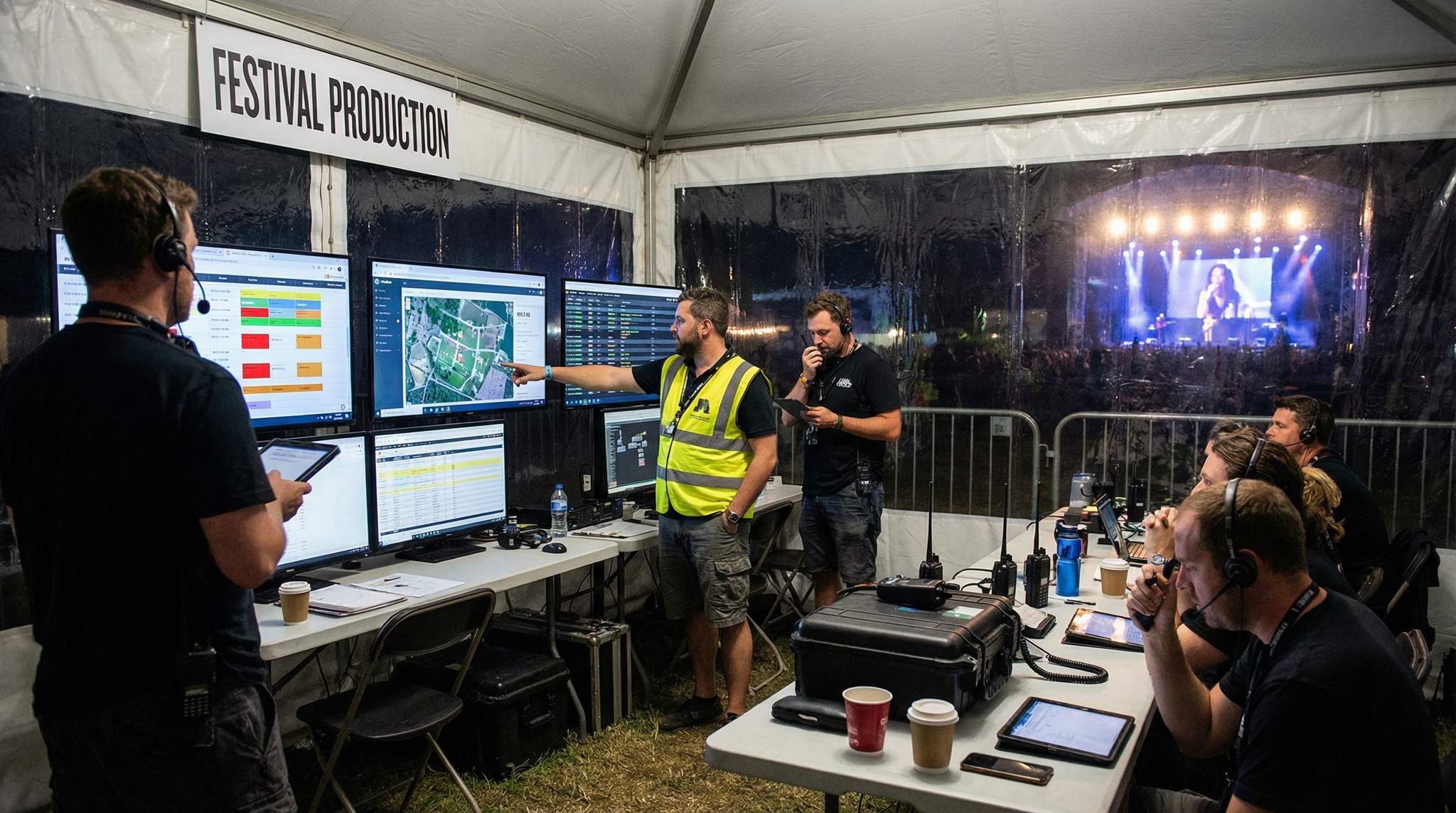
Festivals are exhilarating for attendees, but planning them is a daunting endeavor. Each festival is a massive production with countless moving parts – from last-minute schedule changes and crowd management to meeting the requests of artists and their teams. If the planning and logistics aren’t rock-solid behind the scenes, a festival can quickly unravel, leading to stress for staff and poor experiences for performers and fans. In an era when competition is fierce (over 2,600 music festivals took place worldwide in 2023 alone, according to data on music festival growth trends), a single major mishap can tarnish an organizer’s reputation. The stakes are high: a botched event can result in negative press, lost partnerships, and reluctance from artists, sponsors, or local authorities to work with the promoter again.
As event planners and marketers, we understand that every detail of event planning – no matter how minuscule – contributes to our brand image and credibility in the industry. It’s imperative to plan thoroughly, anticipate risks, and ensure our teams are fully prepared when it’s showtime. While the spotlight might be on the performers and stages out front, the real backbone of any successful festival lies backstage. All the action on stage depends on a well-oiled operation behind the scenes. This becomes even more crucial for multi-act festivals, where the complexity multiplies compared to a single concert.
In this guide, we will cover:
- Festivals vs. Concerts: Why backstage priorities differ
- Backstage Setup Fundamentals: Core aspects including Planning & Briefing, Logistics & Setup, and Hospitality
- Backstage Setup Checklist: An exhaustive list to make sure you’ve got every base covered (including a bonus meet-and-greet tip!)
By refreshing and updating this article for 2026, we’ll incorporate current best practices and real-world insights that emphasize professional standards and reliability – without ever explicitly mentioning those terms. Let’s dive into the backstage essentials that every successful festival must get right.
Smooth Entry With Mobile Check-In
Scan tickets and manage entry with our mobile check-in app. Supports photo ID verification, real-time capacity tracking, and multi-gate coordination.
Festivals vs. Concerts: The Difference Lies in Priorities
For those who have organized both concerts and festivals, the contrasts are significant. A festival might span an entire day or multiple days, feature a lineup of many artists or speakers, and typically takes place outdoors on a sprawling site. A concert usually centers on a single headlining act (with perhaps a couple of openers), often in a fixed venue like an arena, theater, or club. These structural differences mean the backstage priorities and challenges aren’t the same at all.
At a single-artist concert, the organizer has relatively more control over the environment – the venue’s infrastructure is often established (be it an indoor arena or a managed open-air venue), and the focus backstage is on serving that one main act. The headlining artist is the singular highlight, so ensuring they feel taken care of is paramount. This means setting up a clean, comfortable green room with all the requested amenities ready on arrival, arranging a proper soundcheck, and assigning a dedicated stage manager or technician to the artist. In smaller concert settings like clubs, even if the DJ booth or stage is in plain sight, a backstage management mindset is applied – much of the setup is done ahead of time, sound and lighting are tested, and a technician is on standby to handle any glitches. Especially in markets like the US, concerts tend to be meticulously planned, often running like clockwork with few surprises on the night.
Ready to Sell Tickets?
Create professional event pages with built-in payment processing, marketing tools, and real-time analytics.
The physical layout also dictates your operational flow. For instance, managing an in the round concert stage—where the audience surrounds the performance area—requires entirely different backstage routing than a traditional proscenium setup. When considering exactly where do singers perform and how they access the stage without breaking the fourth wall, organizers must design hidden tunnels or secure walkways. Festivals rarely use in-the-round setups due to these complex access requirements, opting instead for massive directional stages with dedicated, secure backstage compounds directly behind them.
Festivals, on the other hand, are a different beast. With multiple acts rotating on and off stage across possibly several stages, things can get chaotic if not managed carefully. You’re constantly switching between performers while simultaneously coordinating lighting, sound, and stage crews, often in real time. An outdoor festival faces variables like weather (scorching heat, sudden rainstorms) and larger crowds moving around, which can all impact the schedule. It’s not uncommon for festivals to face last-minute changes – an artist delay, a sudden equipment issue, even a brief evacuation for safety – far more often than a tightly controlled single-venue concert would. This is why stage management and contingency planning are pivotal in festival settings. Every aspect needs a backup plan so the show can go on smoothly even if parts of the plan change at the last minute. In short, a festival demands a higher degree of agility and on-your-feet problem solving from the backstage team.
To illustrate the differences in scope, compare some key factors of concerts vs. festivals:
| Aspect | Concert (Single-Act Show) | Festival (Multi-Act Event) |
|---|---|---|
| Duration | 2–3 hours, single day | Full day or multiple days (e.g. 2–4 days) |
| Number of Performers | One main act (plus openers) | Dozens of artists across multiple stages |
| Venue & Infrastructure | Pre-existing venue (arena, theater, club) with fixed setup | Often open fields or custom outdoor sites requiring temporary infrastructure |
| Schedule Complexity | One set, fixed start and end times | Continuous sets, frequent changeovers, strict set times for each act |
| Backstage Needs | One green room, small crew | Multiple green rooms, large crew compounds, many more moving parts |
| Potential Last-Minute Changes | Rare (once show starts, changes minimal) | Common (weather holds, surprise guests, tech delays, etc.) |
| Crowd Size | Hundreds to ~20,000 (typical arena) | Often 10,000–100,000+ per day (major festivals) |
| Example Scenarios | Tour stop in an arena or stadium | Large multi-stage events like Coachella, Glastonbury, Tomorrowland |
In essence, a festival is like operating a temporary city, whereas a concert is like running a high-profile show in a single building. Your priorities shift accordingly. For concerts, you might prioritize the artist’s individual experience and ensuring the singular performance goes perfectly. For festivals, you prioritize coordination and flow – maintaining a tight schedule, orchestrating transitions between acts, and keeping every part of the machine (stages, staff, equipment, artists) in sync. As one festival operations veteran put it in a discussion on festival backstage and operations area layouts, “While attendees enjoy the music out front, backstage teams are running a small city behind the scenes.” That small city mentality means you need robust infrastructure backstage: production offices, crew break areas, catering, transport routes for equipment, and more – all of which we’ll dive into below.
It’s also worth noting how unforgiving festival operations can be if under-prepared. Major single-venue concerts seldom face, say, weather evacuations or multi-stage logistical jams, but festivals regularly contend with these issues. For example, at a large U.S. festival in 2023, severe supply chain delays prevented the main stage from being completed in time, forcing the cancellation of the entire first day, as reported regarding Electric Zoo’s supply chain issues. (The organizers cited “global supply chain issues,” but insiders knew the planning timeline hadn’t included enough buffer.) And in recent years, extreme weather has hit festivals hard – flooding turned the UK’s Standon Calling site into a swamp in 2021, highlighting how freak weather affects music festivals and forced a full cancellation. In 2023 a desert festival saw its site roads become impassable mud after unexpected rain. These scenarios highlight why meticulous planning and contingency measures are not just bureaucratic exercises, but survival tools for festivals.
Pro Tip: If you’re used to concert planning, don’t underestimate festival logistics. Even experienced tour managers have been caught off guard by how quickly things change at festivals. Shadow an established festival production team if you can, to gain first-hand experience. The scale and pace are incomparable – but with the right planning (and a calm mindset), you can orchestrate it all.
Now, let’s break down the fundamental aspects of a great backstage setup that should be a staple at every successful festival. We’ll cover detailed planning and briefing, smart logistics and site setup, plus artist and crew hospitality. These pillars form the backbone of your event’s success backstage.
The Fundamental Aspects of a Backstage Setup
A successful festival requires certain backstage essentials to be firmly in place so that the event is enjoyable and memorable for both performers and the audience. Without these behind-the-scenes fundamentals, a festival can descend into chaos despite what’s happening front of house. Remember, if things break down backstage – if an artist is late because they weren’t informed where to go, or if a critical piece of gear is missing – it will be felt on stage sooner or later. Performers who feel stressed or mistreated won’t deliver their best, and technical hiccups can disrupt the entire show. Ensuring artists’ comfort, crew efficiency, and overall safety all starts backstage.
Topping your list of priorities should be building a strong backstage backbone for the festival. From comfortable green rooms to robust security and on-call catering, a well-equipped backstage area creates a smooth experience for everyone involved. This is where your staff coordinate, artists relax and prepare, and the show is monitored and adjusted in real time. It’s imperative that you supply the backstage with all essentials so staff and performers can focus on their jobs without scrambling for basic needs. As we explore the key aspects below, think of them as the core ingredients of a backstage “engine room” that keeps the festival running.
(We’ll break down Planning & Briefing, Logistics & Setup, and Hospitality in detail, and then provide an all-in-one checklist at the end.)
Free Tool: Will the Room Actually Be Full?
Forecasts expected attendance from ticket type, event type and day of week. Calculates safe over-book count for free-RSVP events. Free estimator.
Mastering backstage management in events requires a holistic approach that goes beyond simply assigning dressing rooms. Whether you are producing a massive multi-day outdoor festival or a specialized corporate summit, effective behind-the-scenes coordination hinges on proactive problem-solving and clear departmental communication. Event organizers must treat the backstage area as a high-security, high-efficiency workplace where technical crews, artist liaisons, and site operations teams can collaborate without friction.
When scaling up to large-scale events, music festival backstage operations become a specialized discipline. Unlike a standard venue where the infrastructure is static, festival backstage teams must build and manage a dynamic ecosystem. This encompasses everything from coordinating heavy machinery during load-in to managing the intricate flow of multiple touring camps arriving simultaneously. Effective backstage operations require a dedicated site manager who oversees the physical footprint—ensuring power distribution, waste management, and secure perimeters are maintained—while the production manager focuses on the stage and talent. By separating these operational duties, organizers can maintain a secure, efficient environment even when unexpected challenges arise.
Grow Your Events
Leverage referral marketing, social sharing incentives, and audience insights to sell more tickets.
Planning & Briefing
There’s no better way to set your festival up for success than by having a rock-solid plan – complete with backup plans – and making sure your entire team is on the same page. Thorough planning with zero ambiguity will ensure a seamless experience not only for attendees, but also for performers, crew, and other stakeholders. In the festival world, “winging it” is not an option. As one saying goes, “A festival is 90% preparation and 10% execution on the day.” This section covers the planning and briefing components that form the foundation of backstage management.
Core Operations Plan & Activity Checklist: One of the first steps is developing a core operations plan for backstage. This is essentially the blueprint of how things will flow behind the scenes. Sit down with your production team and map out, in detail, everything that needs to happen, when and where. The plan might include:
- Backstage Layout & Zones: Determine how large the backstage area is and partition it into functional zones. For example, outline areas for equipment storage, green rooms and dressing rooms, the production office/operations center, catering, and so on. Everyone should know what each zone is for and who is allowed there.
- Personnel Access & Roles: Decide how many production staff and crew members will have access to each area, and what their responsibilities are. You might have stagehands only in stage-adjacent areas, a dedicated artist relations person managing the green rooms, etc. Define roles clearly so there’s no overlap or confusion.
- Equipment Placement: Plan where major backline equipment, tech racks, lighting controls, and other gear will be set up backstage. Proper placement prevents clutter and ensures staff can find what they need quickly. Mark these on a map (more on site mapping below).
- Center of Operations: Identify the “HQ” of your backstage – often a production office or trailer that serves as the command center. This is where stage managers, technical directors, and coordinators gather to monitor the show’s progress and troubleshoot issues. It’s also typically where last-minute changes are communicated and logged.
- Communication Methods: Decide how backstage communications will happen. Will everyone use walkie-talkies/radios on specific channels? Are there group text messages or an event management app for updates? Plan this early (we’ll cover more under Logistics, but it should be in the core plan too).
All of these elements can be captured in a master activity checklist or show bible that outlines every key task and who’s responsible. Don’t shy away from detail – a thorough operations handbook that might run dozens of pages could save you from disasters. Veteran producers often create physical or digital handbooks for staff. Having checklists for each area (e.g., “Green Room Setup Checklist”, “Stage Turnover Checklist”) ensures nothing is overlooked. Print them out or distribute them on tablets – your crew will appreciate the clarity.
Experience Insight: The best festival producers treat the backstage plan as a living document. In the lead-up to the event, gather your core team for a table read of the operations plan – similar to a script read-through. Walk step by step through a festival day from load-in to load-out. This often reveals gaps or unrealistic assumptions. By doing this dry run, you can catch issues on paper before they become real problems at the event.
Developing a comprehensive backstage plan is only half the battle; distributing it effectively ensures your entire team can execute it. A modern backstage plan should be accessible digitally to all department heads, featuring interactive site maps, real-time schedule updates, and emergency protocols. By centralizing this operational blueprint, you eliminate version control issues that often plague paper-based schedules. When every stage manager, security lead, and artist liaison works from the same unified strategy, cross-departmental friction drops significantly, allowing your team to focus on proactive problem-solving rather than chasing down outdated information.
Scheduling & Contingency Plan: As you know, scheduling is the heartbeat of any music event’s flow – especially for a large-scale festival with multiple acts. Creating a detailed timetable of which artists perform when, and on which stage, is just the start. Once you have the performance schedule, work backwards to build the backstage schedule: when does each artist need to arrive at the backstage “wing” before their set, when do changeovers start and end, which crew members need to be where at those times, etc. For example, if Band A is ending at 5:30 PM on Stage 1 and DJ B is set to start at 5:45 PM on the same stage, you know that by 4:45 PM DJ B should be in the backstage warm-up area, and by 5:15 PM their equipment should be loaded on stage. Meanwhile, crew should be ready at 5:30 PM sharp to strike Band A’s gear. These timings go into the operations plan.
Modern festivals often use production scheduling software or spreadsheets to track these minute-by-minute schedules. In fact, AI-driven scheduling tools are emerging to help optimize complex festival lineups. Some large 2025 events used AI software that crunched endless schedule permutations to minimize overlaps of popular acts and predict crowd flow, cutting down what used to take weeks of planning into mere days, utilizing 2026 festival tech trends that deliver value. There are even algorithms now that forecast crowd surges at entry gates or certain stages with over 90% accuracy, significantly improving attendee satisfaction and safety – these can inform your staffing schedule for security, volunteers, and medical teams.
No matter how perfect your schedule, always prepare for surprises. Build in buffers where possible (e.g., a 15-minute break every few acts on a stage) and have a contingency plan for common issues:
- What if an artist is late or no-shows? Have a standby act or DJ who can fill a gap, or plan for extended changeover music/videos to keep the crowd warm.
- What if an act runs over time? Train stage managers on how to tactfully cut power or signal the act (often via the monitor engineer) to wrap it up, especially if going overtime causes permit issues or clashes.
- What if severe weather approaches? Decide in advance the trigger points for delays or evacuation (e.g., lightning sightings, wind thresholds) and how you’ll communicate holds to the crowd and artists. This should tie into your emergency plan (discussed later).
- What if gear breaks on stage? Have backup instruments or equipment ready to swap, and ensure techs are on standby to fix issues on the fly.
Leave time and space for the “what-ifs.” Slot a few longer changeovers in the schedule where you can absorb a delay if one occurs earlier in the day. Essentially, hope for the best, plan for the worst. If you never need the contingency, great – but if you do, you’ll be the hero for having a Plan B ready to go.
Another scheduling variable that requires careful coordination is integrating musical guests smoothly into a planned set. Surprise collaborations or unannounced sit-ins are massive crowd-pleasers, but they can wreak havoc on your stage manager’s timeline and the audio engineer’s input list if not communicated in advance. To handle these special appearances without disrupting the flow, require artists’ tour managers to clear any guest performers with your production office at least a few hours before stage time. This allows your technical crew to prep extra microphones, adjust monitor mixes, and ensure the guest has proper backstage accreditation to bypass security checkpoints quickly.
Collect Any Attendee Data at Checkout
Add custom registration fields to your checkout — dietary needs, t-shirt sizes, company names, and more. Conditional logic and per-ticket-type fields.
Site Map, Access & Security: An often underestimated planning task is drawing up a site map that includes the backstage areas in detail. You should create a map of the entire festival grounds and a focused map of the backstage compound. Every room, tent, gate, and pathway should be labeled. Why? Because your teams (from production crew to security staff) need to know exactly where to go and how to get there quickly, especially in a time-sensitive situation.
On the backstage site map, mark the locations of all critical areas: stages, green rooms (label them per artist if assigned), crew break area, catering, production office, first aid post, storage “boneyard”, generator locations, toilets, etc. Also indicate access points – where can vehicles enter backstage, where do artists enter, how do crew move from backstage to front of house, etc. If you have multiple stages, consider creating separate backstage zones for each, with a central operations hub connecting them. Familiarize your whole team with this map during pre-show briefings. Some festivals even distribute small printed maps to staff or have it on a staff-only mobile app.
Tightly linked to mapping is security and access control. Security is an essential part of any successful festival – it keeps both performers and attendees safe. Your security team should be intimately familiar with the site map, especially backstage, so they know which areas are restricted and who is authorized to be there. Plan out your credential system: artists, crew, VIPs, media, etc., might all have different passes and permitted zones. Clearly demarcate no-go zones for anyone without the right credentials. For instance, general attendees might be allowed up to a certain point (like a backstage tour area or VIP platform, if you have one), but beyond that line only staff and artists can enter. Within backstage, you might further restrict so that only core production staff can access the operations office or certain technical areas.
A robust security plan covers staffing (guards at key points, roaming security across backstage), surveillance (maybe CCTV covering equipment areas), and protocols for incident response. Also, consider modern threats – in 2026, one new concern is unauthorized drones flying over festival sites and backstage areas. Top festivals now enforce no-fly zones and use drone detection or signal jamming tools to prevent rogue drones from endangering people or filming private backstage moments, as automation helps fill labor gaps and allows security teams to spot fights, fires, or medical issues. Partner with local authorities if needed to monitor airspace, especially if high-profile artists are present who value privacy.
Pro Tip: Enforce strict access control with colored wristbands or laminates and clear signage for zones. Demarcate backstage zones such as “Crew Only,” “Artist Entrance,” “VIP Guest Area,” etc. Not only does this keep out wandering fans or friends-of-friends, it also prevents accidents – you don’t want an unauthorized person tripping over cables in a restricted area or sneaking into the pyrotechnics zone. Give security the authority to politely but firmly turn away anyone without proper credentials, no exceptions.
Work Safety Protocol: Safety for your workers and crew is just as important as safety for attendees. Backstage and production work can be hazardous – you have heavy equipment, electrical hookups, working at height on stage rigs, and long hours that can lead to fatigue. It’s critical to brief all staff and volunteers on work safety protocols before the festival begins. In some regions, it’s legally required to conduct a safety briefing or even have a safety officer inspect the site (for example, a local fire marshal might need to approve stages and tents). Even if not required, do it because it’s the right thing to keep your team safe and avoid accidents that could shut down the show.
Go Cashless With RFID Technology
Enable contactless payments, faster entry, and real-time spending analytics with RFID wristbands and NFC-enabled ticketing for your events.
A good approach is to identify a Safety Manager or the most experienced production hand on your team to lead this aspect. In the briefing, cover basics like:
- Personal Protective Equipment (PPE): If crew are building stages or handling any construction, they should have hard hats, gloves, steel-toe boots, etc. Emphasize when PPE is mandatory (e.g., during load-in and load-out, or when working near forklifts or heavy gear).
- Emergency Procedures for Staff: Explain what any crew member should do if there’s an accident (who to call via radio, where the on-site medic is, how to signal if you need help). Also cover what to do if they themselves are hurt – e.g., not to keep lifting if you threw out your back, but to report it immediately.
- Restricted Areas and Behavior: Remind crew about any hazardous zones (like a generator or pyrotechnics storage area) where only authorized techs should enter. Also, discourage horseplay and remind everyone that festival sites can have hidden hazards like cables on the ground or overhead rigging – so stay aware.
- Local Regulations: If applicable, brief on labor laws – for instance, some jurisdictions limit how many hours in a row crew can work without a break. Have a plan to rotate staff to stay compliant and keep people alert. In 2026, many festivals are also mindful of new regulations around heat safety (ensuring crew get shade and water during daytime shifts) and COVID/post-pandemic health guidelines if any (like sanitation for food handling, etc.). Stay updated on regulations via organizations like the Event Safety Alliance and local authorities.
Ensure any temporary staff or volunteers also attend a safety briefing. They might be less experienced, so training is crucial. If you have a lot of volunteer help, check out our guide on revamping festival volunteer programs for 2026’s new reality – it offers tips on training and assigning volunteer roles effectively. Ultimately, you want every member of your backstage team to understand that safety comes first, and that they have the power to speak up if they see something unsafe. A culture of safety and openness means small issues get fixed before they become big accidents.
Medical Facilities, Emergency Response & Evacuation Plan: While we hope never to use them, robust medical and emergency plans are non-negotiable for a festival. Work with medical professionals (e.g., hire an event medical services company or coordinate with local EMTs) to set up first aid stations both in the main event area and backstage. Backstage medical facilities might be a small tent or room where performers or staff can be treated privately if needed (for anything from dehydration to a twisted ankle). Make sure this area is clearly marked on your site map and that all staff know its location.
Plan for worst-case scenarios with a written Emergency Response Plan. Identify the types of emergencies that could occur (medical incidents, fire, severe weather, security threats, etc.) and spell out a response for each. For example:
- If there’s a severe injury or health incident backstage, how do you call for the medics? (Usually via radio – ensure one channel is designated for emergencies.) Do you halt performances if the incident affects the stage? Who makes that call?
- If there’s a need to evacuate the site (e.g., approaching storm or security threat), how will the order be given and by whom? Detail the chain of command for that decision. Usually, the festival director in consultation with safety officers and perhaps local police/fire chiefs will decide. Have a clear communication plan to notify attendees – often through stage announcements, video screens, and app notifications, following a structured festival organizational chart protocol where the Communications Lead ensures all parties are notified.
- Know your evacuation routes. Work with your security and crowd management team to designate how people should exit both the audience area and backstage. Backstage crew should have an agreed rally point offsite to meet if they evacuate so you can account for everyone.
- Consider scenarios like a performer injury on stage (have a plan to lower the curtain or turn off cameras if needed, and get medics in) or an overdose situation. Unfortunately, with the prevalence of recreational drugs at festivals, artists or crew could also face overdoses. As of 2023, naloxone (Narcan) has become available over-the-counter in many places, as music festivals become more open to harm reduction, and festivals have increasingly made opioid overdose kits and training standard. In fact, one harm reduction group distributed over 46,000 doses of Narcan at U.S. festivals in 2024 alone, marking a shift where harm reduction initiatives are standard practice – a sign of the times. Consider having naloxone on standby and train your medical team (and even key staff) in its use. Our detailed 2026 Festival Overdose Preparedness Guide dives deeper into how to set this up.
When developing emergency plans, consult resources like the Event Safety Alliance’s guidelines and any local government requirements. Some jurisdictions may require you to submit an emergency plan or have certain equipment like fire extinguishers, ambulances on site, etc. Safety regulators and insurance companies will want to see that you have planned for contingencies. It’s not just bureaucracy – having a practiced response can save lives and also save your event from chaos. A useful exercise is to do a brief tabletop drill with department heads: “What would we do if scenario X happened?” Walk through it together to ensure everyone understands their role. If you want more insights on comprehensive safety planning, check out our guide on festival risk management and safety planning for an incident-free event.
Logistics & Setup
If planning is the blueprint, logistics & setup is the execution phase that brings it to life. This is the heart of on-site preparations and operations. Festivals have a lot of logistical moving parts – far beyond what a typical concert would require. In this section, we’ll cover how to handle communications, equipment storage, backups, ambiance, and all the physical setup needed backstage. It’s all about ensuring you have the right things in the right place, and the mechanisms to keep things running without hiccups.
Free Tool: Model Promoter Payouts
Flat-percentage, flat-per-ticket, or tiered-bonus commission structures — get per-promoter payouts and total commission as % of gross. Free calculator.
Communication Systems: In a festival venue that might span several acres (or hectares), communication is absolutely critical. Your team can’t waste time running across the grounds to relay messages; they need instant communication channels. The tried-and-true festival tool is the two-way radio (walkie-talkie). Equip your key staff (stage managers, production leads, security supervisors, medical team, artist liaisons, transport coordinators) with radios and assign channels – typically one channel per major function, plus an emergency channel. For instance, Channel 1 for overall production, 2 for security, 3 for site ops (power, toilets, etc.), 4 for artist relations, etc., and a code or separate channel for emergencies only. Train everyone on radio etiquette (e.g., think and then speak clearly, say “copy” to acknowledge a message, keep chatter minimal on the air). The Communications Lead should oversee this as part of the communications protocol and running order.
Beyond radios, utilize technology for coordination. Many events set up mass texting systems or use apps like WhatsApp/Slack groups for non-urgent comms among staff. There are also specialized event management apps that allow push notifications to crew. However, be cautious relying on cellular networks; at big festivals, public cell networks may be overloaded by attendees. It’s wise to invest in a reliable Wi-Fi or private radio network for your operations if possible. Some festivals bring in mobile cell towers or coordinate with carriers to ensure staff can communicate, but radios remain the most fail-safe option for immediate needs.
Importantly, establish a clear chain of communication. The center of operations (production office) should be the hub for disseminating any major updates (like schedule changes or emergency instructions). Many top festivals have instituted daily briefing meetings each morning of the event for all department heads, a practice essential for running your event like a small city. In these briefings, each lead shares key info (e.g., weather outlook, any VIP visits, known issues). This ensures everyone is in sync before the gates open. As the event runs, if there’s a significant change (like an artist delay or a sudden schedule tweak), have a protocol: for example, stage manager informs production office, production alerts communications team and security, and then an announcement is made on all radios or a text blast to staff. Keeping everyone in the loop in real time prevents confusion and mistakes. As one expert notes, regular communication rituals (like those stand-up meetings and quick cross-functional check-ins) can transform how smoothly your team operates through cross-functional ops briefings. No one is left guessing; everyone knows what’s happening.
Handling & Storage of Equipment: Festival production involves tons of gear – literally. One big question early on is where will all the equipment be stored and handled before, during, and after the festival? Unlike a concert at a fixed venue (where gear might come in that day and leave that night), a festival often requires setting up an entire site from scratch. You might begin load-in and construction weeks ahead of the show date. This means you need secure storage solutions for staging, lighting, sound systems, generators, cables, tents, decor, and more.
Ideally, your festival venue is secured and available not just for the days of the event but also a buffer period before and after. Always book your venue (or get permits for your site) to include extra days for load-in and load-out. For example, if the festival runs Friday to Sunday, you might reserve the site from Monday of that week through Wednesday of the next week. This way, you can start building on Monday and have a few days after teardown to ensure everything is cleared. Having this cushion reduces the chance of a mad scramble that could lead to safety issues or fines for running late.
While on site, designate a backstage zone as the “boneyard” or storage yard, a critical zone in festival backstage and operations layouts. This is where spare equipment and cases go when not in immediate use. It should be out of the way of main foot traffic but easily accessible by crew (perhaps near the loading dock or production road). The boneyard must be kept organized and secure. Use signage and tape to mark areas (audio gear here, lighting truss there, empty road cases in a stack over there). If possible, shade or tent the storage area to protect sensitive equipment from sun or rain. If the festival is outdoors and multi-day, weather is a concern – consider renting waterproof shipping containers or portable warehouses if you need to lock up gear overnight. In fact, some festivals partner with local storage companies or use on-site stadium storage if available for multi-day events.
Security of equipment is paramount. Sadly, theft can happen even in artist and crew areas. Hire security to watch the storage zone, or employ a check-in/check-out system for valuable gear. If you have overnight down time, ensure security patrols are active. There have been incidents of equipment trucks being broken into at night; don’t let yours be one. We’ve seen festivals use volunteer “boneyard runners” whose job is to be stationed in the storage area, ensuring performers get what they need quickly. This is great for efficiency – instead of every tech combing through storage, one person familiar with the layout can quickly retrieve items and also keep an eye on stock.
Another aspect of handling is transport logistics on site. Larger festivals might use golf carts, Gators, or even forklifts to move gear around backstage. Plan routes for these vehicles and keep them separate from pedestrian paths if possible (perhaps a service road behind stages connecting to the storage area). Manage vehicle access strictly – only licensed drivers for forklifts, and have a speed limit for carts. If an artist’s gear needs to go from Stage 2 to Stage 3, know the quickest route and whether you have vehicles or enough crew to lug it quickly. In one cautionary tale, a big festival expanded stages but not the backstage roads, creating a traffic jam of delivery trucks and forklifts that delayed a headliner’s setup, proving the importance of planning backstage transport routes. The lesson: ensure your logistical infrastructure scales with the festival’s size. If you’re adding more stages or attractions, also add more storage space and transport paths to support them.
Reserve & Backup Equipment: One mantra of live events: anything that can break will break – usually at the worst time. That’s why having reserve and backup equipment is essential. Of course, budget is a factor; not every festival can afford full duplicates of major systems. But at minimum, identify the critical equipment whose failure would jeopardize the show, and have backups for those.
Examples:
- Power: If the grid power fails or a generator dies, do you have a backup generator on standby or redundant power feeds? Many festivals set up backup generators that can kick in for critical stages or safety lights. At least have a contingency contract with a rental company to deliver a generator at short notice, and multiple fuel sources for power.
- Audio: Keep spare microphones, cables, and DI boxes side-stage. If a mic cuts out mid-set, your audio tech can swap it in seconds. Likewise, have a backup mixer if your budget allows (even a smaller one that could run a bare-bones show if the main console failed). Critical performers might have duplicate wireless mic packs or in-ear monitors ready to go.
- Lighting: Have extra lighting fixtures and bulbs, and consider a backup lighting console or a pre-programmed laptop that can take over basic lighting cues if needed.
- Video: If you have video walls, an extra spare panel or two is good to have in case of breakage, as well as a backup media server or laptop for running visuals.
- Communications: Extra radios and batteries (dead radio comms in staff can be a critical failure during an emergency). Also, multiple charging stations for all the devices.
- General Supplies: Always procure more gaffer tape, extension cords, chargers, tools, and hardware than you think you need. These items disappear fast during a busy show.
- Furniture & Amenities: Have a couple of spare folding tables, chairs, or pop-up tents in case you need to quickly create a new station or expand an area.
Test all primary equipment during soundchecks and rehearsals before gates open, so you’re not discovering a bad mixer channel when the crowd is already there. And think about worst-case scenarios: if the main stage sound completely dies, could you move a headliner to another stage or do an abbreviated DJ set? If Stage A’s lights go out, can you quickly bring in a light tower? Having even rough backup plans for major failures will make you far less stressed. You might never need them, but if you do, you’ll look remarkably composed as you execute Plan B while others panic.
A great example of preparedness: Glastonbury Festival (UK) in 2019 banned single-use plastic bottle sales on-site, and by doing so they arranged a network of water refill stations and gave artists reusable bottles. Not only was this eco-friendly, it meant they anticipated hydration needs: extra water tanks were on standby so no one went thirsty. In fact, banning plastic bottles prevented an estimated 1 million bottles from being used that weekend, demonstrating the impact of greening festival artist hospitality. The takeaway here is twofold – planning backups can be an opportunity (in this case, to improve sustainability) and meticulous planning avoids crisis (no water shortage despite the ban).
No Hidden Fees, Just Honest Pricing
One all-inclusive fee covers the platform, payment processing, support, and every feature. Free events are always free. No setup costs, no surprises.
Ambiance, Lighting and Sound (Backstage): When we think ambiance, lights, and sound, we usually picture the stages. But backstage ambiance is also important for both practicality and morale. For practical reasons, ensure work lights are set up in all backstage areas – especially if your festival runs into the evening or night. Crew need to see what they’re doing when packing up gear or walking between tents. Use appropriate lighting (e.g., string lights, LEDs on stands) that are safe (no hot halogens near fabric) and ideally have a secondary power source (even battery-operated lights or flashlights available) in case of a brief power loss.
For artists and staff comfort, the ambiance backstage shouldn’t be an afterthought. A well-thought-out backstage can actually boost performance quality – a relaxed, happy artist will give a better show. So consider things like temperature control, if possible. Are there heaters in the green rooms for a cold-weather festival, or fans/air conditioning units for a summer festival? Even small touches like putting carpet in the green room or having some colored LED lamps can make a tent feel cozy rather than harsh. Some festivals decorate the artist area with local art or give it a theme to make it special. These details convey hospitality and professionalism.
Sound-wise, try to balance quiet and information. Artists often appreciate if the backstage isn’t too noisy or hectic – they might want to warm up in peace. Don’t place loud generators or machinery right next to green rooms. At the same time, make sure important announcements (like “10 minutes to stage time for Act X”) can be heard. You might use a simple PA system or a talkback monitor in green rooms to relay stage calls. Alternatively, assign an artist liaison to each act to personally inform them when it’s time to move to side-stage.
One thing to watch: lighting backstage during the show should be kept low around stage entrances to avoid spilling onto the stage or distracting the audience. Use blue “running lights” (common in theater productions) which give enough illumination for crew to work but won’t interfere with stage lighting or be noticed by the crowd.
Finally, maintain a clean and organized atmosphere. Have trash bins backstage and someone assigned to periodically tidy up – it shouldn’t look like a junkyard. An orderly backstage reflects an overall organized production and keeps everyone’s spirits higher. If you’ve ever seen behind the scenes at Disney World or a top-tier festival, you’ll notice even the utilitarian areas are kept neat; it sends the message that the crew has their act together.
Production Workstation Setup: As mentioned earlier, your production office or workstation is the nerve center of backstage operations. This is where the production team (festival director, stage managers, tech leads, artist relations managers, etc.) can coordinate and oversee the event. Setting this space up efficiently is key.
Equip your production office with reliable power and connectivity. That means plenty of power strips (with surge protection), and ideally a strong wired internet line and dedicated Wi-Fi for staff devices. In 2026, connectivity is crucial – everything from digital schedules (Google Sheets or other planning docs) to weather radar and messaging apps require internet. If the festival budget allows, rent portable satellite internet or have a robust backup like a cellular hotspot that’s tested on site. Do not rely on public Wi-Fi or cell networks that attendees use; have an isolated one for operations.
Set up communication boards or screens in the office. A whiteboard or digital screen that shows the latest schedule, any changes, and to-do lists can help everyone stay on track. Some festivals use project management boards with magnets or sticky notes to visualize the status of each act (e.g., Act A – “Arrived”; Act B – “On Stage”; Act C – “Delayed 15min”, etc.). It sounds old-school, but in a crunch it’s often easier to glance at a whiteboard than to open an app. In the production trailer, you might also have CCTV monitors showing stage feeds or crowd shots so you can monitor the event’s progress visually.
Keep your essentials at the production desk: printouts of all schedules, contact list of all key personnel and vendors, a map with emergency exits and nearest hospitals, and copies of permits or contracts that might be needed if officials show up. It’s basically your festival HQ office, so treat it like a central command post. Have a runner or assistant who can fetch anything people in the office might need (from coffee to spare printer ink) so the decision-makers can focus on the event.
One more tip: Just as you have daily briefings in the morning, consider brief on-site debriefs or check-ins at regular intervals (maybe once every few hours or at key milestones like “afternoon changeover meeting”). The production office can host these quick stand-ups with department heads to ensure all is well or to resolve issues collaboratively. It fosters real-time problem solving and keeps everyone aligned, turning potential chaos into a choreographed operation .
Experience Insight: Many top festival producers liken the operations to a military or emergency response command center. In practice, treat your festival like a mission that requires coordination. For example, at a large international festival in 2025, the operations team implemented an “emergency ladder” protocol for decision-making. If an issue was minor (e.g., a generator refuel needed), it stayed at the ops team level. If it was moderate (e.g., an artist missing their flight), it escalated one rung up to the festival director and communications lead, following a predefined decision-making hierarchy. If it was major (e.g., severe weather approaching), it escalated further to involve local authorities and triggered full staff alerts to ensure all departments are notified. They rehearsed these escalation flows ahead of time. The result was a near-flawless execution during the actual event when multiple small problems popped up – each handled at the right level without panic. The lesson: set up your command structure and empower your team to handle issues at the lowest appropriate level, only escalating when necessary.
Green Rooms and Artist Lounges: At a standalone concert, much of your focus is naturally on the star artist’s needs. At a festival, there may be dozens of artists of all levels, but you must intentionally plan for each artist’s comfort and privacy. A happy artist is more likely to deliver an electrifying performance and speak well of your event afterwards. On the flip side, if an artist feels mistreated or if their backstage experience is chaotic, it can sour their show and your relationship with them.
Start with the basics: provide enough green rooms or dressing rooms to accommodate your lineup (or at least all the headliners and mid-tier acts; smaller acts might have to share or use a common area on a rotating basis). Depending on your venue, green rooms could be actual rooms (in a stadium or building) or portable cabins or tents set up as dressing rooms. If using tents, invest in solid ones that can be zipped or closed for privacy, and consider things like flooring so artists aren’t on bare grass or mud. Each green room should ideally have separate spaces for dressing/makeup and a rest/lounge area. This could be as simple as one side with mirrors, good lighting, a garment rack and makeup table, and the other side with a couch, table, and some comfy chairs.
Stock each green room with essentials as per artists’ riders. Common items: bottled water (or better yet, reusable water bottles and a nearby water station to align with sustainability – more on that shortly), a first-aid kit, and some snacks or fruit. Don’t forget phone chargers and power outlets, and adaptors if you have international artists. Little touches like a full-length mirror, a fan or heater, and clean towels go a long way. And absolutely ensure the green rooms are spotless before artists arrive – have a cleaning crew do a once-over after any previous occupant. Nothing is more off-putting to an artist than walking into a dirty or smelly dressing room.
Communication with artist teams is key to knowing what they need. Some might request specific gear (like a piano for warm-ups, or extra speakers to practice) or specific foods and drinks. While you may not fulfill every extravagant request, do your best to meet reasonable ones, as it shows professionalism. It helps to designate artist liaisons or runners – essentially point people – for each performer or stage. These staff members are responsible for greeting the artists when they arrive, getting them to their green room, and updating them on schedule (“You’re on in 30 minutes, shall we head toward side-stage in 15?”). The liaison can also fetch things the artist needs or communicate any problems back to production.
Privacy and security for artists in the green room area is crucial. Limit access strictly to the artist, their authorized entourage, and specific staff with a reason to be there (artist hospitality, stage manager checking in). Security guards or a check-point at the entrance to the artist compound are a good idea. This prevents any enthusiastic fans or even low-level crew from wandering in. High-profile artists might also have personal security – coordinate with them on your layout and passes so there’s no friction.
Another nuance: consider artists who have multiple sets or a long gap between sets (for example, a band playing an afternoon acoustic set and a nighttime full set, or a DJ who spins on Friday and again on Sunday). They might appreciate a secondary lounge or a quiet area to rest for a longer period. Some festivals have an “artist village” with common hospitality (like a cafe or massage services) separate from the private dressing rooms. This can be a nice perk and also encourages artists to hang out and possibly collaborate or give surprise guest appearances.
Pro Tip: Plan for multiple green rooms and lounges, especially if your festival has overlapping performer schedules or multiple stages. Even if you can’t give every act a private room, create a tiered system: e.g., headline artists each get a dedicated trailer; mid-tier artists share a large tent divided in half between two artists; smaller acts get a communal green room tent with partitioned sections or time slots. Label everything clearly (nothing worse than artists wandering into the wrong tent). And assign a hospitality host or stage assistant to each performer or stage. That person keeps the artist happy – whether it’s grabbing a cup of coffee for them or cueing them when it’s showtime. This human touch ensures no artist feels lost in the shuffle.
Speaking of hospitality, we promised an important note: artists’ riders sometimes contain very specific requests. The famous example is Van Halen’s “no brown M&Ms” clause in their 1980s tour rider – often misunderstood as diva behavior, it was actually a clever test. David Lee Roth explained that if he saw a brown M&M in the backstage candy bowl, it was a red flag that promoters hadn’t read the technical rider thoroughly – and indeed, every time brown M&Ms appeared, serious technical mistakes were also found on stage, a famous story explaining why Van Halen demanded no brown M&Ms. The takeaway for today’s organizers is clear: pay attention to the details. If an artist asks for something seemingly trivial in their green room, treat it with respect (it might be there for a reason, even if just their comfort). Fulfilling reasonable rider requests — whether it’s a certain brand of kombucha or fresh towels on every hour — shows professionalism and builds trust. And it keeps artists in a good mood, ready to give their best performance.
Restrooms & Basic Amenities: This may seem like a “no-duh” thing, but in the flurry of festival planning, don’t overlook adequate restroom facilities for artists and staff backstage. These folks can’t easily run out into the public porta-potties when nature calls; they need accessible, clean options backstage. Depending on your site, you might rent luxury restroom trailers for the artist area (common for higher-end festivals), or designate certain portable toilets as staff-only and place them conveniently near crew areas and stages. Make sure you have separate units or sections for men, women, and ideally a gender-neutral option to be inclusive. Clearly sign them (you can even label “Artists Only” on a couple of units to ensure privacy).
Maintenance is key – assign the sanitation team to service backstage restrooms regularly throughout the event (refill toilet paper, clean, restock hand sanitizer, etc.). A dirty backstage restroom can become a talking point among touring crews (and not in a good way). Conversely, a clean, pleasant facility backstage is a small detail that leaves a big positive impression.
Aside from restrooms, think of other basic amenities that keep people comfortable: a water station or cooler exclusively for crew (so they don’t deplete the artist stock), perhaps a coffee/tea table for crew breaks, and a place to sit and eat meals. Crew will often be working 12+ hour days, so providing a shaded break area with some chairs is important for their welfare. Many festivals create a crew mess area or break tent separate from the artists’ lounge, where crew can grab a quick sandwich and hydrate. If you treat your crew well backstage, they’ll have the energy and morale to keep the show running at peak performance.
Hospitality (Transportation & Catering)
“Hospitality” in festival terms extends to how you care for your artists, VIPs, and crew in terms of getting them to the show and keeping them fed. Logistics and hospitality often intertwine. In this section, we focus on two backstage hospitality essentials: transportation and catering.
Transportation and Transit: Long before show day, you should figure out how everyone – artists, key staff, suppliers – will get to and from the festival site efficiently and safely. For artists, this might mean arranging airport transfers, hotel shuttles, or local ground transport. Create a transportation plan that covers:
- Artist Transportation: If you have artists flying in, decide who meets them and how they get to their hotel and to the venue. Many festivals hire dedicated drivers or a transport company for artist shuttles. On show days, have a call time for when the artist needs to leave their hotel to arrive backstage by the agreed time. Account for traffic (e.g., if it’s a city festival, rush hour could delay a 5 PM arrival unless planned). Have contacts for each driver and a backup driver on call. Provide all drivers with the necessary credentials to get into backstage gates without hassle.
- Crew & Staff Parking: If the festival is remote, arrange shuttles or parking areas for staff too. Often, staff and crew will have a separate parking lot or drop-off point. They might get bused in from a production office off-site or from the same shuttles that bring artists. Make sure this is clearly communicated to all staff in advance (nobody wants confused crew stuck at the wrong gate at 7 AM). A crew parking and transport plan is even highlighted as a key zone in backstage layout guides.
- Equipment and Supplier Transport: Coordinate the load-in schedule with your suppliers – staging, lighting, sound, vendors, etc. Stagger arrival times so not everyone comes at once. Have a loading dock or load-in area with a sign-in so trucks know where to go. When multiple trucks are trying to squeeze down a narrow service road, things get messy – avoid gridlock by scheduling. Also plan the load-out after the festival; often everyone wants to leave at midnight Sunday, which is chaos. Staging might load out first, then sound, etc., or give different nights for different stage breakdowns if possible.
- Internal Backstage Transit: As touched on earlier, you might have golf carts or vans moving people around on site (especially if stages are far apart). Assign drivers or allow certain staff to use them. Always emphasize safety – there have been incidents of joyriding or crashes with golf carts at festivals, which can cause injuries.
During the festival, have a transport dispatcher in your crew – someone with a radio who knows where each vehicle is and coordinates pick-ups/drop-offs. For example, “Artist X is done with their set at 8 PM, their driver should be by the artist gate at 8:15 PM to take them back to the hotel.” This level of coordination prevents long waits or lost drivers. Post-festival, ensure everyone’s transport home is sorted too – crew shuttles at end of final night, etc. Small details like providing an early morning airport shuttle for artists with 6 AM flights, or a designated rideshare pick-up for crew, show that you care and think ahead.
Catering: Feeding Artists and Crew: Food keeps your workforce and talent fueled, pure and simple. Catering in a festival context usually means two things: artist hospitality catering and crew catering. Some festivals combine them (e.g., one catering tent where both artists and crew can eat, sometimes at separate times), while others keep them separate (a crew mess hall and a smaller artist dining area). Whichever approach, plan to provide substantial, quality food options – hungry people don’t perform or work well.
For artists, you’ll often be guided by their hospitality riders on what to provide in dressing rooms (snacks, drinks) and at meal times. Communicate with each artist’s tour manager in advance to find out any dietary restrictions or preferences. It’s common to ask, “Do you plan to eat on site, and if so, lunch or dinner?” Some artists prefer to have a hot meal after their set, others may want something before. Many will eat from your catering if it’s decent; some might request specific meals which you can accommodate via a local restaurant or special order if needed (within reason). Label foods clearly to respect dietary needs – vegetarian, vegan, gluten-free, etc., should all be marked. Also, in 2026, it’s good practice to offer some healthy choices (not just fries and burgers) because artists performing multiple shows appreciate lighter fare or specific diets (plant-based, keto, etc.). We have an entire article on next-gen festival food trends which can inspire catering ideas not just for attendees but for backstage too!
Crew catering is just as important – these folks are doing physically demanding work for long hours. Aim to provide at least two solid meals a day for crew on long show days (e.g., lunch and dinner), plus snacks and drinks available at all times. If budget is tight, even a simple buffet with pasta, sandwiches, or local favorites can work, but don’t let your crew subsist on potato chips alone. A coffee urn or brewed coffee supply is a lifesaver for those dawn load-ins. Keep crew water supplies abundant (big coolers of water or canned water) – hydration is a safety issue as well as comfort, especially in hot weather. One pro tip some festivals use: give each crew member a reusable water bottle with the festival logo (maybe even with their name on tape) to encourage them to stay hydrated and cut down on disposable cup waste.
In terms of operations, have set meal times and communicate them (e.g., “Crew lunch is 12:30 – 2:00 PM, backstage catering tent”). Stagger if needed so that critical positions are always covered (half the crew eats while half works, then swap). Also, schedule a catering service for overnight crew if you have people working through the night on breaks – even pizza delivery at 1 AM for the stage de-rigging team is deeply appreciated. Remember to feed your security, medical, and volunteer teams too if they’re on long shifts.
Finally, consider sustainability in catering. The industry is moving toward greener practices backstage to reduce waste and be good community citizens. Simple steps: use real plates and cutlery in catering when feasible (or compostable disposables) instead of Styrofoam. Provide large water coolers to cut down on single-use plastic bottles – many festivals in 2025-2026 have outright banned single-use plastics backstage, a major step in sustainable backstage practices, aligning with artists’ and fans’ growing eco-expectations. Some artists even include sustainability requests in riders now (like no plastic or locally sourced foods) to reduce the environmental footprint of single-use items. Embracing these trends can bolster your festival’s reputation for doing the right thing. For more ideas on eco-friendly backstage practices, see our guide on Greening Festival Artist Hospitality – it shows that you can pamper performers while also being sustainable, such as using refillable water stations and offering organic, locally sourced foods.
6 Ticketing Industry Backstage Insights for Smoother Operations
Modern festival production doesn’t just rely on walkie-talkies and clipboards; it integrates deeply with your event’s digital infrastructure. Leveraging data from your ticketing partner can transform how your backstage functions. Here are 6 ticketing industry backstage insights that top organizers use to streamline their events:
- Real-Time Access Control: Integrating your festival ticketing essentials with backstage RFID or QR scanners ensures that only credentialed staff and artists enter restricted zones, instantly flagging unauthorized access attempts.
- VIP and Meet-and-Greet Routing: Ticketing data reveals exactly how many fans purchased VIP upgrades or artist meet-and-greets, allowing production teams to staff these specific backstage hospitality zones accurately.
- Arrival Heatmaps: By monitoring live scan data at the front gates, the production office can anticipate crowd surges and adjust backstage security deployments or delay a headliner’s start time if thousands of attendees are still in line.
- Cashless Backstage Catering: Linking crew and artist wristbands to the festival’s cashless ticketing system allows for seamless tracking of catering consumption, preventing budget overruns in the crew mess hall.
- Automated Guest Lists: Moving away from paper lists, modern ticketing platforms allow artist liaisons to input guest lists directly into the system, reducing bottlenecks and friction at the backstage accreditation tent.
- Post-Event Data Debriefs: Ticketing analytics provide a clear picture of peak entry times and zone capacities, offering invaluable data for the post-festival debrief to improve next year’s site map and backstage layout.
Backstage Checklist
We’ve covered a lot of ground. To help you ensure nothing slips through the cracks, here’s an exhaustive backstage setup checklist you can reference during your festival planning. Use this as a starting point and tailor it to your event’s specific needs:
Treating this as your master festival logistics checklist ensures that every department—from site operations to artist relations—is aligned. A comprehensive operational roadmap prevents last-minute scrambles, allowing your production team to systematically verify power distribution, credentialing, and transport schedules well before the first truck arrives for load-in.
- Planning & Coordination: Complete a detailed Core Operations Plan covering backstage workflows. Create an Activity Checklist of all tasks and assign responsibilities.
- Scheduling: Finalize the festival schedule and build a detailed timetable for backstage (artist arrivals, changeovers, etc.), including a Contingency Plan for delays or disruptions.
- Site Map: Draw a backstage site map labeling all zones (stages, green rooms, storage, catering, etc.). Plan Access Control points and credentials for each zone.
- Security Plan: Coordinate with the security team on backstage coverage. Demarcate restricted areas, establish entry checkpoints, and plan for safety of artists and crew. (Include modern threats like drone monitoring and a no-fly zone enforcement plan.)
- Safety Protocol: Conduct a Work Safety briefing for all staff/volunteers. Go over PPE, hazard areas, and emergency communication. Ensure compliance with any local safety regulations.
- Emergency & Medical: Set up backstage Medical Facilities (first aid tent/room) and stock with supplies. Brief staff on emergency response steps. Have an Evacuation Plan ready (with clear roles and rally points) and share it with all departments. For overdose or major medical incidents, have naloxone kits and trained personnel on site, as harm reduction initiatives become standard.
- Communication Systems: Distribute radios/walkie-talkies to key team members; assign channels and test them. Establish a communications protocol (who calls whom for what). Share an emergency contact list. If using any event management apps or crew messaging groups, ensure everyone has access and knows how to use them.
- Logistics & Infrastructure: Secure the venue early for load-in. Arrange for Storage areas (boneyard) and mark them on the map. Schedule load-in and load-out with all vendors to avoid congestion. Prepare on-site transport (carts, forklifts) and assign drivers.
- Equipment Check: Before the festival, test all critical systems (power, sound, lights, Wi-Fi). Prepare Backup Equipment for key items: spare mics, cables, backup power generators or fuel, extra lighting fixtures, etc. Check that tool kits and repair kits are on hand for quick fixes.
- Power & Utilities: Set up generators/distribution and have an electrician or tech monitor loads. Arrange backup power or UPS for critical areas (e.g., production office, stage PA). Ensure adequate lighting in all backstage areas (with backup flashlights in case). Set up any backstage running water or HVAC as needed (e.g., portable AC units, heaters).
- Production Office Setup: Equip the ops center with communications gear (radios, chargers), office supplies (printer, paper, tapes), and information boards (schedules, running orders, contact list). Verify internet connectivity or alternative comms. Schedule regular briefings or check-ins at the production office for updates.
- Green Rooms & Artist Areas: Prepare Green Rooms (trailers/tents/rooms) for all artists. Equip each with seating, mirrors, wardrobe rack, good lighting, and hospitality stock (water, towels, snacks, first aid basics). Create separate dressing/makeup areas if possible or required by artists. Ensure climate control (fans, heaters) in each as needed.
- Amenities: Set up Restrooms for backstage (clean porta-potties or restroom trailers). Mark some as Artists Only and others for Crew. Provide basic hygiene supplies (toilet paper, sanitizer) and keep them serviced. Also arrange any shower facilities if artists/crew might need them (for multi-day camping festivals, a backstage shower can be a godsend for crew who are on site all weekend).
- Access & Credentials: Print and distribute credentials/passes according to your access plan. Brief the security team and staff on who is allowed where. Implement a sign-in or escort system for any guests or media that have temporary backstage access.
- Catering & Hospitality: Finalize the Catering menu and schedule. Set up catering tents or dining areas for crew and artists. Accommodate dietary needs (vegetarian, vegan, gluten-free, etc.). Coordinate with artist hospitality riders – have special requests ready or scheduled (e.g., artist X’s requested dinner delivered at 6 PM). Stock backstage fridges or coolers with plenty of water and drinks (consider sustainable options like large water dispensers). Plan meal break rotations for crew so operations remain covered.
- Transportation: Confirm all Transportation arrangements. Distribute a transport schedule to drivers for artist pick-ups/drop-offs (airport, hotel, venue). Issue parking passes or directions to staff/crew for their parking or shuttle. Arrange on-site shuttle/golf carts and instruct drivers on routes and rules.
- Rehearsal/Warm-up Space: If artists need a spot to warm up (practice room or drum kit, etc.), allocate a small rehearsal space backstage. It could double as an extra green room. At the very least, have an open area where dancers can stretch or vocalists can do exercises without crowd intrusion.
- Technical Support: Ensure tech crews (audio, lighting, stagehands) have their workstations side-stage as needed with all tools. Implement a clear system for tech support communication – e.g., if a monitor engineer needs a new cable, how do they call for a runner? If an artist has a technical request (different amp, etc.), who handles it and how quickly? Basically, be ready to troubleshoot on the fly.
- Final Briefing: Before gates open each day, hold a final all-hands briefing or radio check-in. Verify that every section (security, medical, stage crew, hospitality) is ready and staffed. Share any last-minute changes. Set a positive tone – remind everyone to stay hydrated, stay professional, and that you’ve got each other’s backs.
With these items checked off, you’ll have created a backstage environment primed for success. Your performers will feel comfortable and cared for, your crew will be organized and informed, and you’ll be ready to handle surprises with poise. A well-run backstage not only ensures this year’s festival goes well, but it builds your reputation in the industry, making artists and staff eager to work with you again.
Take Your Backstage to the Next Level: Meet-and-Greet Opportunities:
If some of your artists are open to fan meet-and-greets, consider setting up a special area backstage or adjacent to the stage. You can turn this into a VIP experience by allowing a limited number of fans to meet the artists. Logistics are key – choose a secure spot where you can bring fans without exposing all of backstage. Have extra security and a clear schedule for meet-and-greet times (usually earlier in the day or immediately after a performance). To manage this smoothly, ask interested fans to pre-register. You could even sell a separate ticket for meet-and-greet access or use a registration link for contest winners. This is where an all-in-one event management platform like Ticket Fairy comes in handy – as an organizer, you can easily set up a special ticket type or email invite for meet-and-greet RSVPs without hassle. Just be sure any additional activity like this is worked into your backstage plan (don’t surprise your crew with extra people without preparation) and always get the artist’s explicit approval and parameters on how it will run.
In conclusion, ensuring an end-to-end backstage setup strategy – paying attention to the minutest details – is absolutely essential for any successful festival. From comprehensive planning and briefings, to physical logistics and infrastructure, to hospitality and safety, each component reinforces the others. A comfortable green room means a happier artist on stage; robust communications mean quicker response to any issue; a well-placed generator means the show goes on even if one power source fails. By updating these practices with the latest insights (as of 2026) – incorporating smart tech tools, meeting higher safety standards, and embracing hospitality with care and even sustainability – you demonstrate expertise and trustworthiness as an event organizer. When backstage runs like a Swiss watch, often by stationing volunteers in key operational areas, the performers feel it, the crew feels it, and ultimately your audience gets a seamless, memorable festival experience. That’s the backbone of success in live events – and now you have the essentials and then some to make it happen at your next festival.
Feature image credit: TrackTik
Frequently Asked Questions
How do backstage requirements differ between festivals and concerts?
Festivals operate like temporary cities requiring complex coordination for multiple acts across sprawling outdoor sites, whereas concerts focus on a single headliner in a fixed venue. Festival backstage teams prioritize agility, contingency planning, and managing continuous changeovers, while concert teams focus on perfecting one specific performance environment.
What are the essential zones for a festival backstage layout?
A functional festival backstage layout includes distinct zones for equipment storage (the “boneyard”), green rooms for artists, a production office serving as the command center, catering areas, and medical facilities. Effective layouts also designate specific access points and transport routes to separate pedestrian traffic from heavy equipment vehicles.
Why is contingency planning critical for festival operations?
Festivals face unpredictable variables like severe weather, artist delays, or equipment failures that rarely affect indoor concerts. Robust contingency planning ensures the show continues by establishing backup protocols for power loss, having standby acts ready, and preparing emergency evacuation routes, preventing minor mishaps from escalating into major reputational damage.
What communication systems are best for festival staff coordination?
Two-way radios remain the most reliable tool for immediate festival communication, with specific channels assigned to production, security, and medical teams. To avoid network overload, operations teams should utilize private radio networks or dedicated Wi-Fi rather than public cellular networks, ensuring critical updates reach staff instantly during the event.
What amenities should be included in a festival artist green room?
Festival green rooms must provide privacy, comfort, and essential amenities like mirrors, good lighting, power outlets, and climate control. Hospitality riders should be fulfilled with specific food and drinks, including sustainable options like refillable water stations. Clean, secure spaces with dedicated artist liaisons ensure performers are relaxed and prepared.
How do modern festivals handle backstage security and drone threats?
Modern festival security combines strict access control using credential systems with advanced measures like drone detection to enforce no-fly zones. Organizers must demarcate restricted areas for artists and crew, utilize surveillance for equipment storage, and implement safety protocols that include personal protective equipment and emergency response plans for medical incidents.
What are the festival ticketing essentials for backstage management?
Festival ticketing essentials for backstage management include real-time access control integration, automated guest list processing, and live attendance tracking. By connecting ticketing data to backstage operations, organizers can monitor crowd flow, secure restricted areas with RFID or QR scanning, and efficiently manage VIP or meet-and-greet capacities without relying on outdated paper systems.
What are the core principles of backstage management in events?
Effective backstage management in events relies on meticulous pre-planning, strict access control, and real-time cross-departmental communication. Organizers must create a secure, efficient environment where technical crews, performers, and hospitality staff can operate seamlessly, ensuring that any behind-the-scenes challenges are resolved before they impact the audience experience.
What should a comprehensive festival backstage plan include?
A robust backstage plan must include detailed site maps, credential and access control protocols, minute-by-minute production schedules, and emergency response procedures. It serves as the central operational blueprint, ensuring all department heads—from artist relations to technical crews—are aligned on logistics, transport routes, and contingency measures before the event begins.
What are the key components of music festival backstage operations?
Music festival backstage operations encompass the complete logistical and administrative management of the behind-the-scenes environment. Key components include site infrastructure setup (power, lighting, and sanitation), strict access control and credentialing, artist hospitality and transport coordination, and real-time cross-departmental communication. Successful operations require separating site management from stage production to ensure both the physical compound and the performances run smoothly.
What should a comprehensive festival logistics checklist include?
A thorough festival logistics checklist must cover site infrastructure (power, lighting, and sanitation), backstage access control, equipment storage, artist hospitality, and emergency response protocols. By systematically tracking these operational elements, production teams can prevent critical oversights during load-in and ensure smooth coordination across all departments.
How can organizers ensure they are integrating musical guests smoothly into a festival set?
To seamlessly incorporate surprise performers or unannounced sit-ins, organizers must establish a strict communication protocol between the artist’s tour manager and the festival production office. Advance notice allows the audio team to prep additional microphones and monitor mixes, while the artist liaison can arrange proper credentials and secure side-stage access, ensuring the collaboration delights the crowd without causing technical delays or schedule overruns.