Why Programmatic Advertising Matters for Event Promotion in 2026
Evolving Beyond Social Media
Event promoters in 2026 face a fragmented digital landscape. While social media advertising (like Facebook, Instagram, and TikTok) remains a staple of event marketing, it no longer covers the entire journey. Many potential attendees spend time on news sites, forums, streaming services, and niche apps beyond the reach of social feeds. Relying solely on social ads means missing those touchpoints. Programmatic advertising fills this gap by automatically placing your event ads across thousands of websites and apps, extending your reach far beyond the walled gardens of social media. The result is a web-wide presence for your event – your festival banner might appear on a popular music blog, your conference ad could show up in a business journal app, and your club night promotion might greet users streaming music on a free tier. This omnipresent coverage ensures you’re present wherever your target audience goes online, not just on social platforms.
The Rise of Automated, Data-Driven Ad Buys
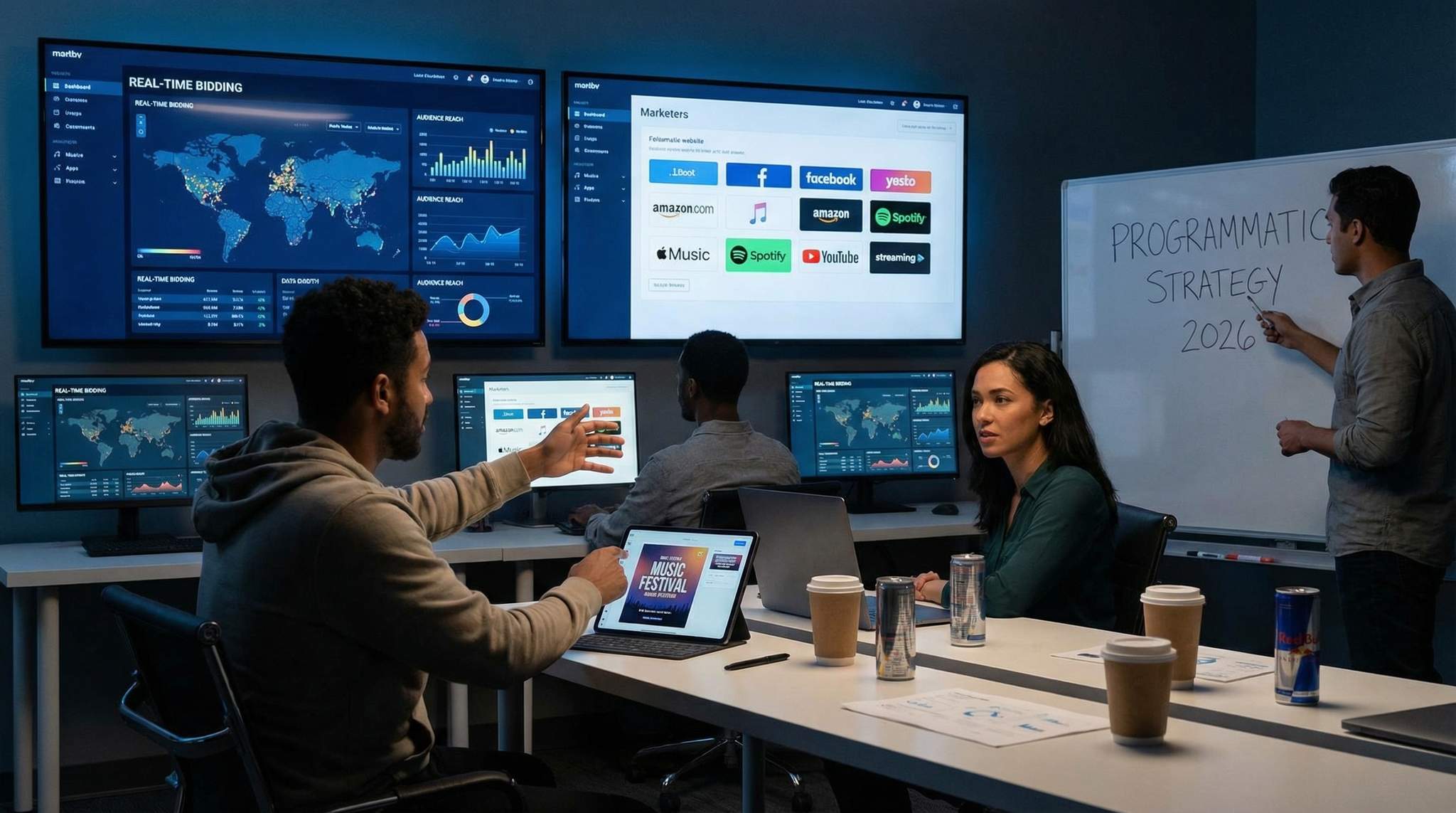
Programmatic advertising isn’t new, but by 2026 it has become the dominant way to buy digital ads. In fact, over 90% of all digital display ads are now purchased programmatically. This automated, data-driven approach lets event marketers use sophisticated targeting data and algorithms to get the best placements at the best prices in real time. Unlike manual ad buying (think negotiating banner placements site-by-site), programmatic uses software and real-time bidding (RTB) to evaluate millions of ad impressions per second and bid on the ones that match your audience criteria. Why does this matter for events? It means even lean event teams can tap into enterprise-level advertising power – letting the machines optimize when and where to show your event ads for maximum impact. As a result, programmatic often delivers more impressions and better targeting at a lower cost than traditional direct buys. Event marketers who embrace this automation gain a huge efficiency edge, freeing up time and budget for other initiatives.
Tapping New Audiences Across the Web
The biggest advantage of programmatic for event promotion is the ability to find new ticket buyers in places you wouldn’t normally advertise. Social media caters to engaged followers, but programmatic can introduce your event to fresh eyes by leveraging data. For example, a music festival can target fans of similar artists as they browse music news sites or use other apps – capturing likely attendees who haven’t yet heard of the event. A B2B conference can target professionals by industry when they read relevant trade publications online. Even local nightlife events can use geo-targeted programmatic ads on popular local websites or weather apps to attract nearby audiences. This data-driven precision ensures your budget goes toward people likely to convert, not random web users. According to event marketing trend reports, using broader programmatic reach in tandem with social campaigns has become a key approach for sold-out events in 2026. In short, programmatic advertising empowers event promoters to reach the right people (ideal attendees) on the right platforms (anywhere on the web) at the right time, dramatically expanding the funnel of potential ticket buyers.
Real Results Prove the ROI
Skeptical that these automated ads actually drive ticket sales? The proof is in the results. Seasoned event marketers cite numerous campaigns where programmatic ads contributed directly to sell-outs. For instance, one 2026 music festival in Atlanta ran a multi-channel marketing campaign that included programmatic display ads – the programmatic portion alone generated over $600,000 in ticket revenue on a $30,000 ad spend, as detailed in a case study on music festival ticket sales. That’s an impressive ~20× return on ad spend (ROAS) from programmatic. In the same campaign, programmatic delivered 1,293 ticket conversions (purchases) by targeting festival-goers across music websites and apps, complementing the even higher returns from social and search ads observed in similar multi-channel campaigns. These kinds of outcomes aren’t outliers; they’re increasingly common as promoters learn to wield programmatic effectively. Experienced event promoters have watched their ROI climb when adding programmatic into the mix – especially for reaching new audiences that don’t respond to other channels. With solid conversion tracking (discussed later) in place, you can see exactly how many tickets your programmatic ads are selling and at what cost, making it easier to justify every pound or dollar of your ad budget according to industry forecasts. In a landscape where marketing spend must prove its worth, programmatic’s trackable ROI is a game-changer for events of all sizes.
Data-Driven Event Marketing
Track ticket sales, demographics, marketing ROI, and social reach in real time. Exportable reports give you the insights to make smarter decisions.
Programmatic Advertising 101: How It Works for Events
Demystifying Programmatic Jargon (DSPs, SSPs, and RTB)
If terms like DSP, SSP, and RTB sound like alphabet soup, don’t worry – the concepts are simpler than they appear. Programmatic advertising basically means using software platforms to buy ads automatically, rather than manually negotiating buys. On one side, you (the advertiser) use a DSP (Demand-Side Platform) to set up your campaign – this is your dashboard for choosing targeting, budgets, and creative for your event ads. Examples of DSPs include Google’s Display & Video 360, The Trade Desk, Amazon DSP, and other ad buying tools; even the Google Ads interface for the Display Network is a basic DSP. On the other side, publishers (websites, apps, streaming services) use SSPs (Supply-Side Platforms) to list their available ad spaces. The magic is in the middle: when a user visits a site or opens an app, an RTB (Real-Time Bidding) auction happens in milliseconds where DSPs bid for that impression if the user matches your targeting. The highest bid wins, and that ad is instantly shown to the user – e.g., your concert banner appears on a music blog page just as the person loads it. All of this happens faster than a blink, across billions of opportunities. The key takeaway: programmatic allows you to access vast ad inventory across the web in an automated fashion, using data to decide which impressions are worth buying for your event.
Why Programmatic Fits Event Marketing
Events have unique marketing needs – they are time-bound, often localized, and targeted to specific interest groups. Programmatic advertising aligns well with these needs because of its flexibility and precision. You can swiftly turn campaigns on or off (perfect for short event sales cycles), ramp up impressions as your event date nears, and geo-target ads to the areas where your potential attendees live or travel. With programmatic, an event promoter can do things like: only show ads during weekends for a nightlife event (using day-parting settings), or blast a last-minute promo to a 50-mile radius around the venue two days before the show. This level of control is hard to achieve with traditional media buys or broad social campaigns alone. Moreover, programmatic platforms often have built-in frequency capping (so you can limit how often the same person sees your ad) and budget pacing tools, which help optimize how your ads are delivered within the short window of your event promotion. Experienced event marketers appreciate that programmatic wastes less money – instead of blanketing an entire metro area with a billboard or untargeted ads, you’re only paying to reach the specific people who fit your demographic, interest, and location criteria. In essence, programmatic gives even a mid-sized event access to the kind of laser-targeted ad capabilities that big brands use, leveling the playing field when you’re trying to sell out a show.
Ready to Sell Tickets?
Create professional event pages with built-in payment processing, marketing tools, and real-time analytics.
Key Players and Platforms in 2026
To get started with programmatic advertising, it helps to know the main platform options available in 2026. Many event promoters go through specialized ad agencies or trading desks to access premium DSPs (especially for large budgets), but there are also self-service tools:
- Google Ads / Display Network – Easiest entry point, using Google’s platform to serve banners and responsive ads across millions of sites in the Google Display Network. It’s essentially programmatic lite, with Google’s AI doing a lot of the heavy lifting (e.g. Performance Max campaigns). You set targeting and let Google find the users.
- Demand-Side Platforms (DSPs) – For more control and multi-channel reach: popular ones include The Trade Desk, MediaMath, Amazon DSP, Adobe Advertising Cloud, and Google Display & Video 360 (the enterprise version of Google’s DSP). These allow access to exchanges that reach virtually every ad-supported site/app (OpenX, Xandr, Index Exchange, etc.). If you’re working with an agency or have an in-house buyer, these are powerful options. They can also get your ads on Connected TV and digital audio platforms via the same interface.
- Social Extensions – Some social ad platforms offer programmatic-like reach beyond their native app. For example, the Meta Audience Network lets you show Facebook-style ads in third-party apps. TikTok’s ad network (Pangle) does similar for outside apps. While not full-fledged DSPs, they extend your reach to mobile apps using the social platform’s data.
- Managed Service Programmatic – If you’re a smaller promoter without in-house expertise, you can use services like StackAdapt, Centro (Basis), or Yahoo DSP where an account rep helps run the campaign or provides a managed interface. These often come with minimum spends (e.g., a few thousand dollars to start). Alternatively, some ticketing platforms or marketing agencies bundle programmatic offerings for event clients.
When evaluating these options, cost efficiency is a major draw. For instance, the advertising CPM for social extension ads is often significantly lower than native in-feed placements. Event marketers frequently notice that while standard Facebook or Meta ads CPM might hover around £8 to £15 depending on the audience, utilizing the Meta Audience Network (a prime example of social extensions) can drop those costs to £2 to £5 per thousand impressions. This makes social extensions a highly cost-effective way to scale reach, provided you monitor placement quality closely.
Leveraging “social extension ads” via Meta (Facebook) or similar networks serves as an excellent stepping stone into broader programmatic advertising for event organizers. Because these extensions utilize the same robust behavioral data found within the native social apps, they offer a hybrid approach: the vast, off-platform reach of programmatic events combined with the familiar targeting interface of social media. When setting up these campaigns, ensure you separate your native feed budgets from your extension budgets to accurately measure the performance of your programmatic advertising event initiatives.
Transitioning from basic “social extension ads” to a fully fledged programmatic DSP is a natural progression for growing event brands. While utilizing the Meta Audience Network or TikTok’s Pangle provides a taste of off-platform reach, true programmatic advertising unlocks access to premium inventory—like Connected TV, digital audio, and high-tier publisher direct deals—that social extensions simply cannot offer. For promoters managing large-scale programmatic events, graduating to a dedicated DSP ensures greater transparency over exact ad placements and more sophisticated frequency capping across the entire open web.
Full Pixel & Analytics Integration
Install Meta Pixel with Conversions API, Google Analytics, TikTok Pixel, Reddit Pixel, and Spotify Pixel on your event pages. Server-side tracking for accurate attribution.
Choose the platform route that fits your budget and skills. Many event marketers start with Google’s Display Network or a modest managed-service test to get their feet wet, then scale up to more advanced DSPs once they see the potential. The main point is that in 2026, technology has made programmatic accessible even to teams without huge ad budgets or dedicated media buyers – if you can set up a Facebook ad, you can transition to setting up a programmatic campaign with a bit of learning and the right partner platform.
Real-Time Bidding in Action (A Day in the Life of Your Ad)
To truly appreciate programmatic, follow one of your ads through its day: In the morning, a 30-year-old music fan in London opens a popular blog on their phone – behind the scenes, their browser triggers an ad request. Your DSP evaluates that user’s profile (age, music interest inferred from their browsing, location in London) and sees they match your targeting for an upcoming EDM show. You’ve pre-set a bid of £3 CPM for users in the UK with music interests. Competing advertisers are bidding too, but your bid wins the auction for that impression because few others specifically target “EDM fans in London” at that moment. Within milliseconds, your event’s banner loads on the site, catching the fan’s eye. Later that day, the same person opens a weather app – again an ad opportunity is auctioned, but this time they’ve already seen your ad twice, and you’ve set a frequency cap of 2 impressions per person per day. So your DSP abstains from bidding, saving your budget for a fresher prospect. Meanwhile, another user – a tech executive in New York – opens a business news site. She fits the profile for your B2B SaaS conference, so your ads (via a LinkedIn targeting integration on the DSP) appear as a native ad in the sidebar. She clicks and registers for your event’s newsletter. All this happens automatically across time zones. By the end of the day, tens of thousands of micro-auctions have taken place on your behalf, and your ads were shown to, say, 50,000 targeted individuals across dozens of sites/apps – all within the audience criteria and budget parameters you set. This always-on, lightning-fast process is what makes programmatic so powerful for event promotion: you achieve massive, precise ad exposure without manual placement and with the system constantly optimizing who sees your message.
Grow Your Events
Leverage referral marketing, social sharing incentives, and audience insights to sell more tickets.
Reaching Beyond Social: Programmatic Channels and Ad Formats
Display Banners Across the Web
The most common format in programmatic event campaigns is the classic display banner ad. These are image or HTML5 ads that appear in designated ad slots on websites and in mobile apps. In 2026, display ads come in many shapes (leaderboards, rectangles, mobile interstitials, etc.), but the purpose is the same – to visually promote your event with eye-catching graphics and a clear call-to-action (e.g. “Book Tickets for SummerFest 2026 ?”). Programmatic display is excellent for building awareness among broad audiences. For example, a festival promoter might run banners on music review sites, lifestyle blogs, or local news pages, ensuring anyone reading about nightlife or entertainment in the region sees the festival ad. The reach is vast: through programmatic, you can get placement on millions of sites – far beyond what you could negotiate individually. It’s important to prepare a set of standard banner sizes (e.g. 300×250, 728×90, 320×50, etc.) to cover the inventory out there. Many DSPs allow responsive ads too, where you upload an image, logo, and text and the system auto-sizes it. Display banners are relatively affordable (cost per thousand impressions, CPM, can range from a few £ to £10+ depending on targeting). For event marketers, this channel is a cost-effective way to saturate your local market or target demographic with your event imagery and message. Just remember: since banner ads are visual, invest in high-quality design – use vibrant event photos, artist images, or branding that pops, and include critical info like event name, date, location, and a ticket purchase button or URL. Display ads may not always get high click-through rates (~0.2–0.5% is common), but they create numerous touchpoints that drive people to search for your event or click later when retargeted, ultimately boosting ticket sales indirectly and directly.
Mobile In-App Ads and Geo-Targeting
By 2026, a significant portion of internet traffic (and ad impressions) is on mobile devices. Programmatic advertising reaches not just mobile web browsers, but also within mobile apps – think of banner or interstitial ads in a weather app, a mobile game, or a navigation app. These in-app ads are prime real estate for event promotion, especially with geo-targeting. For example, a nightclub promoter can geofence a 10-mile radius around their city and serve in-app ads for their DJ night, so that anyone using popular apps in that area might see the invitation. If you’ve ever been in a new city and suddenly noticed ads for local events popping up in your apps, that’s programmatic geo-targeting at work. It’s incredibly useful for regional events – county fairs, city concerts, theater shows – because you can concentrate spend on people physically near the venue (or in markets from which people travel to your event). Mobile ads can also leverage device data like location history and even real-time location (with privacy-safe methods) to target people currently at a relevant location (for example, promoting a sports event to people currently inside a sports equipment store). The key to success here is matching the message to the moment – use concise, mobile-friendly creatives (“Rock Concert this Saturday – 5 miles away – Tickets on Sale!”) and strong calls-to-action that encourage immediate response. Also, ensure your ticketing site or landing page is mobile-optimized since you’re driving mobile traffic; nothing loses a sale faster than a clunky mobile checkout. In-app programmatic ads are typically bought on a CPM basis similar to display, but some networks offer CPC (cost-per-click) buys for performance-oriented campaigns. With the right geo-targeted approach, mobile programmatic can translate into foot traffic and ticket scans on event day.
If your event caters to younger demographics, understanding the mobile app publisher eCPM in 2026 is vital for Gen Z targeted ads. Because Gen Z spends a disproportionate amount of time in gaming, social, and entertainment apps, publishers in these categories often command varying effective cost-per-mille (eCPM) rates based on user engagement. To win these auctions without overspending, event promoters must bid strategically, balancing the higher eCPM of premium Gen Z apps against the sheer volume of cheaper, hyper-casual gaming inventory.
Video and Streaming Platform Ads (OTT/CTV)
Smart Promo Codes & Presale Access
Create percentage or flat-rate discount codes with usage limits, date ranges, and ticket type restrictions. Plus unlock codes for private presales.
Native Ads and Content Discovery
Another channel within programmatic is native advertising – ads that blend in with the content format of the site (often appearing as “recommended articles” or in-feed content). For events, native ads can be used to promote content about your event, rather than a direct “Buy Tickets” pitch. For example, you might have a blog post like “10 Reasons You Can’t Miss XYZ Festival this Year” or a news piece announcing your event lineup. Through native ad networks (like Taboola, Outbrain, or programmatic native via DSPs), you can amplify this content to readers on major news sites and blogs. The ad might appear at the bottom of an article as a recommended reading, with a headline and thumbnail that you craft. The benefit is that native ads often get higher curious clicks because they look like editorial content. A well-written piece can persuade readers and warm them up to buying a ticket. During campaign season, some event marketers allocate a portion of budget to native ads to drive traffic to long-form content – educating the audience on the event’s value proposition (artists, speakers, unique experiences) – and then retarget those readers later with direct ticket ads. It’s a one-two punch in the funnel: native for awareness/consideration, display/video for conversion. Keep in mind, native ad success depends on having quality content that truly engages; clickbait may get clicks but won’t necessarily convert to sales. Measure time on site and eventual ticket purchases from those who came via content. If done right, native programmatic placements can subtly build desire for your event in a way a banner “Buy Now” might not, especially for higher-priced events where attendees research before purchasing.
Programmatic Ad Formats & Channels – At a Glance
| Format / Channel | Description | Best Use for Events | Tips |
|---|---|---|---|
| Display Banners | Image or HTML5 ads on websites/apps | Broad awareness; reinforce branding & info | Use striking images, clear event details, CTA |
| Mobile In-App | Ads within mobile apps (banners, interstitials) | Local/regional targeting via geo; on-the-go reach | Keep it short & bold for small screens; ensure mobile-friendly landing pages |
| Video (Online & CTV) | Short video commercials before/during content | Immersive storytelling; showcase event vibe | Hook viewer in 3 seconds; include event name/date verbally and on-screen |
| Streaming Audio | Audio spots on music/podcast platforms | Hands-free reach; great for driving website searches (radio-style) | Use clear voiceover with event name and URL; consider companion display banner if platform allows |
| Native Content | In-feed or recommended content ads | Educating & exciting potential attendees via articles or listicles | Headline should create curiosity; content must deliver value (don’t oversell) |
Each of these channels can be accessed through programmatic buys, often in the same DSP interface. A well-rounded event campaign in 2026 might utilize multiple formats – for example, banners and native ads during early announcement phase for awareness, video ads closer to the event to drive urgency and FOMO, and mobile geofenced ads in the final week to pick up last-minute buyers. In planning your media mix, consider your audience’s media habits: if you target young adults, short-form video ads (even on TikTok or YouTube via programmatic) might be key; for a professional conference, native ads on LinkedIn or business sites plus retargeted display could work best. The beauty of programmatic is you can experiment with many formats and see which yields the best engagement and conversions for your specific event.
Data-Driven Targeting: Finding Your Ideal Attendees Online
Defining Your Target Audience (Who Are Your Ideal Ticket Buyers?)
Successful programmatic campaigns start with crystal clear audience definition. Before you even log into a DSP, define who you want to reach in detail. Traditional event marketing asks “Who would attend my event?” Programmatic lets you break that down into specific data points: demographics (age, gender), location, interests, behaviors, and even device usage. For example, “Females 25-40 in Los Angeles who are interested in electronic music and have attended music festivals” could be one segment for a festival campaign. Or “IT managers in the UK interested in cybersecurity content” for a B2B tech conference. The more precisely you outline your ideal attendees, the better you can leverage programmatic’s targeting options. Experienced event marketers often start by analyzing past attendee data – if you have access to previous ticket buyers’ profiles (from your ticketing platform or surveys), look at the common traits. Did you attract mostly college students? Corporate professionals? Travelers from certain regions? These insights will inform your targeting. Remember to consider multiple segments: an event might have a primary core audience (e.g., hardcore fans) and secondary audiences (casual attendees or related interest groups). You can craft different targeting profiles for each. For instance, a Comic Con might target comic book fans in one segment, sci-fi movie fans in another, and families (for the kid-friendly day) in a third. Each gets its own tailored ad creatives later. By clearly defining segments upfront, you’ll avoid the common failure of “spray and pray” marketing that wastes budget on the wrong crowd – a mistake highlighted in lessons from event promotion failures in 2026, where poor audience targeting led to disappointing ticket sales. In programmatic, precision is power – know your audience, then let the data find them.
Leveraging First-Party Data and CRM Lists
One of the most potent weapons in programmatic targeting is your own data. First-party data refers to information you’ve collected directly – past attendees, email subscribers, website visitors, contest entrants, etc. In a post-privacy-update world (with cookie restrictions and GDPR), first-party data is gold for advertisers moving beyond experimentation for event marketers. Uploading this data to your programmatic platform can unlock highly efficient targeting. For example, you can take a list of last year’s attendees (emails or phone numbers) and create a **Custom Audience** – the DSP will attempt to match those to users (often via device IDs or hashed emails) and you can then exclude them (if your goal is to find new attendees) or include them (if you’re retargeting for loyalty or upsells). Many promoters use CRM targeting to retarget past attendees with special offers (“Welcome back! Loyalty discount for you”) or to exclude current ticket-holders from seeing ads (no sense wasting budget advertising to someone who already bought a ticket). Another use: if your Ticket Fairy dashboard or Google Analytics shows a list of people who started checkout but didn’t complete (abandoned carts), you can retarget those via programmatic ads saying “Oops, did something go wrong? Complete your ticket purchase for XYZ event.” Modern ticketing platforms (like Ticket Fairy) make it easy to embed tracking pixels on your event pages to optimize sales conversions, so you can build these remarketing pools automatically based on site behavior (e.g. pixel fires on view of the ticket selection page). Case in point: A conference in 2026 used first-party data to great effect – they uploaded their email list of past attendees into a DSP and targeted those people with early-bird ads for the new conference date. The result was a high click-through and conversion rate from those known fans, at a fraction of the cost of finding a cold audience. The takeaway: activate your existing audience data in programmatic campaigns. It’s permission-based and privacy-compliant when done with proper consent, and it often produces *above-average ROI* because you’re marketing to folks who already know your brand.
Leveraging First-Party Data and CRM Lists
One of the most potent weapons in programmatic targeting is your own data. First-party data refers to information you’ve collected directly – past attendees, email subscribers, website visitors, contest entrants, etc. In a post-privacy-update world (with cookie restrictions and GDPR), first-party data is gold for advertisers moving beyond experimentation for event marketers. Uploading this data to your programmatic platform can unlock highly efficient targeting. For example, you can take a list of last year’s attendees (emails or phone numbers) and create a Custom Audience – the DSP will attempt to match those to users (often via device IDs or hashed emails) and you can then exclude them (if your goal is to find new attendees) or include them (if you’re retargeting for loyalty or upsells). Many promoters use CRM targeting to retarget past attendees with special offers (“Welcome back! Loyalty discount for you”) or to exclude current ticket-holders from seeing ads (no sense wasting budget advertising to someone who already bought a ticket). Another use: if your Ticket Fairy dashboard or Google Analytics shows a list of people who started checkout but didn’t complete (abandoned carts), you can retarget those via programmatic ads saying “Oops, did something go wrong? Complete your ticket purchase for XYZ event.” Modern ticketing platforms (like Ticket Fairy) make it easy to embed tracking pixels on your event pages to optimize sales conversions, so you can build these remarketing pools automatically based on site behavior (e.g. pixel fires on view of the ticket selection page). Case in point: A conference in 2026 used first-party data to great effect – they uploaded their email list of past attendees into a DSP and targeted those people with early-bird ads for the new conference date. The result was a high click-through and conversion rate from those known fans, at a fraction of the cost of finding a cold audience. The takeaway: activate your existing audience data in programmatic campaigns. It’s permission-based and privacy-compliant when done with proper consent, and it often produces above-average ROI because you’re marketing to folks who already know your brand.
Grow Your Social Following With Every Sale
Require social media follows, shares, or playlist adds to unlock presale access or special pricing. Turn every ticket purchase into audience growth.
Lookalike Segments: Expanding to New Prospects
After tapping into your first-party data, the next step is to reach people who resemble your audience – this is where Lookalike Audiences come in. Similar to how Facebook Ads allows lookalikes, many DSPs and data management platforms will take a seed audience (e.g., your list of 5,000 prior ticket buyers) and analyze thousands of data points to find other consumers who “look” similar in behavior and profile. The algorithm might consider factors like similar sites visited, purchase history, demographic patterns, etc., all privacy-safe and anonymized. When you create a lookalike segment, you’re essentially saying “find me more people like my best customers.” For an EDM festival, a lookalike might uncover new ravers who haven’t attended your event yet but have similar music streaming habits and website visitation patterns as your past attendees. This technique vastly extends your reach without sacrificing relevance – it’s a data-driven way to go beyond your known circle and find fresh ticket buyers. In practice, you might instruct the DSP to build a 1% lookalike (the top 1% of the population most similar to your seed) for precision, or a broader 5% lookalike for scale. Many event marketers start with narrower lookalikes for efficiency, then broaden out as needed. Real campaign example: a large UK music festival in 2025 built lookalike audiences from their prior ticket buyers and found it delivered 3× higher conversion rates than interest targeting alone (essentially because the lookalikes were highly predisposed to live music events). They combined this with TikTok ads targeting Gen Z, which ended up yielding nearly 50% lower cost per acquisition than their Meta ads—a trend experienced event marketers recognize – illustrating how identifying the right people through lookalikes and the right channel can dramatically improve results. The key is to have a good seed list – quality (e.g., 1,000 true fans who bought tickets) is better than sheer quantity of mixed-quality leads. Once your lookalike audience is ready, make sure your creatives speak to them in a way that will grab someone who maybe hasn’t heard of your event but shares traits with your fans.
Contextual and Interest-Based Targeting
Beyond audience identity data, programmatic also allows targeting based on context (the content being viewed) and declared interests. Contextual targeting is essentially placing your ads in relevant environments. For example, you can instruct your DSP to only show your ad on webpages or app content that contain certain keywords or categories – a jazz festival might target pages that have “jazz” or “music review” content, a startup pitch competition might target tech news sections. This way, you reach people at the moment they are consuming related content, which can be great for alignment. It doesn’t rely on who the user is, just what they’re looking at. In a world of increasing privacy, contextual targeting has made a comeback because it doesn’t require personal data – you’re targeting topics, not people directly. Meanwhile, interest-based targeting (or behavioral targeting) uses data providers to reach users who have shown a specific interest or behavior online. Data companies aggregate things like “people who frequently travel internationally” or “auto intenders” or “rock music enthusiasts” based on browsing and purchase history. Through programmatic platforms, you can buy these segments to target. For instance, an extreme sports event could target a segment of “outdoor adventure enthusiasts” so their ads show to that crowd across many sites, even if the site’s content isn’t about sports. Keep in mind that third-party data (interest segments) quality can vary, and with cookie rules tightening, some older data might be less reliable in 2026. Still, many DSPs partner with reputable data providers for fresh segment data. Pro tip: Combine contextual + interest for a one-two punch. For example, target “music lovers” data segment and only show on “entertainment” category sites – this ensures a high relevance context to reinforce the user’s predisposition. However, use layered targeting carefully; too many restrictions can shrink your scale too much. A/B test different strategies: one campaign using lookalikes, another using contextual, a third using a broad interest group, and see which yields better ticket purchase rates. Veteran event marketers often find that contextual targeting for niche events (like targeting niche content for a niche event) can outperform broad interest data because the intent is higher when someone is actively reading about that topic.
Geo-Targeting and Local Precision
For events, location is everything. Programmatic excels at geo-targeting, letting you pinpoint exactly where your ads should (or shouldn’t) serve. Are you promoting a festival that people would fly to internationally? You might target major cities where your target demo lives (e.g., ads in London, Berlin, Los Angeles, Sydney for a destination festival) and exclude regions that are unlikely to travel. Conversely, for a community theater production, you might geo-target only within a 30-mile radius of the venue, because those are the people likely to attend. With programmatic, you can get as granular as postal codes or even real-time geo-fencing (targeting a radius around a specific latitude/longitude). Some cool use cases the pros use:
- Geo-Fencing Competitor Events: Have a rival festival or a big concert in town a month before yours? Target the venue’s coordinates during those event days – as attendees use apps at that location, they could see your ad for your upcoming event (“Loved this show? Don’t miss Ours in August!”). This can convert known event-goers to your audience.
- Tour Stop Targeting: If you’re promoting a multi-city tour, programmatic lets you easily duplicate campaigns with different geo targets for each city. Each city’s ads only show in that city during its on-sale window, then you shift budget to the next city.
- Exclusion Zones: If your event draws regionally but not from, say, the far side of the country, you can exclude certain states or regions to avoid spending budget where conversions are unlikely. One EDM promoter learned the hard way that not geo-restricting his campaign led to a chunk of his budget serving impressions overseas (due to interest targeting picking up foreign fans of the headliner) – those impressions got clicks but almost zero conversions, essentially wasting spend. After adding geo filters to just the UK and nearby countries, his click-to-ticket conversion jumped dramatically.
The rule of thumb is to target as tight as makes sense for your event’s draw. If unsure, start a bit broader but monitor where ticket buyers actually come from (your analytics can tell if conversions are happening in certain cities). Then refine your geos to concentrate on high-performing areas. In 2026, many programmatic platforms allow multi-touch attribution by geo, meaning you can see if users in London needed fewer ad impressions to convert than users in Manchester, for instance, which might indicate stronger organic awareness in one city. Use those insights to budget accordingly (more ads in places with higher cost per conversion, fewer in the organic hotspots). Geo-targeting is truly where event marketing and programmatic shine together – it ensures the right people in the right place hear about your show.
Frequency Capping and Avoiding Ad Fatigue
When you’re excited to promote an event, it’s tempting to show your ad as often as possible – but more exposure isn’t always better. Seeing the same ad too many times can annoy potential attendees and even turn them off your event. That’s why frequency capping is a crucial setting in programmatic campaigns. A frequency cap limits the number of times a single user will see your ad within a given time frame (per day, per week, or overall). Experienced advertisers often set caps like 3 impressions per user per day for prospecting campaigns and maybe 5-6 per day for retargeting (where the user is already interested, like they visited your site). The goal is to balance ad recall (you generally need multiple touchpoints to drive action) with overexposure (where marginal returns drop or negativity rises after too many views). For example, one festival promotion campaign initially had no cap and some keen internet users saw the same banner 20+ times in a week – the promoter received a few social media complaints like “I’ve seen this ad everywhere, enough already!” That’s not the buzz you want. After capping at 5 per week, they found users were still clicking and converting, and complaints disappeared.
Programmatic tech allows you to cap across all channels, so a user might see your video ad twice and your banner once, then be done. It’s wise to also cap per format if your DSP allows – maybe 2 video impressions and 3 display impressions per user, since people tolerate seeing different creatives more than the exact same one repeatedly. Also consider ad fatigue over the campaign lifespan: if you run the same creative for 3 months, even at a low frequency per week, your core audience might tire of it. That’s why refreshing creatives or rotating multiple versions is recommended (more on creative testing later). A/B testing different frequency strategies can be illuminating. Some data might show that conversions per user actually peak after, say, 3 impressions and then flatten – use that to guide your cap. Insider tip: As your event date nears and you enter the “last chance” sales phase, you might temporarily relax frequency caps for retargeting campaigns. Since urgency is high, showing an undecided visitor the same “Only 2 days left to buy tickets!” ad a few extra times in those final days could push them over the line (without too much annoyance because the message is immediately relevant and time-sensitive). In fact, ethical use of urgency and FOMO in marketing suggests that repetition of an urgent deadline can spur action if done in moderation. So, implement smart frequency capping to spend your budget efficiently – enough views to persuade, but not so many to irritate – and adjust as needed by campaign stage.
Built-In Email Marketing for Events
Send targeted campaigns, automated purchase confirmations, and post-event follow-ups directly from your ticketing dashboard.
Step-by-Step: Setting Up a Programmatic Event Campaign
Step 1: Set Clear Goals and KPIs
Every successful campaign begins with clear objectives. Ask yourself: What am I trying to achieve with these programmatic ads? Common event promotion goals include:
- Ticket Sales (Conversions) – e.g., directly selling 500 tickets via ads, or hitting a target ROAS (Return on Ad Spend) like 5:1.
- Leads/Signups – e.g., collecting email RSVPs or waitlist signups if you’re in a pre-sale phase.
- Awareness & Reach – e.g., getting your event in front of 1 million targeted eyeballs to boost overall awareness (often measured via impressions, views, or uplift in branded search volume).
- Engagement – e.g., driving traffic to your event page or content, or getting video views if you have a teaser trailer (with the assumption that engagement will later translate to ticket sales through other channels).
Define Key Performance Indicators (KPIs) matching your goal. If sales are the goal, your KPIs might be number of tickets sold via the campaign, cost per acquisition (CPA) per ticket, and ROAS. If awareness, a KPI could be number of impressions served to the target demographic and maybe post-view traffic lift. Having these KPIs will guide how you set up tracking and optimization. For example, if sales are the main goal, you’ll want to ensure conversion tracking is in place (more on that later) and maybe use an automated bidding strategy that optimizes for conversions. If you have secondary goals (like awareness leading to sales), you might run a mix of campaigns – some optimized for clicks/views, others for conversions – each with their own KPIs. It’s also important to align the campaign’s timeframe with goals: a campaign timeline for events usually has phases (early awareness, on-sale push, last-minute push), and your goals may evolve across these. Perhaps initial campaigns focus on traffic and engagement (to build retargeting pools), whereas later campaigns focus squarely on conversions. Write down these goals and share with your team or any agency helping out, so everyone knows what success looks like. And for each KPI, if you have historical benchmarks or industry benchmarks, note them. E.g., “We aim for a $20 CPA per ticket, because last year’s search ads were around $15 and we’re willing to pay slightly more for new reach.” Setting clear goals will not only shape your strategy but will also justify your budget to stakeholders by tying spend to expected outcomes (essential for proving event marketing ROI internally).
Step 2: Choose the Right DSP or Platform
With goals in hand, decide where to run your programmatic campaign. As discussed earlier, you have options from self-service to managed DSPs. For newcomers or smaller budgets, starting with a familiar platform like Google Ads (using Display Network or Discovery campaigns) might be easiest – it has lower barriers and integrates with Google Analytics well for conversion tracking. If you have a bit more budget or an agency partnership, consider using a dedicated DSP (like The Trade Desk or Basis) where you’ll have more inventory access (including video/CTV, more data providers) and fine-grained controls. If your event is B2B or very professional-audience focused, you might even start on LinkedIn Ads for a portion of programmatic-like targeting on their Audience Network, or combine LinkedIn with a DSP to catch those professionals off LinkedIn too. One strategy seasoned event advertisers use is a hybrid approach: for instance, allocate some budget to Google’s ecosystem (Display & YouTube) and some to a DSP to reach additional exchanges and channels. Be mindful of budget minimums – some DSPs require a few thousand in spend to really optimize or even to enable certain channels like CTV. For example, if you want to do a Connected TV push, you might need to commit at least $5k+ on that channel to access certain premium inventory. Ensure the platform aligns with your creative formats too. If you have killer video ads, make sure your platform choice can serve video (most can, but some simplified tools might be display-only). Also, assess the support and tools: does the platform offer an intuitive dashboard? Do you have a rep or community to ask questions? Is there AI optimization available that you can leverage (many modern DSPs have AI that will auto-optimize bids towards your goal)? Don’t be afraid to ask for a platform demo or trial – many vendors in 2026 are competitive and will give you guidance if they know you’re considering them. The bottom line: pick a platform that matches your needs (budget, channels, ease of use), and get access set up. This might involve creating an account, entering billing info, and possibly inserting some tracking code on your site (some DSPs have their own universal pixel). With your platform ready, you’re set to build the campaign.
For larger event portfolios, the programmatic advertising DSP selection factors a media director must weigh in 2026 go beyond basic usability. Key considerations now include direct integrations with major ticketing platforms, transparent fee structures (avoiding hidden tech taxes), access to premium omnichannel inventory (like DOOH and CTV), and robust identity resolution capabilities that don’t rely on third-party cookies. Choosing a DSP that aligns with these advanced factors ensures your event marketing infrastructure is future-proofed.
Understanding programmatic advertising platform pricing fee structures in 2025 and 2026 is essential for protecting your event’s marketing ROI. DSPs typically charge either a flat technology fee (a percentage of media spend, often ranging from 10% to 20%) or operate on a hidden margin model where the platform marks up the inventory cost. For independent promoters and venue operators, transparent percentage-based fee structures are generally preferable, as they allow you to see exactly how much of your budget is going toward working media versus software costs. Always ask potential platform partners to clarify their minimum monthly ad spends and any additional costs for premium data segments or cross-device identity graphs.
Step 3: Set Up Conversion Tracking and Analytics
Before launching any ads, configure your tracking – this step is absolutely critical to measure success and optimize. Conversion tracking typically entails placing a pixel or tag on your event website or ticketing page to capture when a user buys a ticket (or completes whatever goal action you set, like filling a form). For ticket sales, ideally you track the purchase event and revenue amount. Many advertising platforms allow you to input the value of tickets sold so you can directly see revenue in the dashboard (Ticket Fairy’s platform, for instance, can pass back the purchase value to your tracking pixels to confirm ticket sales data). If you’re using Google Ads, you might set up conversions via Google Analytics or use Google’s global site tag on the checkout confirmation page. If on a DSP, you’ll use their pixel and likely set it to fire on the “Thank You for your purchase” page. Additionally, consider implementing a Server-to-Server Conversion API (like Facebook’s Conversion API or similar for other DSPs) if available, which sends purchase data from your server to the ad platform. This can bypass issues like ad blockers or iOS opt-outs that might cause the browser pixel to miss a conversion, a challenge often seen with standard pixel tracking. For example, TikTok Ads in 2026 often use the Events API to ensure conversions are tracked even if the pixel is restricted by privacy settings using server-side solutions – programmatic DSPs are moving the same way, offering server-side tracking for better accuracy.
Free Tool: How Much to Spend on Marketing
Ticket price × capacity × sell-through target produces recommended budget and a channel split (paid social, search, email, PR) based on event type.
Moreover, set up analytics funnels to track the customer journey: use Google Analytics (GA4 by 2026) to see how users from your ad campaigns behave. Tag your campaign URLs with UTM parameters (e.g., utm_source=programmatic&utm_campaign=EventName2026) so you can identify that traffic in Analytics. This will help you see not just the last-click conversions, but also if programmatic traffic is contributing to awareness (like people coming back via search or direct later – a common scenario). Many event marketers utilize multi-touch attribution modeling or at least look at view-through conversions – people who saw an ad and didn’t click, but later came and bought a ticket. Your DSP should report view-through conversions (usually within a 1-day or 7-day window). Include those when evaluating total impact, as programmatic ads often assist in the conversion even if the final step might happen via direct website visit. Set up appropriate attribution windows in the platform (e.g., count a conversion if within 7 days of click or 1 day of view by default, adjust as needed for your sales cycle length). Finally, make sure to test the tracking: do a dry run where you simulate a purchase with the pixel enabled (some platforms provide a Pixel Helper tool or test mode). Verify that conversions show up in the platform dashboard. Only when your tracking is reliably capturing data should you proceed – flying blind with no tracking is a recipe for wasted spend because you won’t know what’s working.
Step 4: Craft Your Ad Creatives (Multiple Versions)
Now the fun part – creating the ads that people will actually see. In programmatic, you often need a suite of creatives to cover different formats and to test what works best. Start by aligning creative with each audience segment or messaging angle you plan to use. For example, if you have a few audience segments (say, “loyal fans”, “newcomers”, and “VIP upscale buyers”), you might tailor creatives slightly for each. At minimum, have several banner variations: different images, text, or color schemes. Perhaps one focuses on the headline artist or keynote speaker (to grab fans of that person), another focuses on the overall experience (crowd shot or venue). Include your event name, date, and location prominently. For banners, often a short text like “Tickets Available” or “Book Now” helps drive action, whereas a purely branding message might not prompt a click.
For video creatives, keep them snappy – 15 to 30 seconds at most for pre-roll or in-feed video ads. Front-load the excitement (crowd cheering, amazing visuals, or a compelling question) in the first 3 seconds to hook viewers who have twitchy skip-fingers. Ensure branding is present early (don’t hide your event name until the end) and have a clear call-to-action at the end, either spoken or in text (e.g., “Get Tickets at TicketFairy.com”). If doing audio ads, write a script that is clear, energetic, and mentions the event name and where to get tickets at least twice.
Prepare all the required ad specs: if using a DSP, upload in recommended sizes for display (common ones: 300×250, 728×90, 160×600, 320×50, 300×600, etc.) and lengths/ratios for video (like 16:9 and perhaps 1:1 or 9:16 if doing any mobile feed video). Many programmatic buys can also use HTML5 animated banners or rich media, so if you have an interactive banner (maybe one that scrolls images of artists), that can be used to stand out. Just test it to ensure it works on multiple devices. It’s wise to also produce a few text-based native ads if you plan to use any native channels – these usually require a headline (e.g., “5 Reasons EDM Fest 2026 Will Blow Your Mind”), a thumbnail image, and short description. The more creative assets you provide the platform, the better it can optimize. In fact, some DSPs and Google’s Display can do dynamic creative optimization (DCO) where they auto-combine images and text you give to find the best performer.
Don’t skip on the call-to-action (CTA) in your design. Whether it’s a “Buy Tickets” button on a banner or a voiceover saying “Visit our site to secure your spot,” make sure the viewer knows what to do next. And double-check that the landing page/URL is correct and active – oftentimes it’s best to drive clicks directly to your ticket purchase page or a highly relevant landing page (e.g., if you have multiple events, take them to the specific event page, not just your homepage). One pro tip: Use urgency or limited availability cues ethically – for example, “Early Bird Prices Until 1 May” on the creative can boost conversion rates by giving a timely reason to click, leveraging event data analytics. Just ensure you actually honor those deadlines. Another example, if you’re near sell-out: “90% Sold Out – Get Your Tickets Now!” can spur action (FOMO is real!). A/B test these messages to see what resonates.
Finally, localize creatives if you have different markets. A festival running in multiple countries might have one ad version with pricing in local currency or using local language/slang for each region to better connect. Regularly rotating new creatives (fresh design or updated copy) every few weeks is ideal, since even a capped user might ignore a banner they’ve seen a dozen times over a month. Keeping the ads “fresh” can maintain interest and also let you highlight different selling points (one week push VIP tickets, next week push general on-sale, etc.). As you launch, be ready to swap out any ad that underperforms – the data will quickly tell which creatives have higher click-through or conversion rates.
Step 5: Configure Campaign Settings – Budget, Bids, and Schedule
With your platform ready, tracking set, and creatives in hand, you can now build the campaign in the DSP. Create a new campaign (or line item/ad group depending on platform structure) for your event. Name it clearly (e.g., “SummerFest2026 Programmatic – Lookalike Audience” or similar) for tracking. Then set the budget and schedule: decide how much you want to spend and over what time. If your event is months away, you might have an always-on schedule with a monthly or total budget cap. Many event promoters budget heavier as the event approaches – for example, spend 30% in the early phase and 70% in the last 4-6 weeks when urgency is higher and people tend to buy tickets, maximizing seamless multi-channel campaigns. You can set daily budgets or lifetime budgets. It’s often wise to use daily budgets to prevent overspend if something unexpected happens (like one audience eating up budget too fast due to high bids). E.g., £100/day initially, then perhaps increase to £200/day in final weeks. Ensure the schedule end date is the day of or day before your event (no point running ads after the event is over, unless you plan a post-event campaign for something else).
Next, set your bid strategy. Many platforms offer automated bidding now (e.g., “optimize for conversions at lowest CPA” or “target ROAS”). If you have conversion tracking working and enough expected volume, these can be useful – essentially, the AI will adjust bids user-by-user trying to hit your goal. If using such strategies, you often set a target CPA or ROAS. For instance, if each ticket is £50 and you want a 4:1 ROAS, you’d want CPA around £12.50, so you might set that as a target CPA. Be realistic – if you have no historical data, you might start with an attainable CPA and adjust. Alternatively, you might choose manual bidding or simple CPM bidding, especially if your goal is awareness or you don’t trust the automation yet. For manual CPM bidding, the platform may suggest a range. A good practice is to start modestly (say, a £3–5 CPM for general display) and see if you win impressions. If you’re not getting much delivery, increase the bid. For premium inventory like CTV, be prepared for higher bids (£20+ CPMs). Monitor “win rate” metrics if available – that shows how often your bid won the auction out of all opportunities; if it’s very low, your bid may be too low or your targeting too narrow.
Now, targeting settings: choose the geography (as detailed earlier, pick your cities/regions and exclude others if needed), the demographics (age/gender if applicable – although many DSPs rely more on interest data than declared age/gender, but you can often exclude under 18 if your event is 18+ for instance). Then set up the audience targeting: here you’ll select those lookalike audiences, interest segments, or contextual keywords you prepared. It’s often wise to separate different targeting tactics into different ad groups or line items. For example, have one line item for “Retargeting past website visitors,” another for “Lookalike new prospects,” and another for “Contextual music sites.” This way you can allocate budget or see performance for each. Otherwise, if you lump everything together, the platform will favor one and you won’t know which was truly better. Also, ensure you layer targeting appropriately: if you put multiple criteria on one line (e.g., an interest + a geo + an age + a contextual keyword), know if it’s using AND logic (most DSPs do, meaning all conditions must be met) or OR logic. Usually it’s AND within a single targeting category and OR across different categories by default, but confirm. Simpler approach: use one primary targeting method per campaign to keep it clean.
Finally, apply frequency caps as discussed. For instance, set 3 impressions per user per day for prospecting campaigns, and maybe 10 per user total over the campaign duration for that line item (some DSPs let you cap for the life of the campaign as well). For retargeting segments, you might allow a higher cap since those people are more important to reach repeatedly. Also decide on day-parting if relevant: if your audience is most active in evenings (maybe nightlife event folks), you could choose to only serve ads from say 5pm to midnight each day to save budget for prime hours. B2B event ads might perform better on weekdays during office hours versus weekends. These can be adjusted later once you see data, but it’s good to think about. One promoter of a finance conference found almost all his conversions from ads happened Mon-Fri 9am-6pm, so he turned off weekend delivery to avoid inefficient spend. With all these settings configured, upload your creative assets into the campaign, associating each with the proper line item or ad unit.
How to Run Affordable Programmatic Advertising Campaigns at Scale
A common challenge for independent promoters is figuring out how to run affordable programmatic advertising campaigns at scale in 2025 and 2026. The secret lies in aggressive placement filtering and dynamic bidding. Instead of bidding high across all inventory, start by targeting lower-cost, high-viewability ad slots on niche publisher sites that index highly for your specific attendee demographic. As your pixel gathers conversion data, use algorithmic bidding to automatically scale spend only on the specific domains and apps driving ticket sales. Additionally, utilizing frequency capping and excluding existing ticket holders from your audience pools ensures that every dollar spent goes toward acquiring net-new attendees, allowing you to scale your reach without proportionally inflating your budget.
Step 6: Launch and Monitor Closely
Double-check everything – targeting, budget, dates, creative previews, tracking – and then launch your campaign. Once live, the work isn’t over (in fact, it’s just beginning in terms of optimization). In the first 48-72 hours, watch the campaign like a hawk. Programmatic campaigns often have a learning period for the algorithms to calibrate, so don’t panic if day 1 doesn’t bring a flood of sales. However, keep an eye on a few early indicators:
- Impression Delivery: Are you serving the number of impressions expected? If it’s much lower, you might have too narrow targeting or too low bids. If zero, something’s wrong (possibly an approval issue or a misconfigured setting).
- Click-Through Rate (CTR): This will tell you if your ads are resonating enough to get clicks. If CTR is extremely low (say 0.05%), your creative or targeting may be off. Different formats have different norms (display maybe ~0.2%, native 0.3-0.5%, video might track view-through more than clicks). Early on, identify the top-performing creative – maybe one banner has double the CTR of another. You can start reallocating more impressions to it by pausing the poorer one.
- Cost per Click (CPC) or CPM: Check if you’re paying what you expected. If CPC is sky-high (e.g., £5 per click on a banner), you might be in a very competitive audience segment; perhaps broaden targeting or optimize creative. If CPMs are creeping above your bid, see if limited inventory is causing auto-bid to raise. Also ensure you’re on budget – not overspending due to pacing or underspending (if underspending, you might loosen some constraints to let more delivery happen).
- Early Conversions: Depending on your sales cycle, you might see some purchases within days. If you already set up retargeting, those may come faster. Note the cost per conversion you’re getting and how it compares to your goal. It might start high and then drop as the algorithm optimizes who it shows ads to (if using conversion optimization). One promoter’s campaign started at $60 per ticket conversion in week 1 and gradually fell to $20 per conversion by week 3 as the DSP learned which users were likely to buy. The key is it was trending in the right direction.
Use your DSP’s reporting dashboard and if possible, integrate with Google Analytics or your ticketing dashboard to see the whole picture. For example, you might notice lots of people coming to the site but not converting – which could indicate an issue with the landing page or ticketing site (maybe it’s slow or confusing for mobile users). This is where checking your funnel metrics (click to add-to-cart to purchase drop-offs) is critical. If needed, make quick fixes to the landing experience – e.g., simplify the page, add a more obvious “Buy Now” button, etc., to boost conversion rate. Remember, turning clicks into tickets is just as important as getting the clicks, based on firsthand experience with omnichannel strategies. If you see traffic but no checkouts, refer to conversion rate optimization tips for event ticket sales to troubleshoot the bottleneck.
Step 7: Optimize and Iterate
After the initial launch phase and once you have sufficient data (usually a week or two into the campaign), it’s time to dial up the optimization. This involves both automated adjustments and manual tweaks based on performance:
- Creative Optimization: Identify which ads have the best CTR and conversion rate. Pause or retire the underperformers, and consider making new variations inspired by the winners. For instance, if your ad showing the headline artist is outperforming the generic logo ad by 3× clicks, create another version featuring a second popular artist or a different image of the headliner to test if it does even better. Continuously refreshing creative can keep the campaign from getting stale. Also consider format performance – maybe your video ads are driving a lot of awareness but few direct clicks, whereas banners are driving last-click conversions. That’s fine; each has a role. But you might allocate credit appropriately and ensure you’re not misjudging a video ad’s influence if conversions happen later via another channel (use view-through data and Analytics assisted conversions).
- Audience & Bid Optimization: Look at the breakdown by audience segment or placement if the DSP provides it. You might find, for example, that your lookalike audience line item has a $25 CPA while your contextual music sites line item has a $60 CPA. That’s a sign to shift more budget into the more efficient channel and/or adjust bids. You could raise bids for the better-performing segment to get more of that inventory (or simply allocate a higher daily budget to it if using separate budgets). Conversely, lower the bid or narrow the targeting on the one with $60 CPA to improve efficiency (or pause it if it’s clearly not working after sufficient testing). Many DSPs also show site-level performance – you might notice certain websites or apps where your ads get lots of impressions but zero conversions. For example, maybe a mobile game is serving tons of impressions for your festival ad but no one from it buys tickets. If so, consider blacklisting that app or site. You want to trim the fat of placements that are draining budget without results. On the flip side, if you see a particular site yielding multiple conversions at a good CPA, you might want to target it more aggressively or ensure your ads stay there (some platforms let you do site-specific adjustments or whitelists). This kind of placement optimization can steadily improve ROI – it’s essentially finding the websites that are goldmines for you and cutting out the duds.
- Frequency & Cap Adjustments: Check frequency reports – how many times on average people are seeing your ads. Is your cap being respected and is it sufficient? If people are only seeing 1 ad each on average and not converting, maybe your cap or reach is too low; perhaps allow a bit more frequency to reinforce the message (especially if conversions typically happen after several exposures). If frequency is high but conversions per user aren’t increasing, you might be overserving – reduce the cap or exclude users after X impressions (some retargeting setups do this, like stop showing ads to someone who hasn’t converted after 20 impressions – they likely won’t ever, at least not due to ads).
- A/B Testing: Programmatic isn’t set-and-forget; it’s continuous testing. Run formal A/B tests where possible – many DSPs allow experimental splits. For example, test two different CTAs (“Buy Tickets” vs “Learn More”) or test targeting strategy A vs B by splitting your budget evenly for a period and seeing which yields more sales. In 2026’s data-driven marketing world, even small tweaks can yield significant gains when harnessing AI for event marketing. One campaign might discover that an ad with a pricing mention (“Tickets from $30”) outperforms an ad without price – or vice versa, depending on the context. The only way to know is to test systematically.
- Budget Reallocation: As you optimize, don’t hesitate to reallocate budget to where it’s working best. If your initial plan was 50/50 spend between two audiences but one is clearly giving better ROI, you might shift to 70/30 or 80/20. Also, consider the timeline: as you near the event, you might allocate more daily budget to retargeting (since those are high-intent users who just need a reminder to buy), and less to broad awareness. Early on, you cast a wide net; later, you focus on the low-hanging fruit and fence-sitters who need a nudge.
Keep stakeholders informed by reporting results and learnings. Show how the campaign is improving – for example, “Our cost per ticket has dropped from £40 in week 1 to £18 in week 3 after optimizing placements and creative.” These concrete metrics build trust in your marketing approach (and secure future budgets). If something isn’t working, be candid and pivot – it’s better to pause a failing tactic and try a new one than to stubbornly waste money. Event promotion timelines are short, so agility is key. Top event marketers often hold weekly optimization meetings during a campaign, looking at dashboards, deciding tweaks, and ensuring everything stays aligned with the overall strategy (including other channels like social or email). This way, by the time the event arrives, they’ve squeezed every bit of performance out of programmatic – resulting in maximum tickets sold for the budget.
Real-World Examples: Programmatic Event Marketing in Action
Festival Case Study: Multi-Channel Success with Programmatic
To illustrate the power of programmatic, let’s dissect a real example. A 3-day outdoor music festival in California aimed to sell 50,000 tickets. Their marketing team ran a multi-channel campaign: programmatic display/video ads, Meta (Facebook/Instagram) ads, Google Search, and TikTok. The programmatic component focused on reaching new festival-goers beyond their social followers. They used a DSP to target a lookalike audience based on last year’s attendees, plus contextual targeting on music and lifestyle websites. Over 8 weeks, the programmatic campaign delivered about 10 million impressions, mostly via mobile banners and some CTV video spots. The results were telling:
- Programmatic drove 1,500 ticket sales directly (last-click conversions tracked), at an average CPA of $45 per ticket. Many of these conversions were attributed to people clicking a banner ad on a music blog or seeing a video ad on streaming TV and later visiting the site to buy.
- The ROAS for programmatic was calculated at roughly 10:1 (each $1 in programmatic spend returned $10 in ticket revenue). While this was a bit lower than their Facebook ads ROAS, it was still highly profitable and represented incremental buyers they suspect wouldn’t have come through Facebook alone.
- They noticed programmatic was especially effective in certain cities where their social media presence was weaker. For instance, Phoenix and San Diego delivered a lot of clicks and sales via programmatic, even though the festival’s own social following was concentrated in Los Angeles. Programmatic essentially “found” pockets of demand in secondary markets.
- A big win was on Connected TV ads: they placed a 15-second festival highlight reel on a streaming platform, targeted to 18–34 year-olds watching music and travel related shows. The CTV ad didn’t allow clicking, but they saw a spike in direct traffic and searches whenever the ad ran. Post-event surveys revealed that a notable chunk of attendees mentioned “saw a TV ad” as where they heard about the festival – something that would have been prohibitively expensive via traditional TV buys, but was achievable with a limited budget via programmatic CTV.
- The team also leveraged programmatic for retargeting: anyone who visited the ticket checkout page and didn’t buy was hit with retargeting ads (banners and even some Gmail sponsored ads) reminding them to complete purchase. These retargeting ads had a high conversion rate, bringing back about 20% of abandoners to finish buying. It reinforced the idea that multiple touchpoints (site + reminder ad) closed more sales.
By integrating programmatic with their overall campaign, the festival sold out 2 weeks in advance. The marketing lead credited programmatic with broadening their reach beyond the “obvious” audience. Many ticket buyers discovered the event through those web and streaming ads first, then followed the festival on social or joined the mailing list, and finally purchased – a true omnichannel journey. This aligns with the principle that omnichannel event marketing – using each channel’s strengths in harmony – yields the best result. Programmatic’s strength was casting a wide net and then focusing it in on the most interested fish.
B2B Conference Case: Precision Targeting on the Open Web
Programmatic isn’t just for big consumer festivals; it’s equally potent for niche and B2B events. Consider a tech conference for cybersecurity professionals, aiming for 5,000 attendees (with pricey tickets). The organizers knew their audience is a specific kind of professional not easily reachable on fun social media like TikTok. While they did run LinkedIn Ads (which performed decently), they also used programmatic to target these professionals elsewhere online. They partnered with a DSP through an agency and:
- Employed account-based marketing (ABM) data to target specific companies: They uploaded a list of 500 target company domains (companies they wanted attendees from) and used a data provider to target users employed at those companies with relevant job titles. This way, their ads (“CyberSec Summit – Learn from industry leaders”) were seen by people at exactly the firms they wanted, across various finance and tech news sites those folks read. This laser focus meant lower volume, but very high relevance.
- Used contextual targeting on cybersecurity and IT-related web content. Their ads appeared next to articles about data breaches, network security tips, etc., which ensured the message hit right when interest was piqued. The contextual approach also gave them credibility by virtually being present in the professional information ecosystem.
- Implemented frequency capping and sequential messaging: A clever move – they set up a sequence such that the first few times someone saw an ad it was a general “Join CyberSec Summit – Early Bird Pricing available”, but on subsequent impressions (say after 3 views), they switched the creative to “Still on the fence? Here’s what you’ll gain at CyberSec Summit: [3 bullet points]” and later “Final chance to save before prices increase tomorrow!” This sequential storytelling via programmatic impressed a lot of prospects (some even told the organizers they noticed the different messages and it pushed them to register). The DSP allowed rules-based creative rotation, which they took advantage of.
- When analyzing results, they found programmatic contributed to about 1,200 direct registration conversions (roughly 24% of their 5,000 goal) at a cost per acquisition of ~$80. Considering the ticket price was $500, that’s a healthy CAC. Many more were likely influenced in conjunction with LinkedIn and email marketing. Interestingly, programmatic delivered a lot of last-touch conversions for those who initially came through a LinkedIn ad but didn’t register – once those people were later retargeted via programmatic banner ads, they eventually signed up. It showed how programmatic can effectively nurture leads acquired from another channel.
- The conference team also set up an after-event retargeting: once the event was done, they used programmatic ads to stay in front of attendees and no-shows with messages about “See you next year!” and related webinar content. This wasn’t selling anything immediately, but it kept their brand present. By the time they launched tickets for the next year’s event, that audience was already warm.
This case highlights how programmatic can be extremely precise (targeting by company and context) and how it complements other channels. The careful sequencing of ads is something that’s much harder to do on social platforms but quite feasible in programmatic, giving a personalized journey feel. It’s a tactic any event marketer can adopt: plan out the ad narrative someone should see over time, not just one static banner repeated. The result for the conference was a highly qualified attendee base and very satisfied sponsors (because they got the right people). The organizers noted that without programmatic, they would have missed many people who ignored LinkedIn ads or weren’t on the house email list – it truly expanded their reach into the precise professional niches they needed.
Another emerging tactic in the professional event space involves leveraging streaming television. We are increasingly seeing B2B SaaS sales success tied to programmatic Connected TV campaigns, particularly when utilizing platforms like the Amazon DSP. By targeting B2B decision-makers based on their Amazon purchase history and streaming habits (such as watching business documentaries on Prime Video), conference organizers can deliver high-impact TV commercials directly to the living rooms of C-suite executives, driving both event registrations and long-term software sales.
What Can Go Wrong: Lessons Learned
Not every programmatic experiment is a hit – there are pitfalls to learn from. Let’s quickly look at a couple of failure points experienced by event promoters (so you can avoid the same mistakes):
- Overbroad Targeting Wasting Budget: A promoter for a mid-sized concert tour thought they’d try programmatic on their own. They set up a campaign targeting “music lovers” across the whole country with no frequency cap. Big mistake – their ads showed to millions of random people, including many far from any tour city. The click-through rate was dismal (0.05%), and a chunk of budget went to showing ads to users in regions that the tour wasn’t even stopping in. By the time they realized and tightened the geo-targeting, they’d burned a significant part of their spend with no sales. The lesson: start with focused targeting (interest + geo at minimum), especially if your budget is limited. You can expand later if needed. Also, monitor placement reports – they discovered many impressions ran on mobile game apps used by kids, utterly irrelevant to their rock concert. A quick fix would’ve been excluding such categories or using a curated inventory list. In programmatic, quantity without quality is useless; refine your aim early.
- Neglecting Creative Refresh: A food and wine festival ran decent programmatic ads that yielded good early ticket sales. But they left the same few creatives running for 3 months straight. Engagement dropped over time as the core target audience had already seen those ads repeatedly. By the final month, the click rate had halved and new sales from ads slowed. They realized they hadn’t updated their banners to highlight newer angles (like “just announced: celebrity chef appearances” or “tickets almost gone” messaging). The audience had effectively gone banner-blind. The fix: they quickly designed a fresh set of ads and immediately saw an uptick in engagement from people who previously ignored the older ads. The takeaway: keep your campaign fresh – swap in new images, new copy, or even a slight redesign every few weeks. Also consider creative variety at launch (so different people see different versions from the start, reducing fatigue).
- Ignoring Post-Click Experience: An event could have the best targeted, most enticing ad, but if clicking it leads to a slow or confusing website, you lose the customer. One venue learned this when promoting a series of shows programmatically. They got lots of clicks (their ads were actually great), but ticket sales lagged. Investigating, they found that their landing page (the event detail page on their site) was slow to load and the “Buy Tickets” button was hidden below the fold on mobile. Users were bouncing. After optimizing the page speed and making the purchase button prominent at the top on mobile, their conversion rate doubled. In programmatic, it’s easy to attribute blame to the ads or targeting if sales aren’t happening, but always examine the full funnel. Tools like Analytics or even session recordings can reveal these issues. Make sure your ticketing or registration process is smooth – minimal clicks, no unnecessary sign-ups required (this is where using a reliable ticketing platform like Ticket Fairy helps, as it’s built for conversions). The lesson: the ad doesn’t work in a vacuum. For every $1 spent driving a click, ensure the user journey after is optimized to make that $1 worthwhile.
By learning from these scenarios, you can anticipate and prevent similar pitfalls in your campaigns. Programmatic advertising for events has amazing upside but it must be executed thoughtfully – data without strategy or reach without relevance can backfire. Fortunately, as we’ve outlined, there are well-established best practices to guide you to success.
Integrating Programmatic into an Omnichannel Strategy
Programmatic’s Role in the Event Marketing Mix
It’s important to underscore that programmatic ads should not exist in isolation. The most successful event marketing campaigns are omnichannel, meaning they deliver a cohesive message across social media, email, PR, search, and on-ground efforts, alongside programmatic. Programmatic is one piece of that puzzle – a very big piece for extending reach – but it works best when aligned with your other promotions. For example, if your email campaign announces a lineup drop on Tuesday, it’s smart to have your programmatic banners that week also reflect “Lineup just announced!” messaging. If your Facebook and Instagram ads are using advanced targeting to retarget website visitors with a specific offer, you might coordinate so that programmatic retargeting shows a similar offer or at least doesn’t conflict. Consistency is key: the user should feel that whether they see an ad on Facebook, a banner on a news site, or an email in their inbox, it’s all singing the same tune about your event (same branding, similar tone, complementary info). This reinforces credibility and recognition – each channel’s touchpoint amplifies the others rather than acting as separate silos.
Strategically, many promoters use programmatic to fill the gaps that other channels can’t. Social media might be great for engaging existing fans (followers) and for viral content like challenges or influencer posts, but it might not reach, say, older demographics or people who aren’t active on those platforms. Programmatic can target those people through other sites or even show them ads on their Smart TV or radio app, as we discussed. Email marketing is fantastic for direct communication to past attendees or subscribers, but what about the people not on your list? Programmatic finds them. PR and media coverage can provide validation and hype (like an article about your event in Billboard or a local newspaper), and programmatic can actually amplify PR – for example, you can target people who read that very Billboard article with a follow-up ad for tickets, staying on their radar after the media impression. We see top marketers doing things like: after a press release hits and a flurry of news articles go out, they run a short burst of programmatic ads on those news sites or via contextual targeting of the event name, basically piggybacking on the press to drive ticket clicks from readers while interest is hot.
The timing and phasing between channels is also crucial. A holistic timeline might look like this:
- 12 weeks out: PR announces the event; programmatic display ads start for general awareness; social media buzz begins; email save-the-dates go out.
- 8-6 weeks out: Programmatic ramps up with video ads (when there’s content to show, like artist lineup); social contests and content get people engaged; search ads always-on for those researching the event.
- 4-2 weeks out: Heavy retargeting via programmatic and social to encourage anyone interested to pull the trigger; influencers post about the event driving traffic which programmatic can then retarget as well; email sends “last chance” reminders.
- Final week: Programmatic geo-targeted ads in the local area (“Happening this weekend!”), maybe even Waze ads for drivers; SMS blasts for last-minute deals (if opted in); on-ground street team does flyering; all channels push urgency messages.
When each channel is used at its sweet spot, they add up to a seamless campaign. This omnichannel unity is covered extensively in guides like the one on mastering omnichannel event marketing. The gist is that programmatic should be integrated so that, for the consumer, it feels like one continuous conversation. They might first hear of your event via a programmatic ad on a website, then see a sponsored post about it on Instagram, then get an email via a friend referral – if all those are coherent (not contradictory), it builds trust and familiarity that nudges them closer to conversion. In contrast, if your programmatic ads look completely different or give a different vibe than, say, your social media content, it can create dissonance (“is this the same event?”) and reduce effectiveness. So share assets and messaging across your creative teams to ensure coherence.
Cross-Channel Retargeting and Sequential Messaging
One powerful way to integrate programmatic is through cross-channel retargeting. Many ad platforms now allow you to retarget users that engaged on another platform. For example, some DSPs can retarget people who watched your YouTube video ad (via a pixel integration) with a banner ad later on a different website. Or retarget those who clicked a Facebook ad but didn’t buy with a programmatic ad later (this often involves sharing segments via data onboarding services). While a bit advanced, these techniques break down walls between channels. A simpler approach is to use UTM parameters and your site analytics as the common link: no matter where someone comes from (social, organic, etc.), once they visit your site, your programmatic retargeting pixel can capture them. Then you can follow them around with ads reminding them to take the next step. This is why all roads eventually lead to Rome (your website or ticket page). Programmatic excels at retargeting because it can reach people anywhere. An example: someone clicks a Twitter post about your event, lands on the site, doesn’t buy. Later that day while reading the news, boom – your programmatic ad appears saying “Don’t miss out, tickets are selling fast!” That second touch might close the sale.
Sequential messaging is another cross-channel tactic. You can coordinate so that after someone sees your email or social post, the next message they see via programmatic advances the story. Say your email announced the lineup drop, and you notice John Doe opened that email. Through a custom audience match, John is then shown a programmatic ad the next day that says “Lineup Out: See who’s coming to XYZ Fest [Buy Tickets].” John clicks and checks tickets but leaves. Now your retargeting kicks in and later shows John a final ad: “Tickets Almost Gone, John! Secure yours now.” This kind of personalized flow is increasingly doable with integration of CRM data and programmatic. Even if you don’t go to that level of personalization, you can plan generically that all channels follow a common sequence – announcement phase, early bird phase, last chance phase, each with its own creative across channels.
An underrated part of cross-channel integration is consistent frequency management. If someone is bombarded by your message on every channel simultaneously, it can be overwhelming. While there’s no single tool in 2026 that perfectly coordinates frequency across all channels, you as the strategist can avoid overkill by staggering some deployments. For instance, if you have a huge email blast going out today, maybe dial down your programmatic ads for the day or two after, assuming that email will drive people who are interested. Conversely, if you pause social ads for a week (maybe costs spiked), you might temporarily raise programmatic spend to compensate. Think of the channels as levers – you don’t always have to push all to max at once; you balance to maintain presence without burnout. The goal is achieving that magic number of touches (often cited 6-8 touchpoints in marketing before conversion, though it varies) across channels in a way that feels natural, not spammy.
Using Programmatic Data to Inform Other Channels
One benefit of programmatic campaigns is the rich data insights they produce. You can take those learnings and apply them to improve other marketing efforts. For example, programmatic reports might reveal that users aged 35-44 are clicking and converting at a much higher rate than 18-24 for your event. That could signal you to adjust your messaging on social media to better appeal to that younger group if they are underperforming, or conversely, double-down on targeting the 35-44 group in Facebook as well. Or perhaps your programmatic contextual targeting shows that a lot of conversions came from placements on cooking websites – a somewhat unexpected affinity. That insight could inspire you to pitch a PR story to food magazines about the culinary offerings at your festival, or it might lead you to create a blog post on your site about “Top food & drink at our festival,” knowing that interest is there.
Another example: programmatic might surface new keyword ideas for search marketing. Some DSPs show top site keywords or query strings that led people to sites where your ad was shown. You might find that people reading about “cheap summer activities” converted well for your event – a hint that you should bid on similar keywords in Google Search or use that angle in content marketing. Additionally, by monitoring which creative messaging performed best in programmatic A/B tests, you can unify that winning message across channels. If “Family-friendly fun at XYZ Fest” got better response than “Biggest party of the summer” in your web ads, perhaps your social ads and emails should emphasize the family-friendly angle more as well.
Programmatic data can also validate which segments are genuinely interested. Maybe you thought your rock concert would attract mostly 25-34 males, but the programmatic results are showing a surprising number of 45+ people clicking and buying (perhaps they’re fans of the legacy headliner). You could then adjust your radio advertising or partnerships to include classic rock stations or older-skewing media, which you hadn’t originally prioritized. In essence, treat programmatic as not just an ad delivery system but a market research tool in real-time. It’s like casting multiple lures when fishing – you see what bites and then pivot your strategy to focus on the ponds with the most fish. When all channels are adjusted in concert with these insights, your entire campaign becomes more efficient and resonant.
Finally, ensure that credit is fairly given in your analytics for programmatic’s role. In an omnichannel world, a ticket sale might not be solely due to the last click on a Google ad or a direct type-in. Programmatic often plays assist – maybe it was the first touch or a mid-funnel reminder. Using an attribution model that considers multi-touch (either via your DSP or analytics tool) will help you show the value of programmatic when you report the campaign results. For instance, multi-touch attribution might reveal that programmatic influenced 30% of all ticket buyers at some point in their journey, even if only 15% clicked directly to purchase. That’s valuable to know for future budget planning.
In summary, weave programmatic tightly into your overall event marketing strategy. When integrated well, it doesn’t feel like a separate channel to the consumer – it feels like your event is everywhere they turn, reinforcing excitement and trust. That ubiquity, achieved efficiently via programmatic plus other channels, is often what it takes to convince someone to spend their hard-earned money on an experience. And once they’re at your event, you can bet the next time they see your ad (maybe for next year’s event), they’ll remember the great time they had – making them even more likely to convert again. That’s the long-term brand building that a cohesive omnichannel approach delivers.
Future Trends: Programmatic Advertising in 2026 and Beyond
Staying updated with programmatic advertising news in 2026 is no longer optional for event marketers—it is a critical operational requirement. With rapid shifts in privacy legislation, AI capabilities, and platform algorithms happening almost monthly, what worked for a festival campaign in January might be obsolete by July. Regularly reviewing industry updates, trends, and daily news briefings ensures your media buying strategy remains compliant and competitive.
Adapting to a Privacy-First, Post-Cookie World
Digital advertising is in a state of evolution as privacy regulations and browser changes (like the phasing out of third-party cookies) reshape how targeting works. By 2026, Chrome is finally deprecating third-party cookies (following Safari and Firefox which did earlier), meaning the traditional way of tracking and targeting via cookies is largely behind us as programmatic advertising trends evolve. What does this mean for programmatic event marketing? It puts an emphasis on first-party data and contextual targeting. We already discussed how valuable your own attendee data is – that only increases in a post-cookie world. If you haven’t already, now is the time to invest in building your own audience databases: encourage sign-ups, use your ticketing platform’s data capture features, and possibly implement Data Clean Rooms with partners (for example, a festival and a beverage sponsor might share anonymized data in a privacy-safe way to enrich targeting for the event). The industry is also rolling out replacements for cookies, such as Universal IDs (Unified ID 2.0, etc.) which use hashed emails or phone numbers as identifiers when users opt in. If you use a DSP that supports these, ensure you pass any available IDs (like when someone logs in on your site) to help maintain targeting accuracy.
For many marketers, contextual targeting has become the reliable fallback: focusing on content rather than user identity. Expect contextual options to get more sophisticated, with AI able to read page semantics and tone to match your ads even better with relevant content. It’s less granular than personal targeting but avoids privacy concerns since you’re not tracking individuals, just aligning with content. Embrace contextual as a strategy – e.g., a “sports events” context, “music festival news” context, etc., which will continue to be effective to reach engaged potential attendees. Also, use location-based targeting which remains strong (geography doesn’t rely on cookies, it’s usually IP or device-based which still functions). For local events, that’s always going to be a pillar.
On the measurement side, losing cookies affects how we attribute conversions across sites. We’re seeing a shift to aggregate measurement and modeling. Platforms may report fewer direct conversions if a user’s journey spans devices or browsers that aren’t linkable. As an event marketer, be prepared to interpret modeled conversion data. For example, Google’s tools might say “estimated conversions including modeled = X” to account for conversions it believes came from someone who saw your ad but can’t be directly tracked due to privacy. It’s a bit of a black box, but use your common sense and additional signals (like surges in direct traffic when ads are live) to triangulate. Also, invest in post-purchase surveys (“How did you hear about us?”) as a qualitative attribution measure – it can validate that a good portion saw “Online Ad” or “Website Ad” which often means programmatic.
Ultimately, building trust with consumers will be crucial. Be transparent in your privacy policies about how you use data for advertising, honor opt-outs (respect do-not-track and provide easy unsubscribe mechanisms from your remarketing if someone wants), and lean into marketing tactics that deliver value. One reason contextual and content marketing are rising is they’re less intrusive – a useful article or a relevant ad in context feels less creepy than a random banner following you around. The takeaway: the tactics might shift, but programmatic is here to stay, commanding the lion’s share of budgets and delivering true value beyond just scale. By focusing on privacy-compliant strategies and diversifying targeting methods, you’ll continue to thrive in acquiring event audiences efficiently.
AI and Automation Enhancing Programmatic
The year 2026 has also been marked by leaps in artificial intelligence (AI) being applied to marketing. Programmatic platforms are now bristling with AI-driven features that event marketers can harness. One big area is creative optimization – AI tools can dynamically generate variations of your ads or personalize them to the user. For instance, dynamic creative might use AI to swap out the background image in your banner depending on the user’s profile (showing a rock band image to one user vs. a fireworks image to another, based on what the AI predicts will resonate). We also have AI writing ad copy or suggesting headlines, taking into account performance data. This doesn’t remove the need for human creativity, but it speeds up testing of ideas. Top marketers in 2026 might use an AI assistant to create 50 slight variations of an ad, then the system quickly tests and kills off 45 of them, doubling down on the best 5. It’s like evolutionary biology but for ads – rapid mutation and selection for the fittest ad.
AI also supercharges audience targeting. Machine learning algorithms in DSPs can analyze conversion patterns and automatically adjust your targeting slices – maybe the system finds that people who often visit hiking websites are unexpectedly buying a lot of tickets to your country music festival (perhaps indicating a lifestyle crossover). The AI might then start targeting more of that subgroup even if you didn’t explicitly choose it, via what’s called auto-optimization or expansion. Google’s Performance Max is an example, where you give it conversion goals and it finds customers across channels using its AI signals. In a DSP context, “AI optimization” might manifest as suggestions like “Consider increasing budget on weekends when conversion rate is 20% higher” or it might auto-shift spend hour-by-hour based on when people are converting (diurnal patterns). It takes a lot of the heavy lifting off you in monitoring, but it’s still wise to keep a strategic eye, because AI optimizes for the goal you gave it, which might not capture the full picture (e.g., it might overly optimize for cheap conversions and not realize that some higher-cost conversions are higher lifetime value attendees, something an experienced marketer would know if, say, VIP buyers cost more to acquire but spend more too). So use AI as a powerful ally, but combine it with your domain knowledge.
Another trend is chatbots and conversational ads entering programmatic. Imagine an ad where a user can actually ask a question in-chat (like “What’s the age limit for this festival?”) and an AI chatbot (possibly connected to your FAQ) responds right there in the ad unit. This is becoming possible with the blending of programmatic delivery and AI chat tech. It can reduce friction by addressing concerns instantly, potentially boosting the conversion chances. Keep an eye on new ad formats that incorporate interactive AI elements – early adopters can stand out and engage users in novel ways, which is valuable in a crowded ad space.
Finally, AI may help in predictive analytics for budgeting – for instance, forecasting ticket sales based on current ad pacing and recommending adjusting spend. If the system projects you’re trending behind, it might prompt you to invest more in a certain channel or identify that a certain demographic is lagging and needs a targeted push, using practical AI tools to supercharge ticket sales. As covered in harnessing AI for event marketing, these technologies are here and practical.
The upshot is, don’t be afraid to embrace automation in your programmatic strategy. It can seem a bit like handing over control, but in reality, it’s augmenting your capabilities. The combination of your creative vision and strategic brain with AI’s number-crunching and pattern-spotting is far more potent than either alone. As the tools get more sophisticated, event marketers who leverage them will find they can do more with less effort – optimizing dozens of variables simultaneously in a way no human team could. That efficiency will be necessary to keep up with competitors and the fast-paced digital landscape.
New Channels and Emerging Opportunities
Programmatic advertising in 2026 is not just banners and videos – it’s extending into some exciting new frontiers that event promoters should watch (and test!). One such frontier is Digital Out-of-Home (DOOH). Many digital billboards and screens (in malls, transit stations, airports, etc.) are now hooked into programmatic networks. This means you can buy billboard space via a DSP, targeting times and locations just like online ads. For instance, you could programmatically display your concert’s ad on digital panels around the city only during weekends when people are out, or only if the weather is good (yes, there are triggers like weather or even live data). While DOOH isn’t clickable, it’s a great awareness driver and lends that big-screen prestige. It’s also more accessible than before – you don’t have to commit to a 4-week buy on a billboard; you could run it for two days just during rush hour via programmatic. Event promoters are starting to use this to blitz a city the days before an event, reinforcing online ads with real-world presence (“every screen in downtown was showing our festival video, it was impossible to ignore!”). It’s a bit more expensive per impression than online, but the impact is high.
Another area is programmatic direct mail – yes, physical mail. Some innovative platforms take online intent data and automate sending of postcards/flyers to high-value targets. For example, if someone visited your high-end VIP festival package page and didn’t buy, you could trigger a postcard to their postal address (if obtainable through data partnerships) with a special offer. This blurs channels but it’s interesting how programmatic principles (automation, targeting) are being applied to offline channels too. It may not be widely used yet, but high-ticket event promoters might experiment, since a personal mailer can cut through digital noise for serious buyers.
Streaming services and gaming platforms also present opportunities. We touched on audio ads in Spotify, but also consider programmatic placement in podcasts (some networks allow dynamic insertion targeted by listener data). If there’s a popular podcast your target audience listens to, you could get an ad in an episode dynamically for listeners in your city. Additionally, in-game advertising: many mobile and even console games have ad slots. Programmatically, you can now place ads on gaming platforms and even within esports streaming on services like Twitch via programmatic channels. If your event aligns with the gaming crowd (like an anime convention or an esports tournament), buying ads in games or gaming streams could be gold.
Looking slightly further, augmented reality (AR) and the metaverse have been buzzwords. By 2026, there are some programmatic offerings to place content in AR applications or virtual worlds. For example, an AR game might show virtual billboards that are sold programmatically. These are niche, but early adopters get PR and buzz value by being present in cutting-edge spaces. If your brand voice is tech-forward, trying one of these emerging channels (maybe a virtual event teaser inside a popular VR app) could generate extra hype beyond the direct reach.
Finally, consider programmatic influencer collaborations. While influencer marketing is normally manual (finding and paying individuals to promote), there are now programmatic marketplaces for micro-influencers where you can upload your campaign and creators can opt in to share it for a fee, all automated. This isn’t programmatic ads in the pure sense, but it’s automating a paid media-esque process across many small influencers. If your event benefits from authentic promotion, these platforms can get you dozens of local influencers posting about your event concurrently, coordinated like an ad buy. It complements traditional programmatic by adding a human touch at scale.
The main message: keep your eyes open for innovation. The digital ad world evolves quickly. The core principles you’ve mastered (targeting data, engaging creative, optimization) will apply to any new channel. Each year new avenues open up – the event marketers who experiment early often reap outsized rewards (or at least gain learnings to stay ahead of the curve). However, don’t spread yourself too thin: ensure you have your foundation (web, mobile, social programmatic) solid, then allocate maybe 5-10% of budget for trying novel channels where your audience could be moving. For instance, if younger audiences are spending hours in a new social VR platform, maybe a small immersive ad or virtual sponsorship there could tap a vein of interest untouched by others. In 2026 and beyond, programmatic will continue to expand to wherever attention goes – and as an event promoter, you want to follow that attention with your message.
Frequently Asked Questions About Programmatic Event Advertising
What are some cost-effective programmatic advertising options for events?
For promoters working with tighter budgets, the most cost-effective programmatic advertising options for events include utilizing social extension networks (like the Meta Audience Network), running highly targeted contextual display ads, and leveraging self-serve DSPs with low minimum spends. By focusing on retargeting past attendees and using strict frequency caps, organizers can run affordable programmatic advertising campaigns at scale throughout 2025 and 2026 without overspending.
Which event programmatic advertising platforms are best for beginners?
If you are new to ad-tech, starting with the Google Display Network or self-serve platforms like StackAdapt and Basis (Centro) is highly recommended. These event programmatic advertising platforms offer intuitive interfaces, robust AI optimization, and lower barriers to entry compared to enterprise-level solutions, making them ideal for mid-sized venue operators and independent festival producers.
What are typical programmatic advertising platform pricing fee structures?
In 2025 and 2026, programmatic advertising platform pricing fee structures generally fall into two categories: transparent percentage-based fees (usually 10-20% of your total media spend) or marked-up inventory models. Event organizers should seek transparent pricing to ensure the majority of their budget goes toward actual ad placements rather than hidden tech taxes.
Are “social extension ads” considered true programmatic advertising?
While “social extension ads” (like those served through the Meta Audience Network or Facebook’s off-platform partners) use automated bidding to place ads on third-party apps and websites, they are generally considered a hybrid rather than pure programmatic advertising. They rely exclusively on the parent social network’s data ecosystem and algorithms. In contrast, a true programmatic DSP allows event organizers to plug into multiple ad exchanges, utilize third-party data providers, and access diverse formats like Connected TV and digital audio, offering far more control and transparency for your programmatic advertising event campaigns.