High-Volume Show Nights: Turning Packed Houses into Smooth Operations
The Unique Challenges of a Full-Capacity Night
Defining a “High-Volume” Show Night
High-volume show nights are those events where your venue is at or near full capacity – think sold-out concerts, holiday shows, or major tour stops. On these nights, every bar line is packed, every seat is filled, and the lobby is buzzing shoulder-to-shoulder. Full houses amplify everything: customer excitement, operational complexity, and risk. A 2,000-capacity theatre on a normal night might feel comfortable, but with 2,000 eager fans all arriving within a short window, the venue operates more like a beehive. Successfully managing these peak crowds requires foresight and precision planning beyond the norm.
Whether you are managing a massive stadium tour or figuring out how to streamline arts venue operations for a sold-out theatrical run, the core principles remain the same. High-volume nights demand that every department—from the box office to the backstage crew—operates in perfect synchronization.
Tailoring Tactics for Performing Arts Centers
When evaluating how to streamline arts venue operations specifically, the focus often shifts from general admission crowd control to managing highly compressed timeframes. Historic theaters, symphony halls, and performing arts centers typically deal with seated audiences and strict curtain times. The operational bottleneck in these spaces isn’t usually a mosh pit; it’s the 15-minute intermission. During a sold-out theatrical run, thousands of patrons will simultaneously rush the lobby for restrooms, coat checks, and a glass of wine. To keep these refined spaces running efficiently, veteran operators implement pre-ordering systems where guests purchase their intermission drinks before the show begins, allowing staff to pre-pour and stage beverages for immediate pickup. Additionally, digitizing playbills and utilizing mobile coat-check ticketing can drastically reduce lobby congestion, ensuring the facility maintains its upscale atmosphere even at maximum capacity.
Implementing best practices to streamline arts venue operations requires a nuanced approach to audience flow. For example, establishing staggered arrival windows—such as inviting premium subscribers or donors to exclusive pre-show talks 45 minutes before curtain—naturally diffuses the lobby rush. Furthermore, cross-training your front-of-house staff to handle both rapid ticket scanning and high-touch guest relations ensures that operational speed never compromises the refined patron experience expected at a symphony or ballet.
Go Cashless With RFID Technology
Enable contactless payments, faster entry, and real-time spending analytics with RFID wristbands and NFC-enabled ticketing for your events.
High Stakes for Guest Experience and Revenue
When you have a packed venue, the stakes are high on multiple fronts. Guest experience hangs in the balance – long waits at entry or concessions can sour what should be an amazing night. From a financial perspective, a capacity crowd also represents a major revenue opportunity across ticket sales, merchandise, parking, and food & beverage. On a packed night, every inefficiency (like a bottleneck at the bar or delays at the door) means lost sales and frustrated patrons. For example, a recent industry survey showed 59% of fans would spend more on concessions if wait times were cut in half – meaning efficient operations directly boost profits. In short, peak nights can make or break your reputation and bottom line, so nothing can be left to chance.
Common Pain Points on Peak Nights
What specifically tends to go wrong on high-volume nights? Entry queues can snake around the block if ticket scanning or security can’t handle the surge. Concession stands might see 20-minute lines (and as one veteran put it, “a 20-minute bar line is all guests will remember”). Overloaded staff can get overwhelmed, leading to slow service or safety lapses. The sheer number of people also means everything is under stress – bathrooms are at capacity, tempers can flare in crowded spaces, and a minor technical hiccup (like a brief sound outage) affects thousands at once. Crowd control is paramount; history has sadly shown that without proper management, dangerous surges can occur. The Astroworld 2021 tragedy, where a crowd crush resulted in multiple fatalities, is a stark reminder of what’s at stake, as seen when a nine-year-old boy became the 10th victim following the tragedy. Experienced venue operators know these pain points well and have developed strategies to address them preemptively. In the following sections, we’ll break down those strategies – from staffing and front-of-house to backstage coordination and real-time crisis control – to ensure your packed events run like clockwork.
Ready to Sell Tickets?
Create professional event pages with built-in payment processing, marketing tools, and real-time analytics.
Pre-Show Preparation: Plan Big to Avoid Chaos
Scaling Up Logistics and Infrastructure
The foundation for a smooth high-volume night is laid long before doors open. Early planning is essential – as soon as you anticipate a full house, double-check that your venue’s infrastructure can handle the load. That means verifying you have enough of the basics: seating or floor space, restrooms, parking capacity, and equipment. For example, are there sufficient toilets and bar outlets for an audience twice the usual size? Many large venues follow guidelines (like providing roughly one restroom fixture per 75–100 patrons) to prevent unpleasant waits. It may also mean bringing in extra infrastructure: renting additional barricades for queue management, setting up portable concession kiosks, or adding temporary Wi-Fi and cell boosters so thousands of smartphones can connect. As one industry mantra goes, “Infrastructure is the new headliner” – top venues invest heavily in the unglamorous basics because they know fans notice when those basics fall short. From power supply to plumbing, make sure nothing gets overloaded when the crowd arrives. For more tips on scaling the physical setup, venue managers can look at upgrading essential venue facilities to meet modern fan expectations and avoid any collapse of service under high demand.
Coordination with Stakeholders and Authorities
Big nights aren’t business-as-usual, and communication with external stakeholders is key. Proactively inform local authorities if your event will strain traffic or transit – police or traffic management may help direct cars or pedestrians around your venue. In many cities, arena operators hold coordination calls with police, fire marshals, and even transit officials ahead of sold-out concerts to ensure smooth crowd dispersal and emergency access. If you operate in a dense urban area, consider alerting nearby businesses or residents about the event timing, so they’re prepared for the influx (and less likely to complain about noise or congestion). Internally, meet with your vendors and partners early: brief the contracted security company about expected attendance and demographics, confirm medical/first-aid teams are adequately staffed, and ensure your cleaning crew knows it’s “all hands on deck” for a major cleanup afterward. High-volume shows often have extra needs like ambulance on standby or dedicated on-site fire personnel; don’t assume these will be available without pre-planning and formal requests. The goal is a 360° coordination, where every stakeholder – from city officials to your ticketing provider – is in the loop and ready to support an exceptional (and safe) event night.
Informing and Staggering the Audience
An often overlooked strategy in pre-show prep is communicating with ticket holders to set the stage for smooth operations. Use email, social media, and your ticketing platform to gently manage attendee behavior in advance. For instance, if your venue has multiple entrances, tell attendees which gate is best for their ticket or section. Encourage early arrival by advertising pre-show specials (Happy hour from doors open until show time) or opening acts that are worth seeing. The idea is to spread out the entry peak so 5,000 people don’t all show up 20 minutes before curtain. Clear communication about bag policies, prohibited items, and ID requirements will also speed up security screening – let people know before they arrive, so they can travel light and have IDs ready. Many savvy venues now send a “Know Before You Go” email on show week, outlining parking options, door times, and any special procedures. By educating your crowd in advance, you effectively recruit them into helping the night run well. Attendees who know what to expect are more likely to arrive on time, follow the rules, and exercise patience – reducing the strain on your front-of-house when the big night comes.
Another innovative tactic to manage early arrivals is the use of virtual lobbies for pre-show hangouts. By creating a digital space—such as an exclusive pre-stream, a live chat, or an interactive app experience—you can engage fans before they even leave their homes or while they wait in transit. This digital engagement delays the physical rush to the doors, effectively staggering the crowd and easing the initial burden on your front-of-house staff.
Smooth Entry With Mobile Check-In
Scan tickets and manage entry with our mobile check-in app. Supports photo ID verification, real-time capacity tracking, and multi-gate coordination.
Smart Staffing Strategies for Peak Capacity Events
Adjusting Staff Levels and Roles to Audience Size
A packed house demands a larger and smarter staffing plan than a half-full event. The first step is to right-size your team: schedule more ushers, ticket scanners, bartenders, security guards, and cleaning crew in proportion to the crowd. While every venue has different needs, many veteran venue managers use rules of thumb for staff-to-guest ratios. For example, one bar industry guideline is aiming for approximately one bartender per 50 guests for fast beer/wine service; in a 1,000-person show, that could mean 15–20 bartenders across all bars to keep lines moving. Similarly, security staffing might scale from one guard per 100–250 guests for general admission areas (adjusting higher if an artist’s crowd is known to be rowdy). The table below provides an example staffing plan for a hypothetical high-volume concert, illustrating how roles might scale:
| Venue Function | Normal Night (500 guests) | Sold-Out Night (2000 guests) |
|---|---|---|
| Ticket Scanning & Entry | 4 staff (2 lanes) | 12 staff (6 lanes + supervisor) |
| Security Personnel | 5 guards + 1 supervisor | 20 guards + 2 supervisors (zones assigned) |
| Ushers / Guest Services | 4 ushers | 15 ushers (all sections covered) |
| Bartenders & Barbacks | 6 bartenders, 2 barbacks | 24 bartenders, 6 barbacks (all bars open) |
| Merch Sellers | 2 staff | 6 staff (merch booth + roaming sellers) |
| Cleaning Crew (during show) | 2 porters | 8 porters (continuous restroom cleaning) |
| Emergency Medical | On-call EMT via 911 | 2 on-site EMTs (first aid station) |
Staffing levels will vary by venue layout and event type. The above illustrates how a 4x increase in crowd might require roughly 3–4x the frontline staff to maintain service quality.
Grow Your Events
Leverage referral marketing, social sharing incentives, and audience insights to sell more tickets.
Beyond sheer numbers, assign roles strategically on big nights. Identify key pressure points – like entry gates, the mosh pit, or the main bar – and ensure the most experienced staff or extra team members are allocated there. You may need specialized roles that aren’t necessary on smaller nights: e.g., a dedicated queue manager at the main entrance directing people to the fastest lines, or a float manager who roams between bars to assist wherever a line is longest. Communication roles are critical too; designate a staff coordinator or runner who can redistribute team members in real time if one area is short-handed (for instance, pulling an idle usher to help at a busy merch stand for 30 minutes). Essentially, high-volume staffing is about both quantity and quality – enough people on schedule, and each person deployed where they can make the biggest impact on flow and safety.
Training and Cross-Training for Peak Nights
Even a large crew can stumble if they aren’t well-prepared. Before a high-volume event, conduct a focused pre-show briefing or training refresher with all staff. Emphasize the differences on a sellout night: higher crowd density, more first-timers who need help, and the importance of sticking to assignments to avoid confusion. Train staff on handling common scenarios at max capacity – e.g., how to politely but firmly ask guests to keep fire lanes clear, or how to manage frustrated customers in a slow-moving line. It’s also wise to cross-train team members in multiple duties where possible. As a contingency, have a few staffers who can wear two hats: maybe your event intern normally helps with social media, but is also trained on ticket scanning if entry needs reinforcement. Or a bartender who knows the basics of running the point-of-sale system at the merch table, in case an unexpected rush happens there. This kind of cross-training is a cornerstone of robust operations; festivals and venues alike find that multi-skilled crew and backup staff pools can save the day when surprises hit. Encourage a culture where staff are aware of the “bigger picture” and can jump in outside their usual silo when needed (without abandoning their primary post unless directed).
Backup Plans: Floaters, Extras and No-Show Protocols
On a high-volume night, Murphy’s Law applies to staffing: if you’re going to have staff call in sick or arrive late, it will happen on your busiest night. Plan for it. Veteran venue operators always schedule a cushion of extra staff or on-call workers to account for no-shows and last-minute needs. For example, if you calculate you need 30 ushers, schedule 33 and label a few as “floaters” who can be reassigned anywhere. It’s far easier on the budget to pay a few extra people for one shift than to have a critical department understaffed. Some venues maintain a list of trained on-call personnel (former employees, off-duty staff, or temp agency workers) who can be phoned in a pinch. Make sure these folks have been briefed on your venue or even invited to observe a show in advance, so they’re not walking in blind. Additionally, establish a clear protocol for shift no-shows: at what point do you decide to reassign someone or call in backup? A guideline might be, if any critical staff hasn’t arrived 30 minutes before doors, initiate the backup plan. That could mean promoting a senior usher to lead a section or having a manager step into an operational role temporarily. The key is not to scramble at the last second – anticipate that a few people might drop out, and you’ll handle it calmly. As one festival case study noted, having a 10–15% surplus of volunteer or part-time staff ready can prevent major disruptions. The same logic applies in venues: better to have one or two people go unused (you can always send them home early if truly not needed) than to have an unmanned position during a crunch.
Volunteers vs. Paid Staff on Busy Nights
Some venues, especially independent or community-oriented ones, supplement their workforce with volunteers – perhaps to scan tickets, help usher, or assist in concession stands in exchange for free entry. Volunteers can be a lifesaver when budgets are tight and extra hands are needed, but on a high-stakes night you must deploy them thoughtfully. Remember that volunteers often lack the training and accountability of paid staff. It’s risky to put volunteer personnel in critical roles without professional oversight. For example, you wouldn’t want an untrained volunteer solely responsible for an emergency exit or for handling cash at the bar during a packed concert. However, in low-stakes support roles (like handing out wristbands or staffing a coat check), volunteers can free up your experienced staff for the more complex tasks. If you do use volunteers, train them just as rigorously as employees for that evening and pair them with veteran staff who can provide guidance. Also, have a backup plan in case a volunteer doesn’t show or isn’t performing well – it may happen since their accountability is different. Many festival organizers have learned hard lessons in this area: over-reliance on volunteers without proper training or backups can lead to operational hiccups like missing gate attendants or understaffed info booths. So if volunteers are part of your staffing formula on big nights, treat them as a bonus rather than a crutch – ensure the core operations can run on professional staff, and use volunteers to enhance service (for example, as additional greeters or “ask me” info helpers in the lobby). This way, the show will go on smoothly even if a few volunteers fall through, and those who do help out will be set up for success.
Free Tool: Size Your Festival Site
Zoned capacity planning for arena, campsite, parking and entry lanes — against UK Purple Guide and NFPA density standards. Finds your bottleneck zone.
Front-of-House Efficiency: Fast, Friendly, and Flowing
Streamlining Ticketing and Entry
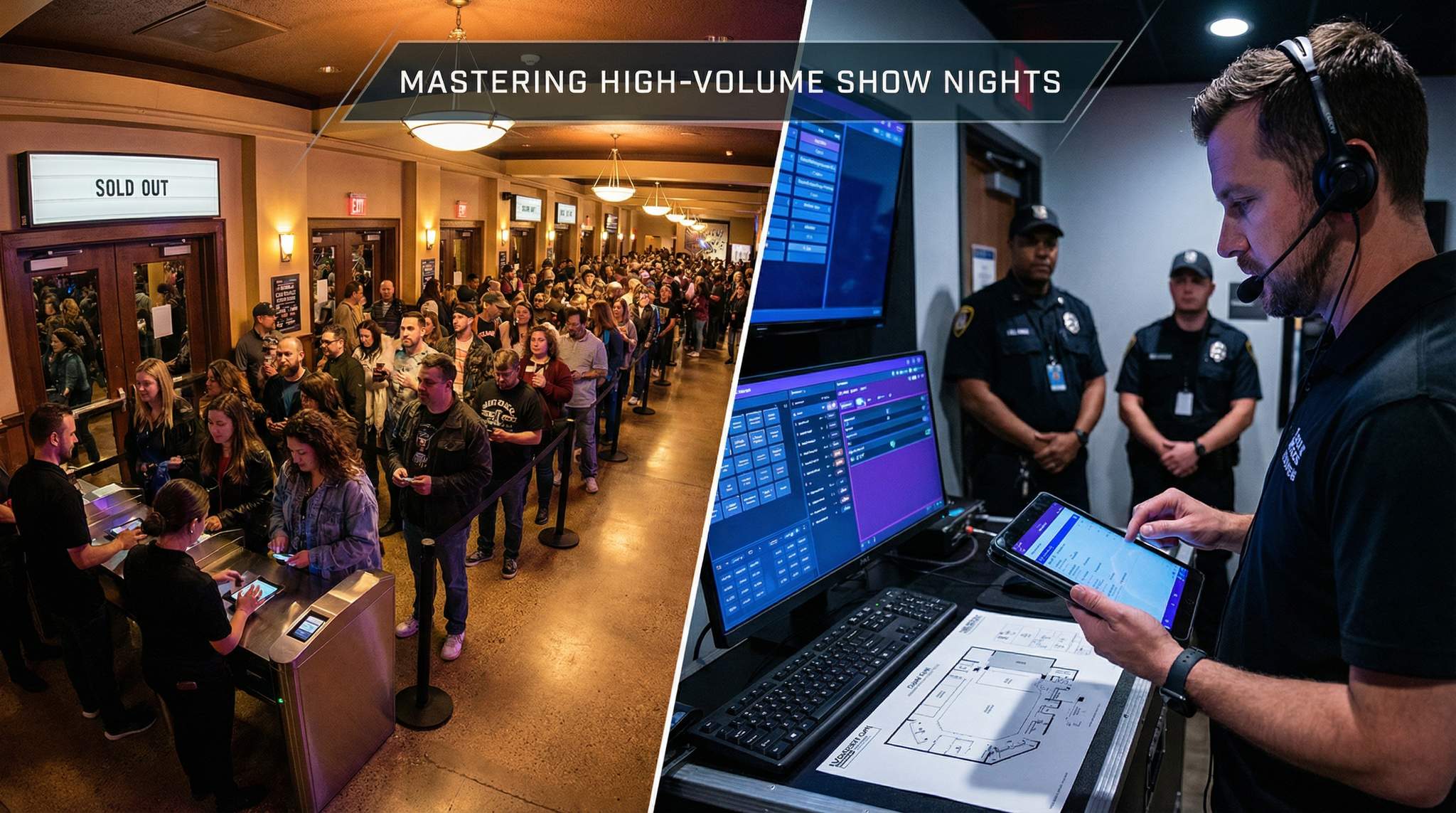
When thousands of excited fans show up at once, the entry process must be a well-oiled machine. To avoid daunting queues and delayed show starts, deploy every tool available for fast and secure entry. This begins with your ticket scanning operation. Use multiple entry points if your venue layout allows, and clearly signpost them (e.g., “Tickets A–M this way, N–Z that way” or separate doors for floor vs. balcony). Leverage technology to accelerate the process: handheld scanners or turnstiles that can validate tickets in a split second are far more efficient than manual checklists. Modern venues increasingly opt for self-service scanning kiosks – much like the automated gates in transit stations – where attendees scan their own digital tickets under supervision. This can drastically increase throughput; festivals testing these systems found a smaller number of staff could handle the same volume, as self-serve entry kiosks let one attendant oversee multiple lanes of ticket scanning. If you anticipate a full house, it may be worth renting or borrowing extra scanning devices or tablets so that every door is open and staffed. Ensure your ticketing system is up to the load too – a crashed ticket scanner app or Wi-Fi issue at the gate can spell disaster with a crowd waiting. Always have a Plan B for ticket verification: if the internet fails, be ready to switch to offline mode or have printed attendee lists at each door for backup (sorted alphabetically to quickly look up names). High-volume entry is no time for cutting corners on validation either; scammers thrive on chaotic door situations. Train your door staff to spot duplicate or fake tickets and have a protocol to politely redirect those guests to the box office. With sold-out events especially, scammers may prey on fans – deploying robust anti-fraud measures and training staff on spotting fake tickets will prevent awkward holdups at the gate and protect genuine ticket holders. In summary: open all possible gates, use the fastest tech and methods available, and have contingency plans so that when 7:00 PM hits and the crowd rushes in, you’re ready to process hundreds per minute smoothly.
When looking to speed up venue entry, operators must evaluate their physical footprint alongside their digital tools. Implementing dedicated venue entry flow solutions—such as staggered arrival times, dynamic queue routing, and pre-check stations for ID verification—can dramatically reduce bottlenecks. For instance, separating the ID check from the actual ticket scan allows your security team to process age verification while fans are still in line, meaning the final scan at the door takes mere seconds.
Another highly effective method to speed up venue entry is the deployment of tiered ingress zones. Rather than funneling everyone through a single perimeter, operators can establish an outer perimeter for initial security screening and an inner perimeter for ticket validation. This decoupled approach prevents a single snag—like a rejected bag or a scanning error—from halting the entire line. When you combine these physical zoning strategies with robust digital ticketing infrastructure, your front-of-house team can maintain high throughput even during the most intense pre-show rushes.
When evaluating hardware, operators frequently ask which FAS (Fast Access System) solutions are optimized for high-volume ticket scanning. The most effective setups combine ruggedized, laser-based handheld scanners with high-speed local network processing, ensuring that each scan takes milliseconds rather than seconds. Unlike standard smartphone camera apps—which can struggle in low-light or glare—purpose-built FAS hardware reads barcodes and QR codes instantly from any angle. Pairing these rapid-scan devices with automated turnstiles or pedestal scanners allows a single staff member to monitor multiple lanes, drastically increasing your front-of-house throughput during the critical hour before curtain.
Efficient Security Screening Without Cutting Corners
Alongside ticket scanning is the equally crucial step of security screening – bag checks, metal detection, and ensuring contraband doesn’t enter. High-volume nights pose a dilemma: you need to be thorough for safety, yet you can’t afford to have security become a chokepoint that backs up your lines. The solution is two-fold: optimize the screening setup and staffing, and prepare the crowd in advance. First, configure your security checkpoints for maximum throughput. This might mean all entrances have magnetometers (walk-through metal detectors) if available, so multiple people can be processed in parallel. If you only have wands, put your most efficient guards on the task, and consider adding a secondary check line for guests who need additional screening (so one bag issue doesn’t hold up everyone behind). For bags, a clear bag policy can speed visual inspections – many arenas mandate clear bags or small clutch sizes on big nights to cut search times. You can also designate “No Bag / Express” lanes where guests without bags or with just a phone and keys can zip through a separate line; this encourages light travel and relieves pressure on full searches. Second, staff adequately: ensure you have enough guards at each point (if one guard can thoroughly check ~5 people per minute, do the math for your crowd and opening window). It’s wise to station a security supervisor at each entrance during rush to make judgment calls quickly, like diverting people to a different lane or authorizing bag re-checks, to prevent bottlenecks. Some venues even employ off-duty police with K9 units for bomb/drug detection on major shows – which can add both real security and perceived security, potentially reducing the need to meticulously search each bag by hand.
Finally, never sacrifice safety for speed – the goal is smart, not lax, screening. One emerging solution is new tech: for instance, Evolv scanners or similar AI-powered systems let attendees walk through without stopping, automating threat detection. While not every venue has access to these, it’s worth keeping an eye on advances that promise faster security. In the meantime, focus on process: clear signage about emptying pockets, dedicated staff instructing attendees while they wait (“Please have your bags open and ready for inspection”), and a bin or table to swiftly confiscate prohibited items without argument (people can reclaim them later or dispose). If your security team is well-drilled and properly manned, you can achieve the holy grail of entry: moving a huge crowd through screening quickly and safely. Reaching that point means constant refinement and learning – analyze how long entry took, identify choke points, and tweak the setup for next time.
Data-Driven Event Marketing
Track ticket sales, demographics, marketing ROI, and social reach in real time. Exportable reports give you the insights to make smarter decisions.
Managing Lobby Flow and Venue Entry Points
Once past the doors, crowds tend to clump in lobbies, corridors, and other choke points – unless you actively manage the flow. On high-volume nights, pay special attention to how people move from the entrance to their seats or the general admission floor. Deploy staff specifically as crowd flow managers: greeters who not only welcome guests but also direct traffic (“Stairs to balcony this way”, “Floor access to the left”). Stanchions and temporary barriers can help channel the flow and prevent chaotic mingling in the lobby. For instance, if you have multiple sections, use signage and staff to split the crowd early (“Sections 100-200 upstairs, Sections 201-300 down the hall”). This prevents the classic scenario of a mass of people stopping in the foyer trying to figure out where to go.
Inside the venue, consider one-way routes during peak times if your layout supports it. Many large arenas practice “one-way traffic” on concourses at intermission or post-show: e.g., designating certain doors or hallways as exit-only to keep people moving in one direction. You might not need formal one-ways in a smaller venue, but the concept of separating flows (incoming vs outgoing) can still apply at bottlenecks like restroom hallways. Another tactic borrowed from theme parks and stadiums is utilizing “fast lanes” or Disney-style crowd flow principles. That could mean creating an express walkway down the center of a hallway with barriers so people can pass through the lobby without getting stuck in queues at merch or concessions. Observing how experts like Disney handle queues and movement can inspire venue operators – for example, adopting crowd flow techniques from major events and theme parks such as clearly marked routes and staff “ushers” at key junctions to keep foot traffic moving.
Don’t overlook simple fixes too: prop open interior doors (if fire code allows) so people aren’t slowing to push doors; remove unnecessary obstacles or furniture that constrict pathways; and ensure all area lights are on full brightness during ingress and egress so people can navigate confidently. The period just after doors open is critical – within the first 15–30 minutes, the aim is to get everyone distributed into the venue rather than congregating at the front. A combination of good signage, actively directive staff, and perhaps even audio announcements (“Doors are open, please make your way inside and find your seats”) can achieve a remarkably smooth flow. When it works, it feels almost magical: thousands of fans come in excited, yet there’s no sense of chaos, just a steady movement to the places they need to be. That’s the mark of front-of-house efficiency at its best.
Beyond physical barriers, modern venue entry flow solutions increasingly rely on dynamic digital signage and real-time crowd analytics. By installing overhead sensors or utilizing camera-based density tracking in the lobby, operators can monitor ingress rates from a central dashboard. If the main atrium begins to bottleneck, digital wayfinding screens can automatically update to redirect incoming fans toward underutilized secondary concourses or auxiliary scanning lanes. This proactive approach to queue architecture prevents the dangerous “crush” effect at the front doors and ensures a steady, manageable distribution of attendees throughout the facility.
Box Office, Will-Call, and Last-Minute Issues
Even with a sold-out show, you will inevitably have some ticketing customer service issues on the night – and how you handle them at scale is important. Box office operations on high-volume nights should be optimized to handle a high volume of transactions and inquiries quickly. If many attendees need to pick up will-call tickets, consider opening the box office extra early that day (or even the day before) so some can retrieve tickets in advance. Clearly separate the lines for sales (if any tickets are being sold or upgraded at the door) versus will-call pickup versus customer service issues. Use signage like “Ticket Pick-Up” vs “Ticket Problems” to funnel people to the right window.
It’s wise to assign some of your most patient and experienced staff to the box office on big nights, because they will deal with stressed customers who’ve lost tickets, or whose digital ticket won’t load, etc. Empower them with fast solutions: for example, a dedicated “troubleshooter” staffer with a tablet who can look up orders and re-issue tickets or direct guests to the correct entrance. This prevents one distraught customer from holding up a whole line at a single window. Also, anticipate common issues: if the show was postponed and rescheduled, have the refund/exchange policy printed and handy; if there’s an age restriction confusion, have extra wristbands or stamps ready for underage/21+ marking.
Automated Waiting Lists for Sold-Out Events
Capture demand when tickets sell out and automatically notify waitlisted buyers when tickets become available through cancellations or resale.
One of the busiest times for the box office can actually be right after the headliner starts – latecomers rushing in or people with problems finally arriving. Keep your box office or a customer service desk open at least 30 minutes into the main act to handle these stragglers, or else they’ll end up frustrated at the doors. After that, you can scale down and close it, but plan to reopen near the end of the show if needed (e.g., if will-call held any confiscated items or lost-and-found). In summary, treat the box office like the command center for individual guest issues. On a high-volume night, that team should be over-prepared and well-resourced, turning potential gate problems into minor hiccups. A smoothly run box office ensures that unique cases (the person with the duplicate ticket, the VIP whose name wasn’t on the list, etc.) don’t derail the overall front-of-house flow.
VIP and Accessibility Considerations
Amid the hustle of a capacity crowd, don’t forget to special-case your special guests. VIPs, guests with disabilities, and other groups with unique needs must be catered to even more diligently on high-volume nights, because general crowding can make their experience challenging. For VIPs (such as suite holders, artist guests, or premium ticket buyers), provide a clearly marked VIP entrance with staff that can give them immediate assistance. If they have access to lounges or special seating, ensure those areas are well-staffed and that there’s a clear path to get there – nothing is worse for a VIP experience than having to elbow through a packed general admission floor to reach a reserved area. Consider assigning a VIP concierge staff member who stands at the VIP door or roams the VIP section to handle any issues (like ticket scanning snags or guiding them to their suite). This not only keeps your VIPs happy but also keeps them out of the general flow, which benefits everyone.
For guests with disabilities or mobility issues, high-volume nights can be particularly overwhelming. Make sure your accessible entry point (ramp or elevator access) is fully operational, not impeded by crowds, and staffed by someone who knows how to expedite ADA guests into the venue. If needed, temporarily pause an entry queue to allow a wheelchair user or someone with difficulty standing to get through without waiting excessively – most patrons will understand when they see courtesy being extended appropriately. Also, ensure that ADA seating areas are not obstructed by standing crowds if it’s a GA floor situation; use barriers or staff to keep sightlines clear. Service animals, medical devices, or medication (like insulin) should be handled at security with discretion and speed – brief your security team so they know, for example, that breast milk or medical liquids are allowed even if other liquids aren’t, and that they should not separate a person from their mobility aid under any circumstance. High-volume shows often mean higher ambient noise and commotion, so prepare to assist those who might need extra help navigating this environment (like someone who is visually impaired or an autistic guest who might be overwhelmed by crowd noise – perhaps providing earplugs or a quiet corner briefly). In essence, plan for inclusivity: the mark of a truly great venue is one that shines not just for the majority, but also for those who require a bit more help to have an equally enjoyable night. A full house should feel thrilling, not exclusionary, for everyone who attends.
Maximizing Concessions and Merchandise on Peak Nights
Keeping Food & Beverage Lines Moving
On a high-volume night, your concession stands and bars will likely see record sales – if you can serve everyone efficiently. To turn the rush into revenue (and not frustration), optimize your F&B operations for speed. Start with staffing: as noted earlier, having sufficient bartenders and food servers is non-negotiable. Experienced venue managers often schedule their absolute best bartenders for sell-out events, knowing they can each handle dozens of transactions per hour. In addition, implement assembly-line techniques for speed: for example, have barbacks continually restock and pre-pour popular drinks (setting out cups of beer or soda ready to grab) so bartenders aren’t stuck doing basic tasks when the crowd is 5-deep. Simplify menus on peak nights to focus on high-demand items that staff can prepare quickly – save the complicated cocktails or special gourmet food items for less busy times, unless those are a signature draw. Every extra step in service (blending a drink, custom toppings on nachos, etc.) can add precious seconds that multiply into long waits for a big crowd.
Leverage technology and modern payment systems to shave off minutes. Contactless payments (tap-and-go credit cards, mobile payments) are faster than making change for cash, so encourage cashless transactions if possible. Some venues even equip roving vendors with mobile POS devices to sell drinks or snacks in the seating areas, capturing sales without fans leaving their seats. Self-serve kiosks for ordering food and drink are another tool: a line of kiosks can take multiple orders simultaneously, which the kitchen or bar can then fulfill, effectively increasing throughput without needing more counter space. One global study of sports venues found that 58% of fans would spend more on concessions if they didn’t have to wait so long – in other words, demand (and revenue) is lost when lines look too intimidating. Shorter lines not only mean happier fans, but they actually encourage more spending per head. Many venues report that when they introduced quick “express” beer carts or grab-and-go snack booths for big games, their overall food & beverage revenue spiked because fans who normally skip the concessions due to long waits were willing to buy. Essentially, speed equals sales.
A useful tactic is to constantly monitor wait times at each concession on the night. If one stand is slammed while another is light, have a supervisor dynamically direct people (“Bars at the upper concourse have no wait!” announced via a sign or PA) or shift staff around if feasible. During an intermission or half-time, even a one-minute reduction in service time per guest can mean hundreds more get served. Consider setting up temporary pop-up bars or snack stations in high-traffic areas just for the peak periods. For example, roll out a portable beer cart in the lobby pre-show and during the interval to catch impulse buys. The investment in a couple of jockey boxes or cooler stations can pay off rapidly on a 5,000-person night when your permanent bars are maxed out. Overall, make it your goal that no one waits more than 5–10 minutes for a drink or a bite – ambitious, but completely attainable with the right strategies. The payoff is two-fold: fans spend more, and they remember the venue in a positive light (“even at sold-out shows, I never wait long for a beer!” is the kind of word-of-mouth you want to cultivate).
Boost Revenue With Smart Upsells
Sell merchandise, VIP upgrades, parking passes, and add-ons during checkout and via post-purchase emails. Increase average order value by up to 220%.
Technology, Pre-Ordering and Cashless Systems
Innovations in concession technology can be a game-changer for high-volume events. If your venue has the capability, allow fans to pre-order or mobile order their drinks and food. Mobile ordering apps let attendees place an order from their seat and get a notification when it’s ready for pickup at a dedicated window – meaning they spend more time enjoying the show and less time standing in line. This system can distribute demand more evenly by essentially creating a virtual queue. During critical moments (say, right before the headliner or during a short intermission), dozens of people might order at once, but since they only approach to pick up when notified, you avoid an uncontrolled physical rush. It’s the kind of modern convenience fans increasingly expect; surveys show large portions of event-goers are interested in solutions like in-seat delivery or express pickup options to improve the overall food and beverage experience at the stadium. Even if in-seat delivery (like having runners bring orders to seats) is not feasible for your venue, the express pickup model can be implemented with a few tablets and a streamlined workflow in the kitchen/bar. Make sure to heavily advertise the service (via pre-show emails, signs with QR codes in the venue, announcements) so that fans know it’s available – adoption won’t happen by itself.
Going cashless is another trend that pays dividends on high-volume nights. Counting change is slow, and handling cash can be error-prone and less secure. Many stadiums and arenas have gone 100% cashless, reporting faster transaction times and higher per-caps (per capita spending) as a result. If you still accept cash, consider at least having one “card-only” line at each bar for speed, or use attendants with portable card readers to walk the cash-paying line to take orders while they wait. Also, ensure your point-of-sale systems are robust to handle the volume of swipes or taps – nothing is worse than a card processing outage at peak time. Always have a backup (like a mobile hotspot or a spare tablet with a 4G connection and Square/Stripe, etc.) in case your main network goes down. That backup could save thousands of dollars in sales in a scenario where otherwise you literally couldn’t process transactions for 15 minutes.
Another tech-forward idea is RFID wristbands or loyalty programs that allow quick payments. Some festivals and venues issue RFID wristbands linked to the attendee’s credit card – a simple tap of the wristband pays for the item, often faster than any other method. If implementing something like that is overkill for one night, you can still benefit from simpler tech: digital menu boards that update in real time (e.g., marking an item as sold out to avoid wasted time), or even using AI cameras to monitor lines and alert managers when queues exceed certain lengths. The bottom line: embrace tools that shave seconds and reduce friction. Many fans now are tech-savvy and actually prefer self-service and cashless payment options, as long as it’s reliable. By introducing these conveniences, you not only handle the current big crowd better but also lay the groundwork for future efficiency gains. Keep an eye on industry developments – from drone beer delivery tests to AI-powered inventory systems – but focus on the tech that genuinely adds value and speed for your operation. If a new system can serve 20% more people in the same time, that’s an investment that likely pays off on the very first sold-out show.
Behind the scenes, high transaction volumes also mean complex financial reconciliation. A common operational hurdle is figuring out how to handle tip reports at high occupancy venues without keeping your bar managers late into the night. The best practice is to utilize modern POS systems that automatically pool and distribute digital gratuities based on logged staff hours. By shifting away from manual cash tip-outs and relying on automated end-of-night reporting, you streamline the close-out process, reduce accounting errors, and ensure your exhausted staff get paid accurately and promptly.
Merchandise Sales and Crowd Management
Merchandise can be another major revenue stream on a packed night – especially if you have a popular artist with must-have tour gear. Yet merch lines can become the longest in the venue if not managed right. Strategic merch operation planning is key. First, decide on the best locations for merch booths: you may need multiple points throughout the venue to distribute the load. A common approach is one main mega-booth in the lobby plus smaller satellite merch tables on each level or at each major sector of the venue. This way, fans don’t all jam into one corner to buy shirts. Ensure each merch area is well-staffed; on high volume nights it’s worth assigning extra sellers and even a dedicated “line manager” to each merch location. That person can keep the queue orderly, answer quick questions (like pricing or sizes) for those waiting – which speeds up the actual purchase when they get to the front – and deter any attempts at line-cutting that might cause frustration.
Implement display and sales techniques that speed up selection. For instance, display one of each t-shirt design prominently with big signage for price and sizes available, so people don’t need to spend time at the counter figuring out what they want. Use printed order sheets or numbered items on a board; some venues hand out merch menu cards in line so customers can tick a box of what they want and hand it to the cashier, making the transaction faster. Track what your top-sellers are early in the night and pre-stock those in easily accessible bins. If the artist’s team allows it, consider mobile merch sellers – staff walking through halls (or even the floor, if feasible) with some light items like hats or glow merchandise. This can catch impulse buys from people who don’t want to leave their spot. Some festivals and big arenas are testing mobile ordering for merch too, or pickup later, but the simpler win for now is just to have enough points of sale.
It’s also smart to coordinate closely with the artist’s merchandisers (many touring acts have their own merch manager). Sync up on predictions: if you know a particular item is limited and likely to sell out by half-time, discuss whether they want to impose per-customer limits to stretch inventory, or at least have a polite sign ready: “Item X sold out – we apologize”. This transparency prevents anger later. Ensure you’ve smoothed out the logistics for artist merchandise sales – from having ample float cash for change (if still using cash) to enough shopping bags, and a system for holding merchandise if someone buys early but doesn’t want to carry it (some venues offer a “merch pickup after show” service at a kiosk, which can be helpful but requires good organization).
Finally, be mindful of when and how the merch rush happens. Typically, there’s a spike pre-show and during intermission or immediately post-show. Pre-show, you might encourage people who’ve entered early to hit the merch stand by announcing “Merchandise is available in the lobby – avoid the rush and grab your tour gear now.” During the show, if there’s a quieter moment (e.g., support act on stage and many fans are in bars), that’s a good time to quietly restock and prepare for the intermission onslaught. At show end, consider reopening all merch stands (even the satellite ones which might have closed once the main act started) to disperse the departing crowd. It’s at this moment many fans decide they must have that T-shirt as a souvenir – don’t pack up until a good chunk of the crowd has filtered out or you’ll lose sales. With thoughtful placement, adequate staffing, and a crowd-conscious approach, merch sales can be maximized without becoming an operational headache.
Amenities, Cleanliness, and Comfort
With great crowds comes great responsibility… to keep the venue clean and comfortable throughout the night. In a packed venue, amenities can get overwhelmed: bathrooms can become messy or backed-up, trash bins overflow, and air conditioning struggles against body heat. Pay attention to these less glamorous aspects, as they heavily influence the overall guest satisfaction. Schedule additional restroom attendants or custodial staff to continuously cycle through bathrooms, restocking supplies and cleaning messes. It might even be necessary to employ a “bathroom line manager” for the ladies’ room if lines historically get long – this person can direct women to the next available stall, remind people not to hold things up, and even occasionally redirect someone to another restroom if one is less busy. Such active management, rare as it is, can actually make a dent in wait times for facilities. For the gents, if your crowd is mostly male and the lines are for urinals at peak, consider the age-old festival trick of temporary urinal stations tucked in somewhere (for outdoor venues, porta-urinals; indoors, maybe opening a staff toilet area temporarily if allowed).
Ventilation and temperature are another concern. A full house means a lot of body heat. Check your HVAC settings earlier in the day – many venue managers will pre-cool the space significantly, knowing that when 2,000 bodies arrive, the temperature will shoot up. It’s better for fans to bring a light jacket than to have a sweaty, stuffy environment that becomes uncomfortable. If you have the ability, kick on ventilation fans or AC a bit higher during intermissions when everyone’s moving around. Conversely, in winter, a huge crowd can melt a snowstorm – don’t blast the heat just because it’s cold outside; the crowd will warm themselves nicely. The goal is to maintain air quality and comfort; if people feel physically at ease, they’re less likely to get agitated or tired.
Finally, plan for trash and cleanliness on the fly. High volumes of concessions mean high volumes of trash – empty cups, wrappers, etc. If the floor is littered and trash cans are overflowing halfway through the show, it sends a negative message about the venue’s management. Deploy trash pickers or sweepers during the event (discreetly if possible, during breaks or even lightly during the show in the dark corners) to keep ahead of the mess. Add extra large trash bins or even trash bags taped next to full bins as a quick stopgap. Encourage responsible behavior by making announcements or putting up signs: “Help keep [Venue Name] clean – please use trash bins located [location].” Most fans won’t mind tossing their rubbish if bins are nearby and clearly visible. A small detail: provide plenty of water – on a jam-packed night, people get dehydrated. Have water stations or fountains accessible and announce that they’re available (you don’t want medical incidents just from dehydration). Many venues now provide free water refills or cups, especially if heat is an issue. It’s both a safety measure and a goodwill gesture.
In short, think of the venue as a giant machine that needs oiling throughout the show: bathrooms serviced, AC adjusted, trash cleared, spills mopped (because with crowds, spills happen). If you can quietly tackle these tasks during the event, the post-show cleanup will also be far easier, and the fan impression will be of a venue that, despite the crowds, was clean, comfortable, and well-run. Those are the kinds of impressions that turn first-timers into repeat customers.
Back-of-House: Smooth Production Load-In and Load-Out
Coordinating Load-In with Production and Touring Crew
High-volume show nights often coincide with large-scale productions – big bands or elaborate stage setups that require significant load-in. Smooth operations backstage are just as crucial as front-of-house because any delays in load-in can cascade into delays for soundcheck, doors opening, and show start. Begin coordination with the artist’s tour manager and production crew well in advance. Get the detailed production rider and schedule and identify potential bottlenecks: How many trucks? What time are they arriving? Do you have enough dock space or a street closure planned if multiple semis need to unload simultaneously? On a peak night, it’s worth staggering load-in times or assigning docking order to trucks so they’re not all jockeying for position at once. Communicate clearly with the tour about local constraints – for example, if your loading dock can only accommodate one truck at a time, tell them upfront and plan the unloading schedule accordingly (Truck 1 at 8:00 AM, Truck 2 at 9:30 AM, etc.). If possible, have additional hands on deck for unloading – even a few extra stagehands pushing cases can cut down unload time by a big margin when there’s a lot of gear.
Crew management is key. Ensure your venue’s technical staff (sound engineers, lighting techs, stage manager) are all present early and briefed on the day’s plan. It’s wise to hold a quick production meeting first thing in the morning with department heads from both the venue and the touring party: review the timeline (when is soundcheck, when do doors absolutely have to open), special effects (pyro, confetti? coordinate with fire marshal), and any unique needs (e.g., the artist is filming the show, so extra power or cable runs are needed). By aligning expectations early, you reduce surprises. One pro tip: have a contingency buffer in your schedule. For example, if soundcheck is set to end at 5:30 PM and doors at 6:00 PM, that’s tight on a big show day if anything goes wrong. Instead, pad the schedule by scheduling soundcheck to end by 5:00 PM if you can, giving a buffer for overruns or last-minute tweaks. If all goes on time, everyone gets a short break – but if (more likely) something took 20 minutes extra, you’re still okay to open doors punctually. Nothing creates front-of-house chaos like doors being held late due to production issues, with thousands of fans piling up outside restless.
During load-in, safety and efficiency go hand in hand. Use clearly marked zones backstage for storing cases and equipment as they come off trucks – a chaotic stage or dock area not only slows down work as people navigate around clutter, but it also risks accidents. Enforce the rule that empty cases get rolled out of the stage area (to a storage zone or back onto trucks if they’re leaving) as soon as gear is set up. Keep fire lanes and exit paths clear of equipment at all times, even when you’re in a hurry. It helps to have a venue ops person or stage manager whose sole job during load-in is “traffic control” – directing where each piece goes and making sure the loading bay doesn’t become a jammed parking lot of gear. Seasoned production managers often appreciate a venue that takes charge of this, because it lets their crew focus on assembling the stage rather than logistics of moving boxes around.
Five Signs Your Event Needs Dedicated Artist Management
As your venue scales up to host larger, high-volume shows, the complexity of backstage logistics increases exponentially. Recognizing when to bring in specialized help is crucial. Here are five signs your event needs dedicated artist management: 1) Your internal team is spending more time fulfilling complex hospitality riders than managing venue operations; 2) Load-in schedules are consistently delayed due to miscommunications with touring crews; 3) You are hosting multiple high-profile acts on the same bill with competing backstage requirements; 4) VIP and artist guest lists are causing bottlenecks at the back-of-house entry points; and 5) Technical soundcheck overruns are threatening your strict door times. When these operational red flags appear, assigning a dedicated liaison ensures the talent is handled professionally while your core staff remains focused on the broader event execution.
Soundcheck and Technical Preparation
On big show nights, technical excellence is expected – the audience is huge and the stakes high for delivering a great concert experience. That means soundcheck and tech prep are critical and should be handled with an almost military precision. If multiple acts are on the bill (supporting acts plus headliner), coordinate a realistic soundcheck schedule. Often the headliner will soundcheck last, closer to doors, which is fine, but ensure the opening acts get a quick line check or at least a virtual soundcheck (if using digital consoles with saved settings) so that their sets start off on the right foot too. In an arena or large theatre, calibrate the PA for full house conditions – an empty room sounds very different from a packed one. Savvy audio engineers will ring out the system in the afternoon and maybe re-check levels when some audience is in for support act; allow them time to do this. The last thing you want is ear-piercing feedback at 8 PM due to a rushed or skipped soundcheck.
Lighting and effects should also be tested in full. Have the touring LD (lighting director) do a complete run-through of a couple of songs with their rig, especially if there are strobe effects or complex cues. This not only verifies that the venue power can handle the lighting load (avoiding a breaker trip mid-show) but also helps the staff spot any safety issues (e.g., strobing might affect certain patrons – ensure you have warning signage up for epilepsy if intense strobes are used). If there are special effects like pyrotechnics, confetti cannons, or CO2 jets, double-check the permits and tests with local fire safety officers well before doors. It’s ideal to have a fire marshal walk-through in the afternoon to approve the setup if required, rather than scrambling 10 minutes before show because someone forgot to mention the flame pots.
One area to pay extra attention to is communication systems: your radios, in-ear monitors, and intercoms. A full venue can sometimes interfere with wireless signals (all those cell phones and metal can wreak havoc on frequencies). So have your tech team scan frequencies and coordinate any wireless mics or IEMs to free channels that won’t get interference once the crowd is in using their phones. Similarly, test your staff radios when the venue is empty and do a quick radio check once the audience is filing in – sometimes you’ll find a dead spot or extra static only once bodies fill the space. Having solid comms between security, front-of-house managers, and production is vital on a chaotic night, so consider using repeaters or higher-power radios if range is an issue in a packed building.
Finally, don’t overlook backups. On a big night, Murphy’s Law might target your critical systems. Is there a spare amplifier or mixer ready to swap if the main one blows? Do you have a backup generator or at least emergency lighting if the power goes out? Some venues prepare a “tech disaster kit” – e.g., a couple of powered speakers on standby in the wings that could at least be rolled out to amplify emergency announcements if the main PA fails. It can also help to have an off-duty technical expert on call – maybe an extra electrician or an A/V tech – who isn’t working unless needed, but can rush in if something extraordinary happens (like a motor fails on a moving truss, etc.). For most shows these backups won’t be touched, but the peace of mind in having them for a sold-out concert is huge. You’re ensuring that even if something goes wrong, the show will go on (and the audience likely won’t even realize anything was amiss).
Showtime Backstage: Maintaining the Flow
Once the show is on, operations backstage should remain vigilant to keep everything on track. Stage management becomes crucial with multiple acts. If you have opening performers, strictly enforce set times – use visual timers, and have a stage manager ready to politely shepherd them off if they run over. A few minutes delay may not matter on a regular night, but with a full house and possibly a strict curfew (many cities fine venues for running past curfew, especially with loud crowds leaving late), those minutes count. Ensure that your crew is ready for quick changeovers between acts. Do a mock run-through of the changeover in advance with the stagehands: who’s striking the opener’s drum kit, where does it go, who’s rolling out the headliner’s amps, etc. Have clear assignments and make sure all needed tools (gaffer tape, extra mic cables, dollies) are staged nearby. A well-rehearsed crew can swap bands in 15 minutes what might otherwise take 30 – and that difference keeps impatient crowds happy and the show on schedule.
During the show, keep an eye on dressing room and backstage needs so they don’t inadvertently disrupt the public side. For example, if the artist requests more water or hospitality during the show, have a runner handle that quietly; don’t send someone pushing through the audience with a dolly of supplies at peak crowd time if you can avoid it. If VIP guests need to get backstage, assign security to escort them rather than having them wander and potentially pop out an unexpected door into the crowd. Many venues hold a brief “intermission meeting” (even if the show doesn’t have an official intermission) where key staff touch base – say right after the opening act – to quickly communicate any issues so far (e.g., “Concessions running low on ice, but more is coming” or “Lots of fans crowding Section B exits, we should station an usher there”). These rapid updates allow small course corrections while the event is live.
Also consider the noise and vibration backstage. A raucous, sold-out show might be way louder than usual, which can affect backstage communications. Simple fix: use in-ear plugs with your radios or noise-canceling headsets for critical crew so they can still hear commands. And remember, a high-energy crowd can literally shake the building – this can set off sensitive equipment if not secured (we’ve seen unlatched road cases “walk” a few inches during loud bass-heavy sets!). Double-check that all heavy items are secured or on level ground to prevent any accidents backstage.
Finally, maintain tight security backstage. Big night, big temptations – more fans might try to sneak backstage, local bigwigs might show up wanting a meet-and-greet, etc. Station credential checkpoints and make sure only authorized people are roaming in production areas. The touring crew especially will appreciate a focused backstage where random extra people aren’t distracting them when they’re doing critical jobs like mixing sound or doing live video. A sold-out show might also mean more local crew hired for the night – keep track of everyone with a sign-in sheet or credential system so that in an emergency you can account for all staff. It sounds like overkill, but in the heat of a major event, knowing exactly who is where (and who can access what) keeps things controlled and safe. The show itself might look like rock ’n’ roll chaos on stage, but behind the scenes it should operate with the calm and order of a pit crew at a Formula 1 race.
Load-Out: Striking Quickly and Safely
As soon as the final encore is done and the crowd starts cheering for one more song (that isn’t coming), your crew’s mindset switches to load-out mode. The goal now: tear everything down quickly but safely, so the touring crew can pack up and everyone can go home (and so the venue can reset for the next event). First, coordinate with the tour manager on the load-out plan – often it’s the reverse of load-in, but confirm if they need to prioritize certain trucks leaving early (maybe some gear is going straight overnight to the next city). If you had a buffer in load-in, you’ll want a sense of urgency in load-out without panic. Strike while the iron is hot: have stagehands ready in position as the show ends, so the second the house lights come up, they’re already disconnecting cables, lowering trusses, covering the grand piano, etc. Everyone should know their task: some pack up audio, some on lights, some helping the band’s crew with instruments. It can help to assign a team lead for each aspect (audio, lighting, backline, staging) who coordinates their sub-team.
Meanwhile, consider crowd egress in your load-out strategy. You typically can’t move the main gear cases out through audience areas until most people have left (for instance, if your loading route crosses the lobby). So plan to break down on stage first, but maybe hold big moves until the floor is mostly cleared of attendees. If you have multiple exit points, encourage the production to use a back or side exit for load-out if possible, so you’re not sending heavy equipment through the same corridor as fans. Some venues briefly hold audience exit from one particular door because it’s needed for load-out – if so, communicate that clearly via staff (e.g., “Please exit to your right tonight, left side doors are for equipment move-out”). The last thing you want is an audience member colliding with a road case or wandering backstage in the confusion of load-out.
Safety cannot be overstated here: after a long show, crew are tired and there’s a temptation to rush. Enforce safe practices – hard hats if things are coming down from rigging, no one going under a truss that’s being lowered, use lift gates properly, etc. It’s often helpful to take 5 minutes after the show (once the stage is clear of performers) to gather the crew, take a breath and quickly recap the load-out plan: “Team, great job. Now let’s strike. Audio and backline first, lighting trusses coming down in 10 minutes so stay clear until then. Remember to secure all cases. Let’s aim to have Truck 1 loaded by 12:30.” This micro-meeting focuses everyone and actually saves time because all know what’s happening and in what order, rather than stumbling over each other.
As locals, your venue crew can assist the touring crew by managing local logistics: for example, coordinate with venue parking/security to bring trucks in as soon as possible, ensuring the loading dock is clear. If you had to close any streets or use a parking lot for production, keep those arrangements in place until all trucks are gone (sometimes external security or police try to reopen a street too soon – politely remind them of the agreed teardown window).
Also prepare for a quick venue reset. If you have another event the next day, you may need to start setting up immediately after this load-out. Even if not, stuff like lost and found, cleanup, and maintenance checks are best done right after. In a high-volume event, seats might have been damaged or lots of confetti might be stuck in weird places; doing a walk-through with the lights on post-show is invaluable. Engage your cleaning crew to start as sections empty – for instance, have them begin in the upper levels while people are still exiting the lower bowl. By the time the last truck pulls out, you want the venue nearly back to baseline condition. One approach many venues take is to schedule a small overnight cleanup crew to work alongside the production load-out; by 2 AM the stage is gone and the venue is spotless, which is a great feeling (albeit an expensive one in overtime – but for marquee events, it may be worth it).
Load-out is complete when all gear is packed, all trucks departed, and your house gear is back in place. Do a final sweep: check that no rental gear or touring equipment was accidentally left behind (it happens – and then you’re overnight shipping a guitar to the next city). Ensure all stage doors are secured once the crew leaves. And if you really want to go the extra mile as a venue operator, have some hot pizza or coffee for your own crew and the touring crew during load-out – those small touches at 1 AM build goodwill and acknowledge the hard work. A high-volume night isn’t truly over until the last cable is wrapped and the doors are shut. With a solid plan, you’ll achieve that efficiently while keeping everyone safe, ending the night on as strong a note as it began.
Real-Time Problem Solving: When the Unexpected Happens
The Nerve Center: Communications and Command
During any event – and especially when managing a massive crowd – constant communication is the lifeline that keeps operations together. Establish a clear “command center” or chain-of-command structure for the show night. This could be a dedicated event control room with CCTV monitors and a team of key managers, or simply a designated point person (like the Venue Operations Manager) who all departments report into regularly. Equip all relevant personnel with radios (fully charged, extra batteries on hand) and use a structured channel plan: for example, Channel 1 for overall coordination, Channel 2 for security, Channel 3 for maintenance, etc., with a protocol for escalating major issues to everyone. Make sure everyone knows who is in charge of decision-making in real time. If an incident occurs, the staff should immediately know “Who do I call first?”. A well-defined chain of command ensures that if, say, the Head of Security is dealing with one issue, the Head Usher or Ops Manager can make a judgment call on another without waiting, and everyone will back that decision. Establishing a clear chain of command with designated deputies prevents confusion – for instance, if the GM is off radio dealing with an artist meet-and-greet, the next in command (perhaps the Operations Manager) has the authority to direct teams if a crowd issue pops up, ensuring continuity of command during critical moments.
During the event, consider doing quick all-hands check-ins via radio at a regular interval, such as 15 minutes after doors, 5 minutes before showtime, halfway through main set, etc. These can be as simple as, “All departments, report status: Security?” – “All good, lines clear.” – “Medics?” – “Handled two minor faints, all good.” This keeps you proactively aware. Some venues also employ mobile supervisors – staff who roam and report conditions (crowd density, temperature, any misbehavior) to command, sort of like field reporters.
For high-volume nights, having a dedicated problem-solver team ready is invaluable. This might be a small “tiger team” of maintenance and ops folks who aren’t assigned a static position but are free to jump on emerging problems (like a spill, a broken seat, an unruly fan if security is tied up). They act as the rapid-response unit directed by the command center. If your venue is large, you might station them in different quadrants so they can reach incidents quickly. By centralizing decision-making and maintaining open comms, you can catch many issues when they’re still small and solve them before they balloon. A patron might not notice, but things like adjusting the ventilation because someone noted it’s stuffy in the balcony, or dispatching a crew to mop up a spilled drink on an exit stair, are the differences between a smooth night and an incident. The command center’s ears (staff observations, CCTV feeds if available, even social media monitoring for #VenueName complaints in real time) should be wide open throughout the show.
In the heat of a major sold-out event, treat communication like the show’s own heartbeat – steady, continuous, and responsive. It’s the behind-the-scenes orchestra syncing the moving parts: front-of-house hears that backstage is starting encore (so they get ready for egress), security hears that concession stands are closing beer sales (so they anticipate some disgruntled latecomers maybe), and medical staff hears that a crowd surfer is coming over the barricade in Section A (so they stand by to check him). With well-practiced comms, all these moving parts coordinate seamlessly, and to the audience it all appears effortless.
Handling Technical Glitches Mid-Show
Even with the best preparation, technology can misbehave at the worst times – microphones die, lights go out, video screens freeze, or power can trip unexpectedly. The mark of a seasoned venue crew is not the absence of problems, but the ability to react swiftly and cleverly when they occur. Let’s say mid-show, the lead vocal mic stops working. The monitor engineer should immediately radio “Mic 1 down” to stage crew, and within seconds a stagehand should walk on with a swapped mic (always have spares prepped with fresh batteries on the side of the stage). Meanwhile, your front-of-house engineer can push up ambient mics slightly so the crowd still hears something until the swap is done. A good practice is to have redundancy for any mission-critical system running live. For sound, that can mean spare channels and microphones at the ready; for lighting, perhaps a backup lighting console on hot standby (so if the main console crashes, you can switch in seconds to the backup – many modern systems allow session tracking on two consoles). If the giant video wall freezes, have a pre-agreed plan with the video tech: for instance, they might cut to a blank background or venue logo rather than leaving a glitching image. Audiences are surprisingly forgiving of a quick hiccup if it’s handled fast and transparently; often they won’t even notice a glitch if your crew masks it well.
Power outages or electrical issues are the stuff of nightmares, but there are protocols for them too. If a section of your lights goes dark or audio cuts on one side, it could be a tripped breaker – have your electrical tech immediately investigate the affected circuit and have a flashlight handy (backstage should always have an emergency light). If the whole house loses power (except emergency lights), that’s a true crisis but it has happened at arenas and theatres before. Immediately get on backup comms (battery-powered megaphones or the emergency PA if separate) to calmly inform the crowd to stay put and that you’re fixing the issue. One famous incident is when Madison Square Garden lost power mid-concert; they promptly shined battery-powered lanterns and had the artist do an “unplugged” song to keep the crowd calm until power returned. The lesson: think on your feet. If you’re the venue manager, maybe you coordinate with the artist or MC to do a short acoustic set or crowd interaction if tech fails. In smaller venues, if, say, the projector fails and you were supposed to show something, divert attention by bringing the house lights up or initiating a brief intermission while solving it.
Communication with the audience during technical problems is crucial. A simple announcement – “Ladies and gentlemen, we’re experiencing a brief technical issue and expect to resume in a few minutes. Thank you for your patience!” – can defuse a lot of tension. Silence and confusion breed unrest in a packed crowd. Empower someone (likely the FOH engineer or MC) to make that call to communicate after, say, 30-60 seconds of unplanned stoppage. People will cheer if you keep them in the loop rather than leaving them in the dark (literally and figuratively).
Most of all, foster a culture among the crew of problem ownership and creativity. If a spotlight operator’s light dies, they should not just shrug – maybe they can quickly reposition another light or coordinate with another operator to cover their area. If the digital ticket scanners go offline unexpectedly and create a backup at doors, a forethinking staffer might quickly revert to manual check-in or start letting people in holding onto their physical tickets to scan later once fixed (under supervision) if safe to do so. These are the kind of on-the-fly decisions that save the night. And as a manager, always do a post-mortem on any glitch: once the show is over (or during a lull), quickly huddle and ask what happened and how did we fix it – and importantly, how can we prevent it next time. Each tech snafu is a learning opportunity to build even more resilient systems for future high-volume events.
Crowd-Related Incidents and Emergencies
With a full house, you must be prepared for crowd dynamics issues – whether it’s a medical emergency in the audience, a fight, a case of severe overcrowding in one area, or even the potential for mass panic in an emergency. Prevention is step one. Use your security and crowd spotters to keep an eye on any brewing situations: Are there signs of distress in the pit? Is one section getting too densely packed? Are any aggressive fans starting altercations? It helps to have at least one staff member (like a head of security or experienced crowd manager) whose sole job during the show is scanning the audience, not watching the performance. They’re looking for raised voices, sudden sways in the crowd, people trying to push through, etc., and can initiate an intervention early (like pulling someone out who’s overheating or quietly moving a disruptive fan before a fight starts). Modern tools like crowd density cameras or even asking artists to do a quick “take three steps back” PSA if the front is getting tight can be life-savers. Case in point: many festivals have adopted real-time monitoring after past incidents – being aware of density becoming dangerous allows action before tragedy, emphasizing the importance of understanding crowd surges and dynamics.
For medical emergencies, have a clear protocol: if someone collapses or needs help in the crowd, how does the message get to medical staff? Often it’s through security or radio calls. Train your team that any staff who receives a report of an ill patron immediately relays “Code MED, Section X, Row Y” or similar to command, and medical responders are dispatched. Simultaneously, if it’s in the thick of the crowd, your security should create space and get that person out. Many venues place EMS units or paramedics at the front of stage in big GA shows specifically for fast response. Ensure your team knows the signals: usually, fans will wave or make space when someone needs help – don’t ignore those. Better to check on 10 false alarms than miss one real issue. Also equip your team: having basic first aid training for ushers or security means they can stabilize someone (CPR, or even Narcan for an overdose) in the precious first minutes while waiting for the medics. In fact, given the prevalence of opioid issues, consider training and equipping select staff with naloxone – some venues and festivals are doing this to ensure attendees remain safe and comfortable and have saved lives by reversing overdoses on-site.
If a fight or security threat breaks out, your response must be swift and firm, but also measured to not escalate matters. Train security in de-escalation and safe restraint techniques. On a jam-packed night, the worst outcome is a brawl that spreads or causes panic. Thus, several guards converging quickly to contain a fight is ideal – remove the combatants to the hallway or outside where it can be handled without drawing a crowd. If there’s a more serious threat (e.g., a weapon sighted, or a person threatening mass harm), you have to be ready to pause or stop the show and possibly initiate an evacuation or lockdown as per your emergency action plan. It’s heavy stuff, but those plans must exist. Venues post-2010s have had to consider active threats; hopefully you never face one, but doing drills and having codes (like a distinct phrase to alert all staff of a major emergency) can save lives.
One underrated aspect of managing crowd problems is the role of communication with the attendees. Research and experience in crowd psychology indicate that when people are informed and treated with respect, they cooperate better and panic less. If you need the crowd to move back because someone is hurt at the front, get the artist or MC to calmly say “Folks, we have a person down up here, please take a few steps back and give them space.” This not only solves the immediate problem but also builds trust – the crowd knows you’re looking out for them. If there’s a delay, rather than leaving everyone confused, have the MC or a staff make an announcement: “Thank you for your patience, we’re resolving an issue and the show will resume shortly.” Honesty and clarity go a long way. Fans generally handle adversity well if they feel cared for and informed, whereas secrecy or ignoring an obvious issue can lead to unrest or fear.
In summary, expect the unexpected with big crowds: fainting fans, belligerent drunks, lost children, even weather issues if it’s an outdoor queue. Have an action plan for each, brief the team on those plans, and empower them to act fast. A high-volume night might throw you a curveball, but with preparation and a cool head, you’ll knock it out of the park and most attendees will never even realize there was a challenge.
Adapting on the Fly When Plans Change
No matter how detailed your planning, live events have a way of surprising you. The true test of an operation is how well it adapts in real time to changes or setbacks. High-volume nights can be especially tricky because any change affects so many people. Let’s explore a few “what if” scenarios:
What if the headliner is late or a support act cancels last-minute? Communication is step one – update the audience with a friendly tone if there’s a significant delay (“The band’s stuck in traffic, we expect to start 15 minutes late – hang tight and grab a drink, we’ll keep you posted!”). Behind the scenes, adjust your schedule: maybe extend the support DJ’s set or have house music and lights at a comfortable level to keep people calm. If a support act cancels, you might have an unexpected gap; could you advance the headliner set slightly or get a local opener who was not on the bill to do a quick fill-in? Even an announcement and extra intermission music is better than nothing – silence breeds confusion. Always have a contingency timeline in mind: if show start needs to shift, how does that affect curfew, intermissions, etc., and who needs to approve (often artist management and local officials if curfew extension is needed)?
What if weather intervenes for an outdoor or semi-outdoor queue? Say a sudden thunderstorm rolls in during doors open, drenching waiting fans. You might need to temporarily pause entry for safety, usher people to shelter, or open more doors to get folks inside faster and out of the storm. Flexibility is key – maybe you even start the show 10 minutes late to accommodate a weather hiccup and ensure everyone gets in safely. Coordinating with weather services and having ponchos or umbrella stations ready shows foresight.
What if a critical staff or system fails? Suppose half your security team gets stuck in traffic or a few key personnel call in sick that night. As a nimble response, you might redeploy staff from less critical areas to cover essentials (e.g., pull some ushers to help with bag checks initially, then send them back to seating once most are inside). If a system like your entry scanning goes down, you might revert to manual check-in or even let people in, scanning tickets after they’re inside (scanning later in small batches or post-show against records – not ideal, but an option if truly needed). The motto here is “don’t be paralyzed” – quickly decide on an alternative process, communicate it to staff, and execute. A notepad and pen can replace a broken iPad when necessary; glow sticks can replace failed wristbands; a megaphone can replace a PA announcement.
What if the crowd’s behavior or mood is not as expected? Sometimes you plan for a rowdy crowd and they’re mellow – or vice versa. Read the room: if you sense more aggression or moshing than anticipated, quietly increase security presence at hot spots (and maybe have the artist’s team or MC give a reminder to watch out for each other). If the crowd is super chill and lines are actually lighter than expected, you might close a redundant concession early and reassign those staff to help at merch where the line is worse. Adaptive resource allocation – moving people or tools from an over-served area to an under-served one – is a skill that comes with experience. It requires situational awareness and willingness to deviate from the script. Encourage your department leads to feedback info to command: “Hey, we don’t need all 5 people at Coat Check right now, can I pull two to help clean spills in the concourse?” – Yes, do it!
All changes, big or small, benefit from the same approach: Assess, Communicate, Execute, and Review. Assess the new situation or problem calmly (often just seconds of clear thought helps). Communicate the plan or changes to both staff and attendees as needed (clear instructions prevent chaos). Execute the adjusted plan with confidence. Then review afterward (even informally that night) to learn. Perhaps one night you realize allowing re-entry for smokers was a mistake with this huge crowd – too many left and tried to come back at once – note that for next time (maybe next time you create a better re-entry corral or disallow it for sold-out shows). Being reflective and flexible is how the best venue teams turn a potential disaster into just another story of “remember that night when everything went wrong, but the crowd still had a blast?” Those war stories and lessons inform future high-volume nights so the playbook gets stronger with each experience.
Safety and Security: Keeping a Packed House Safe
Scaling Up Security and Crowd Management
When you know the venue will be full, security measures deserve special attention beyond the routine. More people can mean higher chances of security issues, simply by volume of humanity. We discussed staffing ratios – ensuring enough guards – but equally important is deploying them smartly. On peak nights, consider zoning your security: assign teams to specific sections (floor, stands, lobby, backstage) with clear responsibilities and a zone leader. This prevents gaps in coverage; each zone leader continuously scans their area and can call for backup from another zone if needed. In very large venues or critical shows, you might integrate local law enforcement or hire additional off-duty police officers for an obvious deterrent presence. Many arenas have uniformed police at key points (like near stage or mixing desk in GA floor shows, where quick intervention might be needed for fights or to protect high-value gear) – their visibility alone can discourage bad behavior.
One aspect of crowd management is using physical tools like barriers wisely. For a GA floor, think about adding a secondary barrier halfway back (creating a front pit) if the crowd size and artist style suggest heavy front pressure. This “D-barrier” or “moat” technique is common at festivals and large concerts because it splits one massive crowd into two more manageable ones, utilizing a secondary barrier or pass-through barricade. In a venue, even a temporary barrier at the mix position can help by relieving pressure and giving security a corridor to move through the crowd if needed. Ensure all your barriers and railings are checked pre-show – a full-capacity crowd will lean on anything and everything. Borrowing from best practices, convex stage barriers are preferable as they help dissipate crowd force to the sides rather than straight back. If you have such infrastructure, great; if not, at least position multiple security staff across the front to take care of crowd surfers and pushers and to be seen by the crowd as help.
Another consideration: bag and coat check. A stuffed venue means lots of belongings; an overloaded coat check line at end of night can be a security concern as people get impatient. To mitigate, maybe offer an extra coat check station or stagger pickup by allowing some sections to retrieve early. Also, remind people to keep personal items safe – pickpocketing unfortunately can spike in dense crowds, so some venues make PA announcements or signage like “Beware of pickpockets.” It shows you care about patron safety beyond just physical harm.
Crucially, maintain situational awareness even when the show is rocking. Security supervisors should not all be backstage chatting or fixated on the stage performance; they need to be facing the crowd, even with back to the stage if needed, watching for unusual movements or surges. Modern approaches to crowd safety emphasize observing crowds in real time to detect how crowds flow through space. For example, if a mosh pit is forming and getting aggressive beyond what’s acceptable, intervene by shining a flashlight and pulling out the main aggressors, or have the artist calm it down if they’re known to do so. If a crowd surge forward happens, immediately signal the artist’s team to pause the show and bring up lights slightly – many bands are now very attuned to this and will stop music if they see fans in distress. Empower your security to halt a show if they genuinely believe there’s a life-safety issue; it’s a tough call, but far better to have a temporary stop than to allow a dangerous situation to continue for fear of upsetting the artist or audience. Post-Astroworld, more venues are erring on the side of bold action when needed, and artists are generally supportive if it’s about safety.
Emergency Protocols and Evacuation Readiness
A full venue must have a rock-solid emergency action plan because the margin for error in evacuating or responding to an emergency shrinks when so many people are involved. All staff should be briefed on the basics: if there’s a fire alarm, what do we do? If there’s a need to evacuate only one section (e.g. small fire in a concession stand), how do we direct those people while keeping others calm? In high-volume scenarios, often a “defend-in-place” might be considered for minor issues (like a contained fire) to avoid stampedes, but that’s a decision for officials. The key is staff know their role: Ushers direct people to exits, security secures certain pathways, managers coordinate with fire/police, etc. Conducting a short pre-show drill or review with staff on these nights is wise – e.g., walk through verbally “If I say EVAC EVAC EVAC on radio, what do you do?” and ensure each department can answer.
One common failure in emergencies is communications breakdown. So plan redundant ways to communicate with the crowd if you need them to do something. Your PA system is primary (make sure at least one microphone is patched to house PA and someone responsible to use it). As backup, have some megaphones (with fresh batteries) at strategic points. Designate who will speak to the crowd – ideally someone with a clear voice and authority (often the venue manager or head of security, or even the performer if they are willing). People inherently follow the performer’s cues; there are examples where artists helped calmly evacuate venues by telling everyone what to do when a dangerous situation arose. However, you can’t rely on that, so the venue must be ready to lead. Use simple, calm instructions in an actual emergency. Instead of “Exit in an orderly fashion,” be more direct: “Everyone please walk slowly to the nearest exit, do not run. Our staff will guide you. Stay calm.” Repeating key phrases helps too. As crowd psychology studies show, panic is less likely if people are given clear direction and feel someone competent is in charge, preventing self-fulfilling prophecies of panic.
Also ensure emergency equipment is easily accessible even with crowds. This means checking before the show that fire extinguishers aren’t blocked by a road case, exit doors aren’t accidentally barricaded by extra chairs or gear, and that first aid kits and AEDs (automated defibrillators) are where they should be. In the adrenaline of a full venue, mistakes can happen – e.g., someone locks an exit for “security” not realizing it’s an emergency egress. Triple-check these things on big nights. It can help to assign a specific staff member to do an “exit sweep” right after the show starts – they quietly walk all exit routes to confirm everything is still clear and functional (no drunk person piled stuff in front of a door, etc.).
If you have an on-site emergency like a small fire, don’t delay in calling for professional help under the assumption your team can handle it. With so many people present, even a minor incident can escalate rapidly, so alert fire department or EMS as soon as you even suspect you might need them. Better they arrive and not be needed than arrive too late. Many large venues actually station first responders on site for high-profile shows – for example, an ambulance crew parked outside, fire marshal in the building – as a precaution. If you have the resources or city support to do that, it’s a great safety net.
In any dire emergency, after action, conduct a debrief and possibly counseling. These scenarios can be traumatic for staff too. For instance, in one festival scenario after a crowd collapse, organizers brought in counselors for the team, pledging to provide mental health counseling for staff. While that’s an extreme case, even a smaller scare at a venue (like a false gunshot alarm that caused panic) can leave staff shaken. Show them you have their back: discuss what went right, what could improve, and ensure everyone is okay. Being prepared for emergencies is something we hope we never have to execute, but having that plan and training in place on a high-volume night is a professional obligation. It’s part of what keeps live events not just exhilarating, but also as safe as they can possibly be for everyone under your roof.
Managing Patron Behavior and Intoxication
When the house is full, you’ll see the full spectrum of patron behavior – including some bad apples or just overly enthusiastic fans who might jeopardize others’ experience or safety. A lot of operational focus goes into crowd flows and safety, rightly so, but don’t neglect front-of-house policies around alcohol service and misconduct on these busy nights. With more people comes more alcohol sales, which in turn means a higher chance of intoxication issues. Implement stringent but fair alcohol management: ensure bartenders check IDs vigilantly (it’s easy for fake IDs to slip through when lines are long – maybe use tech like ID scanners if you have them). Consider a drink limit policy if appropriate (some venues do max 2 drinks per purchase on big shows, to discourage overconsumption). Also, have “secret shoppers” or managers monitoring for over-service – cut someone off if they clearly appear intoxicated, and communicate that info to security so they can watch that individual.
Train security and ushers on spotting signs of trouble: someone stumbling or harassing others should be intercepted early. It’s usually better to gently escort an intoxicated patron out (or to first aid) before they cause a fight or hurt themselves. Also, plan for safe transport: encourage use of rideshares or public transit and maybe have a taxi queue or rideshare pickup zone well-marked, so drunk folks aren’t wandering into the street or driving. A full venue might also warrant a designated driver program (some places offer free soda to designated drivers as an incentive, which is a nice public safety gesture).
For general misbehavior – whether it’s moshing in prohibited areas, smoking inside (a common one when it’s crowded and people think they can hide in the masses), or trying to rush a VIP area – your team should adopt a zero-tolerance but customer-service-oriented stance. That means, for instance, if someone is caught smoking where they shouldn’t, the first approach is polite: “Excuse me, there’s no smoking in here, please step outside if you need to smoke.” If they comply, great – no harm. If they do not, you escalate with backing from security and possibly ejection. A packed event is not the time to endlessly negotiate with uncooperative patrons; it can send a bad signal to others that rules aren’t enforced. Safely removing one belligerent person can actually prevent multiple others from acting out. Many venues have a pre-written policy (like printed in the ticket or on signs) that they can show as reference: “Attendees engaging in fighting, disorderly conduct, or failing to comply with venue rules may be ejected without refund.” This gives your security moral and legal backing to act.
However, it’s wise to use a graduated response – not every offense merits kicking someone to the curb, which is also a safety issue for that person if they’re intoxicated. Sometimes a time-out works: pulling someone aside, giving them a cooling off period outside of the crowd (maybe in a security office or just at the back of the venue under watch) and letting them return if they’ve calmed can be effective. Of course, if it’s violence or extremely disruptive behavior, then permanent ejection or handing off to police is warranted.
One practical tip: with so many people, misconduct can go unnoticed unless staff are actively looking. Encourage staff to be present and visible. Idle staff on a full night is a missed opportunity – if ushers aren’t busy with seating once the show’s on, have them walk the aisles or concourse looking out for issues. A security guard stationed near the stage should also occasionally glance backward into the crowd, not just face the stage the whole time. The principle is that a visible authority figure can deter bad behavior, and if not, they can catch it early. Also, foster an environment where guests help too: make it easy for patrons to report issues (some venues use text lines like “Text 1234 for assistance in your section”). When crowds know the venue takes safety and behavior seriously, peer pressure often keeps people in line.
In summary, treat a high-volume audience with a mix of firmness and fairness. The vast majority are there to have a great time and will follow the rules when enforced consistently. Dealing with the few troublemakers swiftly and discreetly keeps the focus on the show for everyone else. And if you can channel the crowd’s energy positively (sometimes just through the show’s excellence and a friendly staff vibe), you’ll have less negative behavior to manage. A full venue singing along in unison is a beautiful thing – our job is to set the stage for that collective joy, and step in only when someone’s actions threaten to spoil it.
Post-Event: Wrap-Up and Continuous Improvement
Egress: Getting Everyone Home Smoothly
The show might be over, but for venue operations the final phase – egress (exit) – is just as important as ingress. A high-volume egress is actually one of the most critical moments: thousands of people all leaving, potentially tired or inebriated, and all in a hurry. Proper planning here prevents accidents, neighbor complaints, and leaves a lasting positive impression. First, staff your exits. Just as you had greeters at entry, have ushers and security at every major exit path to direct the flow: “This way out, watch your step, have a good night!” A friendly but organized exit helps avoid bottlenecks. If your venue has multiple exits, open all of them as the show ends (provided they lead to safe, lit areas). Use signage or even announcements to encourage people to use all available exits (“For fastest exit, remember there are doors on the upper level as well!”). This disperses the crowd instead of everyone going out the front door they came in.
Coordinate with local traffic management for the end as well. If a traffic light or crossing needs to be controlled, ideally have police or trained staff assisting outside to move the pedestrians and cars along safely. Many large venues have a departure strategy like staggered parking lot releases or dedicated ride-share zones. Communicate these clearly: e.g., “Rideshare pickup is at X street, follow the signs.” If you have a residential neighborhood nearby, ensure security guards or volunteers help usher noisy crowds quickly down the street and away, to minimize late-night disturbances. Some venues even deploy a “quiet patrol” – staff who gently remind loud groups leaving to keep it down out of respect for neighbors (this can be surprisingly effective, as many people simply forget how loud they are after a great show).
Inside, manage any pinch points: for instance, people tend to linger in the lobby or at merch stands for last purchases. Keep some staff at merch to either handle one last wave or to politely tell folks the merch will close shortly – that gets stragglers moving. Also, if you had any areas closed off that could aid exit (like an extra staircase you didn’t use before), consider opening them now for the outflow. Turn on bright house lights as soon as it’s appropriate – a well-lit venue prompts people to leave and also ensures they can see hazards, preventing trips and falls. It’s psychological too: lights up equals show over, time to go. If you’re concerned about lingering, you can play upbeat but not encouraging music over the PA after the end – something pleasant that fills the space but isn’t making people want to dance or stay (venues often play exit music with a slightly “closing time” feel).
Ensure wheelchair users or disabled patrons get assistance out as needed, since crowds might rush around them. Assign an usher to be looking out for that – maybe holding back a section of crowd momentarily to let a wheelchair exit a row onto the concourse. A few seconds of courtesy from staff at that moment can avoid someone in a wheelchair feeling swept and jostled by the crowd.
Lastly, have post-show transport info readily available: staff who can answer “Which way to the subway?” or signs pointing to taxi stands. If public transit has special late-night service for the event, announce it or display it. By guiding people all the way off premises and onto their next mode of transport, you reduce the chance of congestion right outside your gates. A lot of venues coordinate with transit to maybe hold the last train a bit later for a major concert, etc., which if done, definitely advertise it so people aren’t desperately running or, worse, drunk driving because they thought they missed their train.
In essence, treat egress as part of the show experience: choreograph it. A fluid exit where people feel safe, not overly crowded, and still basking in the afterglow of the performance translates into positive reviews and return customers. If the last memory someone has is a 30-minute gridlock in the parking lot or a crush at the exit doors, it tarnishes what might have been an incredible night. So we want their final memory to be “wow, that was surprisingly easy to get out of, considering the crowd.” That’s the gold standard to aim for.
Crew Debrief and Venue Reset
After the audience is gone and the dust (or confetti) settles, it’s tempting to clock out immediately, but a short crew debrief can be incredibly valuable – especially after a high-volume night. Gather key staff (managers, team leads, anyone who wants to chime in) for 10 minutes. Discuss what went well and what didn’t. Was there a particular entry door that got overwhelmed? Did one concession stand run out of product early? Were there any near-miss safety incidents or guest complaints that need addressing? Capture these insights while fresh. For example, your head of security might note, “The new barricade setup worked great, no crowd surges, but next time we need two more guards at the floor exit.” Operations might mention, “We ran low on cups at Bar B – need to double order for crowds this size.” Write these down. This is how experienced venue managers continuously improve via real-world lessons – the playbook for your venue gets sharper with each big night, provided you take the time to learn and adapt.
Also encourage staff to share any unusual incidents privately if not in the group. Sometimes a frontline employee saw something (maybe a minor injury or a VIP upset about something) that didn’t escalate but is worth noting. These details can feed into better training or a follow-up with a customer. Ensure to thank everyone too – high-volume nights are hard work, and acknowledging the team’s effort is crucial for morale. If things went mostly well, let them know! If something went poorly, frame it as a team challenge to solve together next time, not as individual blame (unless of course someone was grossly negligent, which is a separate HR issue).
Meanwhile, venue reset begins. The cleaning crew might be already doing their thing as mentioned, but also check all operational systems: did anything break? Are all exit signs still lit? Did a door get damaged by the crowd or a chair get knocked loose? Your maintenance team should do a walkthrough of the entire venue once it’s empty (often overnight or first thing next morning) to inspect for damage or excessive wear. It’s common after a huge event to find, say, a cracked toilet seat in the restroom or a section of carpet that got soaked with spilled beer that needs deep cleaning – small things that, if fixed immediately, won’t mar the next event. Also, collect all lost and found items and secure them. Big crowds yield lots of lost items (phones, keys, wallets). Document them and perhaps post on social media or an email to attendees about how to reclaim lost items. Returning someone’s phone the next day with an efficient system turns a potential negative into a positive interaction – they’ll remember your venue’s integrity and service.
The financial reconciliation for the night happens now too: box office settles (any door sales or ticketing issues resolved), concession and merch counts tallied. These figures are important – for instance, you might calculate per-head spending on F&B was $18, whereas your goal was $20; analyzing why (long lines? product mix?) can inform adjustments in pricing or staffing. If you exceeded targets, celebrate that and figure out what can be replicated. Also, if you promised any post-show reporting to city officials (some cities require report of how many off-duty officers used, etc.), get that ready.
Finally, consider sending a quick post-event report or thank-you to stakeholders. For example, if local police helped with traffic, shoot them an email that night or next day thanking them and noting the success (“We got 5,000 people out with no incidents – couldn’t do it without your unit’s help!”). Do the same with any vendors or partner services. This cements relationships and makes them equally invested in helping your next big event.
It’s a satisfying feeling when a high-volume show ends and things largely went right. But never get complacent – always ask “what can we do better?” The pursuit of perfection in venue operations is never-ending, but that’s what keeps us sharp and our venues thriving while others falter. Legendary venues often have decades of these lessons baked into their DNA, which is why they seem to run so well. By systematically debriefing and implementing improvements, your venue will join those ranks as a place known for handling the biggest nights with grace.
Data and Feedback: Measuring Success
In today’s world, even venue operations can be guided by data. After a high-volume night, gather any metrics you have. How long were average wait times at entry (did you track when the doors cleared)? What were peak transaction counts per minute at concessions? If you use a system like people counters or Wi-Fi analytics, you might see exactly when the audience arrived and departed in graphs. These data points help quantify what went well or what needs work. For instance, if data shows 80% of the crowd showed up in the 30 minutes before show time, and that caused stress, you now have justification to perhaps open doors earlier or push pre-show arrival messaging even more for similar future events. If certain bars vastly outperformed others in sales, maybe those locations are more popular and could use expansion.
Collect feedback from guests too, if possible. Social media mentions and online reviews that come in that night or next day can be gold: they’ll quickly point out if “entry was a nightmare” or “lines were surprisingly short”. Some venues email a short survey to ticket buyers after major shows, which can yield useful feedback (and the positive comments are a morale boost for staff!). Identify any recurring complaints: if three different people mention rude behavior by a particular staff or a confusing sign, that’s something actionable. Conversely, note what drew praise: “Super quick security check” – great, keep whatever you did there.
Share relevant data and feedback with the team. It closes the loop for them to hear, “Hey, we got a lot of compliments about how organized the merch lines were – fantastic job by that team,” or “We had a few complaints that one of the bar staff was overcharging – let’s investigate and ensure correct pricing is displayed to avoid misunderstanding.” By treating feedback seriously, staff see the direct impact of their work on customer satisfaction. Also incorporate the data into planning templates. For example, if you see that the throughput per entry lane was X people per minute, you can better plan how many lanes are needed for a future crowd of Y through simple math (plus safety buffer). This moves your planning from gut feeling to more scientific, which increases reliability.
Don’t forget to evaluate revenue outcomes in context: sometimes a venue can be packed but if operations weren’t optimized, ancillary revenues (food, drink, merch) might not hit potential. Compare to benchmarks or similar events. If you only sold $5 per head in F&B where similar concerts do $10 per head elsewhere, something’s off – maybe lines discouraged purchases. That’s a hint to fix operations or adjust product mix. On the flip side, if merch sold out by halftime, maybe you could have sold more with better stock or more points of sale – coordinate with tour merchandising to stock appropriately next time given the high demand.
Lastly, conduct a management review: the venue GM or ops director should summarize how the night went for higher-ups or for records. Did it meet the business and safety goals? Any significant incidents? Document any lessons in a log. This helps for staff transitions too – years later, someone can read “Nov 2023: J. Cole concert, sold out 5,500. Noted need for extra metal detectors; implemented express beer stations – huge success.” That institutional memory is invaluable and turns your venue’s high-volume operation into a continuously learning organism.
Success in this business is often measured by what didn’t happen: no one was seriously hurt, no fights, minimal complaints. Those don’t always show up in data directly, but they manifest in repeat business and community goodwill. So pat yourselves on the back for those intangible wins as well, and use every high-volume show as a stepping stone to even better performance next time.
Frequently Asked Questions About High-Volume Venue Operations
How can operators speed up venue entry on sold-out nights?
To accelerate the ingress process, venues should deploy dedicated entry flow solutions such as self-service scanning kiosks, staggered door times, and separate lanes for bag-free attendees. Separating ID checks from the main ticket scan also prevents bottlenecks at the front doors, a tactic that has saved countless hours on sold-out nights.
What are the best ways to handle tip reports at high occupancy venues?
Managing gratuities during peak capacity events requires moving away from manual cash tip-outs. The most efficient method is utilizing integrated point-of-sale (POS) systems that automatically pool and distribute digital tips based on logged staff hours, ensuring accurate and rapid end-of-night reconciliation for exhausted bar staff.
How do virtual lobbies for pre-show hangouts help with crowd control?
Digital waiting rooms or exclusive pre-stream apps engage fans before they arrive at the physical location. By keeping attendees entertained in a virtual space, operators can effectively stagger physical arrival times and reduce the initial surge on front-of-house staff.
How do tiered ingress zones improve venue entry flow?
Tiered ingress zones separate the security screening process from ticket validation by creating distinct outer and inner perimeters. This architectural approach to venue entry flow solutions ensures that a delay at the bag check doesn’t stop the ticket scanning line, significantly increasing overall throughput and reducing wait times for attendees.
What are the most effective ways to streamline arts venue operations?
Optimizing a performing arts center or historic theater requires managing compressed traffic windows, particularly during strict curtain times and short intermissions. Operators can increase efficiency by implementing pre-order systems for intermission beverages, digitizing coat check tags to speed up post-show egress, and deploying mobile ushers to assist with digital ticket scanning away from the main box office.
Which FAS solutions are optimized for high-volume ticket scanning?
The best Fast Access System (FAS) solutions for peak capacity events utilize ruggedized, laser-based handheld scanners or automated pedestal turnstiles connected to a localized, high-speed network. These purpose-built devices outperform standard smartphone cameras by instantly reading digital and printed barcodes in low-light conditions, ensuring validation takes milliseconds and keeping entry lines moving rapidly.
What are the core best practices for streamlining arts venue operations during sold-out runs?
The most effective best practices to streamline arts venue operations involve proactive crowd management and specialized staff deployment. Key strategies include staggering arrival times through exclusive pre-show donor events, utilizing mobile coat-check systems, and cross-training ushers to manage both rapid ingress and high-touch customer service. These methods ensure that even at peak capacity, the facility maintains its upscale, unhurried atmosphere.