Marketing is one of the most crucial components when planning a successful music festival. The right marketing strategy ensures high ticket sales, engaged audiences, and lasting brand awareness – all of which are crucial for the sustainability of the music festival business. However, to create and implement a powerful marketing campaign, you need a well-planned budget specifically for marketing.
Balancing costs while making the most of your resources is key to achieving your promotional goals without overspending. Competition in the festival space is fierce, with more than one-third of festivals losing money in recent years, and costs like artist fees have surged 30–50% since a few years ago, leading to what industry experts call the bidding wars of 2026. This means strategic budgeting is more important than ever. In this article, we’ll discuss eight key factors you should consider when creating a music festival marketing budget. These factors will guide your decision-making process and ensure that your marketing efforts are both effective and cost-efficient.
1. Understanding Music Festival Budgets

A music festival budget is a comprehensive financial plan that outlines all expected costs and revenues associated with the event. It serves as a financial roadmap, helping organizers make informed decisions and allocate resources effectively for every department – especially marketing. A well-crafted overall budget includes line items for various costs such as venue rental, artist fees, equipment, staff wages, marketing expenses, and security, as well as projected revenue streams like ticket sales, sponsorships, and merchandise. Within this, the marketing budget is a dedicated portion focused on promoting the festival.
Grow Your Social Following With Every Sale
Require social media follows, shares, or playlist adds to unlock presale access or special pricing. Turn every ticket purchase into audience growth.
Understanding music festival budgets is crucial for the financial sustainability of the event. It helps organizers identify areas where costs can be reduced or optimized, ensuring the festival’s profitability even under challenging conditions. Many major festivals run on budgets of millions of dollars where producers juggle myriad expenses, and even modest events must keep tight control to avoid red ink. Marketing & promotion might comprise around 5–15% of the total festival budget on average, sometimes including a kickoff promotional event – a smaller slice compared to talent or production costs, but a critical one to get people through the gates. For example, a small festival might spend about 10% of its budget (say $20,000) on local ads and social media, whereas a large festival could invest around 6% (which might be $1.5 million) in a multi-city promotional campaign and slush fund. These numbers underscore that right-sizing your marketing spend is vital: too little marketing can mean empty stages, but too much wasted spend can eat into profits.
Fixed costs (such as venue rental and core production expenses) remain stable regardless of attendance, while variable costs like artist hospitality or certain marketing expenses fluctuate based on the number of attendees or the scale of campaigns. Marketing has both fixed elements (e.g. hiring a design team for your visuals) and variable elements (e.g. online ad spend might scale with desired ticket sales). A clear grasp of which marketing expenses are fixed vs. scalable helps in planning your budget more accurately.
Ready to Sell Tickets?
Create professional event pages with built-in payment processing, marketing tools, and real-time analytics.
Effective budget management involves tracking expenses in real time, adjusting for unexpected costs, and regularly reviewing and updating budget forecasts. Seasoned festival organizers often set aside a contingency fund (around 10% of the budget) for surprises – for instance, if an opportunity arises to do a last-minute radio ad or if costs run higher in one channel, you have a cushion. By doing proactive management, organizers can ensure that their music festival stays financially on track and achieves its objectives.
When mapping out your financial roadmap, accurately projecting music festival revenue is just as critical as tracking your expenses. Top-line income isn’t limited to general admission tickets; it encompasses VIP upgrades, on-site merchandise sales, food and beverage vendor fees, and parking passes. By forecasting these diverse revenue streams early, promoters can establish a more aggressive, yet safe, marketing budget. If your projected income from ancillary on-site sales is strong, you might justify a higher upfront customer acquisition cost in your digital ad spend.
Pro Tip: Use budgeting software or cloud-based spreadsheets to monitor marketing spend as tickets sell. If sales are lagging, you’ll know early and can redirect funds to high-performing channels instead of blindly overspending. Conversely, if you’re ahead of targets, you might save some budget for on-site engagement or future events.
Finally, keep in mind that the festival market is growing and evolving. The global music events market is projected to reach $4.6 billion in 2026, rising to USD 4 billion throughout the forecast period, which means more festivals vying for attendees’ attention. Careful budgeting gives you the firepower to compete effectively without compromising your event’s financial health.
Turn Fans Into Your Marketing Team
Ticket Fairy's built-in referral rewards system incentivizes attendees to share your event, delivering 15-25% sales boosts and 30x ROI vs paid ads.
Whether you are operating a boutique indie gathering or a massive multi-day electronic dance event, mastering your festival budget is the ultimate safeguard against industry volatility. A well-maintained financial ledger ensures that every dollar spent on talent or marketing directly contributes to the long-term equity of your brand.
While these financial frameworks are tailored for large-scale concerts, the core principles apply universally. Whether you are mapping out a massive EDM gathering or establishing a marketing budget for cultural events and community arts fairs, maintaining strict control over your fixed and variable promotional costs is the foundation of long-term profitability.
Grow Your Events
Leverage referral marketing, social sharing incentives, and audience insights to sell more tickets.
Also Read: For a deeper dive, read our guide on boosting ticket sales and buzz for music festivals.
2. Advertising and Promotions

One of the largest portions of your marketing budget will likely go toward advertising and promotions. The goal is to get the word out about your festival to the right audience and generate excitement that leads to ticket sales. A strong advertising push is especially crucial in an era of “festival fatigue,” where fans have many options and you need to stand out, as many festival producers are finding ways to be unique. Here’s how to allocate for this factor:
For independent promoters wondering exactly how to promote a music festival from the ground up, the most effective approach blends grassroots community building with highly targeted digital spend. Whether you are figuring out how to promote concerts and music festivals locally or scaling a multi-day destination event, your budget must support a phased rollout: teasing the lineup, driving early-bird urgency, and executing a final conversion push.
Smart Promo Codes & Presale Access
Create percentage or flat-rate discount codes with usage limits, date ranges, and ticket type restrictions. Plus unlock codes for private presales.
When figuring out how to market a music festival effectively, building a comprehensive music festival marketing plan is your first step. Successful music festival promotion requires a multi-channel approach that balances top-of-funnel awareness with bottom-of-funnel conversion tactics. Whether you are looking at the latest music festival marketing campaigns or relying on tried-and-true methods, your strategy must dictate your spend, not the other way around.
When developing your overarching strategy, remember that marketing for music festivals is fundamentally about community building. The most successful promotional campaigns don’t just broadcast a lineup; they cultivate a sense of belonging. By empowering your core fans to become brand ambassadors through referral programs or digital street teams, you can stretch your advertising dollars further while driving highly qualified ticket conversions.
When evaluating your music festival advertising mix, it is essential to balance broad brand awareness with direct-response ticketing campaigns. Effective festival advertising in 2026 relies on multi-touch attribution, meaning a fan might see a local transit poster, hear a streaming audio ad, and finally convert after clicking a retargeted social media video. Allocating funds across these diverse touchpoints ensures your promotional ecosystem captures high-intent buyers at every stage of the purchasing funnel.
Digital Advertising
As of 2026, digital platforms remain the primary focus for music festival advertising. This includes social media ads (Instagram, Facebook, TikTok, and YouTube pre-roll ads), Google search ads, and display network ads on relevant websites. Your budget should account for both paid social media campaigns and search engine marketing. Allocate a significant share of your ad budget to digital – industry surveys show that marketers have steadily increased spend on paid online media, allocating over 30% of marketing budgets by 2025. For a festival, this could mean investing in geo-targeted Facebook/Instagram ads to reach local and traveling fans, Google Ads targeting keywords like “music festivals near me,” and banner ads on music blogs or ticketing sites.
Specifically, social media marketing for music festivals has evolved beyond simple organic posts. Today’s landscape requires dedicated ad spend for algorithmic reach. When marketing a music festival on platforms like Meta or TikTok, organizers must budget for continuous A/B testing of creative assets to see which messaging drives the lowest cost-per-acquisition.
Within digital, prioritize the platforms where your target audience spends the most time. For example, if you’re organizing an EDM festival aimed at 18–25 year-olds, TikTok and Instagram Reels ads might yield better engagement than Facebook. On the other hand, a jazz festival targeting an older demographic might still find value in Facebook or even YouTube ads. Keep an eye on performance analytics (click-through rates, conversions to ticket sales) and be prepared to reallocate spend accordingly. The beauty of digital advertising is its flexibility and measurability – you can scale up what works and cut what doesn’t in real time.
Free Tool: How Much to Spend on Marketing
Ticket price × capacity × sell-through target produces recommended budget and a channel split (paid social, search, email, PR) based on event type.
For promoters managing extensive portfolios, scaling your digital strategy is paramount. If you look at how top-tier organizations market 100+ events a year with multi-event ads, the secret lies in centralized campaign structures. Instead of creating isolated ad sets for every single show, these high-volume producers utilize dynamic catalog sales and multi-event retargeting frameworks. This approach allows you to pool pixel data across your entire music festival roster, lowering the cost-per-acquisition and ensuring that fans who attended a spring event are automatically retargeted for your fall lineup.
For those specifically wondering how to run ads for a music event promotion company that manages multiple brands or venues, the key is portfolio-level tracking. Rather than isolating ad spend per festival, a promotion company should utilize centralized ad accounts. This allows you to build lookalike audiences from your entire customer database, cross-promote sister events, and lower your overall cost-per-acquisition across the company’s entire event calendar.
Traditional Advertising
Depending on your target audience and location, traditional advertising channels like radio, local TV, and print can still be valuable. Don’t dismiss these as “old school” – they can be highly effective for regional outreach or older demographics. Budget for regional ads if your festival has a local or national appeal. For instance, a radio campaign on popular stations in your city can build awareness among commuters, or a 15-second spot on local TV during news hours might reach parents of teenagers who’ll then buy tickets for their kids. Print ads in city weeklies or cultural magazines can also lend credibility and reach audiences who are not as saturated with online ads.
Traditional media often requires a minimum spend – for example, a billboard near the venue or downtown might cost a few thousand dollars for a month’s display, and radio slots might be priced per 30-second spot. Get quotes and include these in your budget if they align with your audience. Pro tip: negotiate media packages – some radio stations will throw in bonus mentions on their social media or website if you buy a certain number of ad spots. Ensure you track any redemption codes or specific URLs on these traditional ads to measure their effectiveness.
Influencer Partnerships
Influencers and social media personalities can help boost ticket sales by reaching your festival’s demographic in a more organic, trusted way. Depending on your festival’s scale, set aside funds for influencer collaborations, whether they’re posting on Instagram, YouTube, TikTok, or doing live takeovers during your event. Influencer marketing has grown into a significant marketing channel – the industry was estimated at $32.5 billion in 2025 according to the Influencer Marketing Benchmark Report – and festivals are tapping into that trend.
Identify influencers who align with your festival’s music genre and vibe. For a rock festival, this could be a popular music vlogger or a TikTok guitarist; for an electronic fest, perhaps a well-known DJ or a dance influencer. Budget considerations include appearance fees or content creation fees, plus offering them free tickets or VIP experiences. Some micro-influencers might accept lower fees or just access in exchange for promotion, which can be cost-effective.
Free Tool: Split Tickets for Max Gross
Given capacity and a target price, the optimizer proposes Early Bird / GA / VIP allocations and prices — with projected gross at 100%, 80% and 60% sell-through.
When negotiating, be clear on deliverables – e.g., number of posts, stories, or YouTube vlogs about the festival. Also factor in giving them guidance or assets (like official graphics) to maintain brand consistency. Keep in mind the ROI: if an influencer with 200,000 followers in your region charges $1,000 for a couple of posts, and even 50 of their followers buy tickets because of it, that partnership likely paid for itself. A global survey in 2025 found that nearly 12% of marketers devoted more than half of their entire marketing budget to influencer campaigns, highlighting how impactful this channel can be. You don’t necessarily need to allocate that much, but do ensure influencers have a line in your budget.
Festival Listings and Directories
Many music festivals gain exposure by being listed on event discovery platforms, festival directories, and ticketing calendars. These sites (for example, Songkick, Bandsintown, or local city event guides) often allow free listings, but they may charge for premium placements or featured spots. Be sure to factor this into your marketing budget if relevant. A listing on a high-traffic site in the months leading up to your event can drive curious new attendees who are browsing “what to do” in your area.
Research where your potential attendees discover events. Are they using apps like Eventbrite’s discovery (note: Eventbrite is a competitor ticketing platform, so be cautious if your festival uses Ticket Fairy or others), or local tourism board websites? For niche music genres, there might be community forums or Reddit threads where festivals get mentioned – consider allocating some budget for sponsored posts or ads in those niche channels. For example, if you run a metal festival, a site like MetalInjection or a subforum on Reddit might offer advertising slots to reach die-hard fans.
Also, consider festival aggregators that create content like “Top Festivals This Summer” – sometimes they offer inclusion for a fee or in exchange for free tickets to give away. Allocating a few hundred dollars here and there for directory features or giveaway partnerships can provide a nice visibility boost. Just track where your ticket traffic is coming from (use unique URLs or ask at checkout “How did you hear about us?”) so you know if these listings are worth the spend next time.
Effective advertising and promotions are absolutely critical for driving ticket sales and ensuring the festival’s success. In an oversaturated entertainment market, smart allocation across digital, traditional, and influencer channels will help your festival rise above the noise. Remember to continuously monitor the performance of each channel and be ready to adjust – a marketing budget isn’t set in stone; it’s a living document that should respond to what’s working best.
Also Read: Learn more about using Spotify playlists to market your festival.
Full Pixel & Analytics Integration
Install Meta Pixel with Conversions API, Google Analytics, TikTok Pixel, Reddit Pixel, and Spotify Pixel on your event pages. Server-side tracking for accurate attribution.
3. Creative Development and Content Creation

Compelling content is essential for a successful marketing campaign. The visuals, videos, and messaging you produce are the driving force behind your festival’s brand image and audience engagement. High-quality content creation often involves significant production costs – including professional photography, videography, graphic design, copywriting, and more. It’s easy to underestimate these costs, so plan for them thoroughly in your budget. The payoff is worth it: great content can keep your audience excited for months and significantly amplify your reach through sharing.
Photography and Videography
Allocate a portion of your budget for high-quality photography and videography. These will be essential for your social media content, website, promotional materials, and ads. Investing in a professional team can ensure that you have stunning visuals that convey the energy and atmosphere of your event. Many festivals hire photographers and videographers not just during the event, but also for pre-event promo shoots (for example, capturing the venue build-out or filming an announcement video when tickets go on sale).
Consider the style of content that resonates with your audience. Do you need aftermovies, live performance clips, or artist interview videos? If you’re aiming for a global reach, an epic aftermovie can become a marketing asset in itself. For instance, Tomorrowland’s famous aftermovies are cinematic productions costing upwards of €500,000 to produce, but they’ve collectively generated over 1.5 billion YouTube views, becoming some of the most watched music festival videos globally – driving massive year-round buzz. While your festival may not have a Tomorrowland-sized budget, the principle is the same: high production values in video and photo content can yield exponential returns in fan engagement. One of Tomorrowland’s aftermovies garnered 42 million views in a single year, effectively turning cinematic productions into global advertisements that attracted attendees from around the world in subsequent years.
When budgeting, include costs for the creative crew’s time, equipment (like cameras, drones for aerial shots, lighting), post-production editing, and possibly travel or accommodation if you’re bringing in specialists. Don’t forget real-time content needs too – for example, having a photographer during the festival to post next-day photo galleries or same-day Instagram updates. Many festivals also budget for a quick turnaround highlight reel video released while the event is still happening (to boost FOMO-driven last-minute ticket sales or just general online traction).
Graphic Design and Branding
Whether it’s your festival logo, posters, merchandise designs, or digital banners, graphic design plays a huge role in shaping your festival’s identity. Hire professional designers (or contract a design agency) to create eye-catching, shareable visuals that are consistent across all platforms. A cohesive visual identity – from the color scheme and typography to the style of artwork – helps build brand recognition for your festival.
Budget for design work such as: initial branding/logo creation, poster and flyer design, social media template graphics (like announcement posts, daily lineup images), on-site signage design, and any specialty graphics (for example, stage graphics or a festival map for attendees). If your festival has multiple phases of marketing (teaser campaign, lineup drop, tickets on sale, schedule release), plan design assets for each phase.
Pro Tip: Create a branding style guide once your visuals are developed – this includes your exact colors (hex codes, Pantone), fonts, logo usage rules, etc. It might cost a bit upfront to have your designer compile this, but it ensures any content created by different team members or partners stays on-brand. It also saves money long-term, because you won’t need to redo work due to inconsistent branding.
Remember to include revisions in your timeline and budget. Great design is often an iterative process – you may go through several drafts of a poster or logo. Give yourself enough lead time so that by the time you’re printing banners or pushing ads live, the designs have been refined and approved without costly last-minute changes.
Content Creation for Social Media
Social media is a powerful tool for building excitement before and during the festival. Allocate resources (time and money) for regular posts, behind-the-scenes content, artist takeovers, and interactive content like polls, quizzes, or ticket giveaways. In the months leading up to the festival, plan a content calendar and consider hiring a social media manager or coordinator if you don’t have one on your team. This person or team can be responsible for creating and scheduling posts, engaging with fans online, and monitoring what content performs best.
Your budget here might go into several areas: creating content (e.g., graphic design for Instagram stories, video snippets for TikTok), social media management tools (like a scheduling platform or analytics tools), and possibly paid boosts for key posts (even if you have a separate ads budget, sometimes you boost organic posts to reach more followers). Live content is another aspect – consider setting aside funds for live-streaming parts of your event or hiring someone to do live social coverage (posting live photos, responding to fans in comments, etc.).
One cost-effective tactic is leveraging user-generated content (UGC). Encourage attendees and artists to post about your festival by creating an official hashtag and maybe running a contest for the best post. You might offer a small prize (like free merch or an upgrade) – include that in the budget. UGC is essentially free marketing content that not only spreads the word but also acts as social proof that people are excited about your event. Just be prepared that you’ll need someone on your team to monitor and possibly curate or re-share the best UGC.
Pro Tip: Plan a content timeline that stretches beyond just the pre-event promotion. Capture enough video/photos during the festival to fuel post-event content (afterglow posts, thank-you messages, recap blogs) and even early promotion for next year. This way, the money you spend on content creation keeps providing value long after the gates close. For example, a “thank you” video with highlights from this year can double as a teaser for next year’s early bird ticket sales.
Website and Landing Pages
A well-designed website is an essential tool for ticket sales and promoting your festival. Make sure your website is visually appealing, mobile-friendly, and optimized for SEO so that people searching for festivals in 2026 can find you easily. Allocate funds for web development or a quality website theme, and for ongoing updates to the site. If you don’t have in-house web developers, budget for a freelancer or agency to create and maintain the site leading up to the event.
Key considerations for your website budget include: a robust tickets page or integration (the buying process should be smooth), dedicated landing pages for any special promotions or announcements, and possibly interactive features (like an FAQ chatbot or a schedule builder for attendees). Ensure your site can handle traffic spikes – when you announce the lineup or put tickets on sale, you might get thousands of hits at once. Investing in good hosting or a content delivery network (CDN) can prevent a crash at critical moments.
SEO (Search Engine Optimization) is another aspect – while not a direct “line item” expense unless you hire an SEO expert – it’s about investing time to research keywords (like “[Your City] music festival”) and ensuring your site content is aligned with them. It might be worth consulting an SEO specialist or using SEO tools (which could cost a few hundred dollars) to maximize your online visibility, as organic search can drive a lot of high-intent traffic for ticket sales.
Finally, ensure you budget for web content updates. As your event approaches, you’ll update the site with new info (new artists confirmed, set times, travel info, COVID guidelines if any, etc.). Having a content management system (CMS) you can use without technical help will save money and time. If your site was built by an agency, negotiate in advance how many updates they’ll do or consider bringing someone on temporarily to handle content updates in the final weeks. The bottom line: your website is often the first impression and the final point of sale – it’s worth every dollar to make it professional, engaging, and user-friendly.
Also Read: Discover how to create and plan stellar content for your event.
4. Sponsorship and Partnerships

Sponsorships are a significant source of funding for many music festivals, and they often come with marketing benefits as well. A strong strategy for securing and managing sponsorships is key to maximizing revenue and exposure. In fact, sponsorships can offset a large portion of your marketing costs if done right – they bring in cash or in-kind support that can cover expenses, and sponsors themselves might promote the event to their audiences. However, there are also costs involved in servicing those sponsorships, which should be reflected in your budget.
Looking ahead, securing corporate sponsors for music festivals in 2025 and 2026 requires a deep understanding of corporate finance and marketing ROI. Brands are tightening their belts and scrutinizing event partnerships more closely than ever. To win these deals, your finance and marketing teams must collaborate to present data-driven pitches that prove exactly how a sponsor’s investment will translate into measurable customer acquisition and brand lift.
Navigating the landscape of corporate sponsors for music festivals in 2025 and 2026 requires a sophisticated approach to event finance. Brands are no longer satisfied with simple logo placements; they demand integrated financial models where their investment directly correlates with measurable on-site sales or lead generation. When structuring these deals, your finance team should forecast the multi-year value of the partnership, ensuring that the capital injected by corporate backers aligns with your long-term operational scaling rather than just plugging short-term budget holes.
To secure top-tier corporate sponsors for music festivals in 2025 and 2026, finance and marketing teams must work in lockstep. Budgeting for professional pitch decks, audience analytics, and financial modeling software allows you to present a clear, data-backed ROI narrative to potential brand partners.
Furthermore, when integrating these corporate partners, finance directors must account for extended procurement cycles. Brands are finalizing their experiential marketing budgets earlier than ever. By presenting comprehensive financial models that highlight projected foot traffic, demographic breakdowns, and cost-per-engagement metrics, organizers can secure multi-year funding commitments that stabilize the event’s baseline revenue long before the first ticket is sold.
To truly capitalize on corporate sponsors for music festivals in 2025 and 2026, finance teams must also prepare for performance-based funding models. Brands are increasingly tying their financial commitments to specific conversion metrics, such as app downloads or on-site product trials. By integrating these KPIs into your initial budget forecasts, your promotion company can confidently negotiate higher sponsorship tiers.
Having a clear plan for sponsorship ensures you’re not leaving money on the table. It’s common for marketing budgets to integrate with sponsorship efforts – for example, you might allocate some marketing dollars to create custom content for a sponsor or to host a sponsor’s activation on-site. Let’s break down a few components:
Also Read: Check out these 5 essential elements for a successful live event brand partnership strategy.
Sponsorship Package Development
Budgeting for sponsorships doesn’t just mean expecting money from sponsors – it means spending money to attract and accommodate them. You’ll need to allocate funds for creating professional sponsorship proposal materials (a polished pitch deck or brochure), possibly a sponsorship sales consultant or manager (some festivals hire someone commission-based or full-time to secure deals), and fulfilling the benefits you promise sponsors.
When you negotiate a sponsorship, typically you offer a package of benefits: logo placement on marketing materials, on-site banners, a booth or activation space, VIP tickets, mentions in social media, etc. There are hard costs associated with many of these. For instance, if a sponsor gets their logo on your festival lanyard or wristband, you’ll incur printing costs; if they have a branded stage or tent, you might need to spend on additional signage or even co-producing an activation with them. All these costs (often called sponsor servicing or activation costs) should be estimated and included in your budget. A good rule: allocate an amount equal to roughly 10–20% of the sponsorship revenue for fulfillment. So if a sponsor is paying $50,000, you might spend $5,000–$10,000 making sure their branding, hospitality, and other perks are properly delivered.
Also, consider the cost of hospitality for sponsors – maybe you promise them a VIP lounge with drinks and snacks, or a meet-and-greet with an artist. Those expenses (catering, extra security, etc.) need a line in the budget too. It’s often worth it, because a happy sponsor is likely to return next year, but it’s not “free money” – you do spend some to keep them happy.
Partnership Marketing
Partnerships can extend beyond traditional sponsors that give you cash. They include collaborations with local businesses, tourism boards, other events, or media outlets where you join forces to promote each other. These partnerships help amplify your festival’s marketing efforts by extending your reach to new audiences, often at a lower cost than solo advertising.
Consider co-marketing campaigns where you share costs and promotion duties with partners. For example, if there’s a local brewery as a partner, perhaps you split the cost of producing co-branded content or running a promotional event (like a pre-festival party at their venue) in exchange for them pushing the festival to their customer base. If the city’s tourism board is a partner, they might pitch in funds or advertising in their visitor guides and websites to promote the festival as a tourist attraction. In your budget, account for any such joint initiatives – even if a partner covers some expenses, you may need to allocate funds on your side.
Another angle is media partnerships: you might partner with a radio station, magazine, or online music publication. Often, instead of pure cash, these partners provide promotional value (airtime, ad space, editorial coverage) in exchange for being the “official media partner.” There might be some cost like giving them a free booth or exclusive content, so budget the in-kind value and any real costs. These partnerships can effectively expand your marketing reach without proportionally expanding the budget, but they do require careful management and delivering your side of the deal.
Vendor and Artist Relationships
Don’t forget that vendors or even artists can be promotional partners. If you work with external vendors for food, beverages, or merchandise, they have a vested interest in the festival’s success too. Some might be willing to promote the event in their stores or on their social media. While this usually doesn’t cost you money (it’s a win-win), you could consider formalizing cross-promotion: for instance, a food truck at your festival might hand out flyers for the festival at their regular location in the weeks prior. The “cost” to you could be simply providing those flyers (design/print) which should be in your marketing budget.
Artists, especially those lower on the lineup, often are eager to promote their appearance. Make it easy for them by providing shareable graphics or sample posts (“Can’t wait to play at XYZ Festival on August 5!”). The cost here is the designer’s time to create those artist-specific graphics and maybe a coordinator to send them out. It’s a small line item with potentially big returns if every artist blasts the announcement to their fanbase.
In terms of direct costs, also consider internal partnership outreach – maybe traveling to a conference to meet sponsors (travel costs), or hosting local business meet-and-greet events. These can fall under your marketing/networking budget. For example, setting aside a few hundred dollars for a mixer event with potential sponsors (venue, drinks) could land you a big partnership.
Overall, sponsorships and partnerships can significantly offset costs and even supplement your marketing reach, effectively giving you more bang for your buck. But to leverage them, you must invest time and a portion of your budget into nurturing these relationships. And crucially, in 2026, brands expect more than just their logo on a banner – they want engagement and proof of ROI. Be prepared to provide data on how their involvement boosted the festival or gave them exposure (e.g., how many attendees tried the sponsor’s product at the event). According to festival sponsorship experts, sponsors now demand detailed ROI reports, authentic brand fit, and creative on-site activations to stay ahead in the 2026 sponsorship landscape. Budget for tools or surveys to gather those metrics as part of showing your authoritativeness and professionalism to sponsors.
5. Ticketing and Sales Strategy

The success of your festival ultimately depends on how well your tickets sell. A significant part of your marketing budget should be dedicated to driving ticket sales through a targeted, well-executed strategy. This includes not just advertising (covered earlier) but also specific tactics and tools related to ticketing. A well-executed ticketing strategy will maximize ticket revenue and enhance the festival’s profitability, ensuring all the money you spent on talent, production, and marketing yields a full house on event day.
Ticketing Platform Fees
Most festivals use an online ticketing platform to sell tickets (e.g. Ticket Fairy, Eventbrite, etc.), and these services usually take a percentage or fee per ticket. Budget for the cost of using a ticketing platform, which can range roughly from 2% to 10% of the ticket price (sometimes plus a small per-ticket fee). These fees can add up, especially for larger events or high-ticket-price festivals, so plan for it. For example, if you expect $500,000 in ticket revenue and your platform’s fee is 5%, you’re looking at $25,000 in fees. Sometimes this cost is passed to the ticket buyer as a service fee, but often organizers absorb some or all of it to keep advertised ticket prices attractive.
Research platforms to find one that balances cost with functionality. Some platforms have lower fees but less marketing integration, while others might justify higher fees with better marketing tools (like built-in referral programs or ad tracking pixels). In your budget, also include any add-ons the ticketing provider offers that you plan to use – for instance, a targeted email blast to their database, or a VIP package handling service. If you anticipate a high volume of ticket sales, you might negotiate a custom deal with the ticketing provider (which could save money — a consideration for your budget planning).
Also remember things like credit card processing fees if not included in the platform fee. That’s typically ~2-3% and might be separate. It’s easy to overlook these transactional costs, but they directly impact your net revenue.
Also Read: Compare the top event ticketing platforms for 2024.
Early Bird and Discount Offers
Offering early bird discounts, group packages, or promo codes can encourage attendees to buy tickets early and in larger quantities. These are powerful tools to drive initial sales momentum and cash flow, but they effectively reduce the revenue per ticket, which is a cost you should anticipate in your budget forecast.
When planning early bird and other offers, set a limit on how many discounted tickets will be sold or a window of time they’re available. For instance, you might budget that the first 500 tickets are $10 cheaper than the standard price. That means you’re “spending” $5,000 (500 * $10) in potential revenue to get those early buyers locked in. It’s often worth it for the buzz and the security of upfront sales, but consider it as part of marketing cost. Similarly, if you offer a “buy 4 tickets for the price of 3” group deal, that’s a 25% discount spread over 4 people – factor what that means if, say, 100 groups take the offer.
Include line items for any promotions in your budget model: e.g., Loss from Early Bird Discount (100 tickets x $20 off = $2,000). This helps ensure your overall revenue projections remain realistic. It’s wise to cap discounts so you don’t accidentally overshoot your planned promo allocation. Many festivals release perhaps 5-10% of total tickets at a discount and no more.
Another cost associated with promotions is marketing them – you might run special ads announcing your early bird sale or spend on designing creative “On sale now!” posts. Those should be counted under advertising costs, but note them specifically around ticket launch time, as that period likely needs an extra boost in marketing spend.
Lastly, make sure to analyze how your promotions perform. If early bird tickets sell out in minutes, maybe next time you can afford fewer discounts; if they barely moved the needle, maybe the discount wasn’t attractive enough or the word didn’t get out (meaning you allocate more marketing budget to promoting the promotion!). It’s a balance of psychology and math.
Email Marketing and CRM
An email marketing strategy is crucial for keeping potential attendees engaged, informed, and nudging them toward purchase. Email is often one of the highest ROI channels in marketing – on average, email marketing delivers about $36–$42 return for every $1 spent, representing a high average ROI for email marketing – because once you’ve built the list, it’s inexpensive to reach those people. Use your budget for building and maintaining an email list, sending campaigns, and perhaps investing in a Customer Relationship Management (CRM) system to segment and personalize communication.
What might incur cost here? Firstly, the email software or platform (Mailchimp, SendGrid, etc.) – many charge based on list size or number of emails sent per month. If you have 50,000 people on your list, you could be paying a few hundred dollars a month for a robust email service. Next, consider the cost of creating content: maybe you have a copywriter crafting compelling emails or a designer making sure your email templates look professional and include your branding. If you send physical mailers or invitations as part of VIP marketing, include printing and postage, but most festivals stick to digital now.
Also, list-building activities can have costs. For example, you might run a giveaway where people enter by providing their email – the prize (free tickets or merch) is a marketing cost, as is any paid advertising to promote the giveaway. If you partner with another brand or festival to cross-promote each other to your lists, perhaps you’ll spend on a special email exchange or collaborative content.
CRM tools go beyond just email blasts – they help track customer interactions and purchase history. A good CRM can let you segment your audience (like identifying those who bought VIP last year, or those who clicked the ticket link but didn’t purchase) so you can send targeted follow-ups or special offers. While some basic segmentation can be done in email platforms, a CRM might be an additional expense if you want advanced capabilities. When used well, it can greatly improve your marketing efficiency (like focusing your budget on the most likely buyers). For budgeting, consider if you’ll need a CRM subscription or if your ticketing platform’s built-in tools suffice.
Retargeting Ads
Retargeting ads are a powerful way to reach people who have already shown interest in your festival but haven’t purchased yet. If your festival has a digital ticketing system or even just a website with a lineup and schedule, you can use tracking pixels (from Google, Facebook, etc.) to tag visitors and then “follow” them with ads online. Allocate a portion of your marketing budget for running retargeting campaigns across Google Display Network, Facebook/Instagram, and possibly other platforms like YouTube or TikTok.
Retargeting tends to have a higher conversion rate than cold advertising, because these people are already familiar with your event. You might serve them ads like “Don’t miss out, tickets are selling fast!” or show them the exact lineup poster if they visited the lineup page. Budget-wise, decide how much of your ad spend to devote here – some marketers put 10–20% of their digital ad budget into retargeting. The great thing is you can often get very specific: for example, retarget people who abandoned the ticket purchase at checkout with a “Still time to complete your purchase for Fest XYZ!” message. That could involve an integration between your ticketing platform and Facebook Pixel/Google Ads.
Keep an eye on frequency – you don’t want to annoy potential customers by showing them the same ad ten times a day. That’s wasting budget and goodwill. Most ad platforms let you cap frequency or exclude those who did buy tickets (you’ll need to upload your purchaser list or integrate conversion tracking so you don’t keep targeting people who have converted).
With privacy changes (like browser cookie restrictions and many users opting out of tracking on iOS devices), retargeting may not capture everyone. So, it’s not 100% foolproof, but it’s still a must-have tactic in 2026. If you find retargeting audiences are small, consider using your email list for retargeting – upload emails (with proper consent) to platforms to create a custom audience and show them ads. This way, even if they didn’t hit your site, you can reach past attendees or subscribers with reminders.
In short, ticketing and sales strategy expenses revolve around tools and tactics to convert interest into purchases, and to do it efficiently. By budgeting for these – whether it’s covering platform fees, incentivizing early buyers, maintaining direct communication channels, or smartly re-engaging those on the fence – you’ll pave the way for a sold-out event.
Beyond simply selling out, a sophisticated ticketing strategy is one of the most direct levers for increasing overall music festival revenue. Promoters should utilize their ticketing platform’s checkout flow to upsell attendees on high-margin add-ons before they even arrive at the venue. Offering pre-paid drink tokens, exclusive side-stage viewing access, or fast-track entry passes during the initial ticket purchase can significantly boost your average order value. This approach ensures that your marketing dollars aren’t just acquiring an attendee, but maximizing their financial yield for that specific event.
6. Estimating Costs and Creating a Budget Document

Estimating costs is a critical step in creating a music festival marketing budget (and your overall festival budget). It involves obtaining vendor quotes, researching industry benchmarks, and analyzing historical data to determine the expected costs of various expenses. Essentially, you want to forecast as accurately as possible what each component of your marketing plan will cost, and also what kind of revenue outcomes you expect, before you commit to the spend.
Start by breaking down each marketing category (the ones we’ve discussed above: advertising, content, partnerships, ticketing costs, PR, etc.) and list out sub-items under them. For example, under advertising you might have: Facebook Ads, Google Ads, Influencer fees, Local Radio ads, Print flyers – each with an estimated cost. To get these estimates, use a mix of sources: actual quotes (ask radio stations for their rate cards, ask your graphic designer what they charge per design asset), past experience (what did you pay for similar items last year?), and research (industry reports or peers can hint at typical costs). If you’re new and don’t have historical data, lean on vendor quotes and maybe advice from mentors or online forums for festival organizers.
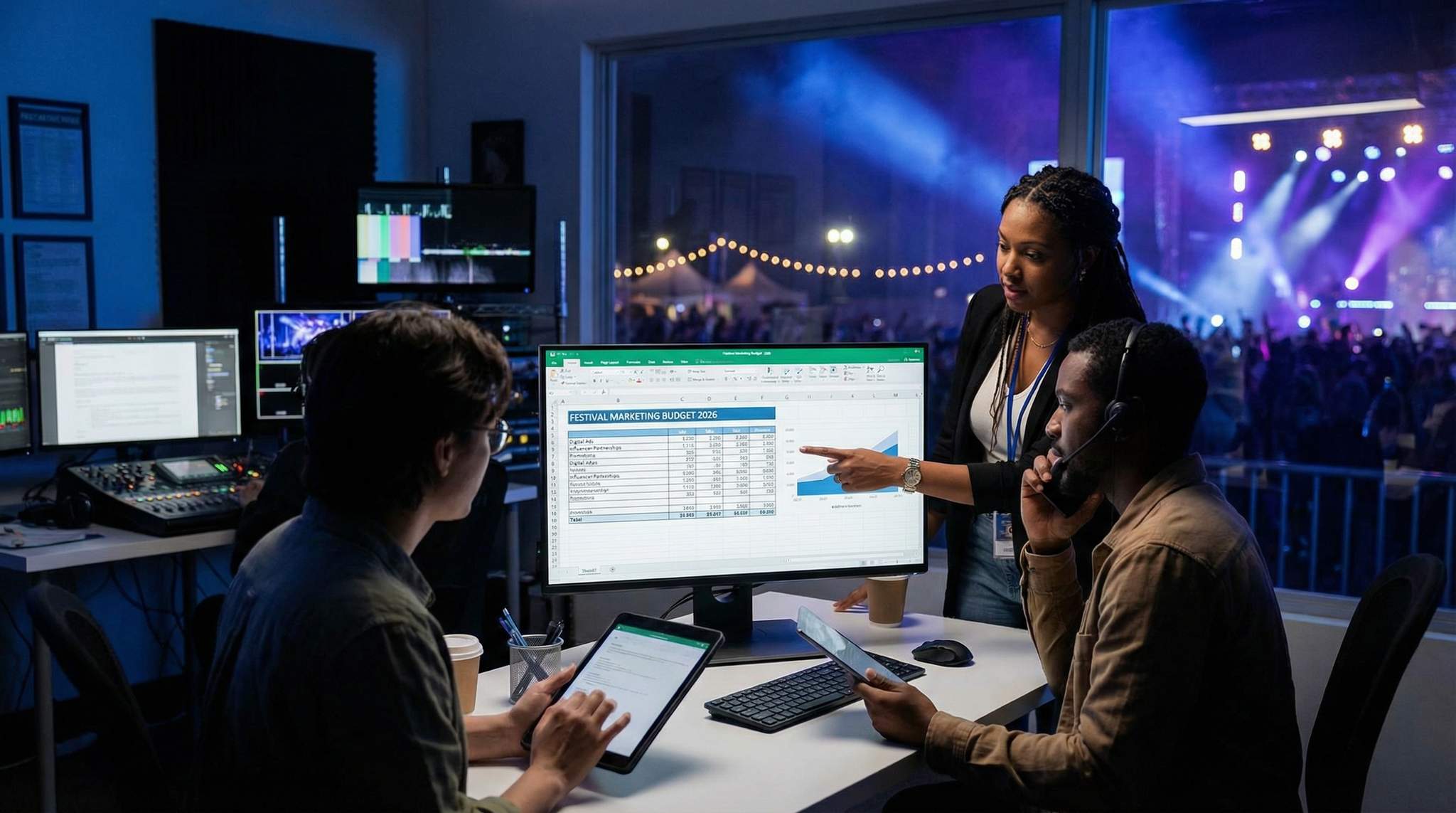
It’s often useful to create a spreadsheet (using Excel, Google Sheets, or a project management tool) to track each revenue source and expense category. Good practice is to include columns for Projected Cost, Actual Cost, and Variance. This will help later in post-event analysis, but it also forces you during planning to delineate each assumption. You may even factor in best-case, worst-case scenarios (could be separate columns or separate sheets) – for instance, a best-case where you sell out early (lower marketing spend needed) vs. worst-case of slow sales (higher marketing spend, maybe more discounts needed).
When creating a budget document, organizers often use templates tailored for event production. These can be found via industry associations or event planning resources. A solid template includes sections for income, expenses, and profit/loss calculations, formatted in a way that’s easy to update. At a minimum, include columns for Item, Description/Notes, Projected Cost, and later, Actual Cost. For marketing, your items list will be quite detailed (don’t just say “Social Media – $20k” without breakdown; split it into more detail like Facebook ads, content creation, etc., because you might end up adjusting one but not the other, and granularity helps with control).
Make sure to include all relevant expenses, even small ones – they add up. Commonly overlooked marketing costs could be things like staff meals during promo shoots, shipping costs for promotional materials, software subscriptions (Adobe Creative Cloud for designers, for example), or minor permit fees for hanging banners around town. Using a comprehensive template or checklist is key. The Ticket Fairy blog’s budgeting guides suggest remembering hidden costs like permits and safety fees. Indeed, a great piece of advice is to overestimate costs and underestimate revenues during planning, to give yourself a buffer, and allocate funds to negotiate effectively with vendors and suppliers.
To illustrate, a simplified music festival budget example for a mid-sized regional event might allocate funds across several core buckets. Out of a hypothetical $500,000 total operating budget, talent buying and production could consume 40% ($200,000), while venue logistics, security, and permits take up 30% ($150,000). The remaining 30% is typically split between marketing ($50,000 or 10%), staffing and administration ($50,000), and a crucial 10% contingency fund ($50,000). Having this baseline framework allows promoters to scale percentages up or down based on their specific operational priorities.
Also Read: Don’t forget these 10 hidden costs to budget for an event.
In the digital age, consider using cloud-based accounting or budgeting software to make updates instantly from multiple devices. Google Sheets is a simple solution if you need multiple people (say, the marketing team and the finance manager) to collaborate on the budget in real time. There are also event-specific budgeting tools that can sync with your ticket sales and expenses. Real-time tracking is invaluable – if, for example, you suddenly have to spend an extra $1,000 on last-minute print signage, updating that immediately in your budget sheet will help you see where to maybe pull back $1,000 elsewhere or dip into contingency.
It’s wise to periodically review the budget vs. actual spending as you lead up to the festival. Maybe set checkpoints – 6 months out, 3 months out, 1 month out, weekly in the final month – to compare what you planned to spend vs. what you’ve actually committed/invoiced. This way, you catch any category that’s trending over-budget while you still have time to course-correct. For instance, if you notice you’ve already spent 90% of your content creation budget but still have two more promo videos to produce, you might decide to scale back a different marketing activity to free funds, or find a cheaper way to get those videos done.
Warning: One common mistake is neglecting to include a contingency line in the marketing budget. If you allocate 100% of your funds with no wiggle room, any unexpected opportunity (like a new advertising channel or a chance to sponsor a related event) or emergency (like having to reprint banners due to a typo) will either push you over budget or force you to rob funds from another crucial area. Always budget a little extra (5–15%) for the unknown.
In summary, meticulous cost estimation and documentation might not be the most glamorous part of festival planning, but it is the bedrock of trustworthy financial management. Your budget document isn’t just a static file – it’s a living guide that will inform every marketing decision, and later serve as a retrospective tool to make your next edition even more efficient.
7. Public Relations and Media Outreach

In addition to paid advertising, public relations (PR) and media outreach play an important role in building credibility and attracting attention from local, regional, and even national media. Effective PR can yield invaluable exposure that money can’t directly buy – a feature story on your festival in a major newspaper or a spot on the morning news can massively boost awareness without the ad spend (although it requires effort and some expense to secure). However, PR and media efforts often come with their own costs, which should be factored into your marketing budget.
A professional approach to PR can set your festival apart from others. It’s about crafting a story around your event that journalists find interesting – maybe it’s the unique theme of your festival, a charity partnership, a headline performer’s only show in the region, or an innovative sustainability initiative on-site. Once you have the story angles, you need materials and hustle to get the word out.
Press Releases and Media Kits
Invest in creating professional press releases and media kits that highlight key details about your festival: lineup, location, dates, unique aspects, and quotes from organizers or headlining artists. A well-written press release follows a standard format and newsy tone that increases the chance of media picking it up. You might write multiple press releases – for example, an initial festival announcement, another when you announce the lineup, maybe a final one with finalized details and “what’s new this year.” If you’re not skilled in PR writing, hiring a freelance writer or PR agency to craft these is money well spent.
A media kit typically includes high-quality photos (from past events or concept images if it’s a first-year festival), your festival logo, possibly short bios of key players or artists, and any other info a journalist might need to quickly produce a piece about you. Budget for a photographer to capture images you can distribute, or set aside visual assets that you already have. Also budget a bit for distribution: using a wire service to send out press releases widely can cost a few hundred dollars, for instance, or you might pay for a service like PR Newswire or a music industry-specific press platform.
Don’t forget to factor in your time or a PR person’s time for media outreach. Simply sending a press release isn’t always enough – often you (or a hired PR rep) should follow up with targeted emails or phone calls to news desks, arts reporters, bloggers, radio producers, etc. If you bring on a PR agency, they might charge a flat fee or retainer to handle this outreach. If you do it yourself, the cost is mostly in labor hours, but acknowledge that in your planning (because focusing on PR might mean you need extra hands on social media or other tasks).
Also Read: Read our guide on how to write the perfect event press release.
Media Partnerships
Consider forming media partnerships with local radio stations, newspapers, magazines, or TV networks to gain additional exposure. A media partnership often involves a formal agreement where the outlet becomes an “official media partner” and in exchange for some perks, they provide a certain amount of coverage or advertising. For example, a radio station might agree to run a certain number of promo spots or do ticket giveaways on air, and in return you list them as a media partner (with their logo on your website and maybe a booth at the festival for their street team). While money doesn’t always change hands in such deals, you should budget for in-kind costs: complimentary tickets, perhaps special accommodation for their crew, or even exclusive content (like an artist interview arranged for them).
Sometimes, a media partner package might include paid components too – e.g., you buy a small ad schedule and they give bonus coverage as part of the partnership. Make sure to account for any actual cash expenditure. And if you’re giving away tickets or merch to media for promotions, note the value (as it’s effectively marketing cost). The upside of media partnerships is you can get a lot of visibility without paying full price for it, leveraging the media’s audience. It’s also a trust signal to the public if a reputable media outlet is associating with your festival.
Set aside some budget for hosting media personnel at the event. You might need a media tent with Wi-Fi, refreshments, and press passes/lanyards. While these aren’t huge costs relative to other things, they show that you take media seriously, which can encourage better coverage. For instance, having a comfortable press area might mean a journalist stays longer and writes a more in-depth review or next-day recap. Consider it an investment in experience, much like you invest in attendee experience.
Influencer and Blogger Outreach
We touched on influencers earlier as paid promoters, but here we’re talking about earned social coverage by bloggers and niche influencers. Identify music bloggers, local culture bloggers, or popular social media figures in your region who might be interested in covering the event because it’s newsworthy or exciting, not just because they’re paid. Outreach to them could include offering free press passes, arranging interview opportunities with artists or the festival director, or giving them behind-the-scenes access during the festival.
Budget-wise, this could involve some cost if you decide to pay travel for a notable blogger or YouTuber to come to your festival (maybe you invite a well-known festival vlogger). Or perhaps you host an influencer preview event – for example, a backstage tour while the stages are being built, exclusively for content creators to get a sneak peek. The cost of a small event like that (some snacks, a staff member to guide them, maybe gift bags) should be planned.
Even without special events, plan to allocate a few guest list spots for influencers/bloggers (which is income you’re foregoing in exchange for coverage). Also, any special content you create for them – like an info packet, or b-roll footage they can use – has a production cost.
Keep in mind the ethics and transparency: if you compensate any influencer or pay for their travel, they should disclose that relationship in their content per advertising standards (FTC guidelines in the U.S., for example). Being trustworthy in how you manage influencer relations will protect your festival’s reputation. It’s perfectly fine to invite and host influencers; just don’t make their coverage feel like an ad if it’s supposed to be organic. Often the best approach is simply facilitating their genuine experience (through free access and info) and letting them share honestly.
Finally, PR isn’t only about traditional media anymore. Podcasts, YouTube shows, and livestreams can be part of your outreach. Maybe you appear on a local music podcast to talk about the festival (cost: maybe just your time and a small donation or sponsorship to the podcast). Or you arrange for a popular Twitch streamer (if relevant to your audience) to do a live “countdown to the festival” stream. The lines between media and influencer can blur, so think broadly and set aside a flexible part of your budget for these emerging PR avenues.
The key takeaway is that PR and media outreach efforts can yield high-value exposure that complements your paid advertising. While they often require finesse and networking more than big spending, dedicating part of your budget to doing PR right – whether via professional help or creating top-notch press materials – will boost your festival’s authoritativeness and credibility in the public eye.
8. Post-Festival Financial Analysis

A post-festival financial analysis is essential for evaluating the financial performance of the music festival, particularly to see how your budgeting plans matched up to reality. It involves comparing actual costs and revenue against the projections in your budget. For the marketing budget, this means examining each marketing expense line: did you spend what you expected on ads, content, etc.? Which areas went over budget and which came under? By analyzing these variances, you gain valuable insights to improve future budgeting and identify opportunities to optimize costs.
One effective way to conduct this analysis (as mentioned above) is to create a table listing each budget category, the projected (budgeted) cost, the actual cost, and the variance. Here’s a simplified example of what that might look like for the marketing portion of the budget:
| Budget Category | Budgeted (USD) | Actual (USD) | Variance (%) |
|---|---|---|---|
| Advertising & Promotions | 100,000 | 110,000 | +10% |
| Content Creation | 50,000 | 45,000 | –10% |
| Sponsor & Partner Activations | 20,000 | 25,000 | +25% |
| Ticketing Platform Fees | 15,000 | 15,000 | 0% |
| PR & Media Outreach | 15,000 | 10,000 | –33% |
In the example above, you can instantly spot areas where spending was higher or lower than planned. Advertising & Promotions ran 10% over budget (perhaps due to additional last-minute ads), while Content Creation came in 10% under (maybe you produced videos more efficiently than expected). Sponsor Activations overshot by 25% – maybe you had to invest more in on-site branding for sponsors than planned, or added a new partner late in the game. PR & Media Outreach spent only two-thirds of its budget – perhaps not all planned press events were executed or some work was done in-house instead of outsourcing.
Analyzing the variance between projected and actual costs lets you identify why those differences occurred. Was it poor estimation, unexpected price hikes, or conscious decisions to reallocate funds? For example, if you overspent in advertising but underspent in PR, it could be that you found digital ads were converting better and decided to pull back on a PR agency engagement to pour more into ads. That’s a strategic decision – noting it means next year you might rebalance the initial budget toward ads. Conversely, an overspend might reveal a mistake, like underestimating print costs or needing extra last-minute expenditures due to miscommunication. Knowing this helps refine your process and maybe include a bigger contingency or better quotes next time.
Importantly, also compare revenues to expectations. Did your ticket sales meet projections? If not, was it because marketing underperformed or external factors? Often you’ll calculate a marketing ROI – for instance, if you did a special $5,000 Instagram ad campaign in the final weeks, how many tickets did it sell? If it brought in $20,000 in ticket sales, that’s a positive ROI; if only $3,000, you lost money on that tactic and need to reconsider it. Some advanced post-mortems even break down Cost Per Ticket Sold by channel: e.g., $10 of advertising spend per ticket via social ads, $5 per ticket via email (since email has minimal cost but drove a lot of sales), etc. This granularity shows which marketing channels were most cost-effective.
A thorough financial analysis also examines the why behind the numbers. Perhaps you’ll hold a debrief meeting with team leads: the marketing team might explain that an influencer partnership fell through (hence underspend there) but they pivoted to more paid ads (hence overspend there). Document these explanations alongside the raw numbers. Over years, these records become a goldmine of context that can prevent repeating mistakes and reinforce winning strategies.
As you do the analysis, calculate overall outcomes like net profit or loss for the festival, and what percentage of revenue was spent on marketing. Maybe you aimed for marketing to be 10% of total budget, but it ended up 12%. Is that okay because it delivered higher attendance, or do you need to trim it? Also, compare your festival’s ratios to any industry benchmarks if available (for example, an indie festival might expect to spend more on marketing per ticket sold than an established one, but maybe you can benchmark against similar size events).
If multiple festivals or years of data are available, you might notice trends: e.g., you needed to spend more in 2025 due to a new competitor festival in town (thus higher marketing cost to compete), or perhaps in 2026 you got more sponsorship support which effectively subsidized some marketing costs. Understanding these context factors is part of the analysis too.
Ultimately, a post-festival analysis is about learning and improving. By conducting it, organizers can make data-informed decisions to enhance financial sustainability and profitability in the future. It demonstrates to stakeholders (investors, sponsors, your own team) that you are running the festival like a business, with accountability and insight. Given the thin margins and high stakes – recall that in some regions, more than one-third of festivals risk backfiring financially – this level of financial diligence is not just advisable, it’s necessary for survival. The good news is that by mastering your budget and learning from each year’s outcomes, you’re building a playbook for long-term success in the festival industry.
Conclusion
A well-structured marketing budget is essential for the success of your music festival in 2026 and beyond. By carefully considering these eight key factors – advertising and promotions, creative development and content creation, sponsorships and partnerships, ticketing and sales strategy, estimating costs accurately, public relations and media outreach, and post-festival analysis – you’ll be able to allocate your resources efficiently and maximize your festival’s visibility and ticket sales. The festival landscape is more competitive than ever, and simply throwing money at marketing is not enough; it’s about spending smartly on the right channels and tactics.
Remember, a music festival marketing budget is not just about spending money, it’s about investing in strategic initiatives that will help you reach your target audience, build excitement, and deliver an unforgettable event experience. Each dollar in your budget should have a purpose – whether it’s capturing stunning content that will excite fans, or running an ad campaign that directly drives ticket purchases, or engaging a sponsor that will expand your reach. By viewing your budget as an investment rather than an expense, you’ll naturally think in terms of returns and impact, which is the mindset of successful festival marketers.
It’s also important to remain flexible and data-driven. Marketing trends evolve quickly; what worked last year might not work as well this year. Continuously track the performance of your marketing activities (sales data, engagement metrics, media coverage) and be willing to reallocate funds on the fly if needed. For example, if you notice mid-campaign that TikTok ads are selling more tickets than Twitter ads, shift more budget to TikTok. If press coverage is lagging, maybe boost your PR efforts or put out another story. Your budget should have some breathing room to adapt to these insights.
In summary, by carefully planning and managing your marketing expenditures, you’ll set your festival up for success and create a lasting impact in the competitive music industry. A well-crafted budget ensures you won’t overspend in one area at the cost of neglecting another, and it forces you to articulate your priorities. With the right budget, you can deliver a powerful marketing campaign that fills your festival grounds with enthusiastic attendees and leaves them buzzing long after the final encore. And when all is said and done, you’ll have the data and experience to make the next edition of your festival even bigger and better.
By mastering your marketing budget, you’re not just saving money – you’re building the foundation for an event brand that is both financially viable and fan-pleasing, year after year. That balance of fiscal responsibility and creative promotion is what will keep your festival thriving in 2026 and for many seasons to come.
Frequently Asked Questions
What are the main components of a music festival budget and why are they important?
A music festival budget is a comprehensive financial roadmap that encompasses all expected costs and revenues for the event. The key components include fixed costs like venue rental and production expenses (which remain constant regardless of attendance) and variable costs such as artist fees and marketing expenses (which can fluctuate based on attendance numbers or scope). Additionally, the budget accounts for revenue streams including ticket sales, sponsorships, merchandise, and concessions.
These components are important because they enable organizers to make informed decisions about resource allocation and to ensure no aspect of the event is underfunded or forgotten. For example, knowing your fixed costs ensures you price tickets high enough to cover the base expenses. Understanding variable costs helps in scaling the event properly (e.g., not overspending on artists if your venue capacity is limited). The revenue side is just as crucial – projecting income from different sources tells you if the festival is viable or if you need to find additional funding. Effective budget management involves real-time expense tracking, adjusting for unexpected costs, and regular reviews of your budget assumptions. This systematic approach maintains financial control and helps achieve your objectives while avoiding overspending. Essentially, the budget serves as a dynamic tool guiding decision-making throughout the planning process, helping balance the goal of creating an outstanding attendee experience with the necessity of ensuring profitability and sustainability.
How should marketing budgets be allocated between digital and traditional advertising channels?
In the mid-2020s, digital platforms are the dominant focus for music festival advertising, but a balanced approach that incorporates both digital and traditional channels can be most effective. The exact split will depend on your target audience demographics and behavior. Generally, festival organizers are allocating a significant portion – often the majority – of their marketing budgets to digital channels. This includes social media advertising (Instagram, Facebook, TikTok, YouTube), search engine marketing (Google Ads targeting specific keywords), and display ads. For a festival targeting younger, tech-savvy attendees, it wouldn’t be uncommon to spend 60–70% of the ad budget on digital channels, because that’s where those potential attendees spend their time and attention.
However, traditional advertising still has value, especially for local and broad awareness. Radio, billboards, print flyers/posters around town, and even local TV spots can effectively reach audiences that digital ads might miss. A festival with a broad local appeal might dedicate, say, 20–30% of its ad budget to traditional media. For example, community festivals or those in regions where local radio has a strong following could benefit from radio ads and on-air contests.
Influencer partnerships occupy a bit of a middle ground – they’re a digital word-of-mouth channel. Many organizers carve out a separate portion of the budget for influencers depending on the festival genre (for an EDM festival, maybe a notable chunk goes to popular DJs or dance influencers; for a folk festival, maybe very little if that audience isn’t on influencer-heavy platforms).
Festival listings and event discovery platforms can be seen as another slice, though usually smaller and often a fixed cost (e.g., a few hundred dollars for a featured listing).
The key is to distribute the budget based on where your target audience is most active and responsive. For a youth-oriented festival, nearly all marketing might be online and on-campus outreach, whereas a heritage rock festival might still rely on classic rock radio and newspaper coverage in addition to Facebook. It’s also crucial to remain flexible: start with an allocation plan (maybe 70% digital, 20% traditional, 10% experimental like influencers) and then monitor results. If you see a great ROI from a traditional channel, you can nudge more budget there, or vice versa. The budget should be a living document that responds to performance metrics and audience feedback from the different channels.
What role do sponsorships and partnerships play in festival marketing budgets?
Sponsorships and partnerships play a dual role in festival marketing budgets: they are both a source of funding and a component of the marketing strategy. On the funding side, sponsors contribute cash or in-kind value (goods, services, promotions) that effectively increase your overall budget and can cover significant festival costs. For example, a beverage sponsor might supply drinks (reducing your F&B costs) or pay a fee to be the exclusive provider, which directly adds to your revenue. This means a healthy sponsorship program can alleviate pressure on ticket sales to fund everything – a big sponsor might cover the entire marketing budget in some cases.
On the marketing side, sponsors and partners can greatly amplify your festival’s reach. Many sponsors will promote the event through their own channels as part of the partnership – for instance, a sponsor might run a contest for their customers to win festival tickets, essentially marketing your event to their audience at no extra cost to you. Partnerships with media (radio stations, local TV, newspapers, blogs) often involve them giving you advertising space or editorial coverage in exchange for being associated with the festival. Local business partnerships (like with hotels, airlines, or tourism boards) can also extend your marketing, such as a hotel offering travel packages that include festival tickets, or a tourism board featuring your festival in their city promotions.
In the budget, you should account for sponsorship activation costs – money you’ll spend to service those sponsors or partners. This includes creating the promised deliverables (printing banners with sponsor logos, providing comp tickets/VIP hospitality, running joint promotions). It’s important to note these aren’t “free” – they cost something, but ideally far less than the value the sponsor provides. For instance, if a sponsor gives $20,000, you might spend $2,000 of it on fulfilling their perks and still net $18,000 that can go into your general or marketing budget.
Additionally, some partnerships directly offset marketing costs. If a media partner gives you $10,000 worth of ad space, that’s $10,000 of advertising you don’t have to buy in your budget (though you might list it as in-kind in your accounting). Or a partnership with a Spotify playlist curator could give you exposure without a large spend.
In summary, sponsorships and partnerships are critical because they can significantly boost your marketing capabilities without proportional spending. They bring third-party credibility (people trust a festival more if big brands or respected organizations back it) and can open new promotional avenues. A strong sponsorship strategy effectively expands your marketing budget – either by providing additional funds or by sharing the promotional load – but it requires careful budgeting and management to deliver the promised returns to those partners. Many festivals that thrive have a big chunk of their marketing presence owed to sponsors (think of stages named by brands, or “street team” promotions by partners, etc.). It’s a symbiotic relationship: sponsors help you market and execute the festival, and in return, you help them reach an audience in an authentic way.
How should festivals approach content creation and creative development in their marketing budget?
Festivals should approach content creation and creative development as a core investment in their brand, not an afterthought. In the marketing budget, a healthy allocation should be set for producing high-quality visuals and engaging content, because this is what ultimately grabs people’s attention and defines the festival’s identity. Here are key approaches:
-
Professional Photography & Videography: Festivals should budget for professional photographers and videographers during the event and potentially for pre-event promotional shoots. As mentioned, compelling aftermovies, recap videos, and photo galleries can be some of the most powerful marketing assets, driving excitement and FOMO (fear of missing out). Plan the costs for a media team, including editing. For example, if you want a next-day highlight video while the festival is ongoing, you might hire an extra editor to work on-site.
-
Graphic Design & Branding: Allocate funds to develop a strong visual brand (logos, color schemes, poster designs). This often means working with a graphic designer or agency early on. All marketing materials – from your website to merch to stage scrims – should reflect this branding. Festivals often spend a few thousand dollars on initial design packages and then more on adapting that art across various media. A well-designed poster or website can significantly increase perceived credibility and interest.
-
Social Media Content: Plan for continuous content creation leading up to the festival. This could include artist announcement graphics, behind-the-scenes videos (e.g., stage build timelapses or interviews with staff about preparations), attendee engagement posts (“Which headliner are you most excited for?” polls), and more. If your team doesn’t have the bandwidth, hiring a social media content creator or manager is worthwhile. They ensure your channels stay active and on-message. The budget here might cover their fees and the tools/subscriptions they need (like design apps, scheduling tools, maybe travel cost if they need to meet artists for an interview, etc.).
-
Website and Landing Pages: Even though it’s not as flashy, a portion of the creative budget goes into web design. A festival’s website must be easy to navigate and visually appealing. Budget for web developers or a good template, plus copywriting for the web content. If you run specific marketing campaigns (say a holiday ticket sale or a theme reveal), consider making dedicated landing pages – budget the creation of those too. They can improve conversion rates by focusing a visitor’s attention.
-
Innovative Content: In 2026, some festivals are experimenting with things like AR filters (for Instagram/Snapchat) or interactive online experiences. For example, a filter that lets users put the festival’s theme graphics on their selfies. These can cost money to develop, but they can go viral. Consider if such creative tech fits your audience and allocate funds accordingly.
The underlying strategy should be consistent: content should tell a story about your festival. Whether it’s “This is the craziest EDM party of the year” or “We’re a cultural experience with art and wellness,” your photos, videos, and design need to convey that message. Budget enough to get it right. Cutting corners (like not hiring experienced creatives) can hurt – blurry photos or amateurish graphics can make a festival look unprofessional and turn off ticket buyers.
Another tip: repurpose content across platforms to maximize value. A professionally shot 30-second promo video can be cut into shorter clips for TikTok, still frames can become Instagram posts, etc. This way the money you spend on one piece of content yields multiple assets.
In summary, festivals should intentionally carve out a significant part of the marketing budget for content and creative work because it’s the face and voice of your marketing. It’s how you generate hype and differentiate your event. Approach it with a mindset that you are producing a media experience, not just an event, and fund it accordingly.
What strategies should be implemented for effective ticketing and sales management?
Effective ticketing and sales management relies on a combination of smart pricing, incentivization, tech infrastructure, and marketing tactics that all need support in the budget. Here are strategies and how they tie into budgeting:
-
Tiered Ticket Pricing: Implement tiered pricing (Early Bird, Advance, Last Minute) to reward early purchases. Strategically, this helps cash flow and builds commitment from fans early on. From a budget perspective, treat the discounts in early tiers as a marketing cost. You’re willingly taking a lower margin on those tickets to drive urgency. Make sure your financial plan can handle that – essentially budgeting a certain percentage of tickets to be sold at lower prices. Also, plan the schedule (e.g., “Early Bird ends on X date or when 500 tickets sold”) and have marketing pushes ready for each phase.
-
Promo Codes and Flash Sales: Use promo codes for specific audiences (college students, certain fan clubs, promo via influencers) to track and boost sales in those segments. For example, give a popular local DJ a promo code for their followers that gives 10% off. This is a marketing tactic that can drive incremental sales. In terms of strategy, it’s targeted discounting; in the budget, again, it’s foregone revenue that you consider as advertising spend. Limit and monitor these to ensure you’re not giving too much away. One way is to set aside, say, $5,000 worth of discounts spread across all codes and monitor redemption.
-
Payment Plans: Offer layaway or payment plans for higher-priced tickets or packages. While not a direct marketing expense, this can increase sales by making tickets more affordable. There might be a small cost if your ticketing platform charges extra for handling payment plans, or if there’s a risk of defaults. But often, those fees can be passed on or are minimal. This is more of a policy decision than a budget item, but it’s worth mentioning as a strategy because making tickets financially accessible can reduce the need to discount heavily later.
-
CRM and Data Analysis: Using CRM tools and sales data can help you identify trends, like when most people buy tickets and who your audience is (zip code, age range, etc.). Strategically, this means you can focus marketing where it’s most effective. For example, if data shows a lot of ticket buyers are from a particular city or university, you might target more ads there or do street team marketing on that campus. Budgeting for a CRM or at least dedicating time to analyze ticket reports is important – it’s an often underused strategy. Email segmentation and retargeting we discussed are enabled by this data analysis.
-
Retarget Abandoned Carts: If someone starts buying a ticket online but doesn’t complete the purchase (abandoned cart), have a system (through your ticketing platform or a script on your site) to capture that email or device for follow-up. This could be an automated reminder email – “Oops, you left XYZ Festival tickets in your cart. Complete your purchase soon before this tier sells out!” Sometimes including a small incentive in that follow-up (like a free merch item at pickup if you complete purchase) can tip people over. This strategy improves conversion and doesn’t cost much – maybe a bit of integration work and the cost of the incentive items (if you use them). Budget a small amount for this if needed (like $500 worth of merch as cart conversion incentives).
-
Last-Minute Sales Push: Recognize that in recent times many fans buy late – often just a few weeks or days before the festival (sometimes called the “last-minute sales surge”). Strategize for this by reserving some marketing budget for late-phase advertising. If you blow your entire budget early, you’ll have nothing to fuel that final push. So explicitly allocate maybe 15–20% of your marketing spend to the final month before the event. That might include retargeting ads (“It’s not too late to join the party!”) or partnering with local businesses for last-minute promotions (like putting up a banner in a popular bar or a countdown on local radio).
-
On-Site and Future Sales: Another strategy is to use the current festival to sell tickets for the next one (if it’s annual). Some festivals offer “loyalty” or “early bird for next year” on the last day of the festival when excitement is high. That’s more revenue-side strategy, but you might budget a bit for marketing materials on-site (like signage that next year’s tickets are available at a special price only today). It’s an effective way to immediately reinvest fan enthusiasm into future sales.
From a management perspective, also ensure you have a smooth ticketing process: any friction like a slow website, limited payment options, or unclear pricing can hurt sales despite great marketing. If it costs a bit more to get a robust ticketing solution or hire a consultant to set up a queuing system for on-sale, it’s worth it and should be considered in the budget.
In short, effective ticketing strategies revolve around making it easy and compelling for people to buy, as early as possible, while also accommodating those who decide late. It’s about finding the sweet spot in pricing (not too high to deter, not so low you leave money on the table) and leveraging psychological triggers (urgency, exclusivity of early bird deals, fear of missing out as tickets run low). By budgeting for the tools (ticketing platform fees, maybe a bit for an app or sales analytics, and promo allowances) and aligning your marketing tactics with these strategies, you create a sales machine that maximizes attendance and revenue, which is the ultimate goal.
If you are hosting a local music festival in your area, what are 3 advertising mediums you would suggest?
When planning a regional event, organizers often ask: “Imagine you are hosting a music festival in your area. Identify 3 advertising mediums you would suggest for the festival to maximize local turnout.” For a localized approach, the three most effective mediums are typically: 1) Geo-targeted social media ads (specifically Meta and TikTok) to reach specific age demographics within a 50-mile radius; 2) Local radio partnerships, which offer both paid spots and organic on-air ticket giveaways that build community trust; and 3) Grassroots out-of-home (OOH) advertising, such as strategically placed posters, flyers at partner venues, and digital billboards in high-traffic local corridors. This mix ensures you capture both digital attention and physical community presence.
What are the most cost-effective strategies for music festival promotion?
For independent promoters and venue operators, cost-effective music festival promotion relies heavily on leveraging existing networks and organic reach before tapping into heavy paid ad spend. One of the highest-ROI tactics in marketing for music festivals is implementing a peer-to-peer rewards program. By incentivizing your early ticket buyers to refer friends in exchange for VIP upgrades, exclusive merchandise, or drink tokens, you transform your audience into an active promotional street team.
Additionally, maximizing your owned media channels—such as a highly segmented email list and SMS marketing—ensures you are communicating directly with high-intent buyers without paying platform algorithms for reach. Partnering with performing artists to run coordinated lineup announcements, complete with custom tracking links and pre-made social assets, is another essential strategy. This collaborative approach to promotion ensures that every dollar allocated in your marketing budget is optimized for maximum ticket conversions.
What is the most effective framework for how to market a music festival from scratch?
When determining how to market a music festival that is entirely new to the market, organizers must prioritize brand positioning and community trust over immediate hard-selling. The most effective framework begins with a “teaser” phase focused on capturing email leads and building social media momentum before any lineup is announced. From there, marketing a new live event transitions into the “awareness” phase, leveraging early-bird pricing and influencer partnerships to generate initial revenue. Finally, the strategy shifts to conversion-focused digital ads and retargeting to sell out the remaining inventory. Successful promotion relies on this phased approach, ensuring that your advertising budget is spent efficiently across the entire ticketing lifecycle rather than exhausted in the first week.
What are the first steps in how to promote a music festival successfully?
When determining how to promote a music festival, the first step is establishing a clear brand identity and target audience before spending a single dollar on ads. From there, organizers should build a phased promotional calendar. Phase one focuses on lead generation (capturing emails and SMS contacts via pre-registration). Phase two leverages lineup announcements and early-bird pricing to drive initial revenue. Phase three involves retargeting and community-driven word-of-mouth to sell out the remaining allocation. For those looking at how to promote concerts and music festivals simultaneously, centralizing your audience data in a robust CRM is critical, allowing you to cross-promote upcoming shows to past attendees efficiently.
How do you budget for a music festival effectively?
Learning how to budget for a music festival starts with separating your fixed operational costs (venue, permits, stage build) from your variable expenses (marketing, artist hospitality, ticketing fees). A best practice for any budget festival model is to build your financial projections based on a conservative 50% to 60% ticket sell-out rate, rather than assuming a sold-out show. This ensures your baseline festival budget can cover all essential liabilities even if attendance is lower than expected. From there, allocate 10-15% of your projected revenue specifically to marketing and promotion, and always maintain a strict 10% contingency fund to absorb unexpected day-of-show expenses.
How can organizers maximize music festival revenue beyond standard ticket sales?
To truly maximize music festival revenue, organizers must look beyond the baseline of general admission ticketing. The most profitable events diversify their income through strategic VIP tiering, premium add-ons (like glamping or fast-pass entry), and robust on-site monetization. Securing lucrative brand sponsorships and charging vendor pitch fees for food and merchandise stalls also provide significant upfront capital. Additionally, integrating cashless RFID wristband systems has been shown to increase on-site attendee spending by 15-30%, driving higher food, beverage, and merch sales throughout the event weekend.
What are the most critical phases when marketing a music festival?
When marketing a music festival, the campaign should be broken down into distinct phases to maximize budget efficiency. The initial phase focuses on brand awareness and lead generation, often utilizing pre-registration landing pages and teaser content. The second phase is the lineup drop and early-bird on-sale, where the bulk of your initial music festival promotion budget should be deployed to capture high-intent buyers. Finally, the conversion phase relies heavily on retargeting ads, urgency-driven messaging, and peer-to-peer referral incentives to push the remaining ticket inventory. Structuring your promotional efforts this way ensures you aren’t burning through your ad spend before the crucial final weeks.
What are the most common pitfalls when marketing a music festival?
When marketing a music festival, the most common pitfall is exhausting the advertising budget too early in the campaign. Many organizers overspend during the initial lineup announcement, leaving insufficient funds for the critical final weeks when the majority of late-adopters actually purchase tickets. To avoid this, a well-structured plan for how to market a music festival should always reserve at least 20% of the digital ad spend for bottom-of-funnel retargeting and last-minute conversion pushes.