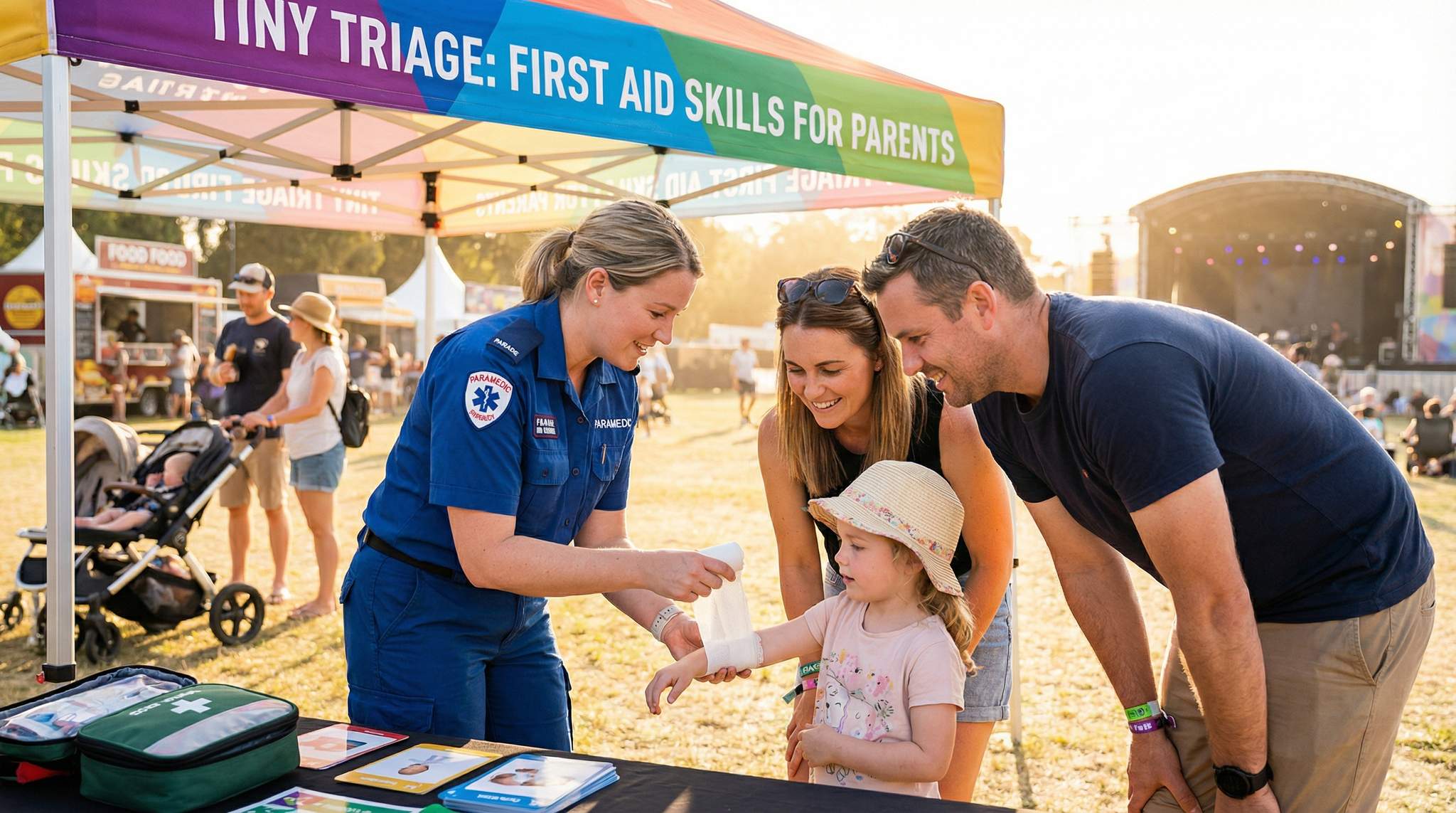
At family-friendly festivals, parents often juggle keeping their kids entertained and safe. Amid the fun, minor mishaps like scraped knees, dehydration, or a child choking on a snack can happen in an instant. By empowering parents with basic first-aid “tiny triage” skills, festivals can create a safer environment for families. Offering quick, practical first-aid classes on-site not only gives parents confidence to handle small emergencies, but also helps reduce the burden on medical tents and staff.
Why Offer First-Aid Workshops for Parents?
Family festivals are vibrant and busy, which can lead to occasional tumbles, heat fatigue, or other child-related health scares. Having festival organizers facilitate mini first-aid workshops is a proactive way to keep everyone safer. Empowered parents are more likely to take prompt action when something happens, meaning fewer panicked trips to the medical tent for minor issues. For example, if a child feels faint from the sun, a parent who recognizes early signs of heat exhaustion can intervene with rest and fluids before things escalate, a strategy supported by Penfield Children’s Center safety guidelines. If more parents are first-aid savvy, the festival’s medical team can focus on truly urgent cases instead of treating every small cut or dizzy spell.
This strategy has community-building benefits as well. Parents appreciate festivals that go the extra mile for safety and education. It sends a message that the event cares about families’ well-being, not just entertainment. Glastonbury’s long-time medical coordinator has noted that when festival-goers are educated on basics like staying hydrated and treating blisters, it “makes a noticeable difference” in reducing on-site medical incidents (as reported in internal safety debriefs). By teaching parents a few key skills, festivals encourage a shared responsibility for safety. It transforms moms and dads from anxious bystanders into capable first responders for their own kids.
Bite-Sized Classes on Common Emergencies
The key is to keep the classes short, engaging, and relevant. Think of them as tiny triage sessions—15 to 30 minutes covering the most common situations that families face at festivals:
Free Tool: Size Your Festival Site
Zoned capacity planning for arena, campsite, parking and entry lanes — against UK Purple Guide and NFPA density standards. Finds your bottleneck zone.
- Bandaging Bumps and Cuts: Teach parents how to clean and bandage minor cuts, scrapes, or blisters quickly. With kids running around on festival grounds, scraped knees or stubbed toes are almost guaranteed by day’s end. A quick demo on proper bandaging technique (and what to do if there’s bleeding) goes a long way. Parents can practice applying a bandage or using disinfectant wipes properly. Emphasise using the supplies available at a typical festival first-aid station or the contents of a basic portable first-aid kit.
- Heat Stress and Dehydration: Outdoor festivals under the sun can put children at risk of heat exhaustion. In a bite-sized class, clinicians can show parents how to spot early signs of heat stress—such as dizziness, clamminess, or an upset stomach—and the steps to take: moving the child to shade, offering water or electrolyte drinks, cooling them down, etc. Remind parents that kids (and adults) get easily distracted by festival excitement and may forget to hydrate, a common risk highlighted by child development experts at Penfield Children’s Center. A little knowledge here means parents can act before a child’s condition requires medical intervention. Real-world festival case studies often find dehydration as a top cause of kid (and parent) trips to the first-aid tent, so prevention and early response are critical.
- Choking Response: With delicious (and sometimes chunky) festival foods in hand, choking is a scary but possible emergency. A mini-class can arm parents with the techniques to save a choking child: how to perform effective back blows and abdominal thrusts (the Heimlich maneuver) for different ages. This is truly life-saving knowledge. There have been instances at community events where a child choking on food was saved by a quick-thinking bystander. In fact, a recent BBC News story told how an 11-year-old boy saved his younger sister from choking on a grape using back blows he learned in a short first-aid lesson at school. His first-aid instructor noted that just 90 minutes of training at school gave him the skills to save a life. If a child can gain such knowledge in an hour and a half, imagine what parents can learn in a brief festival workshop.
Each topic should be presented practically, skipping heavy theory. Use visual demonstrations – for choking, instructors might use a child-sized mannequin or even a simple diagram to show the technique. For bandaging, let a parent volunteer actually wrap a bandage on someone’s arm under guidance. When parents do the action hands-on, they’re more likely to remember it.
Staffed by Clinicians – Keep It Credible and Practical
To ensure these workshops are effective, staff them with real clinicians or certified first-aid instructors. Partner with local healthcare providers, paramedics, Red Cross/Red Crescent volunteers, or event medical staff who have experience with children’s emergencies. Having a friendly nurse, EMT, or doctor lead the session lends credibility – parents know they’re learning vetted techniques, not old wives’ tales. It’s important for attendees to trust the information, and there’s no substitute for a knowledgeable clinician in the teaching role.
Planning a Festival?
Ticket Fairy's festival ticketing platform handles multi-day passes, RFID wristbands, and complex festival operations.
Instructors should focus on practical steps and simple mnemonics. Avoid medical jargon; instead, use festival scenarios and plain language. For example, the instructor might say: “If your toddler gets woozy after hours in the sun, that could be heat exhaustion – here’s what to do immediately…” and then walk through the steps. They might share quick decision rules like when to dial emergency services versus when something can be handled on-site. By keeping the tone supportive and encouraging, parents won’t feel intimidated about asking questions or admitting they don’t know something.
Several festivals have successfully collaborated with medical charities or local hospitals to run similar initiatives. In Australia, a family music festival in Melbourne teamed up with St. John Ambulance to station a few volunteers at the kids’ zone, where they ran 20-minute “Stop the Boo-Boos” clinics for parents. The volunteers (all certified first-aiders) reported that many parents were eager to learn, especially when it was framed as gaining confidence to protect their children. In the UK, the massive Camp Bestival event (which draws thousands of families) partnered with a baby safety organisation to offer advice to parents and even provided on-site expert tips on safe infant sleep and infection prevention, underscoring the value of having health professionals engage with festival-goers. These examples show that when festivals invest in family wellness education, it resonates strongly with the audience.
Scheduling Between Headliners
Timing is everything. To maximize participation, schedule these first-aid micro-classes during natural lulls in the festival program – between headliner performances, mid-afternoon breaks, or early in the day before the big acts start. For instance, if the main stage’s headline band plays at 8:00 PM, consider running a “Parents’ First-Aid Power Session” at 6:30 PM, right after the opening act and before families stake out spots for the headliner. At that time, parents are likely free and wandering with their kids, so it’s perfect for a quick learning stop.
Many family-friendly festivals also have a dedicated kids’ area or family zone with its own schedule of activities. That can be an ideal spot and time for first-aid sessions. You could announce: “Next up at the Family Tent: 15-Minute First-Aid for Parents – How to Handle Common Kid Emergencies.” Scheduling it after a children’s entertainer or before a family movie night ensures parents are already gathered and can stay for the workshop without missing other attractions.
Free Tool: Project Your Bar Revenue
Per-head spend benchmarks by event type turned into projected bar and food revenue, with a stock-mix estimate and gross-margin line. Free calculator.
Keep the sessions short enough that parents don’t worry about their kids losing patience. It might help to have a small play corner or an entertainer to occupy children right next to the class area. For example, at a Singapore family festival, organizers set up a coloring station for kids adjacent to the first-aid workshop; while parents learned about bandaging techniques, kids colored in pages about “festival safety” (a clever tie-in). This way, parents could focus on the instructor for a few minutes without interruptions.
Be sure to advertise the class timings in advance. Use the festival’s app, program leaflet, and signage to remind people (“First-Aid for Parents workshop at 3 PM near the Kids’ Stage”). Some events even announce it from the stage: e.g., “Between our music acts, don’t forget to drop by the Family Tent at 4 PM for a quick first-aid class for parents!” When parents know the festival offers this, they’ll plan to attend, because it’s a unique opportunity to gain peace of mind while at the event.
Need Festival Funding?
Get the capital you need to book headliners, secure venues, and scale your festival production.
Take-Home Cards and QR Links for Reinforcement
Learning doesn’t end when the workshop does. Providing take-home reference material helps parents retain and use their new skills. Prepare pocket-sized cards or foldable pamphlets that summarize the key steps for each emergency covered – essentially a mini first-aid guide that fits in a pocket or diaper bag. For example, a card might list bullet points on what to do if a child shows signs of heat exhaustion, or the quick steps to treat a bleeding cut (clean, apply pressure, bandage, monitor). These cards serve as handy cheatsheets if a parent needs a quick reminder later in the festival (or back at home). The Irish Red Cross even offers a printable wallet-sized first aid guide, which could be adapted with festival branding and the specific tips taught in your class.
Including QR code links on these cards is a smart way to connect parents with more in-depth resources. The QR codes can lead to trusted first-aid websites or short YouTube videos demonstrating the techniques. For instance, one QR code could open the Red Cross or St. John Ambulance’s official page on child CPR and choking response. Another could link to a short blog post on preventing heat stroke in kids. Many first aid organizations have free mobile apps – the British Red Cross has an app full of quick videos and interactive quizzes. Consider printing a QR code on the card that directly prompts parents to download a recommended first-aid app. This way, parents leave not only with knowledge from the class, but also with tools for future learning.
You might also email out digital resources. If your ticketing platform (such as Ticket Fairy) allows you to message attendees, send a follow-up thank-you email to those who attended the workshop, including PDF guides or links. This reinforces the learning and shows that the festival truly cares about attendee well-being beyond the event itself.
Reducing Medical Incidents Through Empowerment
One major benefit of training parents in first aid is a tangible reduction in minor medical incidents requiring festival staff intervention. When parents can handle small issues, the on-site medics and first-aid tents see fewer cases of “basic bandaid fixes” or fainting spells that can be resolved with water and rest. “Empowered parents lower the med load” is more than a slogan – it’s backed up by festival experiences. Organizers from a large outdoor festival in California noted that after introducing parent first-aid sessions, minor first-aid visits (for things like heat, cuts, and similar) dropped by an estimated 20% the following year. Parents were simply managing more on their own, armed with the tips they’d learned.
Turn Fans Into Your Marketing Team
Ticket Fairy's built-in referral rewards system incentivizes attendees to share your event, delivering 15-25% sales boosts and 30x ROI vs paid ads.
Encouraging the audience to take part in safety also builds a sense of community. Festivals often talk about the “festival family” – and in a literal family festival, that spirit is even stronger. When parents feel capable, they also tend to look out for not just their own kids but others around them. It’s not uncommon to see a mom who’s learned first aid in the afternoon lend a hand to another family’s child who fell during an evening show. This peer-to-peer assistance means small problems get dealt with on the spot, faster than waiting for medics to arrive.
Of course, it’s crucial to emphasize that the festival still has professional medical services on-site for anything serious. The goal isn’t to replace the medics, but to create a first line of response for minor issues. Parents should always know how to contact the festival’s medical team or when to seek professional help (and your workshops should clarify those boundaries – e.g., “If a cut is more than a shallow scrape or if bleeding doesn’t stop in 10 minutes, it’s time to get the medics involved.”). By combining knowledgeable parents with readily available medical staff, you establish a robust safety net from top to bottom.
Tips for Different Festival Types and Audiences
Every festival is different. A small community food festival might have a handful of local families attending, whereas a huge international music festival could see thousands of parents with kids in tow. Tailor your first-aid workshop approach to the scale and audience:
- Small Local Festivals: These often have tight-knit crowds and a bit more flexibility. You could run multiple very short sessions throughout the day (e.g., a 10-minute demo every hour at the community center booth). Local festivals might collaborate with community health nurses or volunteer firefighter EMTs to teach parents. Because the atmosphere is informal, instructors can do roving demos – even walking up to picnic tables of families and saying “Hey, can I show you a two-minute trick to stop a nosebleed?” This personable approach can work wonders at fairs or town festivals.
- Large Festivals: Bigger events should schedule formal sessions with a sound system and a clear location, because you’ll need to grab people’s attention amid more noise and activity. Use your festival app to push notifications: “Learn to save a life in 15 minutes – First Aid for Parents at 2 PM in Family World tent.” At larger festivals, consider focusing on the most crucial topics (as attention spans may be short). You might also limit class size for a more hands-on experience, and repeat sessions so everyone interested gets a chance. Large festivals can leverage sponsors – for example, a pediatric hospital or a family brand might love to sponsor your parent first-aid lounge in exchange for some visibility, helping cover the costs of equipment and staff.
- Cultural or Niche Festivals: Adapt to the context. At a food festival, maybe emphasize choking response and food allergy first aid (like using an EpiPen) in your training. At a summer outdoor festival in a hot climate, extra focus on heat-related illness and sunburn care is wise. For an indoor winter holiday festival, you might include tips about hypothermia or slips on ice. Know your audience’s demographics too – if you expect a lot of infants and toddlers, include infant CPR or what to do for a baby choking on milk; if the crowd has older kids, you might cover things like sprained ankles from playgrounds or even basic CPR for teens and adults. Customising the content makes it more relevant and valuable for your attendees.
Also be mindful of cultural differences in medical training. In some countries, citizens regularly receive first-aid training (for example, many schools in Europe teach it as part of the curriculum), while in others, parents may have had little exposure to it. Gauge the comfort level of your audience. It can help to start by asking, “How many of you have ever taken a first-aid class?” and “What are some emergencies you worry about with your kids?” This engages the group and lets the instructor adjust emphasis – for instance, if many parents express worry about allergic reactions, spend a few minutes on that even if it wasn’t in the original plan.
Measuring Success and Learning from Failures
After implementing parent first-aid sessions, gather feedback and data. Track how many people attend each workshop and ask for quick feedback (a show of hands or a short survey via QR code). Maybe even offer a fun incentive – “Complete our safety quiz and get a free festival tote bag!” – to encourage participation and gauge what they learned. If some techniques seem confusing or parents still flock to the medical tent for things you covered, that’s a signal to tweak your approach next time.
Share stories of when the training paid off. Did a parent actually treat their child’s minor cut on Day 2 without needing the medics? Did someone step in to help a lost child who was dehydrated, using the tips from the workshop? Celebrate those successes on your social media or in a post-event newsletter: “We’re proud that dozens of parents at Festival XYZ learned first aid skills – and one hero dad even used his new know-how to help a child who got dust in her eyes during the fireworks show!” Real examples drive home the impact.
Smooth Entry With Mobile Check-In
Scan tickets and manage entry with our mobile check-in app. Supports photo ID verification, real-time capacity tracking, and multi-gate coordination.
Not every attempt will be perfect. Maybe the first session only had three parents show up because it wasn’t advertised well – that’s okay. Learn and improve marketing for the next day. Or perhaps you realize 30 minutes was too long and lost people’s interest; next time, shorten it or make it more interactive. Treat the program itself with a continuous improvement mindset, just like any other part of festival operations.
Even a well-prepared parent can’t handle everything alone – don’t consider it a failure if medics still get calls (they inevitably will). The goal is simply to reduce avoidable incidents and empower attendees. As long as some parents walk away saying, “I feel much more prepared now,” consider your first-aid workshop a win.
Frequently Asked Questions
Why should festivals offer first aid workshops for parents?
Facilitating first-aid workshops empowers parents to handle minor emergencies like scrapes or heat fatigue, significantly reducing the burden on medical staff. When parents can manage small issues immediately, medical teams can focus on urgent cases, creating a safer and more community-focused environment for families.
What are the most important first aid skills for parents at festivals?
Parents benefit most from learning “tiny triage” skills covering three common areas: bandaging minor cuts and blisters, recognizing and treating heat stress or dehydration, and performing choking responses like back blows. Mastering these basics allows for prompt intervention during typical outdoor event mishaps.
How should parents treat heat exhaustion in children at outdoor events?
Parents must immediately move the child to a shaded area and provide water or electrolyte drinks to cool them down. Recognizing early signs like dizziness, clamminess, or an upset stomach allows caregivers to intervene with rest and fluids before the condition escalates to a medical emergency.
What is the correct first aid response for a choking child?
Effective response involves performing a combination of back blows and abdominal thrusts (the Heimlich maneuver) tailored to the child’s age. Learning these life-saving techniques through practical demonstrations enables parents to act instantly if a child chokes on food, a critical skill given the prevalence of festival snacks.
Who should lead first aid training sessions at festivals?
Certified clinicians, such as nurses, paramedics, or Red Cross volunteers, should lead these sessions to ensure credibility and accuracy. Utilizing medical professionals helps parents trust the advice given, ensuring they learn vetted techniques rather than relying on myths or unverified home remedies.
When is the best time to schedule parent safety workshops?
Organizers should schedule short workshops during natural lulls in the program, such as between headliner performances or during mid-afternoon breaks. Hosting sessions in family zones before major acts start ensures parents are available to attend without missing the main entertainment.
How does parent first aid training reduce festival medical incidents?
Equipping parents with basic medical knowledge creates a first line of response that lowers the volume of minor visits to medical tents. Festivals have reported reductions in on-site medical incidents by approximately 20% when parents are empowered to treat simple issues like blisters or mild dehydration themselves.
What first aid resources should festivals provide to attendees?
Events should distribute pocket-sized reference cards or foldable pamphlets summarizing key steps for treating cuts, heat stress, and choking. Including QR codes on these materials connects parents to digital resources, such as instructional videos or reputable first-aid apps, reinforcing the skills learned on-site.