The Challenge of Desert Festivals
Hosting a festival in a desert or arid plain means confronting an extreme environment head-on. Desert festivals face searing daytime heat, plunging night temperatures, unrelenting dust storms, and a complete lack of built infrastructure. From the Black Rock Desert of Nevada to Australia’s outback or the Sahara’s fringes, festival producers must plan every detail of power, water, and safety well beyond the norm. The effort is enormous but achievable – as proven by famous events like Burning Man in the USA, AfrikaBurn in South Africa, Midburn in Israel’s Negev, and mainstream music festivals like Coachella in California’s Inland Empire.
These case studies showcase how seasoned festival teams innovate to provide electricity, manage dust, safeguard attendees from heat, and coordinate logistics in unforgiving landscapes. By comparing their approaches – from microgrid power setups to dust mitigation and wet-bulb globe temperature (WBGT) heat safety triggers – new festival organizers can glean practical tactics for any desert production.
Off-Grid Power: Microgrids in the Desert
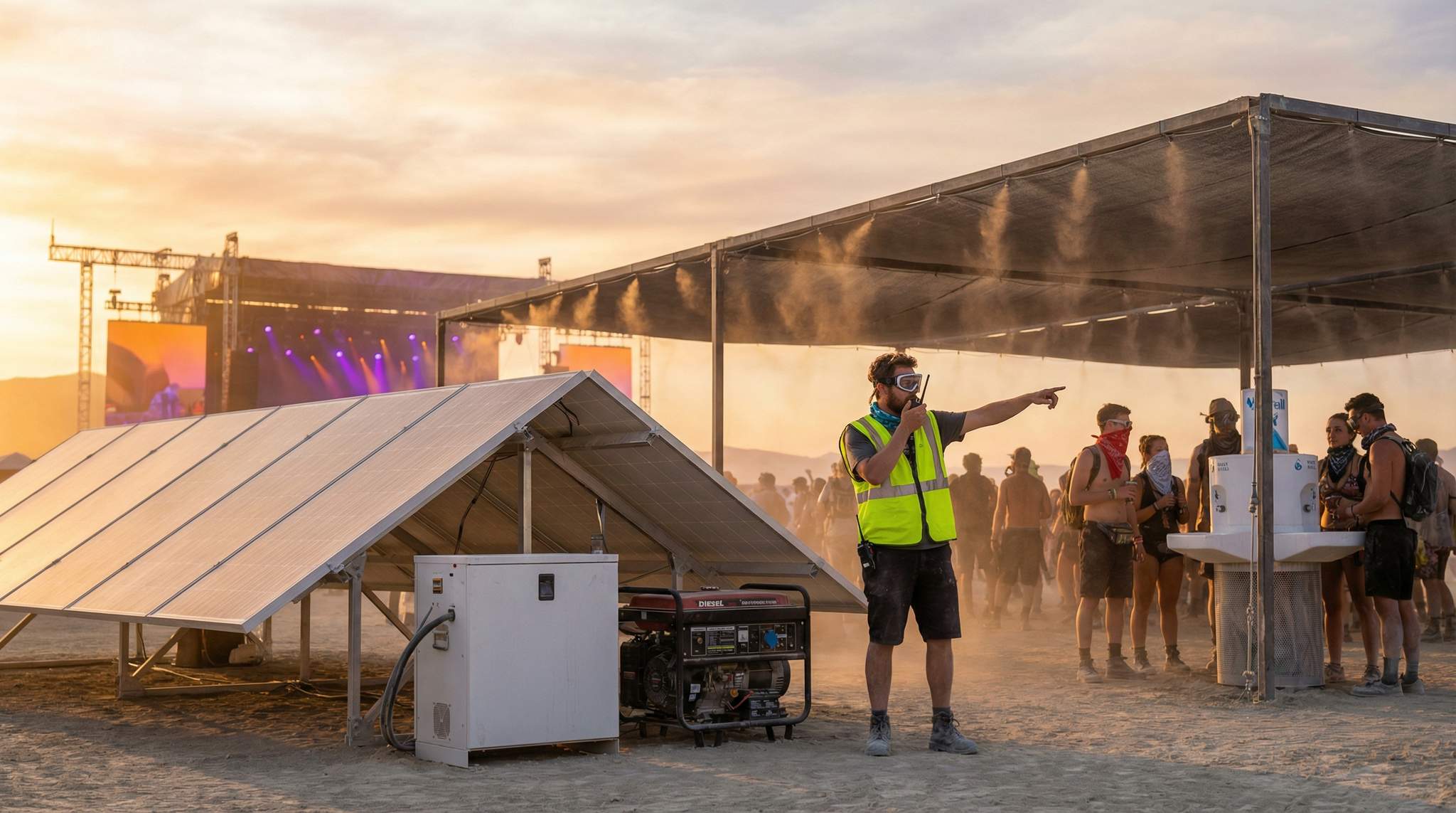
One of the first hurdles is electricity. Deserts rarely offer grid access, so festivals become self-contained microgrids – localized power networks of generators, solar panels, batteries, and distribution cables, a concept explored in CJ Trowbridge’s analysis of Burning Man microgrids. In smaller gatherings, each camp or vendor might run its own generator or solar array, effectively creating “a city of microgrids” as seen at Burning Man, where Elon Musk famously conceptualized SolarCity. At Burning Man (Nevada, USA), 80,000 participants form an ephemeral city where every block runs on communal or camp-scale generators. Camps plug into spider boxes and extension cords from diesel gensets, or increasingly bring solar rigs with battery storage to reduce fuel dependency. The infrastructure is relatively straightforward for individual camps, though experts suggest future improvements will involve larger diesel/solar hybrids. This radical self-reliance model means dozens of independent power hubs humming across the playa each night.
Larger commercial festivals need even more ambitious solutions. For example, the Coachella Valley Music and Arts Festival (California, USA) occurs on a desert plain near Indio and demands around 26 MW of power for stages, lighting, video walls, and attendee services, requiring massive distributed energy resources – equivalent to a small town. Traditionally, fleets of diesel generators meet these “astronomical” off-grid power needs, often relying on mobile power generation. However, modern festival producers are striving to replace “stinky diesel generators” with cleaner mobile microgrids: hybrid setups of solar panels, large battery banks, and backup generators. This shift aims to replace stinky diesel generators with cleaner alternatives to handle Coachella’s massive off-grid power needs. At Coachella, sustainability teams have piloted solar+battery systems to run production offices and light towers, aiming to cut noise and emissions, a strategy that began gaining traction around 2017. Similar experiments are happening worldwide – from Australian outback concerts to European desert art gatherings – where portable renewable energy units can leapfrog fuel usage.
Free Tool: Size Your Festival Site
Zoned capacity planning for arena, campsite, parking and entry lanes — against UK Purple Guide and NFPA density standards. Finds your bottleneck zone.
Whether it’s a boutique arts event in Rajasthan’s Thar Desert or a mega-festival in Nevada, careful load planning and redundancy are key. Desert festival producers emphasize renting reliable generators sized for peak demand, plus spares for critical stages or medical tents. Power distribution must be weather-proof; cables are often run above-ground (to avoid trenching the hard ground) and elevated or covered to withstand sand drifts. Microgrid control – balancing loads and refueling schedules – becomes a daily priority. Many teams designate an Energy Manager on the crew, monitoring generator fuel levels and coordinating refills (sometimes via fuel trucks that patrol the site, as detailed in the Black Rock City fuel program guide). As the technology evolves, festival microgrids will continue shifting toward renewables and even crowd-sourced energy solutions, but diesel remains the workhorse in remote deserts for now, given that power needs remain astronomical.
Battling Dust and Sandstorms
Dust is the desert festival’s constant companion – and often its fiercest adversary. Open plains and dry lake beds can produce blinding dust storms at any time, as Black Rock City veterans know well. A sudden gust can whip fine alkali dust into a white-out that halts art car traffic and sends thousands scrambling for goggles and masks. Burning Man participants prepare for this inevitability with ski goggles and bandanas or respirators as fashion staples. Organizers emphasize how to stay safe and have fun by ensuring masks and goggles are essential gear. Organizers even warn newcomers to expect that everything you own will be covered in dust. The health risks are real; inhaling these particles can irritate lungs and even carry pathogens. In California’s Coachella Valley, festival dust storms have been found to contain heavy metals, fertilizers, bacteria, fungi, and viruses, potentially aggravating asthma or bronchitis. Reports indicate dust storms could trigger health problems due to the array of harmful substances. Public health experts urge attendees to cover their mouth and nose when the wind kicks up, and experts recommend covering up airways to avoid breathing in pathogens. Many desert festivals now include free bandanas or dust masks in their welcome kits.
Planning a Festival?
Ticket Fairy's festival ticketing platform handles multi-day passes, RFID wristbands, and complex festival operations.
To combat dust, festival producers implement both preventive and reactive measures. Speed limits on site roads (often 5–10 mph) are enforced to minimize the dust clouds kicked up by vehicles. Drivers must always adhere to speed limits to minimize impact. Water trucks circulate periodically to dampen the ground, especially along main traffic arteries and dance areas. Attendees should be aware that water trucks perform maintenance like wetting surfaces. (As a safety note, festival staff remind people not to drink or play in this water, which is usually non-potable and mixed with dust suppressants, making it unsafe for drinking or playing in.) At events like AfrikaBurn in South Africa’s Tankwa Karoo, volunteers wet down the burn perimeters and high-traffic lanes to keep dust down during peak activity. Some festivals have tried soil stabilizers or laying straw in problem spots, though Leave No Trace principles limit what can be applied to the natural terrain.
When a major sandstorm does hit, communication and shelter are critical. Festival organizers will use radio announcements, app alerts, and public address systems to caution attendees to take cover when visibility drops. Many events set up designated safe zones (first aid tents, domes, or buses) where those caught off-guard can wait out the worst of the storm. In 2015 at Midburn (Negev Desert, Israel), for example, white-out dust storms (locally nicknamed “pudra”) swept through the temporary city. Coverage of the event noted how dust and ashes exploded in the Negev with fine pudra settling over everything. Event staff and seasoned participants helped newcomers find cover, loaned out extra goggles, and enforced a pause on driving art cars until skies cleared. Training security and medical teams to handle dust emergencies calmly keeps panic low and prevents accidents. Ultimately, dust resilience at festivals comes down to preparedness – encouraging everyone on-site to wear protective gear and designing camps with windbreaks (like snow fencing or strategically parked vehicles) to catch blowing sand.
Managing Extreme Heat and WBGT Safety
Desert heat can be deadly if not respected. Under a high sun, surface temperatures at a festival can soar well above 40 °C (104 °F), and the risk of heat exhaustion or heat stroke becomes a top concern for festival producers. A key tool in the safety arsenal is the Wet-Bulb Globe Temperature (WBGT) index – a metric that accounts for air temperature, humidity, sunlight, and wind to gauge heat stress on the human body. The National Weather Service defines WBGT based on temperature, humidity, sun angle, and cloud cover. Festivals in arid regions often rely on hourly WBGT readings (or the simpler Heat Index when shade and humidity are consistent) to trigger protective actions. For instance, many production teams set WBGT trigger levels that align with occupational safety or sports medicine guidelines. While there is no set standard for all regions, these metrics are vital for safety. If WBGT enters the “red flag” zone (~23–28 °C WBGT) or higher, extra precautions kick in: crew work/rest cycles are adjusted, misting fans and shade canopies are deployed in audience areas, and medical staff start actively reminding people to hydrate. When WBGT approaches the extreme “black flag” level (~28 °C WBGT and above), some events will even pause high-exertion activities. Following ACSM heat safety guidelines helps determine when to pause events. For example, a desert ultra-marathon might delay its start, and similarly a festival might postpone a particularly physical workshop or encourage attendees to rest during the hottest hours.
In practice, this means having a heat action plan on the books. Festival organizers schedule the most vigorous programming (dance sets, physical art performances) for evenings and cooler parts of the day whenever possible. Shade structures become lifesaving infrastructure – whether it’s large open-sided tents over audience zones, or simple shade sails over queue lines for water and toilets. Burning Man and its regional Burns take a decentralized approach: participants bring their own shade tents, and the city layout often clusters public attractions around theme camps that offer cooling misters or iced drinks. Larger commercial festivals provide cool-down zones, sometimes air-conditioned trailers or at least tented chill-out lounges with seating.
Free Tool: Project Your Bar Revenue
Per-head spend benchmarks by event type turned into projected bar and food revenue, with a stock-mix estimate and gross-margin line. Free calculator.
Crucially, staff and volunteers working long shifts in the sun are rotated frequently. At Australia’s outback events, festival organizers follow something akin to OSHA’s work/rest schedules: for example, security staff might do 30 minutes on a sun-baked entry gate followed by a 15-minute break in a cooled tent. Through training, all crew are taught to recognize early signs of heat illness (cramps, dizziness, cessation of sweating) and are empowered to call in medics if in doubt. Many festivals station roaming EMTs with portable water and radios in the crowd during peak heat hours, watching for anyone who might be succumbing to heat. Attendees are also educated via signage and push notifications – as seen when Coachella’s mobile app humorously reminded people to “Quench your thirst – visit one of the water refill stations to stay hydrated so you can keep bootin’ and scootin’ all night long!” This hilarious hydration tip from Coachella went viral. The tone may be light, but the underlying message is serious: in desert heat, constant hydration and cooling are non-negotiable.
Convoy Logistics: Supplying the Middle of Nowhere
Staging a festival far from civilization means that every piece of infrastructure – stages, sound, lights, food, fuel, and people – must travel to the site. Logistics in desert festivals often resemble a military convoy operation. Organizers typically schedule supply runs in waves: first, heavy equipment trucks convoy in during the build week; later, attendee vehicles arrive en masse; finally, strike and cleanup crews haul everything out. Meticulous coordination with local authorities is needed to manage these convoys on remote roads. For example, Burning Man’s production trucks must negotiate rural highways and a single-lane access road into Black Rock Desert; the event works closely with Nevada’s highway patrol to time the largest deliveries during off-peak traffic. On-site, a dedicated logistics team directs where each truck unloads (working off a master site map) so that stages and tents can be assembled efficiently upon arrival.
Need Festival Funding?
Get the capital you need to book headliners, secure venues, and scale your festival production.
In some cases, convoys are literally lifesavers. The Big Red Bash festival in Birdsville, Australia, demonstrated this in 2023 when unseasonal rains turned the outback roads to mud. Heavy rains in the Far North stranded many travelers. Over 40 camper vans of festival-goers were stranded at a remote pub until police granted a special permit for them to travel together once conditions improved. About 100 South Australians were stranded but managed to proceed, with police praising the coordinated effort. They formed a single-file “caravan trail” at daybreak and drove the tenuous route at 40 km/h, helping each other through boggy patches to reach the festival. The convoy departed about 9am on Saturday morning and navigated the conditions successfully, which was a relief for organizers. This story highlights why remote event planners prepare for weather contingencies: having recovery vehicles on standby, satellite phones for communication if cell service fails, and backup plans to shelter or reroute attendees if the usual route becomes impassable.
Even without weather drama, desert convoys require careful planning for basics. Fuel management is one example – generators and all those trucks will need refueling, so some festivals bring their own fuel tankers or arrange local suppliers to be on call. Water delivery is another major concern (addressed below in Hydration). Many events implement a “pack it in, pack it out” rule like Burning Man’s, meaning every convoy that comes in must haul trash out on the return trip. To enforce this, the festival team might issue each vehicle a set of garbage bags and even assign staggered departure times to prevent highway littering or illegal dumping after the event. Local community relations also come into play if convoys pass through inhabited areas – a courteous heads-up, temporary traffic signage, or even community benefit agreements (e.g. road repairs or donations to local causes) can smooth the way for multi-year festival operations.
Hydration Strategies and Water Supply
In a desert festival, water is life. Ensuring that thousands of attendees and crew have ample safe drinking water is arguably the most critical responsibility of festival management. Approaches differ based on the festival model. Participant-driven events like Burning Man and AfrikaBurn put the onus on individuals – “bring at least 1.5 gallons (about 5.7 L) of water per person per day,” stresses the Burning Man water survival guide. Similarly, the Big Red Bash explicitly has no drinking water available on-site, so attendees must fill up in the nearest town and carry enough for all days (organizers recommend a minimum 3 L per person per day in the milder winter conditions). Their what to bring guide notes that there is no drinking water available on-site. Festival organizers support this self-reliance by providing information (e.g. water planning checklists, locations of nearby filling stations) and sometimes facilitating water deliveries to theme camps via third-party vendors – although any potable water supplier must be properly permitted by health authorities. Burning Man delivery protocols state that any person hauling water must be permitted.
On the other hand, large commercial festivals take a more direct role in hydration. Free water refill stations have become standard at major events in arid areas – Coachella, for instance, has numerous refill points and has eliminated single-use plastic bottles, opting for reusable bottles and an official electrolyte drink partner to encourage constant hydration. Hydration is serious business at these events to keep fans refreshed. Organizers strategically place these stations near stages and food courts, and they illuminate them at night so they’re easy to find. To prevent long queues from deterring water intake, high-flow faucets and multiple spigots are installed. Many festivals also permit (or even sell) wearable hydration packs, making it easy for attendees to carry water and sip throughout the day.
Producers further promote hydration through messaging: festival apps send push notifications when the temperature soars, stages feature friendly reminders on video screens (“Drink Water!”), and medical teams roam with water for anyone looking unwell. In especially extreme climates, some events provide free water bottles or have volunteers hand out cups of water in crowd dense areas (much like marathon aid stations). Backstage and crew areas are equally well-stocked – a dehydrated crew member is a liability, so ice water, sports drinks, and salty snacks are provided in staff break tents, with mandatory water breaks encouraged.
Ultimately, a robust hydration strategy marries infrastructure with culture. By making water highly accessible, removing price barriers, and constantly encouraging consumption, festivals can significantly reduce incidents of dehydration. The results are evident: even under brutal sun, well-prepared events see attendees dancing by day without overwhelming the medics – a sure sign that water planning and education paid off.
Frequently Asked Questions
How do desert festivals generate power without grid access?
Desert festivals operate as self-contained microgrids using localized networks of generators, solar panels, and batteries. Large events like Coachella require up to 26 MW of power, traditionally met by diesel fleets, though producers are increasingly adopting hybrid solar and battery systems to reduce emissions and noise in these off-grid environments.
What are the health risks of breathing desert festival dust?
Dust storms in arid environments often contain harmful substances including heavy metals, fertilizers, bacteria, fungi, and viruses. Inhaling these particles can aggravate respiratory issues like asthma or bronchitis. Public health experts recommend covering airways with masks or bandanas and wearing goggles to protect against pathogens found in the dust at events.
How is Wet-Bulb Globe Temperature (WBGT) used for festival safety?
Festivals use the Wet-Bulb Globe Temperature (WBGT) index to gauge heat stress by accounting for temperature, humidity, sunlight, and wind. When readings enter the red flag zone (approximately 23–28°C), organizers implement safety protocols like adjusting crew work cycles, deploying misting fans, and encouraging hydration to prevent heat exhaustion.
How much water do attendees need for desert festivals like Burning Man?
Survival guides for events like Burning Man recommend bringing at least 1.5 gallons (about 5.7 liters) of water per person per day. For festivals without on-site drinking water, such as the Big Red Bash, organizers suggest a minimum of 3 liters daily, emphasizing that constant hydration is non-negotiable in extreme heat.
How are logistics managed for festivals in remote desert locations?
Remote festival logistics operate like military convoys, scheduling supply runs in waves to transport infrastructure and fuel. Organizers coordinate with local authorities to manage traffic on rural highways and utilize dedicated logistics teams to direct unloading. Contingency plans include recovery vehicles and satellite communication to handle weather disruptions or stranded travelers.
What methods are used to control dust at desert festivals?
Organizers combat dust by enforcing strict speed limits of 5–10 mph and circulating water trucks to dampen main traffic arteries and dance areas. At events like AfrikaBurn, volunteers wet down burn perimeters, while attendees are encouraged to use windbreaks and wear protective gear like goggles during sudden sandstorms.