Why True Accessibility Matters in 2026
Changing Expectations and Demographics
The live events landscape has shifted – and venue operators in 2026 face a public more attuned to accessibility than ever. Aging populations mean more patrons with mobility or sensory needs, and younger audiences expect inclusivity as a given. Post-pandemic, many immunocompromised or disabled fans who embraced live-streams now feel empowered to demand better in-person accommodations. Experienced venue operators note that what once passed as acceptable (a lone ramp or a token wheelchair spot) now draws scrutiny. In an era of social media call-outs and advocacy, meeting only the bare legal minimum isn’t enough to satisfy guests or avoid backlash.
Beyond Legal Minimums: What Compliance Misses
Laws like the ADA in the US and the Equality Act in the UK mandate baseline accommodations – ramps, a limited number of wheelchair seats, basic accessible restrooms. But simply complying doesn’t guarantee a great experience. Many venues that tick the legal boxes still leave guests feeling unwelcome. For instance, an ADA-compliant ramp that technically gets a wheelchair inside is little comfort if once indoors, there’s no clear sightline to the stage or no accessible restroom nearby. Industry veterans emphasize that accessibility is about experience, not just infrastructure. Going beyond compliance means thinking from the guest’s perspective: Can a deaf fan enjoy the show fully? Can a patron with autism find a calm space away from crowds? Compliance is the floor, not the ceiling – it’s the starting point for true inclusion.
The Business Case for Inclusion
Investing in accessibility isn’t only an ethical move – it’s a savvy business decision. Expanded audience reach is one major benefit. There’s a large untapped market of people with disabilities who would attend more events if venues accommodated them. A 2025 UK survey found 52% of disabled music fans actively avoid concerts due to poor accessibility, according to Mixmag’s report on disabled fans’ experiences. Nearly 7 in 10 respondents said concert venues are “ill-equipped” for their needs, highlighting significant gaps in venue accommodation. This represents thousands of potential ticket buyers staying home. Conversely, when accessibility is prioritized, attendance can surge – one UK initiative found that simply improving online information and services for disabled patrons led to roughly a 70% increase in ticket sales to deaf and disabled attendees, a statistic highlighted in Ticket Fairy’s guide to inclusive festival experiences. In short, welcoming all fans means more tickets sold.
Inclusive venues also see greater customer loyalty and word-of-mouth. Attendees who feel truly cared for become repeat visitors and enthusiastic ambassadors. This positive reputation extends to artists and promoters as well – agents know which venues handle special requirements seamlessly and will favor them on tour routings. And sponsors are increasingly interested in venues that demonstrate values; some brands will eagerly support accessibility upgrades as high-visibility community initiatives. (Savvy operators even turn this into revenue – for example, securing sponsorships for installing a new accessible viewing platform or funding an assistive listening system, akin to the creative deals outlined in modern venue sponsorship strategies for 2026 revenue growth that leverage community goodwill.) In competitive markets, an inclusive reputation can be a true differentiator that draws events and audiences away from less accommodating sites.
Turn Fans Into Your Marketing Team
Ticket Fairy's built-in referral rewards system incentivizes attendees to share your event, delivering 15-25% sales boosts and 30x ROI vs paid ads.
Avoiding Legal and PR Pitfalls
Staying only compliant poses risks. Legally, venues that fall short of even minimum standards face lawsuits or fines – and disability access lawsuits have been on the rise in recent years as advocacy groups become more active. But often the court of public opinion is an even bigger concern. One bad experience can go viral. Seasoned venue managers have seen the fallout when, say, a wheelchair user posts a video from a “designated accessible area” that turned out to have an obstructed view or when a deaf attendee highlights lack of interpreters at a show. The resulting outrage can damage a venue’s reputation overnight. In 2023, for example, an outdoor festival faced a flurry of refund demands and negative press after wheelchair platform users could barely see the performers – fans felt they paid for an experience they couldn’t enjoy, underscoring that access areas must offer equity in experience.
Going beyond compliance is essentially an insurance policy against such scenarios. By proactively providing great sightlines, assistive services, and trained support, you dramatically lower the chance that a guest leaves feeling discriminated against. Moreover, strong accessibility practices can earn positive media coverage, especially as regulators and communities spotlight inclusion. In Brazil, a progressive 2015 inclusion law spurred major events to innovate – Rock in Rio, one of the world’s largest festivals, added on-screen sign language interpreters and invited dozens of deaf fans to a special front-of-stage section where they could feel the music’s vibrations, an initiative detailed in AP News coverage of the festival’s accessibility efforts. The result was rave reviews from attendees and press, painting the organizers as forward-thinking. The lesson: prioritize inclusion before it becomes a problem, and you’ll avoid crises while building goodwill.
Ready to Sell Tickets?
Create professional event pages with built-in payment processing, marketing tools, and real-time analytics.
(Experienced venue operators often say that “accessibility issues are easiest to fix before the show.” A veteran in Sydney recounts how their historic theater pre-emptively overhauled its seating plan after a near-miss incident – a patron in a wheelchair had been placed in an aisle for lack of proper spaces, leading to a fire marshal warning. Learning from that close call, they freed up more wheelchair spots and implemented a strict policy to never improvise on accessible seating. Incidents like these drive home that compliance alone wasn’t enough to guarantee real safety or comfort.)
Universal Design: Upgrading Physical Spaces
Entrances, Exits, and Pathways for All
Walk into any world-class venue today and you’ll notice how smooth the journey feels for all guests. That’s by design. Step-free, obstacle-free routes from curb to seat are the goal. This starts at the entrance: providing ramps (or better, gentle grade slopes) that are wide enough for two wheelchairs to pass, automatic doors or attendants to assist with heavy doors, and surfaces that aren’t slippery or hard to navigate. Many older buildings have one small wheelchair lift at a side or back entrance – technically compliant, but hardly welcoming. Forward-thinking venues are moving toward main entrances that are inclusive, so everyone enters together through the same grand door. For example, when a historic European concert hall renovated recently, they replaced a little-used side ramp with an elegant front entry ramp integrated into the staircase design, allowing wheelchair users to roll up right alongside everyone else.
Inside, clear pathways are critical. Ensure that once past the door, there are wide, unobstructed routes to all key areas: the auditorium, restrooms, merch and concession areas, etc. Tactile floor indicators or high-contrast markings can help visually impaired guests navigate those routes. It’s also important to think vertically in multi-level venues. Elevators (with braille labels and audio announcements) should reach every public floor. If an elevator is old or slow, consider upgrades or additional units – nothing frustrates guests like long waits or unreliable lifts. And don’t forget emergency egress: inclusive venues provide safe evacuation options for wheelchair users and others who can’t use stairs. This might include evacuation chairs on upper floors and training staff in their use, or designated Areas of Refuge with direct communication to first responders. Veteran operators stress running regular emergency drills that include people of varying abilities. For instance, a large arena in California conducts annual fire drills simulating an evacuation of mobility-impaired guests from the upper bowl, ensuring staff know how to assist swiftly and safely.
Keeping paths accessible also means managing crowd flow on busy nights. Something as simple as a poorly placed trash can or merch table can turn a corridor into a bottleneck that traps a guest in a wheelchair in a sea of people. On high-capacity nights, proactive crowd management is key – many top venues now deploy extra staff or even sensors to monitor congestion and keep accessible pathways clear, similar to the tech-driven approaches used in smart crowd management solutions for peak events. The goal is for all attendees, regardless of mobility, to be able to move about freely even when the house is packed.
Data-Driven Event Marketing
Track ticket sales, demographics, marketing ROI, and social reach in real time. Exportable reports give you the insights to make smarter decisions.
Accessible Seating and Sightlines
For operators reviewing their floor plans, understanding exactly what is accessible seating is the first step. Operationally, it refers to designated spaces specifically designed for patrons using wheelchairs, mobility devices, or those who require transfer seats, featuring appropriate dimensions, level access, and companion placement.
Beyond the basic definition, modern floor plan optimization requires integrating these spaces seamlessly into the overall crowd flow. True integration means these designated spots are not isolated afterthoughts, but premium, well-serviced locations that offer the same acoustic and visual fidelity as any standard VIP box.
Grow Your Events
Leverage referral marketing, social sharing incentives, and audience insights to sell more tickets.
Seating is where the difference between mere compliance and true inclusion becomes stark. Laws might require a certain number of wheelchair positions (often a percentage of total capacity), but they don’t dictate where or how those seats are arranged. Too many venues historically relegated wheelchair users to the back row of the balcony or the very rear of the floor, isolated from the main audience. In 2026, that approach is rightfully seen as outdated. Inclusive seating design means offering accessible seats throughout the venue: on the floor, mid-tier, and balcony levels, if applicable, so guests can choose their preferred view and price point. It also means integrating those sections with general seating so that disabled patrons sit with the crowd, not apart from it.
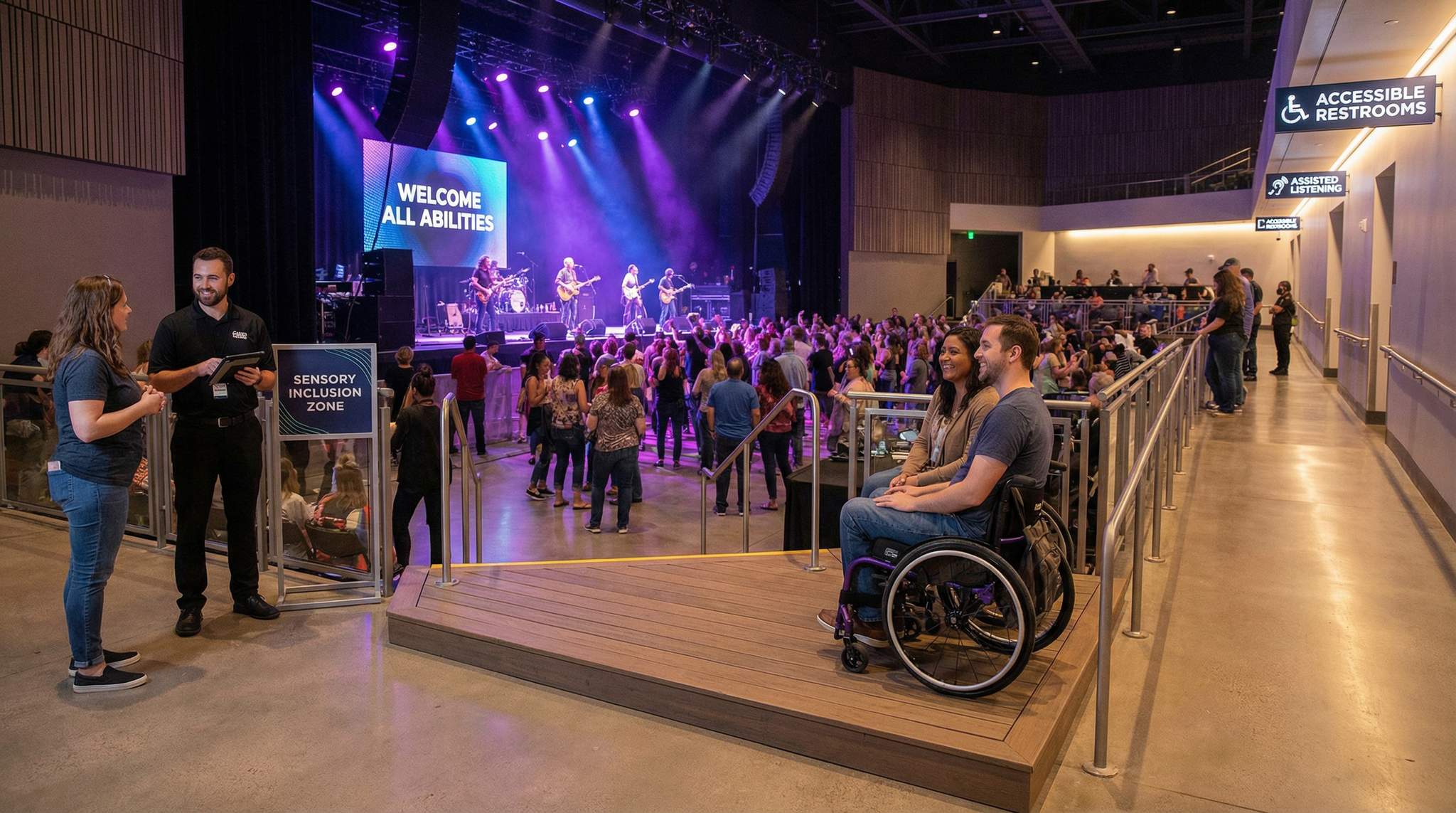
Clear sightlines are non-negotiable. An accessible seat isn’t truly accessible if a guest’s view is constantly blocked by standing crowds or stage equipment. That’s why you’ll see many modern venues with elevated wheelchair platforms at various points in the house or removable seats that create space in prime locations when needed. For example, a major UK arena reconfigured its floor seating layout in 2024 to add raised wheelchair platforms about a third of the way back on each side of the stage. These platforms ensure wheelchair users see over the standing pit, and they’re located such that friends can sit in regular seats right beside them, enjoying the show together. This concept of “equity in experience” – giving disabled fans an equally great view – has become a design mantra. It only takes one viral incident of wheelchair users stuck behind a tall crowd (and furious about paying full price to watch a jumbotron) to know how vital this is.
Another best practice is implementing a companion seating policy for every accessible seat. Standard is at least one companion seat adjacent so friends or caregivers can join. Some venues go further with flexible companion policies – for instance, allowing larger groups to sit nearby by swapping companions during a show, as long as space permits. The key is to communicate these policies clearly and manage them fairly so that disabled guests don’t feel penalized by strict limits. Internally, train your ticketing and front-of-house staff on the procedure for companions (many venues use a simple wristband or lanyard system to identify authorized companions on platforms). When everyone understands the approach, you avoid awkward situations where a companion is mistakenly asked to leave an area.
Finally, don’t forget staging areas for mobility devices. Patrons who transfer from wheelchairs to fixed seats will need a secure spot for their wheelchair or scooter. Allocate some nearby space (an alcove or gap) and have staff prepared to help store and retrieve mobility devices as needed. It’s these small touches – thinking through the entire seating experience – that distinguish a truly accessible venue.
Free Tool: Size Your Festival Site
Zoned capacity planning for arena, campsite, parking and entry lanes — against UK Purple Guide and NFPA density standards. Finds your bottleneck zone.
Restrooms, Concessions, and Other Amenities
One of the biggest complaints among disabled concertgoers is that venues meet the letter of the law (e.g. one accessible stall in the restroom) but fail the spirit (that stall is up three steps, or kept locked, or used as storage!). Make it a priority that every facility in your venue is not just technically accessible, but usable and comfortable. Start with restrooms: beyond having the required wheelchair-accessible stalls, check details like sink height, mirror height, lever-style faucets, and accessible hand dryers or paper towels. There should be an accessible stall in every restroom location (or a clearly marked family/unisex accessible restroom), so no one has to traverse to another floor. In high-capacity venues, consider adding extra accessible stalls or even a dedicated family restroom with a changing bench and hoist for guests with more significant needs – features like adult changing tables go well beyond most code requirements but can be life-changing for attendees who need them. Venues in several countries have adopted the “Changing Places” restroom model (originating in the UK) to offer these enhanced facilities, and it’s an amenity that draws appreciation (and social media praise) from the community.
Concession stands, bars, and merchandise booths also deserve attention. Are counters low enough for someone in a wheelchair to see over and to conduct a transaction comfortably? If not, install a section of lowered counter or a clipboard system for passing items and card readers. Make sure portable bars or merch tables aren’t blocking ramps or corridors when popped up. Many venues have moved to cashless and mobile ordering systems – besides speeding up transactions and boosting sales, these technologies can be an accessibility win. By enabling guests to order food or merch from a phone app and pick it up at a designated counter (or even have it delivered to their seat in some venues), you help those who have difficulty standing in long lines or navigating crowded concourses. In fact, implementing such innovations is part of the broader trend of modern venue food & beverage strategies that not only increase revenue but also make the experience more inclusive. Consider also offering menus in large print or braille at concession stands, and training staff to assist patrons who might have dietary needs due to medical conditions (e.g. a guest with diabetes needing a sugar-free beverage quickly).
Don’t overlook box office and will-call areas. They should have an accessible window or counter, with at least one window at a lower height and headset systems or hearing loops to assist patrons with hearing aids if the area is noisy. Mark these clearly with the universal accessibility symbols so disabled guests know exactly where to go for service. If your venue uses walk-through metal detectors or security screening, have a clear alternative screening process for guests with mobility devices or medical implants (and ensure security staff are trained on it with sensitivity, so no one is made to feel embarrassed when they can’t go through the standard line). It’s all about anticipating needs at every step of the venue experience, from arrival to encore.
Beyond standard guest comforts, operators must also evaluate their infrastructure to support specialized equipment. Operating a venue with accessible power/utilities for events is increasingly critical. Guests who rely on medical devices—such as portable oxygen concentrators or power wheelchairs that require a mid-show charge—need safe, easily reachable electrical outlets near their seats. Similarly, providing accessible utility hookups in vendor and exhibition areas ensures that disabled merchants can operate their booths without navigating hazardous, temporary cable runs. Upgrading these utility access points is a relatively low-cost infrastructure tweak that significantly boosts operational safety and inclusivity.
Stage and Backstage Access
While patron accommodations are the main focus of accessibility efforts, truly inclusive venues also consider performers and crew. Some of the world’s top venues now ensure that stages, green rooms, and production areas are accessible. This can mean installing a wheelchair lift to the stage or providing ramp access so that an artist who uses a wheelchair or other mobility aid can perform on the same stage as any other headliner. In recent years we’ve seen differently-abled artists – from wheelchair-using rock musicians to sign language rappers – take the spotlight. Venues that can accommodate them without special fuss become go-to choices for promoters. Backstage, have at least one accessible dressing room and bathroom, or the ability to make a dressing room temporarily accessible (for example, some theaters keep portable ramp segments and modular risers that can turn a couple of steps into a ramp in backstage corridors when needed). Ensure there’s an accessible route from loading dock to stage as well, since more crew members with disabilities (like deaf technicians or crew on the autism spectrum) are entering the industry and excelling when given equal opportunity.
There’s also an employment compliance angle here: in many countries, if your venue employs 15 or more people, you’re required under disability laws to provide reasonable accommodation to staff with disabilities. It’s much easier to meet this obligation if your facility is designed to be accessible throughout. Several venue managers who’ve gone through renovations note that adding things like an elevator to the tech booth or ramp to the stage not only opened the door for hiring talent with disabilities, but also proved useful in everyday operations (for instance, moving heavy gear carts or hospitality deliveries became easier for everyone). This is the principle of universal design in action – designing for the greatest range of abilities often yields convenience benefits across the board.
Smooth Entry With Mobile Check-In
Scan tickets and manage entry with our mobile check-in app. Supports photo ID verification, real-time capacity tracking, and multi-gate coordination.
| Aspect | Basic Legal Compliance | Inclusive “Beyond Compliance” Approach |
|---|---|---|
| Entrances | One ramp at a side/back entrance; manual doors. | Step-free access at main entrance; automatic doors or greeters at entry. |
| Seating | Required wheelchair spaces, often at back or one section. | Wheelchair & companion seats in multiple locations (floor, mid, balcony) with clear sightlines. |
| Restrooms | One accessible stall (often just meets minimum size). | Multiple accessible stalls; larger family restroom with adult changing table and hoist for complex needs. |
| Wayfinding | Basic signage for elevators/exits. | High-contrast, tactile signage; staff escorts available; pre-event maps of accessible routes. |
| Communication | Assistive listening devices on request. | Assistive listening plus captioning or sign interpretation at major shows; accessibility info prominently advertised. |
| Staff Training | General ADA compliance knowledge. | Comprehensive disability awareness training; specialized roles (Access Manager, ASL interpreters, etc.) on staff. |
Implementing an ADA Compliance Checklist for Sports Venues
For operators managing large-scale athletic facilities, knowing how to implement an ADA compliance sports venue checklist is a foundational step in risk management and inclusive design. Unlike smaller clubs, stadiums and arenas feature complex, multi-tiered environments where accessibility must be verified across concourses, VIP suites, locker rooms, and general seating bowls. A robust implementation strategy begins with a comprehensive facility audit conducted by a certified accessibility specialist. From there, management should digitize the checklist, integrating it into the daily operational workflows of the facility team. This ensures that critical elements—such as verifying the slope of temporary ramps, checking the functionality of accessible turnstiles, and confirming that companion seating hasn’t been displaced by broadcast equipment—are routinely monitored before every game day.
Assistive Technology and Innovative Solutions
Hearing Assistance: Loops, FM, and the Rise of Bluetooth
Technology is a powerful ally in making venues more inclusive. A prime example is the evolution of assistive listening systems. For decades, venues have used induction hearing loops or FM/IR broadcast systems to help guests with hearing loss. An induction loop installed under seating or at a service counter transmits sound directly to hearing aids (via the telecoil setting), providing much clearer audio for those users. FM (radio frequency) and IR (infrared) systems achieve a similar end with wireless headsets patrons can borrow. The problem with older systems is often distribution and awareness – many guests don’t even know to ask for the headset, or staff forget to mention it.
In 2026, we’re seeing a new wave of assistive listening tech that addresses those issues. Bluetooth Low-Energy broadcast (branded as Auracast by Bluetooth) allows venues to beam audio straight to smartphones and newer hearing aids. This means a guest could use their own device or hearing aid to tap into the venue’s audio feed – no need to track down a headset. A rugby stadium in New Zealand recently rolled out a cutting-edge system called Auri, which uses Auracast to cover their entire bowl with assistive audio. They found it delivered the same direct sound clarity as a hearing loop, but without having to install miles of under-seat cabling, as described in AV Network’s analysis of the stadium’s audio upgrade. Similarly, the WYO Theater in Wyoming added a Bluetooth-based assistive system in 2025 to complement its legacy hearing loop, broadcasting high-quality, low-latency audio that any visitor can receive on their phone or compatible earbuds, a deployment featured in AV Network’s report on the WYO Theater’s inclusive technology. This kind of tech is a game-changer: it’s less intrusive to install and can serve an unlimited number of users, since virtually everyone carries a smartphone. Venue operators should keep an eye on these developments – upgrading your assistive listening system to a modern solution can dramatically improve the experience for hard-of-hearing guests and signal that your venue is keeping up with innovation.
Of course, not everyone has the latest hearing-aid tech, so maintaining traditional options is still important. Make sure any new system is in addition to, not a replacement for, existing loops or headsets for now. Also, advertise it! Whatever assistive listening you offer, promote it on signage and pre-show announcements (e.g. “This venue offers hearing assistance – ask staff or tune your device to…”) so those who need it know it’s there. Industry associations like the International Association of Venue Managers (IAVM) recommend regular checks and staff training on these systems; a high-tech solution is only helpful if it’s reliably operational and employees can guide patrons in using it.
Visual and Communication Aids (Captioning and Interpretation)
Live concerts and shows are multi-sensory experiences, and venues are increasingly ensuring that audience members who are deaf or hard-of-hearing, or those who are not fluent in the performance language, can still fully enjoy the content. Captioning is becoming more common at venues for everything from theater performances to arena concerts with a lot of spoken word. For scripted events like musicals or plays, venues often schedule select open-captioned performances where a large LED screen displays the dialogue and lyrics in sync with the show. Some theaters even offer closed captioning devices – individual screens or smartphone apps where patrons can follow along without captions being on the main display for everyone.
New solutions are emerging that leverage speech-to-text technology. While auto-captioning (like what you might see on YouTube) isn’t perfect for live shows, improvement in AI means we’re not far from workable real-time captioning for events. In conferences and talks, CART (Communication Access Realtime Translation) captioners have long been used (a stenographer types into a system that displays near-instant captions). Now, AI-driven systems can supplement this, lowering costs and allowing more events to be captioned. As a venue operator, consider partnering with captioning service providers or investing in captioning boards if you host a lot of spoken-word content. Patrons consistently cite caption availability as a factor in choosing which events to attend, especially older adults with some hearing loss who may not consider themselves “disabled” but benefit greatly from captions.
Free Tool: When Should You Announce?
Pick your event date and genre — the free planner outputs a recommended announce, presale, on-sale and reminder schedule anchored to how your audience actually buys.
Sign language interpretation is another robust way to include deaf guests, particularly for music events where capturing the emotion and rhythm of a performance is key. Music interpretation in sign language is an art form of its own – and it’s catching on. We’ve seen festivals and large concerts around the world start featuring ASL (or local sign language) interpreters prominently on stage or on video screens. By 2024, even mega-festivals like Rock in Rio had interpreters on the jumbo screens for headline acts, as noted in AP News reports on the festival’s sign language integration, and many touring artists now hire interpreters for their deaf fans. Venues should be ready to accommodate this: have a well-lit spot on stage or a side platform for interpreters and ensure camera crews know to keep them in frame for the screens. Also, coordinate with promoters on offering interpretation by request – many venues will provide an interpreter for a concert if requested sufficiently in advance by a ticket-holder. It’s an expense, yes, but the goodwill and additional ticket sales (not to mention compliance with disability rights laws) easily justify it. Some venues keep a roster of freelance interpreters on call, or partner with agencies to streamline the process.
Visual aids aren’t just for deaf audiences. Audio description is a service for blind or low-vision attendees, where a narrator describes important visual elements (think of a musical where the narrator might describe costumes, set changes, or choreography during non-verbal sequences). This has historically been more common in theater and opera – for example, major opera houses and Broadway theaters have headsets where a patron can listen to a live or recorded audio describer. But it’s worth considering for other event types, too, especially visual spectacles. If you’re hosting, say, an elaborate dance production or a Cirque du Soleil-style show, advertising an audio-described performance could bring in new audience members eager to experience it. The key is having trained describers who know how to succinctly convey what’s happening without talking over the show’s audio. This is a specialty service, so you may coordinate with an arts access nonprofit to implement it periodically.
When stakeholders or grant committees ask which of the venue’s features, specifically related to accessibility for audiences with hearing or vision impairments, was promoted through a named project, operators often point to high-profile funding initiatives. For example, a recent “Sound & Sight Inclusion Project” at a major regional theater specifically funded the rollout of AR captioning glasses and tactile audio tours, demonstrating how targeted campaigns can successfully highlight and deliver specialized sensory accommodations.
Multi-Sensory Enhancements
An exciting frontier in venue inclusion is multi-sensory technology – tools that allow people with one sense impaired to experience an event through other senses. A shining example is the use of vibrating vests or backpacks that convert sound into tactile sensation. Devices like the SubPac (a wearable subwoofer) let deaf and hard-of-hearing fans “feel” the music through vibrations. A French association in 2023 equipped several concert venues with SubPac vests, enabling deaf audience members to literally feel the beats and rhythm of live songs, an innovation covered by The Connexion’s article on vibrating vests for deaf concertgoers. Users described it as finally being able to join in with everyone else on the dance floor. Some forward-thinking clubs and festivals now offer these vests or have dedicated “bass platforms” that anyone can stand on to feel low frequencies. For venue operators, investing in a few tactile sound devices can be a relatively small cost that makes a world of difference for deaf patrons – and even for hearing patrons who just love the immersive experience.
Merging sensory experiences is beneficial for neurodivergent guests as well. Visual calming aids – like projected ambient visuals or quiet corners with interactive light panels – can help guests with autism or sensory processing disorders regulate their experience. One veteran stadium ops manager found success by installing a small sensory nook in the family section, equipped with noise-cancelling headphones and a touch-responsive light wall. These kinds of additions, often done in collaboration with nonprofits (such as partnering with a sensory inclusion organization to design the space), send the message that the venue wants everyone to enjoy themselves. Even something low-tech like offering fidget toys at customer service desks or having a few pairs of noise-reducing headphones available can help guests with sensory sensitivities get through a loud event.
Another emerging idea is augmented reality (AR) for live translations or captions. A few pilot programs have tested AR glasses that project captions or translations in the user’s field of view, so they can watch a show and read subtitles without looking away. While still experimental (and currently requiring users to wear a special device), by 2026 this tech is closer to mainstream. A venue known for innovation might partner with a tech company to trial AR caption glasses for a theater run or a conference event, garnering positive press and preparing for a future where such offerings could be commonplace.
Boost Revenue With Smart Upsells
Sell merchandise, VIP upgrades, parking passes, and add-ons during checkout and via post-purchase emails. Increase average order value by up to 220%.
Remote and Hybrid Accessibility
One lesson from the pandemic era was the power of remote access. While in-person experiences remain the gold standard, venues can extend their inclusivity beyond the physical walls via live streams or on-demand content. Offering a simulcast of certain events (with captions and even sign language interpretation on the stream) can include fans who physically cannot attend, whether due to disability, illness, or geography. Some venues fear that streaming might cannibalize ticket sales, but many find the opposite: it can build interest and engagement, especially for people who might attend in-person in the future once they see how much effort you put into accessibility.
For example, a performing arts center in Canada introduced a “hybrid ticket” in 2025 – a patron could buy a ticket to the live show and get complimentary online access to watch it again later (with audio description and captions available online). This was a hit with disabled attendees who appreciated the chance to re-experience a show with additional accessibility features, or to share it with a friend who couldn’t make it in person. While not every concert or event can be streamed due to rights issues, even occasional streams of a show (or at least posting highlight reels with captions) demonstrates an inclusive ethos. It also provides content for social media that can highlight your venue’s commitment to everyone in the community. As one industry report noted, broad accessibility isn’t limited to your physical building – it’s about removing barriers to enjoying the experience, wherever your audience may be.
| Technology | Purpose/Benefit | Venue Use Case | Example Deployment |
|---|---|---|---|
| Induction Hearing Loop | Direct audio feed to hearing aids (telecoil). Clear sound for hearing-impaired guests. | Under seats in main auditorium; at box office counters. | Installed at Sydney Opera House box office and concert hall to assist patrons with hearing aids. |
| RF/IR Assistive Listening | Wireless headsets for audio amplification. | Theaters, cinemas – patrons borrow headsets for audio. | Broadway theaters providing infrared headsets for dialogue clarity. |
| Bluetooth Auracast System | Broadcasts audio to personal devices (new in 2020s). | Arenas and large venues – patrons use smartphone or own hearing aid. | Stadium Taranaki (NZ) implemented Auri system to send game commentary to hearing aids (AV Network). |
| Captioning Displays/App | Provides live subtitles of speech/lyrics. | Conferences, musicals – screens or mobile app show captions. | West End London theatre offering open-captioned performances with on-stage displays. |
| Sign Language Interpreter | Conveys music and speech in sign language for Deaf patrons. | Festivals, concerts – interpreter visible on stage or via video screen. | Rock in Rio festival featuring on-screen LIBRAS (Brazilian sign language) interpreters (AP News). |
| Audio Description | Narration of visual elements for blind/low-vision patrons. | Theaters, sports – via headset describing action or sets. | U.S. Open tennis offering live audio description of matches to spectators. |
| Tactile Bass Vest (SubPac) | Converts audio (bass) into vibrations – tactile music experience. | Clubs, EDM shows – Deaf or bass-loving guests wear the vest. | Paris Electronic Festival loaning vibrating backpacks so deaf attendees feel the music. |
| Sensory Room/Quiet Space Tech | Provides calming environment (dim lights, soundproofing, sensory gadgets). | Stadiums, arenas – space for neurodivergent or anxious guests to decompress. | Tottenham Hotspur Stadium’s Sensory Suite with adjustable lighting and projection toys (Sports Gazette). |
Smart Venue Mobility and Event Tech Platforms
As operations become increasingly digitized, operators are exploring smart venue mobility solutions to streamline the guest journey. This involves using IoT sensors, real-time crowd heatmaps, and automated dispatch systems to ensure accessible pathways remain clear and to deploy mobility assistance—like golf carts or wheelchair escorts—exactly where needed. When evaluating how event tech platforms support accessibility and inclusivity, look for integrations that allow guests to request mobility assistance directly through a venue app or ticketing platform. Modern event technology doesn’t just sell tickets; it actively facilitates a smoother, more inclusive operational flow by connecting disabled patrons with the services they need in real time.
By leveraging these digital management tools, organizers can proactively monitor congestion zones and reroute intelligent transit carts before bottlenecks form. This proactive approach transforms digital ticketing and venue apps from simple sales channels into comprehensive operational lifelines that elevate the entire guest experience.
Creating Sensory-Friendly Environments
Quiet Rooms and Calm Spaces
For some guests, the biggest barriers at live events aren’t physical obstacles or lack of captions – it’s the sensory overload that poses a challenge. Bright lights, thunderous sound, and dense crowds can be overwhelming to individuals with autism, PTSD, anxiety disorders, or sensory processing differences. That’s why many venues are embracing the concept of quiet rooms or sensory retreats on-site. These are designated spaces where the noise and intensity of the event fade away, providing a refuge to regroup without having to leave the venue entirely.
A great example comes from the sports world: nearly every NBA arena in the U.S. now offers some form of sensory room or “nook.” The trend kicked off around 2017 when Cleveland’s arena became the first to earn sensory inclusive certification, and since then, these spaces (whether full-fledged rooms or small quiet corners) have rapidly become commonplace, a trend documented in ESPN’s feature on sensory rooms in sports venues. At Citi Field baseball stadium in New York, the Mets installed a sensory nook in 2022 – a semi-private pod with soft seating, dimmable lighting, and tactile panels – so fans with sensory needs can take a break during games, providing essential respite for fans with sensory needs. The response from guests has been terrific; families report that just knowing the space is there gives them confidence to attend games they might otherwise avoid.
For a venue operator, creating a quiet room doesn’t necessarily require huge space or budget. Ideally, choose a room or section slightly away from the loudest crowds (it could be an unused suite, a first-aid room dual-purposed, or even a curtained-off corner in a lobby). Equip it with comfortable seating, some noise-canceling headphones, perhaps some calming activities (stress balls, fidget items, or a tablet loaded with a relaxing visual app). Keep lighting adjustable and soft. Some venues partner with groups like KultureCity (in the U.S.) or autism charities to design and supply these rooms – often including sensory bags with items like sunglasses, earplugs, and communication cards that can be loaned out. Also, post clear signage from the main areas directing people to the quiet space, and mention its availability in pre-show emails or at the door. This proactive communication is key to usage: guests can’t use a service they don’t know exists.
One opera house manager recounts that after establishing a quiet room and advertising it, they saw a noticeable uptick in attendance by parents of children on the autism spectrum. These families previously avoided certain performances, fearing a meltdown with no safe space to go; now they feel welcome, knowing there’s a refuge if needed. In other words, sensory-friendly facilities not only accommodate those already coming, but draw new audiences who have long been underserved.
Adjusting Lights and Sound
Small tweaks to your production can make a big difference for sensory-sensitive attendees. Lighting is a prime area to consider. Strobe lights or rapid flashing can trigger seizures (for those with photosensitive epilepsy) or just create discomfort and panic for others. While you can’t always avoid using strobes if it’s part of an artist’s show, you can at least warn the audience. It’s becoming standard for venues to place “Strobe light in use” warning signs at entrances when applicable, and even make pre-show announcements or program notes about it. For some events like family performances or movie screenings, venues opt to eliminate strobe/flashing effects entirely or use slower, dimmer alternatives. Likewise, extremely bright spotlights sweeps into the crowd can disorient people; be mindful of how lighting choices impact those with vision impairments or sensory issues.
On the sound front, volume and frequency management is key. Obviously, rock concerts will be loud – that’s part of the draw. But there’s loud and then there’s painfully loud. Smart venues work with their sound engineers to cap volumes at a reasonable level (OSHA recommends 105 dB as an upper limit for even short exposure, though many concerts exceed that). Some events, like sensory-friendly film screenings or children’s shows, intentionally play audio at a lower volume and with reduced bass. Consider programming occasional “sensory-friendly” or “relaxed” performances where sound levels are toned down, house lights are kept on at a low level, and special effects are minimized. These types of shows have been hugely successful in theaters (for example, relaxed performances of Broadway musicals are offered so autistic audience members can vocalize or move around without issue). There’s no reason the concept can’t extend to concerts or sports – in fact, a few sports teams have hosted “autism awareness” game days with lower audio volume and a calmer presentation.
Even during regular events, a venue can offer small aids: have earplugs available (for free or a nominal charge) at customer service for anyone who finds the volume too intense. Many venues now stock earbuds for kids to dampen sound. These aren’t just for those with diagnosed sensitivities – plenty of attendees without disabilities appreciate the option too, which again shows how inclusive design benefits everyone.
Another thoughtful touch is creating “low-sensory” zones within the venue. For instance, an arena might designate the top rows of a certain section as a slightly quieter area, away from the speakers, where yelling and rowdiness is discouraged. Families with someone who gets overwhelmed can choose to sit there. It’s all about providing options – recognizing that one size doesn’t fit all in live events.
Inclusive Programming and “Relaxed” Performances
True inclusion goes beyond physical space – it extends to how you program and present events. Venues leading on accessibility often collaborate with promoters to schedule special performances tailored to those with disabilities. A common approach in performing arts is the “relaxed performance,” where the environment is adapted: house lights remain on at a dim level, sound is reduced, and audience members are free to move, make noise, or take breaks as needed without traditional etiquette rules. Originally created for neurodivergent audiences (such as individuals with autism), these shows have expanded in popularity. Everything from symphony orchestras to blockbuster museum exhibits have done relaxed versions, usually with great turnout and gratitude from attendees who otherwise wouldn’t be comfortable attending.
Venue operators can encourage producers to include such performances, perhaps during matinees or off-peak times. It might involve some extra staffing (like trained volunteers to assist or a quiet zone setup as discussed), but it can open your venue to an entirely new group of patrons. Market these performances through channels that reach disability communities – local autism networks, special education groups, assisted living homes, etc. The goal is to send a message that “we’ve designed this show with you in mind.” Many parents of children with complex needs say they’ll become loyal customers of a venue that offers even one or two relaxed events a season, because those are the only times their whole family can attend together.
Beyond the adjusted sensory shows, consider programming content that features people with disabilities and different backgrounds on stage. A venue known for inclusive casting or hosting disabled artists not only advances diversity but also signals to audiences with disabilities that they belong in that space. In recent years, we’ve seen performances like inclusive dance companies (where wheelchair and able-bodied dancers perform together) or deaf comedians touring with sign-language-centric acts. Booking these kinds of shows, and promoting them as part of your venue’s lineup, integrates accessibility into your brand identity. It moves the conversation from “accommodation” to “celebration” of diverse abilities. As noted in the context of wellness and mental health initiatives at festivals, audiences increasingly appreciate events that prioritize well-being and inclusion alongside entertainment – it makes the experience richer and more meaningful.
Partnering with Experts and Certification Programs
You’re not in this alone – many organizations specialize in helping venues become more accessible and sensory-friendly. If you’re not sure where to start, reach out to disability advocacy and accessibility groups. In the UK, for example, Attitude is Everything works with music venues on improving access and even offers a certification so venues can publicize their status. They advise on things like setting up an Access Advisory Group of local disabled music fans to provide ongoing feedback. Taking such an approach can give you candid insights into what’s working and what isn’t. Similarly, autism organizations often have programs to certify sensory-friendly venues or train your staff (sometimes called “autism aware” certification).
In the U.S. and internationally, KultureCity has made waves with its Sensory Inclusive™ certification. Over 3,000 venues globally – from NBA arenas to museums – have worked with KultureCity to implement training and tools for neurodiverse guests, with KultureCity’s sensory inclusive certification program leading the charge. The process typically includes training all frontline staff in how to recognize and assist guests with sensory needs, providing sensory kits (with headphones, fidgets, etc.), and setting up a designated quiet area. Once certified, venues often proudly display the KultureCity logo, which many families have come to recognize as a sign that “this place is inclusive.” An experienced venue operator who went through this program noted that it was eye-opening for their team; even long-time staff who thought they’d seen everything learned how a few small changes (like offering to let an autistic child and their parent tour the venue early in the day to get familiar before the crowd arrives) could transform someone’s night.
These partnerships and certifications not only provide structure and credibility to your accessibility initiatives, but also serve as marketing assets. They give you positive talking points with the press, local officials, and the community. For instance, when a mid-sized city theater achieved a national accessibility certification, it garnered local news coverage highlighting the venue’s commitment to everyone in the community – a PR boost that likely also helped in their next funding cycle with the city council. Moreover, being able to show potential renters (like corporate event planners or conference organizers) that your venue meets high accessibility standards can influence their decision to book with you. Many corporate and government clients now require venues to be fully ADA-compliant and inclusive for their events – if you fall short, you could lose lucrative rentals. (As a parallel, venues learned in recent years that sustainability features can tip the scales for certain clients; now we’re seeing accessibility and diversity considerations gaining similar weight in venue selection. Embracing these not only opens hearts but also wallets.)
Training Staff and Fostering an Inclusive Culture
Front-of-House Training and Disability Etiquette
All the physical upgrades in the world won’t mean much if your staff aren’t prepared to welcome guests with disabilities in a polite, helpful, and confident manner. Comprehensive staff training is an essential pillar of venue accessibility. Every team member, from the box office and security to ushers and bartenders, should receive training on disability awareness and etiquette. This covers practical skills – like how to guide a blind person safely (offer your arm, don’t grab theirs), or how to fold and store a wheelchair – as well as softer skills, like using respectful language and not making assumptions about someone’s abilities.
A common training motto is “Just ask, don’t assume.” If a patron seems to be struggling or looks like they might need assistance, staff should feel comfortable approaching with a friendly “Hi, I’m here to help if you need anything – just let me know.” Importantly, they should understand not to impose help if it’s not wanted (e.g., suddenly pushing someone’s wheelchair without permission is a big no-no). Role-playing exercises during training can be very effective: have staff practice encounters like answering questions at the access window, or responding to someone having a sensory overload moment. Many venues bring in disability advocates or trainers – sometimes even local actors with disabilities – to conduct these sessions for realism. The result is staff who are confident rather than nervous when they encounter a guest with a disability. That confidence and empathy translate directly into better customer service.
Consider creating an accessibility handbook or quick-reference guide for your team. This might include your venue’s specific policies (e.g., “service animals are allowed in all areas – here’s what to do if one is restless”), locations of all the accessibility features (so staff can direct people), and contact info for the on-duty manager or specialist in case of a unique request. Pair this with periodic refreshers – perhaps a yearly all-staff meeting that revisits inclusion topics or updates on new features (like if you installed a hearing loop, everyone should know how it works). Given ongoing staffing challenges in the industry, which organizations like KultureCity help address through specialized training resources, you might have lots of new employees each year; making accessibility training part of onboarding ensures consistency despite turnover.
Appointing Accessibility Coordinators and Champions
A best practice gaining popularity is to designate a specific Accessibility Coordinator or Manager on your team. This person (or committee in a larger venue) focuses on the big picture – staying current on accessibility issues, planning improvements, and being the point of contact for all access-related matters. On event days, the Coordinator can be the go-to for resolving any issues that arise: last-minute interpreter needs, handling an unhappy patron with a complaint, or coordinating with medical personnel if needed. They essentially act as an advocate within the venue operation for guests with disabilities.
If headcount or budget doesn’t allow a dedicated role, you can still appoint an existing staffer as an accessibility champion as part of their duties. Some venues assign a house manager or senior usher to this role each night – wearing a special badge so guests know who to approach with access questions. The key is that someone has ownership of the experience for disabled patrons, ensuring nothing falls through the cracks. For example, the Accessibility Coordinator might do a pre-show sweep to confirm that the hearing assist devices are charged and ready, the ramps are unblocked, and the reserved seats are properly marked. They might also liaise with any interpreters or caption operators you have on site, and check in with any patrons who requested accommodations to make sure they’re all set.
In practice, having this role greatly streamlines problem-solving. One veteran venue operator shares that after assigning an Accessibility Manager, they saw a sharp drop in minor issues escalating – patrons no longer had to explain their needs to five different staff members; instead, the first employee would radio the coordinator who could address it efficiently. It also demonstrates to guests that your venue takes accessibility seriously enough to have a specialist, which builds trust. When advertising shows, some venues even include a line like “For accessibility inquiries, contact our Access Coordinator at [email/phone]” – making it easy for guests to reach out in advance.
Emergency Preparedness for All Abilities
Safety procedures need an accessibility lens too. In a crisis like a fire alarm, an evacuation, or a shelter-in-place scenario, guests with disabilities might require different or additional assistance. Venue management must incorporate these scenarios into training and planning. As mentioned earlier, evacuation drills that include disabled participants are invaluable. They reveal practical issues, like which exits are workable or how to communicate instructions if the elevators are shut down. Every venue’s emergency plan should designate staff to assist those in need at refuge areas or with evacuation chairs. If you have evacuation devices (special sleds or chairs to carry wheelchair users down stairs), practice deploying them – they often require some skill.
Communication is another factor: how will you alert a deaf patron if an emergency announcement is made over PA? Consider a system of visual alarms (flashing lights) along with audible alarms. Some venues use vibration pagers or text alert systems for deaf or hard-of-hearing guests – at ticket scan, such a guest can request to be tied into emergency text updates on their phone, for instance. Likewise, have a plan for assisting service animals during emergencies (some animals may become disoriented; ideally staff can help keep them with their owner or guide them out if separated).
It’s worth conducting a risk assessment with disability in mind. Walk through various emergency types and imagine guests in wheelchairs, or blind, or on the autism spectrum, and how they might react or need support. This could lead to small adjustments in policy: e.g., instructing security not to block ADA seating areas with equipment, as that space might be needed for maneuvering during an evacuation; or ensuring medical personnel on site know the layout of accessible routes. These considerations echo a broader theme: safety and accessibility go hand in hand. A venue that’s truly safe is safe for everyone. Seasoned operators advise documenting these plans and making sure all staff know them – in a crisis, any employee might be in a position to guide a panicked patron with a disability to safety.
Inclusive Team and Hiring Practices
A often overlooked aspect of venue inclusion is your own team makeup. Hiring employees with disabilities can greatly enhance your venue’s accessibility culture. Not only do you gain valuable perspectives on how to improve (after all, who better to notice a counter is too high than a staff member who uses a wheelchair?), but it also signals to everyone – including patrons – that your venue walks the talk of inclusion. Many roles at venues can be and are ably filled by people with disabilities: ticketing agents who are deaf (with a text relay or in-person interpreter setup), ushers with mobility aids (positioned in areas they can manage), or backstage crew who are neurodiverse but excellent at specialized tasks. Removing bias in your hiring process and perhaps adjusting some traditional job requirements can open the door to amazing talent. Organizations like IAVM and Live Nation have started promoting diversity hiring initiatives which venues of all sizes can adapt.
Additionally, make sure your internal communications and training are accessible to your staff. If you have a deaf staffer, have an ASL interpreter or captioning for staff meetings. Use visual aids and clear language in training materials to benefit employees with learning differences or for whom English isn’t first language. This inclusive approach internally will reflect in how the team delivers service externally. One arena’s general manager often says, “An inclusive staff breeds an inclusive guest experience.” When your employees feel valued and accommodated, they naturally extend that consideration to the public.
Finally, empower your staff to share feedback and ideas on accessibility. They are on the front lines and will often spot issues management might miss (like a particular aisle that always causes trouble for folks with canes, or repetitive questions they get about access). Create a channel – maybe part of post-event debriefs – to discuss any accessibility hiccups and brainstorm solutions. Perhaps an usher notes that during a sold-out show, the accessible restroom line was unmanageably long; that could lead to adding an attendant to fast-track those with visibly urgent needs or to adjusting restroom layouts in the next renovation. When staff are engaged as stakeholders in inclusion, the whole venue benefits.
Inclusive Policies, Communication, and Services
Accessible Ticketing and Booking Policies
Long before a guest sets foot in your venue, their experience with accessibility often begins at the ticket purchase. Unfortunately, this is a stage where many venues historically dropped the ball – but it’s also one of the easiest to fix with the right systems and policies. At minimum, ensure your ticketing platform supports accessible seat booking online. Far too often, disabled fans go to buy tickets online only to find no option to purchase wheelchair or companion seats, forcing them to call a special phone line (and sometimes wait on hold for ages), a frustration highlighted by Which?’s investigation into accessible ticket booking. In the Which? consumer survey, half of respondents who encountered booking problems said the ticket seller didn’t offer accessible seats online at all, according to survey data on disabled consumer experiences, and many lost out on tickets for popular shows because of the extra hurdles, forcing many to abandon their purchase attempts entirely. This is simply unacceptable in 2026. Modern ticketing solutions – including platforms like Ticket Fairy – allow venues to list their accessible inventory for direct purchase, often with a verification step or an account note to prevent misuse. If your current ticketing provider can’t do this, it’s time to push for an upgrade or switch to one that can facilitate inclusive ticket sales easily.
Hand in hand with platform capability is clarity of policy. Decide how you handle companion tickets (most venues offer at least one free or discounted companion ticket per disabled attendee – not doing so can be seen as an “accessibility tax,” where disabled guests end up paying double, an issue discussed in Mixmag’s article on the ‘accessibility tax’). If you do offer a free companion ticket, make that clear in the purchase path or terms. If certain documentation is required (some locales have official disability cards; others use an honor system), ensure that’s communicated but not an onerous process. Transparency is key: outline on your website the steps to book an accessible seat, the facilities available, and a contact for any further assistance. According to a 2024 study, two in five disabled guests reported difficulty finding information about access when booking tickets, as revealed by Which?’s research on event accessibility barriers – don’t let your venue contribute to that statistic. Having a dedicated “Accessibility Info” page linked from every event page is a great practice.
Furthermore, consider flexible policies that show understanding. Allow refunds or exchanges for patrons who encounter accessibility issues – for instance, if a ticket buyer didn’t realize a show would have strobe lights and can’t attend, accommodating them with a swap demonstrates good faith. Ensure your terms of service don’t inadvertently discriminate; e.g., blanket “no outside food” rules should have exceptions for medical necessities, and “no re-entry” rules might need leeway for someone who needs to take a break in a quiet car and come back. In all such cases, train the box office and door staff on the exceptions so they aren’t enforcing rules rigidly when a compassionate exemption is warranted.
One more aspect: secondary ticketing and transfers. If your venue allows resale or transfer of tickets, think about how accessible seats are handled. Ideally, those seats should go to others who need them. Some venues partner with fan exchange platforms that verify disabled status for resale of accessible seats, or they ask that if a non-disabled person somehow ends up with an accessible seat, they contact the venue to be reassigned (so you can relocate them and free the accessible spot for someone who can use it). While it’s hard to police every scenario, having a stated policy (and monitoring resale sites for obvious abuse) helps maintain the integrity of accessible seating.
Clear Communication of Accessibility Features
As the saying goes, “Access starts online.” Many disabled fans will decide whether to even consider your venue based on the information (or lack thereof) you provide publicly about accessibility. Every venue should have a comprehensive Accessibility FAQ or Information page on its website. This page should cover all the basics: parking/drop-off info, entrances, seating options (with a seating map indicating accessible sections), restroom facilities, assistive technology available, policies on service animals, strobe warnings if applicable, and contact info for any specific requests. Keep this page up to date and easy to find (a link in the site header or on every event page works well). In fact, Attitude is Everything’s “Access Starts Online” campaign demonstrated that improving online access info correlates with higher attendance from disabled patrons – fans often won’t buy tickets if they’re unsure about accommodations, a correlation noted in Ticket Fairy’s insights on accessible festival planning.
In addition to a static info page, integrate access info into the event-specific details. For example, if a certain show will have an ASL interpreter or a captioned performance, highlight that in the event description. If you’ve added a relaxed performance or have specific advisories (like “Note: this production contains loud bangs and flashing lights”), list those prominently. This isn’t just about compliance with laws requiring accommodations – it’s about marketing to a segment of fans who will respond to that information. There are millions of live music and theater fans with disabilities who actively seek out accessible opportunities when they know about them.
Don’t overlook the power of social media and newsletters to communicate accessibility. Share behind-the-scenes looks at your new accessible features (“Check out our brand new wheelchair viewing platform in Section B – ready for its first show tonight!”). Feature stories of disabled fans having a great time at your venue (with their permission), which can both celebrate those patrons and subtly advertise your accessibility. When selling tickets, a simple note like “Have access needs? We’ve got you – see our FAQs or contact us so we can help you enjoy the show” goes a long way to making people feel comfortable and welcome even before they arrive.
Finally, ensure that your communications themselves are accessible. Your website should be screen-reader friendly (proper alt text on images, logical navigation order, etc.). Any videos you post should have captions. If you send out PDFs or graphics with info, also provide that info in text form for those who can’t read the images. An inclusive venue extends those principles to how it communicates with and markets to its audience at large.
Day-of-Event Services and Support
The doors are open and the crowd is streaming in – this is where all your preparations come together. To truly elevate accessibility on event days, focus on proactive support and services. Many top venues establish an Accessibility Center or Help Desk in the lobby. This could be as simple as a clearly marked table or booth where guests with disabilities (and their companions) can check in, ask questions, or pick up assistive devices. At festivals, these are common, but fixed venues benefit too: it centralizes your resources. A guest might go there to borrow a wheelchair for temporary use, get a sensory kit (as mentioned earlier), or ask last-minute questions like “When’s the best time to avoid the restroom rush?” Staffing this station with knowledgeable, friendly faces (perhaps the Accessibility Coordinator or trained volunteers) sets a welcoming tone. It also takes pressure off your other staff, since you have specialists handling detailed requests.
Common services to consider offering on event days:
– Wheelchair rentals or escorts: If you have a few wheelchairs on hand, you can assist guests who didn’t bring one but find they need help due to fatigue or injury. Even if not, having staff ready to physically assist someone to their seat (with their permission) is great.
– Assistive listening device pickup: If not doing so at an access desk, ensure your coat check or another spot has the hearing devices and knows how to operate them. Streamline the process with sign-out sheets or by holding an ID card as collateral, so it’s easy for guests to borrow tech.
– Medication storage: Patrons with conditions like diabetes or MS might carry medications that need refrigeration. Your first aid room can double as a secure fridge zone for these. Make sure info on how to access this service is out there (some won’t attend an all-day event if they think they can’t store meds). A quiet word with medical/EMT staff on site to anticipate such needs is wise.
– Early entry or late exit: Some venues quietly implement a policy where guests with mobility issues can request to enter a few minutes before general doors (to avoid the rush) or stay seated until crowds depart and exit last (to avoid getting jostled). Announce this via your access info or let your ushers know to offer if they see someone who could benefit. Coordination with security is crucial so that the usual “everyone out” sweep at the end doesn’t accidentally pressure someone who’s waiting for a clear walkway.
– Transportation assistance: Not every venue can provide transportation, but you can liaise with what’s available. For instance, ensure your partnership with rideshare or taxi services prioritizes an accessible pickup spot. If you have golf carts for a large venue, offer shuttle rides from distant parking for those who need it. Some venues have volunteers specifically assigned to help wheelchair users navigate from gate to seat and back – a very concierge-level touch.
The underlying principle is anticipate needs before they become problems. A seasoned front-of-house manager shared this anecdote: at a certain theater, they noticed a patron with low vision arriving early and struggling to find their seat in the dim light. The next time, the staff made a point to meet that patron at the door with a small flashlight and guide them personally. Word got around and more people with vision impairments started coming, knowing they’d be looked after. This kind of attentive service might feel like above-and-beyond hospitality, but it’s exactly what turns an accessible venue into an exceptional venue.
Feedback Loops and Continuous Improvement
No matter how much you plan, you’ll discover new accessibility challenges through real-world experience. That’s why establishing a feedback mechanism is so important. Encourage guests to share their experiences – good or bad – regarding accessibility, and make it easy for them to do so. Post-event surveys should have a question or two like “Did you encounter any accessibility issues?” or “How could we improve your experience in terms of access or inclusion?”. Monitor your social media and online reviews for comments about accessibility; respond graciously and note any actionable points.
Many venues benefit from forming an Accessibility Advisory Group, composed of community members with disabilities who love events. Invite a handful of diverse individuals (covering various disabilities and ages) to tour your venue and meet periodically (even once or twice a year) to discuss what works and what doesn’t. Often, they’ll catch simple fixes you might overlook – e.g., “The new handrails are great, but the color blends into the wall, and my friend with low vision had trouble seeing them.” This insider perspective is gold. Some independent venues credit their survival and success to deep community engagement like this, similar to how building venue-community harmony has helped venues navigate noise disputes. Treat these advisors to a thank-you (free show tickets or some swag) – their input is as valuable as a paid consultant’s.
When you do receive constructive criticism, respond with action if at all feasible. Even small changes should be communicated back to patrons: for example, if someone emails that the captions were hard to see from Accessible Section A, and you then adjust the screen placement for next time, follow up and let them know. It shows that their voice matters. For bigger projects, incorporate feedback into your capital planning. Maybe several wheelchair-using guests suggest that an additional accessible bathroom on the mezzanine would be helpful – work that into your next renovation budget and mention that you’re doing it because patrons asked for it.
Staying current is also part of continuous improvement. Technology and best practices evolve quickly. Encourage your team (especially that Accessibility Coordinator) to attend industry workshops, webinars or conferences on venue accessibility. There are often sessions at IAVM’s VenueConnect or INTIX conferences focusing on ADA updates, inclusive tech, etc. Networking with other venue managers can spark ideas – like learning how another theater implemented a successful sensory-friendly movie night, or how a stadium revamped their signage for better clarity. You can also keep an eye on what major venues are doing via trade publications. For example, if you read that a new arena earned accolades for its autism accommodations, dig in and see what they did specifically.
Many organizers also turn to digital resources to stay informed. When researching how to improve accessibility at your event, blogs published by ticketing partners, disability advocacy groups, and venue management associations offer a wealth of actionable case studies. Regularly reviewing these specialized industry publications ensures your operational strategies remain aligned with the latest inclusive best practices.
Ultimately, accessibility is an ongoing journey, not a one-time project. By fostering a culture of learning and adaptation, your venue will continue to elevate its inclusivity year after year. It’s rewarding work – each improvement tangibly opens your doors a little wider to the community. And as audiences diversify and expect more in 2026 and beyond, the venues that keep upping their accessibility game will be the ones packing the house.
Leveraging Accessibility Data for Venues
To truly measure the impact of inclusion initiatives, operators must systematically track and analyze accessibility data for venues. This involves gathering quantitative metrics—such as the utilization rates of designated seating, the number of companion tickets issued, and the frequency of assistive listening device check-outs—alongside qualitative feedback from post-event surveys. By integrating this information into your broader event CRM or ticketing dashboard, you can identify clear operational trends. For example, if the analytics show a consistent spike in sensory room usage during specific types of concerts, management can proactively adjust staffing and resources for similar future bookings. Ultimately, treating inclusion metrics with the same rigor as food and beverage sales allows organizers to justify capital expenditures for further facility upgrades and refine their long-term strategic planning.
Spotlight: Venues Leading the Way
New Arenas and Halls Setting the Standard
It’s often easiest to see the state of the art in accessibility in the newest venues – those built with modern codes and a mindset from the start to be inclusive. A prime example is the Tottenham Hotspur Stadium in London, opened 2019, which has won awards for its accessible design, including the IAKS Gold Award for accessibility. With over 250 wheelchair-accessible seats distributed across all levels, multiple elevators, and thoughtful features like seating for fans who use assistive dogs (complete with nearby spending areas for the dogs), it’s considered one of the most disability-friendly sports venues globally. The stadium even includes the Sensory Suite we discussed, offering a calming environment while still viewing the match. What Spurs’ home demonstrates is how incorporating accessibility from the blueprint stage yields an experience where inclusion is seamless. Likewise, in the U.S., many of the recent NBA and NFL arenas boast sensory rooms, hearing loops in luxury boxes and at concession areas, and braille on every sign. Large performing arts centers built in the last decade have embraced features like adjustable acoustics that can also pipe sound directly to hearing devices, or stages that can lift/rotate which also conveniently provide step-free stage access.
The takeaway for operators of older venues is not to be intimidated by these gleaming examples, but to be inspired. When you tour a modern arena, take notes on what could be retrofitted into your space. Even if you can’t change major structural elements, you might emulate smaller things. For instance, the home of the Dallas Mavericks, American Airlines Center, installed a new dedicated sensory room in 2025 with the help of KultureCity, as announced in the American Airlines Center’s press release. If your venue has a spare office or closet, maybe you can do the same. Or if a new concert hall has braille programs available, you could start printing a few in-house. Innovation isn’t limited to new construction – it often just points the way for creative improvements in existing venues.
Historic Venues Successfully Retrofitting
Older theaters, clubs, and stadiums often face the steepest challenges in accessibility. Narrow corridors, lots of stairs, landmark status limiting physical changes – the hurdles are real. Yet, many historic venues have managed to dramatically improve access without sacrificing their character. The Sydney Opera House in Australia is a shining example. This iconic 1970s building (famous for its many steps and layered design) underwent a decade-long renewal project completing around its 50th anniversary in 2023. A major goal was making the Opera House truly accessible. They added elevators in clever ways (within existing concrete shells), gently sloped pathways to bypass stairs, upgraded seating in the Concert Hall to include more wheelchair and companion spots, and installed modern assistive listening systems. They even have an Accessibility Shuttle service that can ferry visitors from the street level up the long forecourt to the entrance. Sydney Opera House’s team had to balance heritage preservation with inclusion, and they succeeded – demonstrating that even UNESCO World Heritage sites can be brought into the 21st century of accessibility.
Similarly, many historic theaters in the US and Europe have tackled improvements: from Broadway houses adding elevators and transferring some inaccessible balcony seats to main floor seating, to century-old music clubs finding creative ramp solutions. One small London venue, built in the 1940s, recently installed a platform lift to its basement level after years of saying it was impossible. How? They worked with a sponsor (a famous shoe brand that wanted to support live music) to fund the custom mini-elevator, and a structural engineer who found a way to fit it without damaging the building. The result: the venue can now honestly advertise itself as wheelchair-accessible, opening its doors to a new group of music fans and earning goodwill from press and artists alike.
The lesson from retrofits is to never assume something can’t be done. It might require extra budget, creative design, or bureaucratic navigation, but many venues have found a path. And doing even what seems like a small improvement can have disproportionate impact. For instance, by enlarging one restroom and adding a single elevator, a 1920s-era theater in Germany went from virtually off-limits to wheelchair users to hosting multiple wheelchair patrons every show. If you manage an older venue, prioritize a wish list of access upgrades and chip away as grants or capital funds allow. Often, local arts councils or governments have grants specifically for accessibility improvements to cultural facilities – a pot of money that some venues leave on the table. In the UK, the Arts Council has funded numerous venue ramps, lifts, hearing systems, etc., while in the US, there are tax credits (the Disabled Access Credit) to help small businesses afford access upgrades, such as the IRS Disabled Access Credit. A financially savvy venue operator will explore these sources, much as they would pursue sponsorship or other revenue enhancements, because better access is an investment in the venue’s future.
When it comes to improving wheelchair access in older arenas, operators face unique structural hurdles like steep concrete grading and narrow vomitories. Successful retrofits often involve converting lower-tier loge boxes into raised viewing platforms or utilizing modular, temporary ramp systems that comply with modern slope requirements without permanently altering historic architecture.
Grassroots and Small Venues Innovating on a Budget
Accessibility isn’t just the realm of big, well-funded venues. Some of the most heartening examples come from independent clubs and community theaters with limited resources but unlimited determination. These smaller venues often have deep local ties and can rally volunteers and community support for projects. We’ve seen music venues hold benefit concerts specifically to raise money for accessibility improvements – turning it into a cause that artists and fans chip in for because they know how much it matters. In one case, an independent venue in Seattle crowdfunded enough money to add an ADA-compliant restroom by dedicating all proceeds from a weekend of shows to the renovation. They promoted it as “Rock for Ramp” (even though it was a bathroom upgrade, the alliteration worked!) and brought the community along on the journey, posting updates as construction went along. It became a point of pride for local concertgoers that their venue was now one of the most welcoming in town.
Another clever approach is sharing resources. If you have multiple small venues in a city, perhaps none can individually afford high-end assistive listening devices or an interpreter for every show. But collectively, they could invest in a shared kit or a rotating interpreter roster that covers a circuit of venues. This kind of cooperation can be facilitated by local venue associations or networks such as NIVA (National Independent Venue Association) in the US or the Music Venue Trust in the UK. These bodies often provide guidance on applying for accessibility grants or even negotiate group rates for things like hearing loop installations. As outlined in various independent venue survival strategies for 2026, tapping into community goodwill and creative partnerships is often how indies get ahead. Accessibility improvements can be a compelling project to galvanize support, because it’s hard to find anyone opposed to inclusion.
Small venues also excel at the personal touch. What they lack in infrastructure they often make up for in concierge-like service. For example, if a tiny club can’t afford major construction, they might still make a point to allow a patron using a wheelchair to enter through the backstage (rolling over some cables, perhaps) and view the show from the wings if that ends up being easier, with staff checking in on them regularly. Or providing a bar service to someone at their seat if the bar itself isn’t accessible. While the ultimate goal is always to remove the barriers structurally, these interim measures show a can-do attitude that resonates with fans. A concertgoer who had a positive experience at a smaller venue – thanks to staff going above and beyond to accommodate them in a less-than-ideal building – often becomes a vocal supporter, telling others in the disabled community that “hey, that place will take care of you.”
The bottom line for modest venues: don’t be intimidated. You don’t need a million-dollar budget to start making changes. Focus on low-hanging fruit (like portable ramps, better signage, staff training) which can have an outsized effect. Celebrate each improvement publicly; it builds momentum for the next. In tough times, being known as an inclusive, community-oriented space can actually help keep an independent venue alive by rallying a loyal base – you’re not just a business, you’re a beacon of accessibility and culture.
Industry Collaboration and the Road Ahead
Across the venue industry, there’s a growing sense that accessibility is a shared mission rather than each venue for itself. Just as sustainability became a collective effort with venues exchanging green practices, accessibility know-how is increasingly shared. Major concert promoters and touring companies now include accessibility riders, not unlike hospitality riders – they’ll ask venues “What are your accessibility features? Here are our expectations.” This top-down pressure motivates venues to step up, but it’s also accompanied by more resources. Organizations like Live Nation and AEG have started to distribute accessibility toolkits to their venue partners, outlining standards and connecting managers with experts. At conferences, panels on “Inclusive Venues of the Future” attract big crowds, indicating the appetite to learn and do better.
What might the accessible venue of the future look like? Likely it’s a place where universal design principles are so ingrained, we stop noticing them – because everything can be accessed by everyone with minimal extra effort. The ticket buying process won’t segregate accessible seats; it will just be a matter of choosing your seat on a map that already accounts for various needs. Venues will regularly feature multi-sensory enhancements by default (imagine every concert having an audio feed for hearing aids and a few SubPac vests available, no special request needed). Staff training will evolve into broader inclusion training, covering not just disabilities but also cultural competency, mental health first aid, and more – an all-encompassing approach to hospitality.
Crucially, venues that invest in accessibility now will be ahead of the curve as these expectations become standard. Governments are slowly tightening regulations – for example, some jurisdictions are moving toward requiring hearing loops in any new public assembly building, or mandating a certain number of sensory rooms in large venues. Public funding often now comes with accessibility strings attached. And with the 2028 Paralympics on the horizon (to be held in LA, which usually spurs ADA advancements stateside), there’s likely to be even more focus on venue accessibility worldwide in the next few years.
But beyond regulation, it’s simply the right thing to do – ethically and for the vibrancy of the live events industry. As one venue GM put it: “We’re in the business of bringing people joy through shared experience. Why would we want to shut out an entire group of people from that?” The more venues that commit to elevating accessibility, the more our audiences can grow, diversify, and enrich every show with their presence. The future is inclusive, and the best venues are embracing that future now.
Guiding Promoters: How to Choose an Accessible Venue
For event organizers and festival producers, selecting the right site is the foundational step in inclusive planning. When promoters research how to choose an accessible venue, blogs published by ticketing partners, disability advocacy groups, and venue management associations are often their first stops for guidance. As an operator, you must ensure your facility meets the criteria these organizers are actively seeking. Promoters look for transparent accessibility documentation, clear companion ticketing policies, and physical infrastructure that goes beyond basic compliance. By proactively publishing your venue’s inclusive features and partnering with event tech platforms that highlight these capabilities, you position your space as a top choice for forward-thinking event producers.
Frequently Asked Questions: Venue Accessibility Operations
How do event tech platforms support accessibility and inclusivity for venues?
Modern ticketing and event management software goes beyond basic sales by integrating specialized features for disabled patrons. These systems allow operators to offer dedicated accessible seating maps, streamline companion ticket verification, and provide real-time communication channels for guests requesting mobility assistance or sensory kits. By centralizing these requests, venue managers can better forecast staffing needs and ensure a seamless, inclusive guest journey from purchase to post-show.
What are the best practices for improving wheelchair access in older arenas?
Retrofitting historic or aging facilities requires a mix of structural creativity and operational flexibility. Venue operators often convert underutilized lower-tier loge boxes into raised viewing platforms, deploy modular ramp systems that meet modern slope codes without permanently altering historic architecture, and implement smart venue mobility solutions like dedicated golf cart shuttles or trained escort staff to navigate steep grading and narrow vomitories.
How can venues fund specialized sensory or hearing accommodations?
Many operators secure grants or sponsorships by packaging upgrades into named initiatives. When stakeholders ask which of the venue’s features, specifically related to accessibility for audiences with hearing or vision impairments, was promoted through a named project, managers can point to successful campaigns like a “Sound & Sight Inclusion Project.” These targeted funding drives often cover the costs of Bluetooth Auracast systems, AR captioning glasses, or tactile audio tours.
Why is it important to provide a venue with accessible power and utilities for events?
Supplying reachable, safe power outlets and utility hookups is critical for guests who rely on medical devices, such as portable ventilators or power wheelchairs that may need recharging during a long show. For operators, ensuring a venue with accessible power/utilities for events—both in designated seating areas and vendor spaces—prevents hazardous cable runs and guarantees that disabled attendees, artists, and exhibitors can safely and comfortably participate.
How can operators utilize accessibility data for venues?
By tracking metrics such as the usage rates of assistive listening devices, companion ticket sales, and sensory room check-ins, operators can make informed, data-driven decisions. Analyzing this information allows venue managers to forecast staffing needs, justify budgets for future infrastructure upgrades, and tailor their services to better accommodate the specific demographic trends of their attendees.
What resources should organizers consult when evaluating a facility’s inclusivity?
Event producers frequently turn to industry publications, disability advocacy guidelines, and B2B event management resources to understand current inclusion standards. When researching how to choose an accessible venue, blogs and case studies from ticketing platforms provide actionable checklists. Organizers should prioritize facilities that offer transparent accessibility documentation, integrated companion ticketing, and comprehensive physical accommodations that exceed basic legal compliance.
How do you implement an ADA compliance checklist for a sports venue?
Implementing an ADA compliance checklist in a sports facility requires integrating accessibility audits into daily operational workflows. Operators should start by consulting a certified access specialist to develop a comprehensive baseline audit covering seating bowls, concourses, VIP suites, and locker rooms. Once established, digitize this checklist within your facility management software so that staff can routinely verify critical elements—such as clear pathways, functional elevators, and proper companion seating alignments—prior to every event.