As the landscape of stage management continues to evolve, technology plays an increasingly vital role in streamlining processes and enhancing communication for festival organizers. In 2026, several applications stand out as essential tools for stage managers, each offering unique features that cater to the diverse needs of production teams managing entire event portfolios. The live events industry’s growth has made these tools indispensable – Live Nation reported a record $23.16 billion in 2024 revenue with 151 million fans attending nearly 55,000 events, illustrating that booming concerts demand smarter solutions. Major festivals now rival small cities in scale (Glastonbury’s capacity is around 210,000 people according to recent reports), so stage managers rely on robust apps to coordinate every detail. As one industry analysis advises, no high-tech gimmick can compensate for solid basics – the following apps focus on practical enhancements that genuinely improve festival production. Drawing from real-world festival experience and current best practices, this updated guide covers 2026’s top apps every music festival stage manager should know.
Stage Plot Pro: Festival Management Software
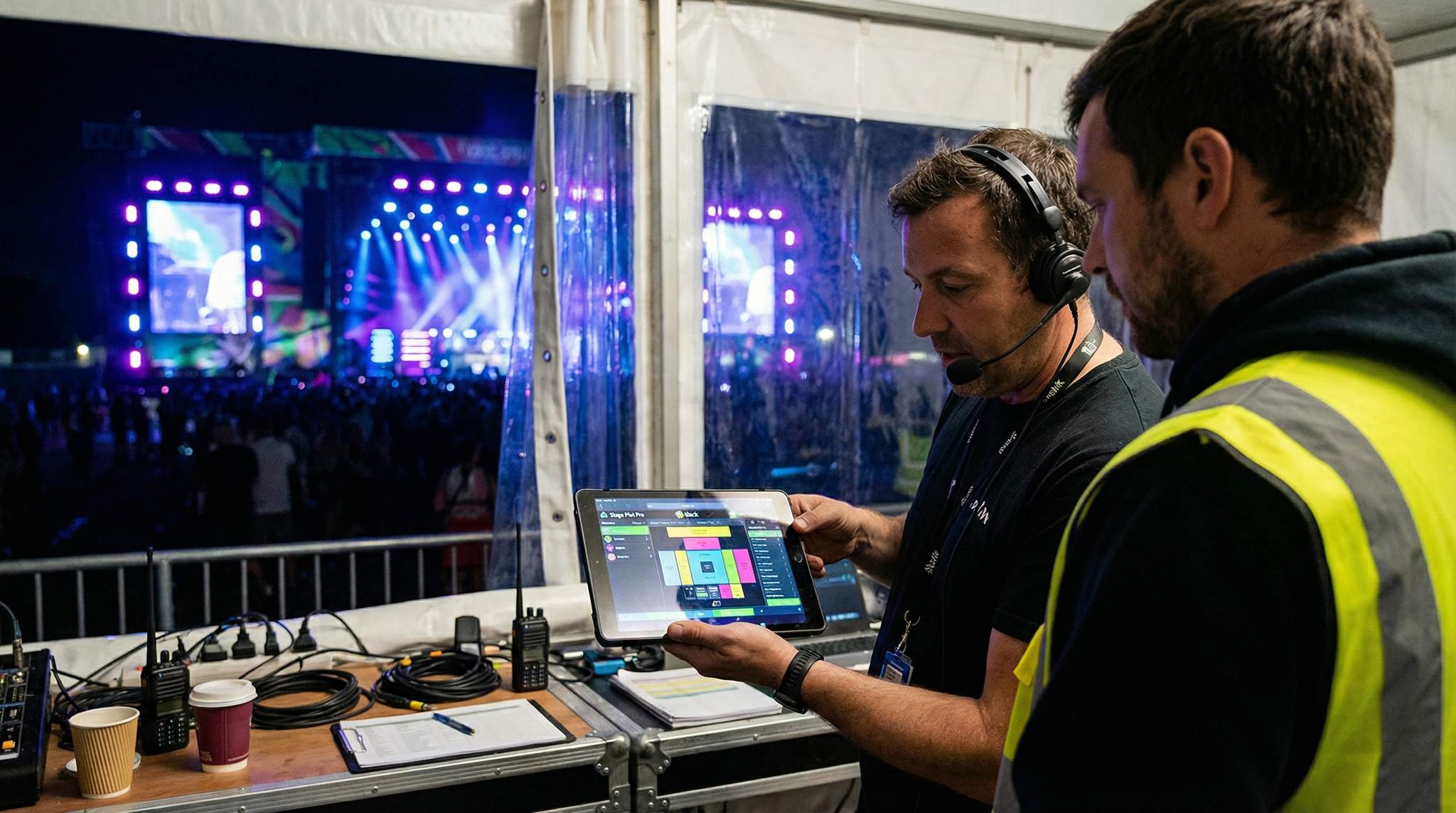
Stage Plot Pro is an intuitive application designed specifically for creating stage plots and managing technical production details. This tool allows stage managers to visually represent the layout of a stage, including placement of performers, equipment, and props. It also offers comprehensive solutions for event logistics – helping coordinate elements like vendors, artists, ticketing, and guest lists in one platform. In other words, Stage Plot Pro functions as a digital blueprint for your stage setup and related logistics, ensuring everyone from sound engineers to lighting techs share the same vision of the stage.
Key Features:
– Visual Stage Layouts: Create detailed, to-scale diagrams that depict the arrangement of all elements on stage (e.g. drum kits, monitors, mic stands, backline gear).
– Customizable Templates: Use pre-designed stage templates or create custom layouts tailored to specific productions or festival stages.
– Collaboration Tools: Share plots with team members for feedback, live editing, and approvals, so designers and crew can collaborate in real time.
– Export Options: Easily export stage diagrams in various formats (PDF, PNG, etc.) for distribution to crew and cast, or to print and post backstage.
– Equipment Library: Drag-and-drop from a library of common gear icons (amps, speakers, lighting rigs) to quickly build accurate stage plots without drawing from scratch.
Stage Plot Pro enhances communication among technical teams by providing clear visual references, dramatically reducing misunderstandings during rehearsals and changeovers. In practice, using a visual stage chart means the audio, lighting, and stage crews all reference the same layout – preventing mistakes like a misplaced monitor or an amp set in the wrong spot. Many stage managers will print or tablet-share the Stage Plot Pro diagram on show day so everyone can double-check placements. By eliminating guesswork, this app helps minimize set-up time between acts and ensures each performance’s technical needs are met exactly as planned. For a broader overview of responsibilities, reviewing your essential stage manager checklist is highly recommended.
Data-Driven Event Marketing
Track ticket sales, demographics, marketing ROI, and social reach in real time. Exportable reports give you the insights to make smarter decisions.
Slack
Slack is a widely used communication platform that facilitates real-time messaging and collaboration among team members. For stage managers, Slack serves as a central hub for communication, ensuring everyone from production assistants to department heads stays informed before and during the festival. This tool has become the modern equivalent of the production walkie-talkie (though radios are still used on show day) – offering structured, persistent communication channels that can be accessed from anywhere. Slack continuously innovates its features, making it a powerful backbone for event management communication in 2026.
Key Features:
– Channels for Organization: Create dedicated channels for different departments or aspects of production (e.g. #lighting, #sound, #stage-crew, #artist-relations) to keep discussions focused and organized.
– File Sharing: Quickly share documents, schedules, stage plots, and updates with the entire team or specific channels. Everyone sees the latest version of run-sheets, contracts, or cue sheets without digging through emails.
– Integrations: Connect Slack with other tools like Google Drive, Trello, and ShowFlow to streamline workflows. For instance, a Trello task update or Google Sheet edit can automatically send a Slack notification to the relevant channel.
– Mobile & Desktop Access: Stay connected on the go with robust mobile apps (iOS/Android) and desktop notifications. A stage manager can be out on the festival grounds and still receive urgent messages or alerts instantly.
– Threaded Conversations: Use message threads to discuss specific subtopics without cluttering the main channel, so important information isn’t lost in a flood of chat.
By utilizing Slack, stage managers maintain clear lines of communication – crucial for coordinating complex productions spread across large festival sites. In the months leading up to an event, Slack channels keep the pre-production team in sync; during the festival, instant messaging can complement radio calls for non-urgent updates or detailed discussions. For example, one can set up a channel like #Daily-Schedule and pin the morning briefing there, or use Slack’s Workflow Builder to send automatic reminders (“Sound check on Stage B in 10 minutes”). Real-world usage: Sixthman – a company that runs music festival cruises – scaled its team communication to over 100 staff using Slack’s automation and collaboration features, allowing them to coordinate complex events at sea as the company grew. Slack even enables communication with external partners securely via Slack Connect, so a stage manager could have a shared channel with an artist’s tour manager if needed. The platform’s versatility (from group channels to one-on-one DMs) and searchability means no vital instruction gets lost. Ultimately, Slack ensures everyone is on the same page, whether it’s a lighting cue change or a last-minute schedule tweak, and its real-time nature means decisions happen faster – a must when you’re managing split-second event logistics.
Trello
Trello is a project management tool that uses boards, lists, and cards to organize tasks and workflows. It’s particularly useful for stage managers who need to track the myriad elements of a production from pre-production through the live event. Trello’s visual approach to task management is like a digital bulletin board covered in sticky notes – but far more organized and interactive. For a festival stage manager juggling schedules, equipment orders, staffing, and more, Trello brings much-needed clarity to what needs to be done and who’s doing it.
Key Features:
– Visual Task Management: Use boards to visualize tasks and their status. Each card represents a task (e.g. “Setup Stage A lighting truss” or “Confirm catering for crew”), and cards can be dragged between lists like To Do, In Progress, and Done, giving an instant snapshot of progress.
– Checklists and Due Dates: Create checklists within cards for multi-step tasks (like a rehearsal checklist or a pre-show rundown of duties) and set deadlines. Trello sends reminders as due dates approach, keeping everyone accountable.
– Collaboration Features: Assign tasks to team members, add watchers, and comment on cards so that discussions about a specific task stay attached to it. Real-time updates show when someone completes or updates a task, avoiding long email threads.
– Customizable Boards: Tailor boards to fit specific projects or productions. You can set up boards by festival day, by stage, or by functional area (e.g., Logistics, Stage Management, Artist Hospitality), and even color-code or label tasks by priority or department.
– Attachments & Labels: Attach relevant files (layouts, permits, contact lists) directly to task cards, and use labels or tags (like “High Priority” or “Technical”) to filter and sort tasks instantly.
Trello’s flexibility allows stage managers to adapt their project management approach to each production’s unique needs. A well-structured festival planning board can break a massive event into manageable pieces – for example, categorizing tasks under Permits, Site Infrastructure, Talent Booking, Marketing, and Vendors, each with its own list of to-dos. In practice, a Trello board can function as an interactive run sheet or production checklist. One common technique is to create a card for each artist’s performance: as the day progresses, stage managers move each artist’s card from “Soundcheck ?” to “On Stage ?” to “Completed ?” lists, reflecting the live status. This visual flow gives everyone (from crew to management) a live snapshot of event progress and ensures nothing falls through the cracks. Trello’s integrations (for example, syncing with Google Calendar to map out deadlines, or with Slack to post updates in chat) further extend its utility. By using Trello, stage managers and their teams can stay organized, meet deadlines, and respond quickly when plans change – all keys to executing a flawless festival. To ensure the physical setup matches your digital planning, consider these seven essential steps behind the perfect event stage.
Luminotes
Luminotes is a specialized app designed for digital note-taking during rehearsals and performances. It allows stage managers to keep detailed, time-stamped records of cues, changes, and important notes in an organized manner that’s far superior to scribbling in a binder. Whether you’re calling a show or managing a festival stage, Luminotes serves as an electronic “prompt book” – capturing everything from lighting cue adjustments to performer entrance timings, all searchable and backed up in the cloud.
Key Features:
– Real-Time Note-Taking: Jot down notes and changes on the fly during rehearsals or shows with a laptop or tablet, ensuring no critical detail is forgotten. Notes can often be linked to specific timestamps or cue points in the script/setlist.
– Cue Tracking: Keep track of cues (lighting, sound, pyrotechnics, etc.) with precise timestamps and detailed descriptions. You can mark cues as completed or note if something was skipped or altered, which is invaluable for error tracking.
– Search Functionality: Quickly find past notes or specific cues using keyword search. For example, search “Spotlight” to find every instance you noted a spotlight cue, rather than flipping through pages of a notebook.
– Cloud Syncing: Access notes from any device with cloud synchronization. A stage manager can take notes on a tablet backstage, and the production manager in the control room can see those updates on their laptop instantly.
– Tagging & Organization: Organize notes by show, scene, or artist. For a festival, you might tag notes by the artist name or stage, allowing you to filter and review all notes related to “Main Stage – Saturday” easily.
Ready to Sell Tickets?
Create professional event pages with built-in payment processing, marketing tools, and real-time analytics.
Luminotes ensures that stage managers have every necessary piece of information at their fingertips, promoting efficiency and accuracy during productions. Traditionally, stage managers relied on paper scripts with pencil marks or memory for tracking changes – now, a tool like Luminotes centralizes all those annotations and makes them shareable. Imagine you’re in the middle of a festival soundcheck and a headliner decides to change the order of their set: with Luminotes, you can update the cue list on the spot, note the new song order and any new cues, and immediately distribute that updated note set to your team. The app’s robust search means if someone asks, “What change did the DJ request during rehearsal?”, you can find it in seconds. And since everything is time-stamped, you can review exactly when and why a change was made. By digitizing note-taking, Luminotes not only reduces the chance of human error (no more illegible handwriting or lost sticky notes) but also speeds up show prep – you can copy notes from rehearsal to performance mode, ensuring consistency. Ultimately, Luminotes streamlines the stage manager’s documentation process, allowing them to focus on execution rather than paperwork.
ShowFlow
ShowFlow is a comprehensive production management tool that focuses on scheduling and cue tracking for live events. It’s particularly beneficial for time-critical scenarios, such as multi-stage music festivals or broadcasted concerts, where precise timing and coordination are everything. ShowFlow essentially acts as a dynamic run-of-show schedule that all team members can follow and update in real time – often referred to as a “show caller’s bible” in digital form. If any change occurs (and in the live event world, something always changes), ShowFlow lets the stage manager adjust schedules or cues on-the-fly and instantly communicate those changes to the entire crew.
Key Features:
– Real-Time Scheduling: Build a detailed show schedule with start/end times for each act, changeover, announcement, etc., and update it in real time as changes occur during rehearsals or live performances. Everyone linked to the event can see updates instantly (e.g., if a set is running 5 minutes late, the system can shift all subsequent times accordingly).
– Cue Management System: Create and manage detailed cue sheets that can be shared with the entire crew – lighting cues, audio cues, special effects triggers, stage entrance cues – all organized in sequence. As cues are executed, they can be checked off or marked, keeping everyone aligned on what’s next.
– Collaboration & Comments: Allow team members (like stage hands, technical directors, or MCs) to comment on schedules or cue sheets directly within the app. This is useful for noting issues (“Spotlight cue C delayed due to fog”) or giving heads-up (“Band needs extra 2 min for instrument change here”).
– Mobile Compatibility: Access schedules and cue sheets from mobile devices or tablets during live events. A stage manager can walk around with a tablet running ShowFlow and see the show timeline, rather than being tethered to a command post.
– Timecode Integration: Some ShowFlow implementations allow integration with timecode or show control systems, so that cues can be synced with official event time or even automated triggers, ensuring split-second accuracy.
ShowFlow’s emphasis on real-time updates makes it an invaluable tool for managing fast-paced productions. When you’re dealing with back-to-back artist sets on multiple stages, being able to adapt instantly is crucial. For instance, if a performer on Stage 2 suddenly extends their set by 5 minutes, ShowFlow lets the Stage 2 manager adjust the schedule, and an alert can notify all departments (audio, lighting, artist hospitality, etc.) of the new timing. Meanwhile, Stage 3’s crew might see a note that they need to hold their start due to a delay elsewhere. In the days of paper schedules or spreadsheets, communicating these chain-reaction changes was slow and error-prone – ShowFlow solves that by acting as the centralized source of truth. Furthermore, team members can use the app to acknowledge changes (so the stage manager sees who has seen the update, adding confidence that everyone got the memo). All these features mean fewer missed cues, smoother transitions, and less downtime. In the controlled chaos of a music festival, ShowFlow is like the mission control for your show flow, keeping the production running on time (or gracefully recovering when it doesn’t). While focusing on the stage, understanding the artist’s perspective is key, as detailed in an essential guide for touring artist managers.
Free Tool: Model Promoter Payouts
Flat-percentage, flat-per-ticket, or tiered-bonus commission structures — get per-promoter payouts and total commission as % of gross. Free calculator.
CrewCaller Pro
CrewCaller Pro is designed specifically for managing crew assignments and communication. It helps stage managers schedule crew shifts, coordinate staffing across different stages or sites, and keep everyone accountable. In the festival environment – where you may have hundreds of crew members, volunteers, and contractors working various roles – an app like CrewCaller Pro can be a game-changer for labor management. It essentially replaces the need for endless Excel sheets or frantic phone calls by centralizing who needs to be where, and when.
Key Features:
– Crew Scheduling: Assign roles and shifts easily within the app. You can build a full crew schedule for each day of the festival (e.g., Stage A Backline Crew: 8am–4pm; Overnight Site Security: 10pm–6am) and ensure no shift is left uncovered.
– Notifications and Alerts: Send automatic reminders to crew members about upcoming shifts or any schedule changes. For example, if the gates will open early on Day 2, you can alert the entry staff to arrive 30 minutes sooner with a push notification.
– Availability Tracking: Monitor crew availability and time-off requests to ensure adequate staffing at all times. Crew members can input when they’re free to work, and the app can suggest scheduling options or flag conflicts if someone is double-booked.
– Integrated Messaging: Communicate directly with crew members or specific teams through the app. This might include broadcast messages (“All crew: lightning delay, take shelter and await instructions”) or one-on-one chats to handle issues like a replacement or a question about duties.
– Labor Compliance Tools: Track work hours, breaks, and overtime for crew to ensure compliance with labor regulations and to prevent burnout. Having a digital log of hours can also help with post-event payroll accuracy and fairness.
Grow Your Events
Leverage referral marketing, social sharing incentives, and audience insights to sell more tickets.
Using CrewCaller Pro, stage managers can streamline crew management processes, reducing confusion and enhancing overall productivity. Consider the common scenario of a volunteer not showing up for their shift: in a manual system, finding a replacement could take dozens of phone calls; with CrewCaller Pro, you can quickly see which alternate staff are marked available and send out a request or alert within seconds. In fact, events that moved from manual crew scheduling to digital platforms have reported up to an 80% reduction in coordination time for staffing. The app also promotes accountability – crew members get clear confirmations of their assigned shifts and responsibilities, which increases the chance they’ll fulfill them (and allows you to track if they check in/out). Another benefit is centralizing contact info and roles: if you need to reach “John Doe – Stage B Lighting Tech” you can find and message him through the app, rather than scrambling for phone numbers on site. Given the ongoing labor shortages in the live events sector, efficient crew deployment is more important than ever. CrewCaller Pro helps you do more with a leaner team by ensuring every person is in the right place at the right time, with instant communication to handle the inevitable last-minute changes.
TechRider Hub
TechRider Hub is an essential app for managing technical riders – the documents that detail an artist’s technical and staging requirements. Stage managers and production coordinators deal with dozens (sometimes hundreds) of artist riders in a festival season, covering everything from audio equipment and stage plots to power needs. TechRider Hub simplifies the process of collecting, reviewing, and sharing these technical requirements with the relevant teams (sound, lighting, stage crew, etc.) and venues.
Key Features:
– Centralized Technical Documents: Store all technical riders, stage plots, and input lists in one secure, searchable place for easy access. Instead of digging through email attachments for the band’s rider, you just pull it up in the app’s library.
– Collaboration & Annotations: Allow team members to comment on or annotate technical documents collaboratively. The audio lead can highlight the FOH mix preferences, or the lighting designer can note any special effects cues listed, all within the shared document.
– Version Control: Keep track of changes made to technical documents over time. If an artist updates their requirements (as often happens on tour), the app logs the new version, and you can see what changed from the previous version – ensuring you’re always working off the latest specs.
– Export & Sharing: Export documents in various formats or share links directly with vendors and stage crews. For example, you can send the staging company a PDF of the headline DJ’s stage layout, or provide read-only online access to the on-site tech lead who needs to check a power spec.
– Offline Access: Download riders to a device for offline use. If you’re on a festival site with spotty internet, you can still pull up the saved technical rider for reference.
TechRider Hub enhances communication between production teams and artists/venues by ensuring that everyone has access to up-to-date technical requirements. It reduces the risk of errors like “we didn’t know the band needed 10 monitor wedges” or “the power specs weren’t communicated” – everything is documented and at your fingertips. For a stage manager, this means less last-minute scrambling: if a question arises about an artist’s needs, you can quickly search the app rather than rifling through binders or email threads. Real-world example: Let’s say Artist X’s rider specifies a particular model of guitar amp and an unusual microphone. With TechRider Hub, the stage manager can tag the audio vendor in a comment on that rider weeks in advance to ensure those items are sourced, and the vendor can confirm right in the app. During the festival, if the front-of-house engineer needs to double-check the input list 30 minutes before the set, they can pull it up on their phone instantly. The app’s version control also builds trust – if an artist sends a revision, the team gets notified and the old version is archived to avoid mix-ups. In short, TechRider Hub is all about preventing technical hiccups through better information management. By having all requirements centralized, communicated, and confirmed, stage managers can deliver smoother shows and strengthen their reputation for professionalism. When advancing shows, referring to the ultimate guide to selecting venues for touring artists can help align technical requirements with venue capabilities.
Free Tool: Will the Room Actually Be Full?
Forecasts expected attendance from ticket type, event type and day of week. Calculates safe over-book count for free-RSVP events. Free estimator.
WeatherWatch Pro
WeatherWatch Pro provides real-time weather updates crucial for outdoor events. Stage managers use this app to monitor weather conditions leading up to and during performances so they can make informed decisions about show schedules, safety protocols, and equipment protection. In the era of wild weather swings – scorching heat, sudden rainstorms, high winds – having professional-grade weather insight is not a luxury but a necessity. Extreme weather has become such a concern that in 2025 a legendary rock band canceled an entire tour due to unpredictable heat, flooding, and storm risks, underscoring why festival organizers rely on real-time weather apps as part of their risk management.
Key Features:
– Real-Time Alerts: Receive instant notifications about severe weather changes that could impact the event. For example, if a lightning strike is detected within a set radius (say 8 miles), the app issues an alert so you can activate delay or evacuation plans before the storm hits.
– Advanced Forecasting Tools: Access detailed forecasts specific to your event location, including hour-by-hour breakdowns, wind speeds, temperature highs and lows, and precipitation probability. Many festivals create weather contingency plans based on these precise forecasts (e.g., adjusting the schedule earlier in the day if a storm is predicted for the evening).
– Historical Data: Review past weather data for the same location and date. This can be surprisingly useful – for instance, knowing that historically the venue gets very cold at night might prompt you to arrange extra heating or crew jackets.
– Radar & Maps: View live radar maps and satellite imagery to visually track incoming storm systems in relation to your venue. This helps stage managers time decisions like “hold the show” or “resume in 15 minutes” by watching the storm’s movement in real time.
WeatherWatch Pro ensures that stage managers are prepared for any weather-related challenges during outdoor productions. This preparedness can mean the difference between a minor delay and a major incident. With the app, you can set custom thresholds – perhaps a wind warning at 20 mph to secure stage scrims and line arrays, or a heat index alert to start distributing water to staff – and be confident you won’t be caught off guard. For example, if a sudden high wind event is detected, a stage manager might decide to pause a show and lower lighting trusses as a safety precaution. Having hyper-local forecast data builds trust with stakeholders too: artists and audiences see that decisions (like evacuations or restarts) are based on solid meteorological info, not guesswork. Some festivals even integrate WeatherWatch Pro with their public announcement systems, so attendees get weather-related messages that are consistent with what the production team knows. In sum, by giving stage managers accurate, timely weather intelligence, WeatherWatch Pro helps protect the audience, the crew, and the equipment – keeping the event safe and on track as much as possible.
SoundCheck Master
SoundCheck Master assists in managing sound checks effectively. It helps stage managers (and audio crew leads) coordinate the audio setup and line checks before performances, which is critical for ensuring every act sounds great from the first note. In a festival scenario, you might only have a short window to line-check each band’s gear, especially on smaller stages with tight turnovers. SoundCheck Master acts as a digital checklist and reference tool to make sure nothing gets overlooked in that pressure-filled time before the audience arrives or the next act starts.
Key Features:
– Custom Checklists: Develop reusable sound check checklists tailored to specific performances or stages. For instance, create a “Festival Stage A – Standard Band Soundcheck” checklist that includes drums (kick, snare, toms), bass DI, guitar amp mic, DJ line, vocals, etc., and simply load it for each act, adjusting as needed.
– Audio Level Monitoring: Track and log audio levels during checks to ensure consistency. The app can integrate with sound level meters or allow you to note the decibel readings for each input. This helps maintain quality control – you’ll know if the lead vocal is peaking during soundcheck so it can be reined in before showtime.
– Line Assignment & Patch Tracking: Document which inputs on the console or stage snake are used by each instrument/microphone. As different bands plug into the system, the app serves as a reference (e.g., Input 7 = Lead Guitar Mic) so there’s less confusion and faster setup, especially if patching is changed between acts.
– Notes & Troubleshooting: Allow the audio team to note any issues observed during soundcheck (like “monitor mix for drummer too low” or “buzz on bass DI – swapped cable”), creating a running log of fixes. This historical log can be life-saving if a problem recurs during the live set – you can quickly recall what was done earlier.
SoundCheck Master streamlines the sound check process, allowing teams to focus on delivering high-quality audio experiences during performances. The value becomes clear on a multi-band lineup: the stage manager or audio tech checks off each item on the digital list as it’s done, ensuring every microphone is tested, every monitor wedge is sending signal, every line is clean. Nothing is worse than starting a show only to find out the keyboard DI was never unmuted – SoundCheck Master’s systematic approach helps avoid those embarrassments. In practice, many users pair this app with a quick communication loop: as the audio engineer tests each channel, the stage manager watches the checklist and confirms completion. If the guitarist was late to soundcheck and arrives last-minute, you can see at a glance that their line isn’t checked off yet and address it immediately. The app’s audio level logs also help after the event – you can review if any stage’s sound consistently ran hot and might need better calibration next time. By bringing consistency to what can be a frantic process, SoundCheck Master gives artists a smoother soundcheck experience and gives stage managers peace of mind that nothing will be left untested when the lights go up.
Smooth Entry With Mobile Check-In
Scan tickets and manage entry with our mobile check-in app. Supports photo ID verification, real-time capacity tracking, and multi-gate coordination.
SecuritySync
SecuritySync is an app focused on managing security protocols and incident response during events. Safety is a top priority at festivals, and this tool brings organization and real-time communication to the security operation. Think of SecuritySync as a digital logbook and walkie-talkie combined, ensuring that security staff, stage managers, and emergency response teams are all in sync regarding any issues on the ground. From minor first-aid needs to major crowd control problems, having a centralized app to track and coordinate the response can significantly improve outcomes.
Key Features:
– Incident Reporting: Enable team members (security personnel, volunteers, even crew leads) to report security incidents directly through the app. They can fill out a quick form or hit an emergency button describing the issue (e.g., “medical emergency at Stage 2”, “unauthorized drone spotted above main stage”). All reports are time-stamped and geo-tagged if possible, creating an organized incident log.
– Access Control Management: Manage and monitor who has access to different areas during events. The app can store access lists or credentials – for instance, verifying if a person asking to enter the backstage area is on the approved list. It can also track if doors/gates are opened or closed and by whom if integrated with smart locks or badge systems.
– Real-Time Alerts & Updates: Broadcast critical security updates to relevant staff. If a child is lost and then found, for example, a quick alert can be sent to all security and stage management: “Missing child incident resolved at Info Tent”. Likewise, if part of the venue must be evacuated (weather or other emergency), an alert with instructions can go out to all staff instantly.
– Analytics & Post-Event Reporting: After the festival, review incident patterns with collected data. Heat maps of incident locations or charts of incident types can help improve future safety planning and demonstrate to authorities/sponsors how issues were handled.
SecuritySync enhances safety protocols by providing a structured, efficient approach to security management during productions. In recent years, the live event industry has faced tragic reminders that robust safety communication is critical – and tools like this are part of the solution. Using SecuritySync, a stage manager or safety officer can open a dashboard at any moment to see exactly what incidents are happening across the venue and their status (pending, in-progress, resolved). For example, if a fight breaks out in the crowd, a security team member can input it immediately; the nearest response team is alerted and dispatched via the app; the stage manager sees it and might decide to briefly pause the show if things escalate. All the while, every action (who responded, how quickly it was resolved) is logged. This level of coordination simply isn’t possible with analog methods alone (radios can only reach so many people at once, and details might be missed). Another scenario: a gate is breached by ticketless fans – with SecuritySync, multiple teams (security, venue management, stage management) get a unified alert, and the incident commander can update the log as the situation is contained. By the end of the festival, you have a complete digital paper trail of safety incidents, which is invaluable for debriefs and improving trust with stakeholders (you can show, for example, that “15 minor medical incidents were handled with average response time of 2 minutes”). In conclusion, as of 2026, these applications represent the forefront of technology available to stage managers aiming to run safe, efficient, and spectacular music festivals. By leveraging these tools, stage managers can enhance their efficiency, improve team communication, and ultimately contribute to more successful productions. It’s important to note that technology doesn’t replace the fundamentals of good stage management – rather, it amplifies a manager’s experience and expertise. When used wisely, these apps let you work smarter, not just harder, turning potential chaos into a well-coordinated operation. Integrating security apps often works best alongside hardware solutions; learn how to use RFID for on-site event payments and access control to maximize efficiency.
Warning: While these apps are powerful, avoid relying on any single tool without a backup plan. Always train your team on contingency protocols (like keeping printed schedules, backup radios or offline files) in case of technical glitches or connectivity issues during an event. Digital tools should augment solid stage management practices – not replace them entirely.
Integrating Stage Apps with Core Festival Management Software
While specialized applications handle the granular details of backstage operations, their true power is unlocked when integrated with overarching festival management software. For modern event producers, operating in silos is a major liability. By connecting stage-specific tools—like cue trackers and crew schedulers—to your primary music festival software, you create a unified operational dashboard. This seamless data flow means that when a stage manager logs a 15-minute delay due to weather, the central system instantly updates the master run-of-show. Furthermore, this integration is vital for attendee engagement. In 2025 and 2026, the most effective event apps for music festivals with sponsor booths and push notifications rely on this real-time backstage data to trigger automated alerts, guiding crowds to alternative stages or sponsored activation zones during unexpected downtime. Ultimately, a centralized platform empowers organizers to maintain total control over both the production logistics and the fan experience.
Transitioning to a Unified Music Festival Management Platform
No Hidden Fees, Just Honest Pricing
One all-inclusive fee covers the platform, payment processing, support, and every feature. Free events are always free. No setup costs, no surprises.
SecuritySync enhances safety protocols by providing a structured, efficient approach to security management during productions. In recent years, the live event industry has faced tragic reminders that robust safety communication is critical – and tools like this are part of the solution. Using SecuritySync, a stage manager or safety officer can open a dashboard at any moment to see exactly what incidents are happening across the venue and their status (pending, in-progress, resolved). For example, if a fight breaks out in the crowd, a security team member can input it immediately; the nearest response team is alerted and dispatched via the app; the stage manager sees it and might decide to briefly pause the show if things escalate. All the while, every action (who responded, how quickly it was resolved) is logged. This level of coordination simply isn’t possible with analog methods alone (radios can only reach so many people at once, and details might be missed). Another scenario: a gate is breached by ticketless fans – with SecuritySync, multiple teams (security, venue management, stage management) get a unified alert, and the incident commander can update the log as the situation is contained. By the end of the festival, you have a complete digital paper trail of safety incidents, which is invaluable for debriefs and improving trust with stakeholders (you can show, for example, that “15 minor medical incidents were handled with average response time of 2 minutes”). In conclusion, as of 2026, these applications represent the forefront of technology available to stage managers aiming to run safe, efficient, and spectacular music festivals. By leveraging these tools, stage managers can enhance their efficiency, improve team communication, and ultimately contribute to more successful productions. It’s important to note that technology doesn’t replace the fundamentals of good stage management – rather, it amplifies a manager’s experience and expertise. When used wisely, these apps let you work smarter, not just harder, turning potential chaos into a well-coordinated operation. Integrating security apps often works best alongside hardware solutions; learn how to use RFID for on-site event payments and access control to maximize efficiency.
Warning: While these apps are powerful, avoid relying on any single tool without a backup plan. Always train your team on contingency protocols (like keeping printed schedules, backup radios or offline files) in case of technical glitches or connectivity issues during an event. Digital tools should augment solid stage management practices – not replace them entirely.
Integrating Stage Apps with Core Festival Management Software
While specialized applications handle the granular details of backstage operations, their true power is unlocked when integrated with overarching festival management software. For modern event producers, operating in silos is a major liability. By connecting stage-specific tools—like cue trackers and crew schedulers—to your primary music festival software, you create a unified operational dashboard. This seamless data flow means that when a stage manager logs a 15-minute delay due to weather, the central system instantly updates the master run-of-show. Furthermore, this integration is vital for attendee engagement. In 2025 and 2026, the most effective event apps for music festivals with sponsor booths and push notifications rely on this real-time backstage data to trigger automated alerts, guiding crowds to alternative stages or sponsored activation zones during unexpected downtime. Ultimately, a centralized platform empowers organizers to maintain total control over both the production logistics and the fan experience.
Transitioning to a Unified Music Festival Management Platform
As your event scales from a boutique gathering to a multi-stage operation, relying on a patchwork of standalone applications often leads to communication bottlenecks. Upgrading to a dedicated music festival management platform centralizes your entire production workflow. Instead of manually transferring data between your crew scheduling app and your ticketing dashboard, a unified system automates these updates. For B2B event producers, this means that when a stage manager adjusts a set time due to a weather delay, the central hub instantly pushes that update to the attendee-facing mobile app, sponsor activation zones, and vendor portals. By consolidating operations into a single, robust ecosystem, organizers reduce administrative overhead, minimize costly errors, and maintain total control over both backstage logistics and the front-of-house fan experience.
Comprehensive Music Festival Management Software
While specialized stage management tools are critical for backstage operations, they often integrate into broader music festival management software ecosystems. As a festival producer, you need platforms that bridge the gap between backstage logistics and front-of-house execution. Comprehensive music festival planning software handles everything from site mapping and vendor logistics to attendee engagement. For example, platforms like Festival Pro let you create and publish dynamic, mobile-friendly event pages without developers, showcasing line-ups, calendars, and vendor lists in real time. This level of integration ensures that when a stage manager updates a set time in ShowFlow, the change can automatically reflect on the public-facing schedule.
Furthermore, organizers are increasingly seeking the best event apps for music festivals with sponsor booths and push notifications in 2026. These attendee-facing applications generate crucial revenue by driving foot traffic to sponsor activations via targeted push alerts, while simultaneously keeping fans informed of stage delays or weather evacuations. When evaluating the top music festival ticketing software that is mobile app friendly, ensure it offers robust API connections to your backstage scheduling tools. The best ticketing software for music festivals doesn’t just sell passes; it acts as the central data hub for your entire event, allowing production teams to anticipate crowd flow based on real-time scan data at the gates.
Let Fans Pay Over Time
Offer flexible payment plans that split ticket costs into manageable installments, making higher-priced events accessible and boosting conversions.
Choosing the Right App for Music Festival Planning
When scaling operations, relying solely on fragmented tools can create data silos. This is where adopting a dedicated app for music festival planning becomes a strategic necessity. A holistic festival app bridges the gap between backstage logistics and front-of-house execution. For organizers, these platforms centralize vendor contracts, site maps, and volunteer shifts. For attendees, a custom-branded festival app serves as a digital concierge, offering interactive maps, real-time schedule updates, and personalized itineraries. By integrating your stage management tools with a comprehensive planning application, you ensure that a last-minute set time change in ShowFlow instantly updates the public-facing schedule, keeping both your crew and your audience perfectly aligned.
Key Features to Look for in Festival Planning Software
When upgrading from basic spreadsheets to dedicated festival planning software, organizers should prioritize platforms that offer end-to-end operational visibility. The most effective systems go beyond simple task tracking to include interactive site mapping, comprehensive vendor management, and real-time budget forecasting. For instance, a robust music festival software suite will allow your production team to overlay stage plots directly onto the venue map, ensuring that power drops and backstage access routes are perfectly aligned before load-in begins. Additionally, look for solutions that seamlessly integrate with your ticketing provider. This ensures that attendee data, VIP upgrades, and sponsor booth analytics flow directly into your central dashboard, empowering promoters to make data-driven decisions on the fly.
Evaluating Stage Management Software: Free vs. Enterprise Solutions
When building your production tech stack, selecting the right stage management software is a critical decision that impacts both your budget and operational efficiency. For boutique events or independent promoters just starting out, utilizing a stage management software free tier or open-source alternative can be an excellent way to digitize workflows without upfront investment. Many entry-level platforms offer basic cue tracking, simple stage plotting, and limited team collaboration at no cost. However, as your festival scales to include multiple stages, complex technical riders, and hundreds of crew members, relying solely on free tools often introduces data silos and security risks. Enterprise-grade production platforms provide advanced features like real-time API integrations with your primary ticketing system, automated labor compliance tracking, and offline redundancy. For seasoned organizers, the ROI of upgrading to a premium solution is realized through faster changeovers, reduced labor hours, and the ability to seamlessly sync backstage logistics with front-of-house operations.
The Unique Demands of a Stage Manager Festival Role
Stepping into a stage manager festival role requires a different mindset compared to traditional theater or single-act concert tours. A festival stage manager is the linchpin of the entire production, tasked with orchestrating rapid set changeovers, managing multiple touring crews, and adapting to unpredictable outdoor conditions. Unlike a standard venue gig, managing a festival stage means coordinating with dozens of artists, each bringing their own technical riders, backline requirements, and personnel. This high-stakes environment is exactly why relying on a robust digital toolkit is non-negotiable. By utilizing the applications detailed above, a production lead can transition from merely reacting to on-site chaos to proactively directing a seamless, multi-day event.
Additional Resources and Industry Support
Professional Development
Industry workshops and conferences
Professional conferences and workshops serve as invaluable platforms for hands-on learning and networking. Major industry events like the Event Safety Summit (hosted by the Event Safety Alliance) and trade shows such as Live Design International (LDI) expose stage managers to the latest technologies via demos and training sessions. The International Festival Forum (IFF) in London, for instance, gathers festival organizers from around the world to discuss production innovations, including dedicated sessions on stage management tools and techniques. In the United States, conferences like FestForums and the Tour Link Conference often feature panels on festival operations and technology implementation. These events frequently include practical demonstrations of new gear (imagine testing a new stage plotting software live), roundtable discussions with experienced production managers, and workshops that provide hands-on experience with the latest management tools and techniques. Attending just one of these conferences a year can spark new ideas – you might learn how a top festival uses a custom app for crew check-ins, or see a case study on integrating RFID access control (which you can complement with your use of tools like SecuritySync or WeatherWatch Pro). Beyond formal sessions, the networking at these events is key: grabbing coffee with fellow stage managers often leads to swapping app tips or war stories that deepen your practical knowledge.
Vendor-provided training sessions
Vendor-provided training is another crucial resource for professional development. Many app developers offer comprehensive training programs, from basic onboarding to advanced user certification. For example, the creators of Stage Plot Pro and ShowFlow regularly host live webinars and publish tutorial video series for users. Some even run user conferences or online communities – think of it as a user group meetup where stage managers share how they maximize a tool’s features. These programs typically include webinars, online courses, and sometimes in-person training sessions that help stage managers unlock the full potential of their tech tools. In 2026, several platforms also offer certifications – after completing training modules and an exam, you might become a “Certified Power User” of a given software. Such credentials not only ensure you know the app inside-out but also look great on a resume. By engaging with vendor training, you’ll discover hidden features (like a new Slack integration or a reporting feature in CrewCaller Pro) and be better prepared to troubleshoot issues during a live event. In short, leaning into vendor resources transforms you from a casual user into a savvy expert who can confidently integrate these apps into your workflow.
Professional associations
Professional associations play a vital role in connecting stage managers with resources, standards, and networking opportunities. Organizations such as the Event Safety Alliance (ESA), International Live Events Association (ILEA), and the Production Managers Forum (PMF) provide members access to educational resources, industry guidelines, and peer support networks. These associations often maintain online forums or member portals where professionals can share experiences, seek advice, and discuss technological challenges with others who’ve faced similar situations. Being active in an association might mean you get early insights into emerging best practices – for example, ESA releases guidance on safety which could include recommended incident command apps (tying into tools like SecuritySync). There are also region-specific groups like the Association of Independent Festivals (AIF) in the UK or the IFEA internationally that focus on festival-specific challenges. Moreover, many associations host regional meet-ups, webinars, and annual congresses. At an ILEA meeting, you might hear a presentation from a stage manager who implemented a new workflow with Trello and Slack at a large festival, including their lessons learned. Involvement in these organizations signals your commitment to professionalism (boosting trustworthiness in the eyes of employers and clients) and keeps you plugged into the collective expertise of the industry.
Networking opportunities
Networking within the festival management community offers invaluable opportunities for knowledge sharing and professional growth. While formal associations are great, a lot of learning happens in informal networks too. Local meetups – for example, a city’s “live event professionals” happy hour – can connect you with fellow stage managers and production folks in your area. Online, social media groups have thriving communities: LinkedIn groups such as Event Producers Network or Festival Production Professionals often have discussions where people ask questions (“What scheduling app do you recommend for volunteers?”) and get answers from around the world. On Reddit, communities like r/StageManagement or r/TechTheatre (and more festival-focused threads) see professionals discussing real-life problems and solutions (for instance, how to integrate new ticket-scanning tech or best practices for overnight stage changeovers). There are even Slack workspaces and Discord servers dedicated to event professionals that popped up in recent years, providing a space to chat casually or crowdsource recommendations. The key benefit of networking is learning from others’ real experiences. You might hear how another festival dealt with a severe weather evacuation (and what apps helped), or how a peer set up their show calling office with multiple screens and software tools. By engaging in these conversations, you not only gather tips and tricks, but you build relationships – and the next time you are confronted with a challenge, you’ll have a roster of contacts to reach out to for quick advice. Remember, today’s big festivals and tours are often run by tight-knit communities of professionals who constantly learn from each other; networking plugs you into that community and accelerates your growth.
Industry publications
Industry publications and online resources provide ongoing education and updates about technological developments in event production. Magazines like Front of House (FOH), Live Design, and Pollstar regularly feature articles about new technologies, case studies of big productions, and best practices in stage management and production design. For example, Pollstar or IQ Magazine might publish an annual report on festival trends that highlights how many organizers are adopting certain software (giving you a benchmark of what’s becoming standard). Festival Insights and Event Industry News often have interviews with production managers, where they might mention specific tools they rely on. Online platforms such as ProductionHub and TheatreCrafts maintain extensive resource libraries, including technical guides, software tutorials, and how-to articles specifically tailored for live events and festivals. Subscribing to these publications or bookmarking their blogs can keep you inspired – one month you read about a European festival that implemented an AI scheduling tool (food for thought, perhaps, for your next season), another month you find a detailed checklist for weather preparedness that you integrate into your own planning. Staying informed through reputable industry publications ensures you’re not reinventing the wheel; instead, you’re learning from the collective progress of the field. It also adds to your authoritativeness as a professional – being able to reference data or stories from these publications in meetings (e.g., “I just read in Festival Insights that RFID entry systems cut queue times by 30%”) shows that you’re engaged with the broader industry dialogue.
Mentorship Programs
Mentorship programs, whether formal or informal, can provide personalized guidance in implementing and optimizing technology solutions – and in growing as a stage manager overall. Many experienced stage managers are generous with their knowledge, and being mentored by a veteran can accelerate your learning curve tremendously. Some professional associations and event companies have formal mentorship initiatives (for instance, ESA has been known to encourage mentorship to spread safety best practices, and ILEA chapters sometimes pair newer members with seasoned pros). In a tech context, a mentor could share how they rolled out a new software to a resistant crew, or how they balance using apps with keeping a human touch on show day. These are experience-based insights you won’t find in manuals. If formal programs are not available, seeking out an informal mentor works too: perhaps you meet a production manager at a conference who is willing to have monthly check-in calls with you. They might review your stage plots or production schedules and offer tips, or introduce you to contacts at a software company for extra support. On the flip side, as you gain experience, consider mentoring others – teaching best practices, like how to properly set up a Trello board for an event, reinforces your own expertise and contributes to the industry’s overall skill development. Mentorship relationships build a two-way trust; they help newer professionals avoid common pitfalls and develop effective strategies for technology adoption and leadership. In an industry as hands-on as live events, that guidance is invaluable.
This comprehensive guide reflects the latest developments in festival management technology as of 2026. While the tools and techniques highlighted here represent current best practices, the field continues to evolve rapidly. We’re already seeing AI-driven scheduling assistants and augmented reality enhancements for backstage coordination in experimental stages. As a stage manager, staying curious and adaptable is key – keep learning, keep networking, and don’t be afraid to try new tools (on a small scale) to see if they add value for your team. Ultimately, the goal remains the same: to put on safe, seamless, and unforgettable shows. With a blend of time-tested stage management wisdom and the smart use of modern apps, you’ll be well equipped to tackle whatever the next festival season brings.
Pro Tip: An all-in-one festival management software platform can integrate many of these functions into a single system. The best solutions let event organizers manage everything from scheduling and logistics to ticketing and communications in one dashboard. For example, with a platform like Ticket Fairy’s comprehensive event platform, you can tie together ticketing data, artist advancing info, and crew management tools in one place. Using an integrated platform alongside the specialized apps above helps eliminate duplicate work and data silos – making stage management a hassle-free experience for your team. To ensure your entire tech stack is optimized, it is worth comparing the top event ticketing platforms in 2024.
Frequently Asked Questions
What are the primary benefits of using Stage Plot Pro for stage management?
Stage Plot Pro is essential for stage managers due to its ability to create detailed visual diagrams of stage layouts. This clarity helps minimize misunderstandings among crew members, which is crucial during load-in, soundchecks, and live performances. The app offers customizable templates, allowing users to tailor layouts to specific productions or stage sizes – so whether it’s a small club show or a massive festival stage, the plot is optimized. Its collaboration features enable easy sharing of stage plots with team members for feedback and final approval, fostering teamwork and alignment well before rehearsals begin. Additionally, Stage Plot Pro supports various export options (PDFs, images), simplifying the distribution of stage diagrams via email or printouts. Overall, Stage Plot Pro enhances communication and organization within production teams, reduces potential errors (like forgetting an instrument placement or monitor), and contributes to smoother, faster stage transitions. As of 2026, it remains a go-to tool for professional stage managers looking to present clear stage plans to audio, lighting, and backline crews.
How does Slack improve communication among stage management teams?
Slack significantly improves communication within stage management and production teams by providing an organized, instantaneous medium for discussion. It allows the creation of dedicated channels for structured conversations on specific topics – for example, #MainStageOps for all main stage issues or #Emergencies for urgent safety matters. This structure reduces chatter in critical channels and ensures team members can easily find relevant information (unlike chaotic group texts). Real-time messaging enables instant communication, which is vital during rehearsals or live events when quick decisions and updates are needed. Slack also facilitates file sharing; crew members can upload run sheets, lighting cue sheets, or vendor contracts directly into channels, centralizing important info that everyone can access. Moreover, Slack integrates seamlessly with tools like Trello and Google Drive, notifying team members of task updates or document changes in real time – so nothing falls through the cracks. The mobile app and desktop notifications ensure that whether a team member is on-site or off-site, they remain connected and responsive. In summary, Slack creates a virtual office for the event, enhancing communication by providing organized channels, instant messaging, file sharing, and integration with other apps, all of which keep the entire team in sync and able to troubleshoot challenges faster.
What features make Trello an effective project management tool for stage managers?
Trello is an effective project management tool for stage managers due to its highly visual and intuitive system of boards, lists, and cards. This structure allows users to break down complex event projects into manageable tasks and see the status of each at a glance. Key features include the ability to create detailed checklists on cards – perfect for rehearsal schedules or show day to-do lists – and assign due dates, which promotes accountability and ensures tasks (like “Rig PA system” or “Soundcheck Stage B at 2 PM”) happen on schedule. Trello’s visual indicators (like colored labels and progress checklists) help track progress and priorities effectively. Its collaboration features allow multiple team members to comment on a card, tag each other with questions or updates, and move cards through a workflow (e.g., from Pending to In Progress to Done), reducing the need for lengthy email threads. Trello is also highly customizable: stage managers can design boards that fit the production’s unique flow – whether that’s segmented by departments (Tech, Hospitality, Logistics), days of the event, or any other scheme – making it flexible for different management styles. Furthermore, Trello integrates with calendar apps and Slack, so deadlines and updates can automatically appear in other platforms the team uses. In short, Trello’s strength lies in visualization and adaptability. It turns the chaos of festival planning into a clear, collaborative workflow with checklists, deadlines, and responsibilities plainly visible, which greatly aids stage managers in keeping everyone organized and on time.
How does Luminotes enhance note-taking during rehearsals and shows?
Luminotes enhances note-taking by providing a digital platform tailored to the fast-paced needs of stage management. Its real-time note-taking capabilities allow stage managers to capture important information as it happens during rehearsals or live shows – for instance, noting a director’s instruction to add a spotlight in Scene 3 or an artist’s request to extend a guitar solo by 8 bars. Unlike paper notes, these can be immediately saved and backed up. The app’s cue tracking feature is especially powerful: it lets you log cues with timestamps and descriptions (e.g., “Song 2 – confetti cannon at 3:45 mark”) so that during the performance you have a precise sequence of actions to follow. Luminotes’ robust search functionality means if you need to find a specific note (like all cues related to “fireworks” or every time Artist B had a monitor request), you can locate it in seconds, even if you made that note weeks ago. Cloud syncing ensures that notes are accessible from any device – you might take notes on a tablet during dress rehearsal, then review them on your laptop in the production office later. It also means multiple stage management team members can access the same updated information, ensuring continuity if there’s a hand-off or if someone needs to step in. Additionally, Luminotes allows categorization or tagging of notes by show, scene, or act, which keeps things organized if you’re managing multiple performances or festival stages. Overall, Luminotes streamlines the note-taking process and makes the information far more actionable: instead of flipping through a paper notebook, you have a well-ordered, searchable, and shareable repository of all the critical details needed to execute the show flawlessly.
What role does WeatherWatch Pro play in outdoor event planning?
WeatherWatch Pro is vital in outdoor event planning because it gives stage managers and event organizers a sophisticated tool to monitor and respond to weather conditions. In an outdoor concert or festival setting, weather can affect everything – the safety of attendees, the scheduling of performances, the integrity of structures, and the comfort of artists and crew. WeatherWatch Pro’s role begins long before the event with forecast analysis: by providing detailed forecasts for the event dates and location, it helps planners develop contingency plans (like knowing in advance which day might need extra tents or whether to have flexible start times if heat is a concern). As the event approaches and during show days, the app’s real-time alerts are crucial – for example, if a sudden thunderstorm or lightning strike is detected nearby, the stage manager can make the call to hold or evacuate a show per safety protocols. WeatherWatch Pro also informs decisions like when to schedule soundchecks or outdoor activities (you might decide to adjust a soundcheck earlier if the afternoon shows high winds). Its historical data feature aids in understanding typical climate patterns, which is useful in the pre-planning phase (e.g., knowing that the past three years had cool evenings, you ensure heaters or crew jackets are budgeted). Essentially, WeatherWatch Pro serves as the stage manager’s personal meteorologist, translating complex weather data into actionable insights. During the event, it’s often integrated into the emergency action plan: certain thresholds trigger specific responses (like “sustained winds above 35 mph = lower the PA and delay the show”). By having this tool, stage managers can confidently make the tough calls regarding weather, communicate early and clearly with artists and attendees about any changes, and implement rain or shine plans effectively. In summary, WeatherWatch Pro’s role is to ensure that weather becomes a managed element of the event, rather than an uncontrolled risk, by providing timely, location-specific information and alerts that keep everyone safe and the event as on-schedule as possible.
What are the core responsibilities of a stage manager at a music festival?
A festival stage manager is responsible for the safe, timely, and seamless execution of all performances on their assigned stage. Core duties include advancing technical riders with artists prior to the event, directing load-in and load-out procedures, managing the stage crew, and enforcing strict set times to ensure the festival schedule stays on track. During the event, they act as the primary liaison between the artists’ touring personnel, the local audio/visual technicians, and the festival’s core production team. Because a stage manager festival environment involves rapid changeovers and unpredictable variables like weather, they must also be adept at crisis management and real-time problem-solving, often relying on specialized production apps to keep all departments synchronized.
Which online platforms provide setlist predictions or typical setlist structures for country artists?
For stage managers and lighting directors advancing shows, anticipating an artist’s flow is critical—especially when dealing with touring acts that might not provide a finalized cue sheet until load-in. Platforms like Setlist.fm and specialized industry databases provide historical setlist data and typical setlist structures for country artists, rock bands, and pop acts alike. By reviewing an artist’s recent tour dates on these platforms, production teams can predict the pacing of the show, anticipate when acoustic breakdowns or high-energy encores will occur, and pre-program lighting or video cues accordingly. This proactive approach is a staple of advanced music festival scheduling software workflows, ensuring the local crew is never caught off guard.
What is the difference between specialized stage apps and all-in-one music festival software?
Specialized apps focus deeply on a single operational niche, such as cue calling or stage layout. In contrast, all-in-one festivals software provides a macro view of the entire event lifecycle. A comprehensive music festival software platform typically includes modules for ticketing, vendor management, volunteer scheduling, and marketing. While a stage manager might rely on a specialized app during the actual performance, the festival director uses the broader management platform to oversee the event’s overall health, budget, and logistics. The most successful mega-festivals utilize a hybrid approach, ensuring their specialized backstage tools can export data or integrate directly with their primary festival management systems.
What features should organizers look for in an app for music festival planning?
When evaluating an app for music festival planning, organizers should prioritize platforms that offer dual functionality: robust backend logistics for the production team and an intuitive interface for attendees. Essential B2B features include real-time schedule syncing, vendor management, volunteer shift tracking, and API integrations with stage management tools like ShowFlow or Stage Plot Pro. On the consumer side, a top-tier festival app must provide interactive site maps, push notifications for emergency or weather alerts, and sponsor activation capabilities. Ultimately, the right planning software eliminates data silos, ensuring that any backstage adjustments—such as a delayed set time—are instantly reflected on the attendee’s mobile device.
How does festival management software improve overall production ROI?
Implementing dedicated festival management software improves return on investment by drastically reducing administrative overhead and preventing costly logistical errors. Instead of relying on fragmented spreadsheets, organizers use these comprehensive platforms to centralize vendor contracts, crew schedules, and technical riders. When integrated with attendee-facing technology, this centralized data becomes a revenue driver. For instance, utilizing the best event apps for music festivals with sponsor booths and push notifications in 2025 and 2026 allows promoters to monetize schedule changes or stage delays by directing foot traffic to specific vendor areas via automated alerts. By streamlining backstage operations and maximizing on-site commercial opportunities, a robust music festival software ecosystem pays for itself.
How does festival planning software differ from standard project management tools?
While standard project management tools like Trello or Asana are excellent for general task tracking, dedicated festival planning software is purpose-built for the unique logistical demands of live events. These specialized platforms typically include industry-specific modules such as artist advancing, technical rider management, vendor contract tracking, and spatial site mapping. Furthermore, comprehensive music festival software often integrates directly with ticketing and access control systems, allowing organizers to monitor real-time gate scans and adjust crowd flow or security deployments accordingly. For B2B event producers, investing in a tailored planning solution reduces the need to duct-tape multiple generic apps together, ultimately saving time and minimizing costly miscommunications during the critical load-in and show days.
What are the main advantages of adopting a centralized music festival management platform?
Adopting a centralized music festival management platform streamlines complex event operations by bringing ticketing, crew scheduling, artist advancing, and attendee communications into one unified dashboard. For large-scale event producers, the primary advantage is the elimination of data silos. When your stage management tools sync directly with your core operational software, any backstage changes—such as a delayed load-in or a shifted set time—are automatically reflected across all departments. This real-time synchronization not only prevents logistical missteps but also enhances the attendee experience by ensuring public-facing schedules and push notifications remain accurate throughout the event.
Is it viable to use free stage management software for a large-scale music festival?
While a stage management software free version can be highly effective for single-stage events, community concerts, or early pre-production planning, it is generally not recommended for large-scale, multi-stage music festivals. Free tiers typically restrict the number of users, limit cloud storage for heavy technical riders, and lack the robust, real-time API integrations required to sync with overarching festival management platforms. For mega-festivals, organizers need enterprise-level reliability, offline access capabilities, and dedicated customer support to handle mid-show emergencies. Upgrading to a premium stage management solution ensures that your entire production team—from the audio engineers to the site director—operates from a single, secure, and instantly updated source of truth.
For further reading on optimizing your production, explore the backstage essentials at every successful festival to ensure your team is fully equipped. Additionally, staying ahead of the curve is vital, so check out the live music event trends in 2025 that organizers should know. Finally, consider how on-ground engagement creates a stronger brand to boost your event’s profile.