API-First Ticketing Platforms vs Monolithic Systems: An Architectural Overview
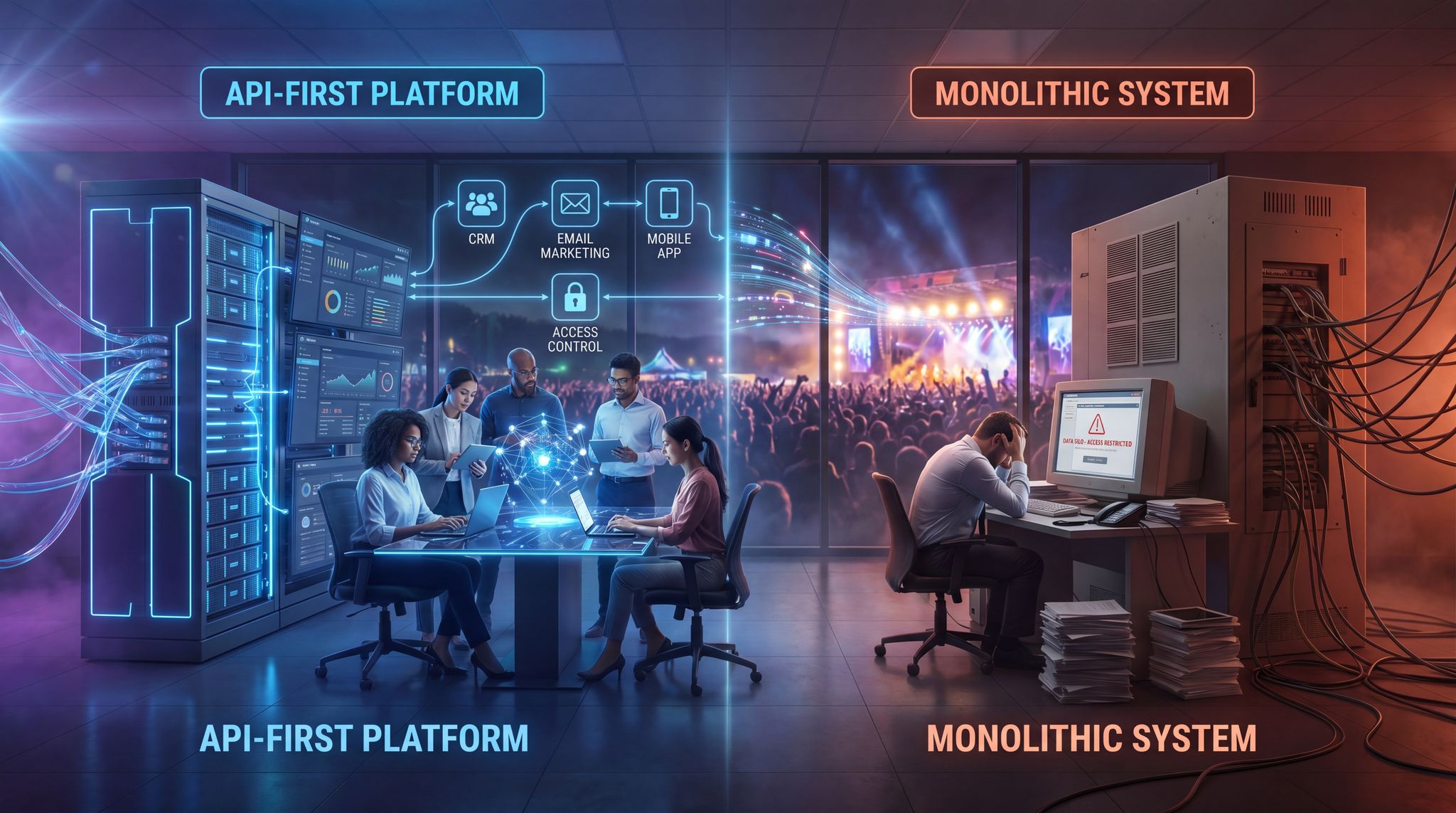
In today’s event technology landscape, organizers face a pivotal decision about their ticketing platform architecture: stick with a traditional monolithic system or embrace a modern API-first ticketing platform. A monolithic ticketing system is an all-in-one solution provided by a single vendor, often operating as a closed ecosystem. In contrast, an API-first platform is built with open integration in mind – every feature and data point can be accessed via APIs, allowing it to plug into a broader tech stack. This choice defines how your event tech stack functions end-to-end, impacting everything from online ticket sales and marketing to on-site operations and data analytics.
Monolithic Ticketing Systems: A monolithic platform typically tries to handle all ticketing functions internally – ticket sales, attendee management, emails, analytics – within one proprietary system. The appeal is simplicity: one vendor, one interface. However, these closed platforms often operate as walled gardens, limiting how you can use the data and integrate other tools. You’re largely limited to the features the system provides, and integrating external applications can be difficult or impossible. Many legacy ticketing systems were not built with modern integrations in mind; some have added APIs or plug-in modules over time, but integration is an afterthought rather than a core strength. An older monolithic ticketing application that simply bolts on an API later cannot match a platform designed API-first from the outset. In practice, that means a monolithic platform might not easily share data with your other event tools – leading to data silos and manual work.
API-First Ticketing Platforms: API-first platforms are built around the idea that your ticketing system should play well with others. From day one, these systems expose robust REST APIs and webhooks for every major feature (from creating events to pulling real-time sales data). This open architecture makes integration their core strength compared to legacy systems. You can connect your ticketing software to your CRM, email marketing system, mobile app, access control hardware, and more with relatively little friction. Modern API-driven ticketing platforms are often cloud-based and modular, allowing them to scale and adapt quickly. Importantly, they tend to give event organizers more control over data and customization (since the platform expects you to build on top of it). The industry is clearly moving in this direction – even investors are backing the API-first approach. For example, one next-gen ticketing provider raised a €12.6 million funding round by offering an API for promoters to customize to their needs, highlighting how open integration is seen as the future of ticketing.
To illustrate the differences between these architectures, here’s a comparison of key factors:
Go Cashless With RFID Technology
Enable contactless payments, faster entry, and real-time spending analytics with RFID wristbands and NFC-enabled ticketing for your events.
| Aspect | API-First Ticketing Platform | Monolithic Ticketing System |
|---|---|---|
| Integration | Designed with open APIs, webhooks, and connectors for easy data exchange with other software. Can sync in real time with CRM, marketing tools, mobile apps, etc. | Limited integration options. Often no public API or only proprietary add-ons. May rely on manual data exports/imports to connect with other systems. |
| Data Access | Full data ownership. Organizers can readily export or sync all attendee information and sales data to other platforms (analytics, CRM) without restrictions. | Data often siloed in the vendor’s system. Some providers still guard attendee information as their own asset, leaving organizers with limited insight into their audience. |
| Feature Expansion | Extensible and flexible. New capabilities can be added by integrating third-party services or custom-built modules via API. Adapts quickly to new tech trends (e.g. adding a new payment method or AR/VR experience). | Feature set is fixed to what the vendor provides. If a needed feature (like an advanced marketing tool or anti-fraud measure) isn’t built-in, you’re stuck waiting for the vendor’s roadmap – if they even plan to support it. |
| Scalability | Highly scalable (often cloud-native). Can handle large on-sales and attendee volumes by automatically scaling infrastructure; proven to support major events without downtime. | Scalability can be a concern if the monolith isn’t engineered for surges. High-demand ticket sales may strain the system, since all functions run on the same stack – risking slowdowns or crashes during peak times. |
| Reliability | More resilient design – often comprised of microservices or distributed components. One issue (e.g. a glitch in the email module) is less likely to crash the entire system. High uptime and targeted redundancy are common. | Single point of failure – one bug or overload can bring down everything (sales, check-in, reporting all at once). If the platform goes down, every aspect of your event operations is affected until it’s resolved. |
| Customization | Allows extensive customization. Organizers or developers can build custom workflows, integrate specialized apps, and even fully brand the ticket buying experience under their own domain. (E.g. Ticket Fairy offers a white-label ticketing platform that lets you sell tickets on your own website with your branding.) | “What you see is what you get.” Limited ability to customize beyond basic settings. Major changes or unique workflows are not possible unless the vendor builds them for all clients – which is rare. Your event has to adapt to the software, not vice-versa. |
| Vendor Lock-In | Lower lock-in risk. Data is portable and integrations mean you’re less dependent on any one vendor. Contracts often flexible – month-to-month or usage-based pricing is common. Easier to switch providers if needed, since you can migrate your data via API. | High lock-in risk. Often involves multi-year exclusive contracts. Switching providers can be costly and complex, especially if the vendor restricts data export or uses proprietary hardware. Legacy vendors may count on this to keep clients from leaving. |
Integration and Data Connectivity: Open Ecosystem vs. Siloed System
One of the biggest considerations is how well your ticketing platform integrates with the rest of your event tech stack. Disconnected systems lead to wasted effort and errors – when attendee data is siloed, your team ends up doing duplicate data entry and putting out fires on event day. An API-first approach helps you avoid these pain points by ensuring all your tools “talk” to each other. In an API-driven platform, data flows freely between systems: a ticket purchase on your website can instantly trigger an update in your CRM and marketing platform, and entry scans or RFID taps at the venue feed back into attendee profiles in real time.
By contrast, monolithic ticketing systems often create data silos. For example, you might have attendee emails locked inside your ticketing dashboard, but they don’t sync to your email marketing list – so your team has to export a CSV after the event (and hope nothing changed in the meantime). If your ticketing provider doesn’t offer a robust API or integration options, you’ll face serious challenges connecting important tools. Integration and flexibility are key – avoid one-size-fits-all platforms that cannot integrate, and favor those with open APIs and a range of integration options. This ensures your ticketing system can plug into marketing automation, analytics dashboards, mobile apps, and any future tools you adopt.
Ready to Sell Tickets?
Create professional event pages with built-in payment processing, marketing tools, and real-time analytics.
Real-world impact: Integration capabilities directly affect operational efficiency and attendee experience. In one case, a festival integrated its ticketing database with self-service RFID gates and was able to reduce entry staffing by nearly 70 percent while speeding up admissions. By linking ticket data with an RFID cashless payment system, they created a seamless experience where a tap of a wristband validated entry and handled payments, dramatically cutting queue times. If a monolithic system couldn’t integrate with that RFID solution, these benefits would have been unrealized.
Modern API-first platforms often come with built-in connectors or out-of-the-box integrations. For instance, some provide a native integration to auto-sync ticket buyer data to email tools – eliminating tedious CSV uploads and ensuring your welcome emails or post-event surveys hit inboxes immediately. (One example: Ticket Fairy’s platform automatically adds ticket purchasers to your Mailchimp mailing lists in real time, so you don’t waste time on manual imports.) In contrast, many legacy providers still make you contact an account rep just to install a tracking pixel or connect an external app, whereas newer systems let you handle these integrations yourself through a user-friendly dashboard.
Another benefit of API-first architecture is the ease of aggregating data from multiple sources. You can merge ticketing data with social media insights, mobile app engagement, survey results, and more to get a 360° view of your attendees. This is nearly impossible if your ticketing data lives in a silo. Choosing a platform that “plays well with others” via APIs or pre-built partnerships sets you up to adopt new tech seamlessly as your needs evolve. At minimum, ensure your ticketing solution can share data with your other tools without friction – whether through direct integrations or at least reliable data export options.
The difference is stark: one enterprise ticketing SaaS, after modernizing from a closed system to an API-driven architecture, reported far greater scalability and seamless integrations with other software – including improved user access through Single Sign-On – once they moved to an open model. In other words, switching to an API-first approach unlocked capabilities that were impossible in the old monolithic model.
Keep Tickets in Fans' Hands
Our secure resale marketplace lets attendees exchange tickets at face value, eliminating scalping while keeping you in control of the secondary market.
From a strategic perspective, integrating your ticketing platform into a broader event technology integration strategy is no longer optional – it’s essential in 2026. Event organizers should evaluate how easily a ticketing system connects to key tools like CRMs, marketing automation, analytics dashboards, mobile apps, and access control hardware. If integrations would require excessive manual work or simply aren’t supported, that system will hold back your event’s potential.
(Pro Tip: When evaluating solutions, ask about available APIs, webhooks, and pre-built integrations. Don’t hesitate to get technical – for example, does the system support Zapier or provide a robust developer API? Also, check on niche needs that matter to you. If you plan to use cashless payments or a custom mobile app, can the platform integrate RFID wristband cashless systems or provide a mobile ticket scanning app with offline mode? The answers will reveal whether the platform can fit into a modern, connected ecosystem.)
Customization and Innovation: Extending Your Ticketing Capabilities
The pace of innovation in live events is faster than ever – from new payment methods and interactive fan experiences to AI-driven personalization. Your ticketing platform’s architecture directly affects how easily you can adopt new features or customize the experience for your event.
With an API-first ticketing platform, you have freedom to innovate. Because the system is open and modular, you can mix and match the best tools on the market. Want to implement an AI-based pricing tool or a bespoke festival mobile app? An open API platform lets you plug it in or build an integration with relatively low effort. If the ticketing provider doesn’t offer a feature natively, you can often find a third-party solution and connect it via API. This agility is a huge advantage – you’re not stuck waiting around for your vendor to support the latest technology. In fact, API-first platforms often enable a best-of-breed strategy, where you use specialized apps for things like audience engagement or sponsor activations, all feeding into the ticketing core.
Monolithic systems, on the other hand, tend to stagnate. Maintaining a closed, monolithic system will increasingly saddle you with longer implementation timelines and higher custom development costs, limiting your ability to leverage specialized tools and slowing adaptation to emerging technologies. If a new trend comes along (say, NFT-based tickets or an AR scavenger hunt on-site), a monolithic platform might not support it until long after more agile competitors – if at all. We’ve seen this play out: organizers tied to one legacy provider often miss out on tech-driven revenue opportunities because their system simply doesn’t have the capability, and it won’t integrate with external solutions.
Customizing the ticket purchase experience is another area of divergence. Many API-first providers allow flexible branding and embedding options – for example, the ability to embed the ticketing flow on your own website with your branding, or even to run a fully branded ticketing portal under your domain. This means you can maintain a consistent brand experience for fans and even capture ticket traffic on your own site. (Ticket Fairy, for instance, provides a white-label ticketing platform that empowers organizers to launch a branded ticketing site with their own URL, logos, and colors – buyers never feel redirected to a third-party.) In a monolithic model, you usually have far less control – fans typically have to use the vendor’s website or app, which limits your branding and might even promote other events to your ticket buyers.
Crucially, an API-first architecture also means faster feature deployment. Upgrades and new integrations can often be introduced without disrupting the whole system. For example, if you want to add a new payment option like “Buy Now, Pay Later” plans, an API-driven platform might let you integrate a service like Klarna or Afterpay in days. A monolithic ticketing system might not support that at all, or require waiting until the vendor’s next major update (which could be many months away).
Innovation in attendee engagement and marketing is another differentiator. Modern ticketing platforms often support advanced marketing features – things like referral reward programs, dynamic promo codes, and real-time insights – that legacy systems lack or make difficult to use. If your current ticketing software doesn’t have a refer-a-friend mechanism or integration with social media pixels, you’re missing out on sales. You typically can’t just bolt those onto a closed platform. By contrast, API-first models either include these features or allow you to connect to specialized marketing tools to achieve the same result.
Grow Your Events
Leverage referral marketing, social sharing incentives, and audience insights to sell more tickets.
A great example is built-in referral marketing. Many monolithic systems simply don’t offer robust referral tracking, whereas some newer platforms bake this in as a core feature. The results can be game-changing – festivals that implemented referral programs through their ticketing platform have seen ticket sales boosted by 15–25% thanks to fans acting as ambassadors through built-in referral marketing. That kind of increase is hard to achieve with a system that can’t support or integrate a referral workflow. Similarly, anti-scalping tools illustrate how architecture matters: a modern, API-first platform might include secure ticket transfer and fan-to-fan resale marketplaces with identity verification or dynamic barcodes to combat scalpers. Legacy platforms often lack these protections, leading to rampant secondary market issues. (One major festival felt compelled to require photo ID checks for entry – printing attendees’ names on each ticket – solely because their ticketing provider couldn’t prevent unofficial resale. It was a drastic workaround that an advanced platform could have handled digitally through secure ticket technology.)
In short, flexibility and extensibility are critical in 2026. If your ticketing provider makes you conform to their way of doing things, you risk falling behind. An API-first ticketing platform gives you the toolkit to tailor the system to your event – whether that’s offering multi-day passes with complex credentialing, integrating a loyalty program for repeat buyers, or creating interactive add-ons that set your event apart. It’s your technology; you should be able to mold it to your needs.
For organizers with advanced technical requirements, an API-first support infrastructure allows full programmatic control over customer tickets. Instead of relying on manual dashboard updates, your development team can use comprehensive endpoints to issue, upgrade, transfer, or revoke credentials automatically based on custom triggers. This level of backend access is what transforms a basic checkout tool into a true 360-degree ticketing system. By leveraging robust API and webhook features, you can build a full-circle support ecosystem where customer service actions—like processing a complex multi-ticket exchange or applying a VIP upgrade—happen instantly across all connected platforms.
(Pro Tip: Look for platforms that actively update their APIs and have developer communities or partner networks. That’s a sign they encourage customization. Also, review case studies of what other events have built on the platform – if festivals have successfully integrated things like cashless payment systems or custom apps, it’s a good indicator the platform welcomes innovation.)
Scalability and Performance Under Pressure
For any event expecting high demand – whether it’s a 500-person conference with a flash sale or a 50,000-person festival on onsale day – scalability of the ticketing system is a make-or-break factor. Here, the differences between API-first and monolithic systems become very clear.
Monolithic platforms, especially older ones, can struggle with sudden spikes in traffic. Because all functions (inventory, checkout, user login, etc.) run through one tightly-coupled system, a surge of thousands of purchase requests in a short window can overload the entire platform. We’ve all seen the headlines where an on-sale for a superstar’s tour overwhelmed a legacy ticketing system, which resulted in website crashes and multi-hour queues for fans. In those cases, the monolithic architecture couldn’t scale up fast enough to handle the load – the result was lost sales, frustrated customers, and damage to the event’s reputation.
API-first platforms are generally better equipped for high performance. Architected with modern cloud infrastructure, they can often scale horizontally by spinning up additional server capacity or load-balancing across multiple services. For example, the purchase processing, ticket inventory, and email notification functions might run on separate servers – each component can scale independently as demand increases, rather than one big application trying to do everything. The payoff is the ability to handle massive on-sales without crashing. There are real-world instances of large festivals selling tens of thousands of tickets in minutes on an API-first platform with zero downtime, after previously experiencing outages on a legacy system. One organizer noted that with their old provider, every big on-sale meant slowdowns and errors, whereas after switching to a more scalable platform, they sold out 75% of their inventory in the first 20 minutes with no technical issues – a night-and-day difference.
Reliability improves as well: if your ticketing architecture is distributed, a failure in one component (say, the analytics module) is less likely to affect everything else. Monolithic systems tend to be all-or-nothing – when something goes wrong, it can bring the whole system down. API-first systems often have more graceful failure modes. For instance, if an analytics API endpoint fails, ticket sales and scanning can continue unaffected, with the system queuing analytics data to sync later. The end result is higher uptime and fewer event-day crises.
For on-site operations, scalability matters too. Think about entry management: a monolithic system might choke if dozens of handheld scanners are all pinging the server at once for ticket validations, especially if internet connectivity at the venue is spotty. Modern ticketing platforms anticipate this – offering offline-capable scanning apps and efficient check-in APIs so that even if you’re scanning 50 people per minute at each gate, the system keeps up (or can catch up quickly once back online). The design (e.g. caching validations locally and syncing later) often comes from an API-oriented mindset that values resilience.
To ensure your ticketing platform can handle the pressure, examine its track record and technical approach. Ask vendors for examples of peak loads they’ve managed – how many tickets per second can it process without failure? Do they use content delivery networks, distributed servers, and auto-scaling to absorb traffic bursts? A good API-first provider will usually have an answer, often pointing to their cloud infrastructure and past performance during big on-sales. In contrast, if a vendor downplays these questions or only offers vague assurances, that could be a red flag that their system is more monolithic and not battle-tested at scale.
Smooth Entry With Mobile Check-In
Scan tickets and manage entry with our mobile check-in app. Supports photo ID verification, real-time capacity tracking, and multi-gate coordination.
As an event organizer, you can’t afford a platform meltdown during a big on-sale or right when doors open. That’s why many are now proactively seeking tech strategies to prevent ticketing platform crashes during high-demand on-sales – and choosing a scalable architecture is step one. In practical terms, the API-first approach tends to win here. It’s the difference between confidently selling tickets to a huge audience versus watching your website go down as demand peaks.
(Pro Tip: Ask potential providers about their largest successful on-sales or highest concurrency events. Get specifics – e.g. “We handled 100,000 users in the queue and 20,000 checkouts in 10 minutes for X festival.” Also inquire about redundant infrastructure and DDoS protection (important for preventing malicious spikes). A provider that’s transparent about these details likely has a robust, scalable setup.)
Vendor Lock-In and Data Ownership
Beyond features and performance, the business implications of platform architecture can significantly impact your long-term success. Monolithic ticketing systems often come bundled with restrictive contracts and limited data access that can hamstring your marketing and growth, whereas API-first, open platforms tend to emphasize data ownership and flexibility.
Data Ownership: In 2026, data is gold for event organizers – but you can only mine that gold if you have access to it. Many legacy ticketing providers have historically guarded attendee information as their own asset, giving promoters only limited access to customer data. For example, a traditional vendor might hide buyer email addresses or require that all communication to attendees go through their system (so they control the messaging). This leaves you “flying blind” about your audience – unable to build your own marketing lists or analyze purchase patterns in depth. It’s a common trade-off with monolithic systems: you get convenience at the cost of autonomy over your data.
API-first platforms by nature encourage data sharing – after all, an API exists to retrieve and use data externally. The best modern ticketing platforms make a point of giving organizers full ownership of all customer data. This means you can access and export all the information about your attendees (often in real time) and use it however you see fit. Want to automatically add ticket buyers to your CRM or target lookalike audiences on Facebook? An open platform will let you do that either via built-in integrations or easy data exports. You won’t have to beg for a list of your own attendees – it’s at your fingertips. This autonomy unlocks a host of benefits: you can retarget past attendees to drive repeat sales, offer special perks or presales to loyal fans, and provide sponsors with detailed insights (increasing the value of sponsorship packages). Simply put, owning your data enables smarter marketing and more revenue opportunities. In an era of GDPR and strict privacy laws, it also means you can ensure compliance on your own terms instead of relying on a third-party’s policies.
When evaluating platforms, make data ownership a top criterion. Ensure the platform explicitly states that you retain 100% ownership of your event’s customer data, and that you have on-demand access to it. Ideally, you should have a secure dashboard where you can view and export attendee details (names, emails, phone numbers, purchase history, etc.) at any time. If a vendor is vague about data access, that’s a red flag. As industry experts often note, your fan data is an asset to your business, and your ticketing platform should empower you to leverage it – not keep it locked away.
Turn Fans Into Your Marketing Team
Ticket Fairy's built-in referral rewards system incentivizes attendees to share your event, delivering 15-25% sales boosts and 30x ROI vs paid ads.
Lock-In and Contracts: Monolithic ticketing providers often use their all-in-one offering as leverage to lock in clients with long-term, exclusive contracts. It’s not uncommon for large venues or festival organizers to be tied into 3–5 year deals with a ticketing company. These contracts might come with incentives – sometimes an upfront bonus or “marketing support” funds – but they also severely limit your flexibility. If the platform is underperforming or the fees become too high, you can’t easily switch due to the financial penalties and the headache of migrating on short notice.
An open, API-first platform usually operates on a more flexible model. Many newer ticketing solutions compete not by locking you in, but by earning your loyalty with better service and features. It’s not unusual to find API-first ticketing providers offering shorter contract terms or even usage-based pricing with no long commitment, knowing that if they continue to deliver value you won’t want to leave. And because you have access to your data and integrations, the threat of losing everything when switching is greatly reduced – you can take your data with you and reconnect it elsewhere.
If you’re worried about the financial safety net that a big legacy vendor can provide (for example, some of the giants advance funds or cover event cancellation insurance), note that independent platforms are addressing that too. Some modern providers have introduced ticket sale advance programs to support promoters with upfront cash flow. Ticket Fairy’s capital program can advance anywhere from $10,000 to $3,000,000+ of a festival’s projected ticket sales to help cover production costs before tickets even go on sale, proving that advance payout programs can be a lifesaver. This kind of feature can be a lifesaver, letting you pay for artists or venues without being at the mercy of long payout cycles. The key difference: these new solutions offer support without binding you to punitive long-term contracts – they invest in your success rather than enforce your loyalty.
Avoiding the Trap: The worst situation is being stuck in a contract with a ticketing provider that isn’t meeting your needs and won’t let go of your data. Not only are you missing opportunities in the short term, but you’re also unable to pivot to a better solution in the long term. To avoid this, scrutinize the fine print. Make sure there are clauses that ensure your organization keeps full access to customer data (and that the data will be provided in a usable format if you exit). Also seek reasonable contract lengths or trial periods – increasingly, even large events are negotiating 1-year agreements or escape clauses if key service levels aren’t met.
Many experienced event organizers have realized that platform openness equals power. By maintaining control over data and having the freedom to switch vendors if necessary, you force any ticketing partner to continually earn your business through performance, not contracts. And truthfully, if a platform is delivering excellently – boosting your sales, simplifying operations – you won’t want to switch. But it’s crucial to know you can if circumstances change.
In summary, the API-first philosophy typically aligns with a more organizer-friendly business approach: your event’s data is yours, and the platform is there to help you use it. Monolithic systems sometimes take the opposite stance: your data (and customers) are theirs, and you’re along for the ride. Be very mindful of these differences when choosing your ticketing solution in 2026.
Data-Driven Event Marketing
Track ticket sales, demographics, marketing ROI, and social reach in real time. Exportable reports give you the insights to make smarter decisions.
Lessons from the Field: Integration Wins vs. Lock-In Woes
It’s illuminating to see how these architectural differences play out in real life for event organizers. Here are two contrasting examples that highlight the stakes:
-
Seamless Integration Win: A mid-sized music festival in Europe decided to revamp its tech stack by switching to an API-first ticketing platform. The immediate motivation was to improve marketing and on-site operations. Over the next year, the festival plugged the open ticketing API into its CRM, email marketing software, and a new festival mobile app. They also implemented a referral program that rewarded fans for sending friends to buy tickets, and integrated their ticketing with an RFID wristband system for cashless payments on the festival grounds. The results were striking – the festival credited the referral system for roughly a quarter of their total ticket sales, essentially gaining thousands of extra sales through word-of-mouth (at virtually no marketing cost). On-site, the integration between ticket QR codes and RFID cashless payments meant attendees could link their entry credentials to a payment account, speeding up bar lines and merchandise sales. Vendors reported higher spend per attendee than in previous years, likely because tapping a wristband to pay is so effortless. In short, by embracing an open, API-driven architecture, this festival was able to adopt innovative features and connect systems in ways that noticeably boosted their bottom line and improved the fan experience.
Streamlining Entry with RFID Integration — Connecting your ticketing data to hardware reduces staffing needs and speeds up admissions for a better fan experience. -
Lock-In Woes (and Rescue): By contrast, consider a large festival that until 2022 was using a well-known monolithic ticketing provider. The platform had very limited anti-scalping measures and kept a tight hold on attendee data. During the 2022 ticket sale, over 200 tickets showed up on secondary resale sites at inflated prices beyond the festival’s control, and the organizers couldn’t even directly contact all buyers with urgent updates because the platform restricted access to email addresses. Fans were furious about price gouging and poor communication – yet the organizers’ hands were tied by a ticketing system that offered no relief. After that debacle, the festival switched to a more fan-first ticketing platform for 2023 – one that included an official face-value resale marketplace and rigorous bot prevention. The impact was immediate: in 2023 they saw only a handful of unauthorized resale listings, versus the hundreds a year before, as the presence of their tickets on secondary markets shrank. Scalpers were effectively shut out, because the new system’s secure ticket tech made fraud extremely difficult. Plus, the organizers now had full access to buyer contacts (with appropriate consent), so they could communicate directly with attendees about schedule changes, weather alerts, upsells, etc. Perhaps most telling, when these changes came together – better marketing reach, reduced scalping, and an improved buying experience – the festival actually saw higher sales and attendance. In fact, major festivals that embrace fan-first, API-friendly ticketing platforms with lower fees and anti-scalping measures often report 15–25% boosts in ticket sales alongside significant gains in fan trust and satisfaction.
These examples underscore a key point: the architecture of your ticketing platform isn’t just a technical choice – it directly affects revenue, fan trust, and your ability to execute your vision. Seamless integrations can drive tangible gains (more tickets sold, higher spend per head, lower costs), while a closed system can quietly undermine your success (missed marketing opportunities, lost revenue to scalpers, frustrated attendees). The stakes are high.
Choosing the Right Ticketing Architecture for 2026
How should event professionals choose between the API-first model and a monolithic system? The best choice depends on your specific needs and goals, but there are some universal criteria to guide your decision:
1. Integration Needs: Make a list of all the other systems you use (or plan to use) alongside ticketing – think CRM, email marketing, mobile apps, on-site access control, payment gateways, analytics, etc. If integration with these tools is important, an open API event ticketing system is likely necessary. Check what integrations or APIs each platform supports, and don’t settle for a closed system if connectivity is crucial. If your strategy calls for a connected tech stack, a best-of-breed approach with API-first ticketing at the center will serve you best.
Boost Revenue With Smart Upsells
Sell merchandise, VIP upgrades, parking passes, and add-ons during checkout and via post-purchase emails. Increase average order value by up to 220%.
2. Customization & Features: Identify the features you absolutely need (and those you’d like). Does the platform support them out of the box? If not, can you add them via API integration or custom development? An API-first platform will give you far more leeway to implement unique features or workflows. For example, if you need a special kind of multi-day pass or a built-in referral rewards program, can the platform accommodate that? The best event ticketing platform for integrations and customization will let you extend its capabilities to meet your vision, rather than locking you into a rigid feature set.
3. Data & Ownership: This is non-negotiable. Ensure any platform you consider provides full access to customer and sales data. You should be able to quickly get attendee lists, sales reports, and any other data out of the system in a usable format. If a provider limits what you can see or export (or claims customer emails “belong” to them), steer clear – that’s your audience and your future revenue. Prioritize platforms that treat your data as a shared asset, with tools for exporting or syncing to your own databases. Owning your fan data is crucial for marketing, personalization, and sponsor value.
4. Scalability & Reliability: Align the platform with your event’s scale and growth plans. If you run small community events with steady sales, a monolithic system might perform just fine. But if you handle large on-sales or anticipate growth, lean toward platforms with a track record of scaling without crashing. Ask for client references or case studies of big events they’ve handled. Also consider infrastructure – cloud-based systems with auto-scaling and global CDNs will generally cope better with traffic spikes than a single-server monolith. You want a solution that can grow with you and handle your biggest moments.
5. Cost & ROI: Evaluate the total cost of ownership, not just per-ticket fees. A monolithic provider might offer a lower base fee but lack features that could boost your sales (e.g. no referral program, poor marketing tools), meaning you leave money on the table. An API-first platform might have slightly higher fees but enable a 15% increase in sales through better integrations and data usage – easily offsetting the cost. Consider how each architecture affects your revenue potential and operational efficiency. Sometimes paying a bit more for an open, feature-rich system yields a much higher ROI when all is said and done.
6. Vendor Support & Culture: Finally, consider the ethos of the provider. Are they trying to lock you in, or win you over? Talk to other organizers using the platform if possible. How responsive is the vendor to integration requests or unique needs? A company that champions APIs and integration will likely have a more collaborative approach to support, since they expect you to use their platform in creative ways. On the other hand, a monolithic vendor might simply say “no” to requests outside their standard offering. Choose a partner whose culture aligns with your values (for example, some platforms like Ticket Fairy position themselves as fan-friendly, avoiding things like surge pricing and focusing on your success).
At the end of the day, there’s a strong trend toward API-first ticketing platforms in 2026, and it’s easy to see why. They offer the openness, flexibility, and future-proofing that modern events demand. That said, one size doesn’t fit all. If you have very straightforward needs and little desire to integrate or customize, a simpler monolithic solution might serve you fine. But if you’re aiming to build an advanced tech stack, deliver unique attendee experiences, or simply want maximum control and insight, an API-first architecture is the smarter long-term play.
Remember, your ticketing platform isn’t just about selling tickets – it’s the digital backbone of your event’s operations and a gateway to your most valuable asset: your attendee data. Choosing a modern, integration-friendly platform sets you up with a solid foundation that can evolve as technology and audience expectations do. Don’t just think about what you need today; consider what opportunities might emerge in the next few years and pick an architecture that will let you plug them in with minimal friction. In 2026’s interconnected event tech ecosystem, openness and agility are key.
(Need a starting point for comparison? Check out our event ticketing software comparison that stacks up major platforms feature-by-feature. Pay special attention to integration, data ownership, and innovation capabilities – those often separate a truly forward-thinking platform from a legacy product.)
Frequently Asked Questions
What is an API-first ticketing platform?
An API-first ticketing platform is an open, cloud-based system designed to seamlessly connect with other software using REST APIs and webhooks. This modular architecture allows event organizers to integrate their ticketing core with CRMs, marketing tools, and mobile apps without creating data silos.
What is a monolithic ticketing system?
A monolithic ticketing system is a traditional, all-in-one platform where a single vendor controls all features within a closed ecosystem. These legacy systems often operate as walled gardens, limiting third-party integrations, restricting attendee data access, and risking full-system crashes during high-demand ticket sales.
How do you prevent ticketing platforms from crashing during high demand?
You can prevent ticketing crashes by utilizing an API-first platform built on modern cloud infrastructure that supports horizontal scaling. These distributed systems separate functions like purchase processing and inventory management, allowing them to automatically scale server capacity to handle massive traffic spikes without downtime.
How does an event ticketing system integrate with RFID wristbands?
Event ticketing systems connect with RFID wristbands through open APIs to sync attendee data with cashless payment and access control hardware. This real-time integration allows fans to tap their wristbands for fast entry and on-site purchases, which can reduce entry staffing by nearly 70 percent.
Why is data ownership important for event organizers?
Data ownership allows event organizers to access, export, and utilize attendee information for targeted marketing and personalized experiences. Securing 100% ownership of customer data prevents vendor lock-in, ensures privacy compliance, and enables promoters to retarget past attendees to drive repeat ticket sales.
How do modern ticketing platforms prevent ticket scalping?
Modern ticketing platforms prevent scalping by utilizing secure ticket technology, dynamic barcodes, and official face-value resale marketplaces. These fan-first systems incorporate rigorous bot prevention and identity verification, which effectively shuts out unauthorized secondary market resellers and protects attendees from price gouging.
How do built-in referral programs increase event ticket sales?
Built-in referral programs increase sales by rewarding existing fans for acting as brand ambassadors and driving word-of-mouth purchases. Festivals implementing referral marketing workflows directly through their open ticketing platforms frequently experience a 15 to 25 percent boost in overall ticket sales.
How do ticketing platform contracts cause vendor lock-in?
Ticketing platform contracts cause vendor lock-in by requiring three to five-year exclusive agreements that restrict organizers from switching providers. Legacy monolithic vendors often penalize early exits and withhold access to historical attendee data, making migration to a new system financially and operationally difficult.
What API-first support infrastructure allows full programmatic control over customer tickets?
An API-first support infrastructure utilizing RESTful endpoints and real-time webhooks allows organizers to programmatically manage the entire ticket lifecycle. This architecture enables a 360-degree ticketing system where developers can automatically issue, upgrade, transfer, or revoke tickets directly from external applications, custom dashboards, or customer service portals.