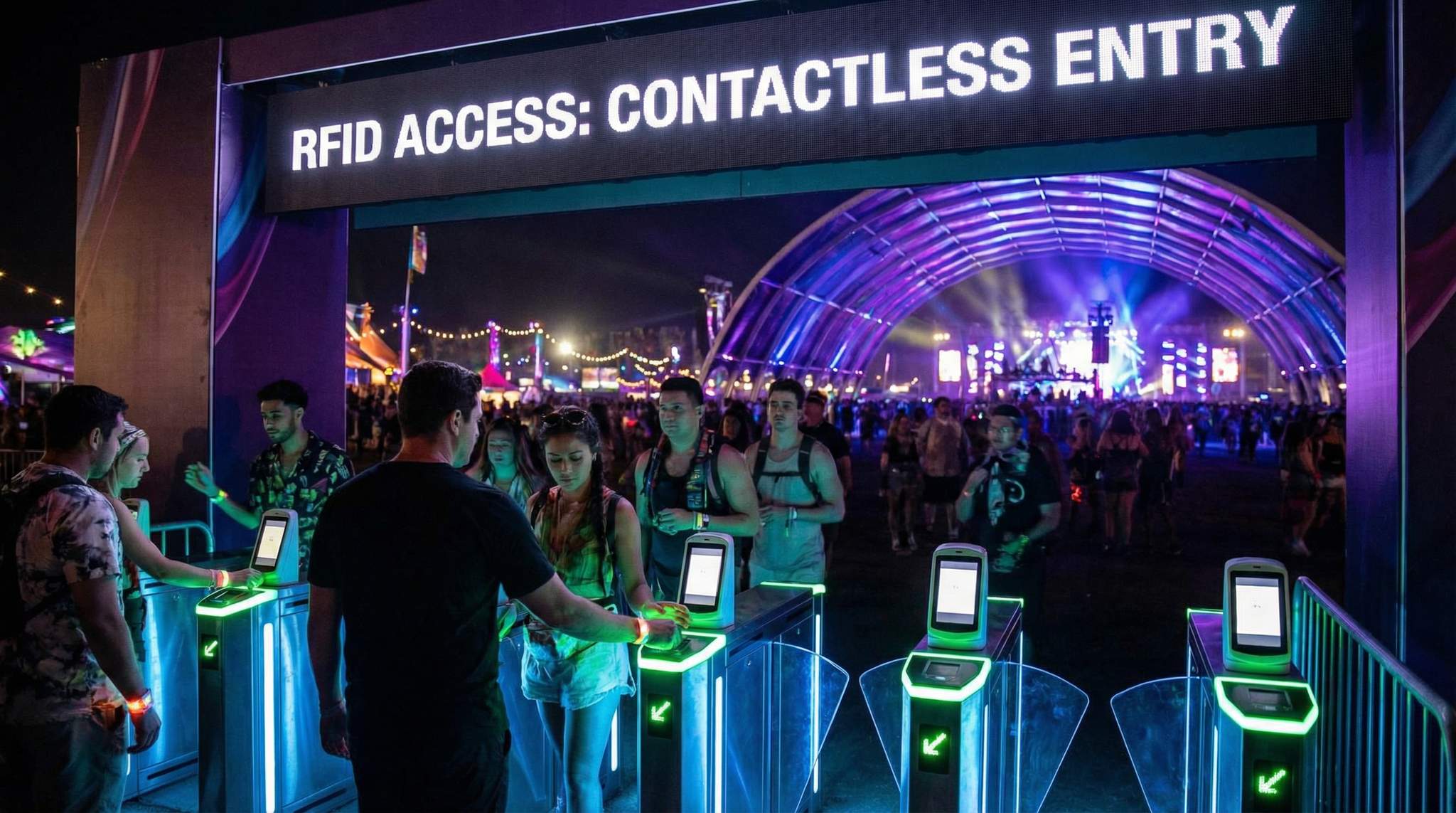
The Evolution of Event Ticketing Technology
The events industry has undergone a transformational journey in how tickets are issued and managed – evolving from paper tickets and barcodes to today’s smart RFID (Radio Frequency Identification) systems. In 2026, RFID technology is no longer a futuristic concept but a mainstream solution reshaping how event organizers handle access control, security, and attendee experiences. This shift was accelerated in part by the demand for contactless interactions during the pandemic recovery, with RFID enabling touchless entry and transactions. Major festivals, concerts, and sports events worldwide have embraced RFID wristbands and cards to eliminate bottlenecks and enhance safety.
The impact is clear in the numbers: the global RFID market – spanning all industries – continues to expand rapidly, projected to grow from $17.1 billion in 2025 to nearly $37.7 billion by 2032 according to Fortune Business Insights market analysis. Event applications are a big part of this surge, as organizers see the technology’s potential to streamline operations and elevate the fan experience. From massive music festivals in Belgium and California to local conferences and expos, RFID has become a cornerstone of modern event management. Attendee data gleaned from RFID systems can now be leveraged to create tailored experiences and optimize everything from entrance logistics to merchandising.
In this complete guide, we’ll delve into how RFID ticketing works, its benefits for events of all types, and best practices for implementing it. Whether you’re running a festival, concert, sports match, or conference, understanding RFID technology is key to staying ahead in today’s live events landscape.
Understanding RFID Technology in Event Management
RFID technology uses radio waves to transmit data wirelessly between a small tag and a reader device. In event ticketing, RFID tags are typically embedded into wristbands, badges, or smart tickets that attendees carry. Each tag contains a unique identifier (often encoded on a tiny microchip with an antenna) that can be instantly recognized by an RFID reader – without requiring a direct line-of-sight scan as barcodes do. This means attendees can simply tap or wave their wristband at a gate sensor and walk through, making entry much faster and more seamless.
Smooth Entry With Mobile Check-In
Scan tickets and manage entry with our mobile check-in app. Supports photo ID verification, real-time capacity tracking, and multi-gate coordination.
RFID operates on several frequency bands, with most event applications using high-frequency (HF) around 13.56 MHz (the same range as contactless credit cards and NFC phones) or ultra-high-frequency (UHF) bands. HF is common for short-range use like ticketing and payments, while UHF can achieve longer read ranges – useful for tracking movement over wider areas. These frequencies offer fast data transfer and the ability to read multiple tags at once, which is ideal for large crowds where quick access and real-time tracking are essential.
There are two main types of RFID tags used in events:
Ready to Sell Tickets?
Create professional event pages with built-in payment processing, marketing tools, and real-time analytics.
- Passive RFID tags: These have no battery and are powered by the electromagnetic field of the reader. Passive tags are very lightweight and cost-effective, often costing under a dollar each in bulk depending on the material used. They can be embedded in disposable wristbands, stickers, or even woven into clothing or jewelry. Most festival wristbands and electronic tickets use passive RFID – when held near a reader, the tag quickly transmits its unique ID. Passive tags typically have shorter range (a few centimeters to a couple of meters depending on frequency), but their low cost and small form factor make them perfect for ticketing, payments, and general attendee credentials.
- Active RFID tags: These contain their own battery and actively broadcast signals. Active tags cost more and tend to be used selectively in event environments. They offer extended read ranges (tens of meters or more) and can continuously transmit, which is useful in dense crowds or complex venues where you might want constant tracking (for example, for high-value equipment, VIP tracking, or real-time location of staff). Active tags might be incorporated into premium badges or used in scenarios like large sports events where organizers want to monitor the flow of people throughout a stadium in real time. Because they broadcast continuously, active tags can be picked up even if tucked in a pocket, but their higher price means they’re usually reserved for specialized use cases.
To illustrate the differences, here’s a quick comparison:
| RFID Tag Type | Power Source | Typical Range | Cost (Approx.) | Use Cases in Events |
|---|---|---|---|---|
| Passive | None (powered by reader field) | Short (a few cm up to ~1–2 m) | Low ( ~$0.50–$2 per tag depending on material) | Attendee tickets, wristbands for entry and payments, session check-ins |
| Active | Battery-powered (transmits continuously) | Long (10–50+ m) | Higher ($5–$15+ per tag) | Asset tracking (equipment), staff badges, VIP trackers, interactive experiences |
In both cases, the RFID tag carries a unique digital code. When an attendee’s RFID-enabled ticket or wristband comes within range of a reader, the tag is activated and sends its identifier to the reader. The reader in turn relays that information to the event’s database system to verify the ticket and grant access. All this happens in a split second without any physical contact.
Also Read: For a broader perspective on connectivity, consider reading about how wireless technology will lead your events to success.
Definition and Explanation of RFID (Radio Frequency Identification) Technology
At its core, RFID is a contactless identification system – it uses radio frequency signals to automatically identify and track tags attached to objects or people. Each RFID tag contains encoded information (often just a serial number linked to a database record) that can be read by an RFID scanner. Unlike a barcode that must be visible and scanned one at a time, RFID tags can be read through materials (like clothing or wallets) and even read in bulk. This capability has led to RFID being widely adopted across industries for efficiency and accuracy. Retailers use RFID tags to track inventory in warehouses, hospitals use them for patient ID and equipment tracking, and transportation systems use RFID (or its cousin NFC) in tap-and-go transit cards.
Keep Tickets in Fans' Hands
Our secure resale marketplace lets attendees exchange tickets at face value, eliminating scalping while keeping you in control of the secondary market.
In the realm of event management, RFID has become a game-changer for ticketing and admissions. Instead of printing thousands of paper tickets (which can be lost, stolen, or counterfeited), organizers distribute smart RFID-enabled tickets or wristbands. These smart tickets are secure, durable, and uniquely coded, so the risk of duplication is extremely low. When an attendee arrives, a quick tap of the RFID ticket against a reader verifies their entry in milliseconds. The contactless nature of RFID not only speeds up the process but also reduces physical contact – a consideration that came to the forefront during COVID-19.
It’s worth noting that the experience of using an RFID ticket is straightforward for attendees: often they just hold their wristband near a sensor pad and wait for a green light or beep. Behind the scenes, though, a sophisticated exchange is happening: the reader pings the tag, the tag sends back its ID, and the backend system checks that ID against a list of valid tickets (ensuring it hasn’t already been used or flagged). This quick handshake replaces manual ticket tearing or QR scanning with an automated, foolproof verification. The result is not only faster entry, but also the ability to collect data on attendance in real time. RFID’s reliability and speed in identification make it an indispensable tool for modern events where large crowd management is required.
Grow Your Events
Leverage referral marketing, social sharing incentives, and audience insights to sell more tickets.
How RFID Technology Works in the Context of Event Ticketing
In event ticketing, the RFID workflow is simple yet remarkably effective. Here’s a step-by-step look at how it works for, say, a concert or festival entry:
- Encoding the Ticket: Before the event, each ticket or wristband is embedded with an RFID tag that contains a unique code (often just a numeric ID). This code is associated with the attendee’s ticket account in the event’s database (including details like their ticket type, access privileges, etc.). For instance, Alice’s wristband might carry the code “A12345,” which in the system corresponds to “2-day pass, VIP area access, paid by Alice.”
- At the Gate – Activation: As Alice approaches the event gate, an RFID reader (which could be a panel at a turnstile or a handheld scanner held by staff) continuously emits a radio signal in a small zone. When Alice’s wristband enters that zone, the tag’s antenna picks up the signal and energizes the microchip on the tag (for passive tags). The chip then transmits its unique identifier (A12345) via radio wave back to the reader.
- Verification: The reader receives the tag’s ID and instantly relays it to the event’s ticketing system (usually over a secure network connection). The system checks the ID against the database of valid tickets. If Alice’s tag is valid and not already marked as used, the system sends back an approval. This happens in a split second, so if everything is in order, the gate light turns green almost immediately.
- Seamless Entry: Alice walks through without breaking stride. There’s no fumbling with paper tickets or QR codes on a phone screen – the process is fast and hands-free. If her ticket were invalid (say she accidentally tried the wrong day), the system would flag it and the gate light might turn red, prompting staff to assist.
This contactless scanning dramatically reduces wait times. RFID readers can even pick up multiple tags in sequence or simultaneously, so a group of friends with RFID wristbands can all be detected one after another just by walking through the gate. Contrast this with manual methods where an usher must scan each barcode individually or tear each ticket stub – RFID is far quicker and less prone to human error.
For event organizers, an immediate benefit is real-time monitoring of entries. As each RFID tag is scanned, the system updates how many people have entered and who they are (in terms of ticket type). This means you can literally watch the crowd build in real time on a dashboard. If 5,000 people enter in the first hour, you’ll know it instantly. Such data helps in making on-the-fly decisions, like opening extra entrances or deploying more staff to a busy area.
Additionally, because RFID doesn’t require line-of-sight, attendees don’t even have to directly touch the scanner in many cases – coming within a few centimeters can be enough. This further speeds up the flow. Some advanced entry systems use RFID portals that can read wristbands as people walk by, enabling a “free-flow” entrance where multiple attendees pass through together and all their IDs are captured. In trials of these self-service scanning gates, one attendant can monitor 2–3 lanes at once, handling roughly 30 people per minute per lane – allowing entry ops to run with about one-third the staff that traditional manual scanning would require, a trend highlighted in 2026 festival tech predictions. These efficiencies translate to shorter lines and a smoother welcome for fans.
Advanced Security Features and Fraud Prevention
In today’s digital ticketing landscape, security is a paramount concern. RFID technology significantly bolsters event security through multiple layers of protection. Each RFID tag’s unique code is typically encrypted and very difficult to clone or tamper with. Unlike a printed ticket or even a plain QR code (which can be photocopied or screenshot), an RFID tag’s data cannot be read or copied without specialized equipment and knowledge – and even then, modern encrypted tags make duplication nearly impossible.
One major security advantage is the elimination of counterfeit tickets. Because the RFID tag is tied into the event’s central system, any attempt to use a fake or duplicate tag will be immediately flagged. For example, after moving to RFID-enabled entry, Coachella virtually eliminated counterfeit tickets at its festival gates through unified festival tech stack integration. If someone tries to copy an RFID wristband, the system’s real-time verification will catch that the code has already been used (or isn’t in the database at all) and deny access. This real-time check effectively stops scalpers and forgers in their tracks, protecting both the organizers and fans.
RFID systems can also be configured to lock a tag’s ID after entry – meaning once you’ve scanned in, that wristband can’t be used again at another gate. This prevents the old trick of one person using a ticket, then handing it off to another outside. The moment a wristband is scanned, it’s marked as “used” until perhaps an exit scan or a timed reset for multi-day passes. Such controls ensure that each credential is one person only.
Beyond the tags themselves, event tech providers have started integrating RFID ticketing with blockchain technology for an extra layer of security and transparency. Blockchain can maintain an immutable ledger of ticket ownership and transfers. This means if a ticket is resold or transferred, there’s a verifiable record of that change. In practice, this could allow legitimate secondary market sales while still ensuring authenticity using blockchain to secure transactions. Some pioneering events experimented with NFT-based tickets – for instance, a major festival auctioned lifetime passes as NFTs – but results have shown that while blockchain can secure transactions, it’s not a cure-all and must be implemented carefully to avoid technical snags as seen in recent festival tech trends. Still, the combination of RFID’s instant verification and blockchain’s trustless record is a promising avenue to combat illicit scalping and ticket fraud.
Another security perk with RFID is data encryption and handshake protocols. Many RFID event systems use encrypted communication between tag and reader – a form of challenge-response that thwarts skimming. If a malicious actor tried to intercept RFID signals at an event, they’d only capture gibberish without the keys. This is similar to how chip-and-PIN credit cards secure transactions, and it lends a high level of trustworthiness to RFID ticketing.
Finally, RFID enhances security monitoring inside the event. Access control points can be set up for different zones (VIP areas, backstage, staff-only sections) and the system will only grant entry if the wristband’s credentials permit it. This means one wristband can replace multiple separate passes and still ensure that, for example, only artists and crew get through the stage door. If an unauthorized person somehow got into a restricted area, the system would log that a tag not on the access list tried to enter, alerting security staff immediately. In an era where event safety is top-of-mind, having an automated log of who is where in real time is invaluable. In emergencies, such as an evacuation, RFID can even assist in headcounts and locating individuals – for instance, wearable RFID tags coupled with sensors can help identify if any attendees or staff remain in a venue, aiding first responders with RFID crowd management solutions.
In summary, RFID technology makes ticket fraud exceptionally difficult, provides fine-grained control over access permissions, and offers new ways to secure events that go far beyond what paper tickets ever could. It’s a key reason why so many events have made RFID a core part of their security strategy.
Revolutionizing Event Entry and Access Control
One of the most visible impacts of RFID in the events world is the revolutionized entry process. Long lines at gates and frustrated crowds are bad for business and safety alike – RFID goes a long way to mitigate that. By allowing rapid, contactless scanning, RFID systems have cut average wait times dramatically. In fact, industry analyses show that RFID-based entry can reduce queue times by as much as 70–80% versus traditional ticket scanning according to Billfold’s analysis of RFID wristbands. When attendees can flow through entrances with minimal pausing, you not only get people inside faster, but you also set a positive tone for the event from the first touchpoint.
At peak ingress (when everyone is arriving), the advantages are stark. For example, Belgium’s famed Tomorrowland festival, which hosts around 400,000 attendees over two weekends, adopted an all-in-one RFID wristband system for entry. As a result, they’ve been able to achieve thousands of ticket scans per hour with minimal gate queues by utilizing a unified festival tech stack, even as the festival grew larger and hosted guests returning from over 200 countries thanks to seamless operational integration. Staff monitor entry rates on a central dashboard, and they’ve hit record ingress numbers with few hiccups – something that would be near-impossible with manual checks. Such throughput is only feasible because RFID readers can rapidly validate tickets and even handle multiple reads in parallel (e.g., several people walking through a wide gate together, each with a unique wristband).
Another benefit is reduced staffing needs and errors. Traditional entry might require a small army of ushers or security scanning tickets and checking IDs. With RFID, many events have introduced self-scan lanes or turnstiles. Attendees simply tap their wristband to a kiosk and proceed, with just a handful of staff supervising several kiosks. This automation allows a single staffer to oversee multiple entry points – as noted, some festivals found they could run entrances with roughly one-third the staff after switching to self-service RFID gates as noted in festival tech value reports. Even in lanes that are staffed (for VIP or special needs), the staff member’s job is easier and faster – they just hold a reader near the wristband, and a green light tells them to let the guest in. Fewer staff scanning means less chance of manual error (like misreading a name or accidentally allowing a duplicate ticket) and often lower labor costs for the organizer.
Access control flexibility is another game-changer. With RFID, multiple access levels can be programmed into one credential. That means the same wristband can allow general admission to the main venue, grant backstage access to certain users, act as a VIP pass for lounge areas, or even serve as an age verification token for alcohol purchases. All these permissions live in the digital profile of the tag. For event staff and security, this simplifies logistics – instead of checking for various colored badges or wristband tabs, a quick scan of the RFID tag will reveal if that person is authorized for a given area. Organizers can dynamically update permissions too; for instance, if a VIP upgrade is sold, the attendee’s wristband can be remotely updated in the system to now include that access, without having to issue new physical credentials.
Attendee re-entry is also easier to manage. If your event allows ins-and-outs (common for multi-day festivals or conferences where attendees might leave and return), RFID can log exit scans as well. This prevents the same ticket from being passed to someone else for re-entry, and it gives a live count of how many people are on site at any given time. Such information is crucial for safety (knowing venue occupancy in real time) and for planning (e.g., if a huge wave of people left after the afternoon session, you might anticipate a surge when the evening headliner starts and prepare accordingly).
From the attendee perspective, RFID-based access control feels modern and hassle-free. No one enjoys being stuck in a slow line or fumbling with a ticket at the gate. With RFID, many attendees barely slow down – families at theme parks simply walk past a sensor, football fans tap their season pass card at the turnstile, festival-goers hold up a wrist as security wands it with a reader. It’s a frictionless experience. In surveys, attendees often cite faster entry lines as a major satisfaction boost for events that implement RFID systems.
And let’s not overlook security at the gate: RFID systems can be integrated with photo verification on a screen (showing the ticket buyer’s photo when scanned), or with backend checks against databases (flagging banned individuals or duplicates). This adds another layer of control that is difficult to replicate with analog methods. The bottom line is that RFID has redefined access control – making it faster, smarter, and more secure. Event producers can spend less time worrying about the door and more time focusing on the show inside.
Cashless Payment Integration and Revenue Management
Beyond access control, one of the most powerful features of RFID in events is its ability to facilitate cashless payments on-site. By linking the RFID tag in a wristband or badge to a payment account or stored credit, events can create a closed-loop economy where attendees purchase food, beverages, merchandise, and more with a simple tap of their wrist. This has revolutionized the fan spending experience and opened up new revenue streams for organizers.
With RFID cashless payment systems, attendees typically either preload funds into their wristband (online before the event or at top-up stations on-site) or connect the wristband to their credit card. Once that’s set, buying a drink is as easy as tapping the wristband to a vendor’s reader – no fumbling for bills or waiting for card chip readers. These transactions are lightning fast: an RFID payment can be completed in under 2 seconds, compared to 15–30 seconds for a traditional card transaction based on RFID wristband transaction data. Over hundreds or thousands of transactions, that speed adds up to much shorter lines at bars and food stalls. One report showed this speed improvement alone reduced queue times by up to 80% at event vendors improving the overall attendee flow, which means fans spend more time enjoying the event and less time waiting in line.
The convenience of tap-and-go payments tends to boost spending. Attendees are more willing to make that extra purchase when it’s frictionless – it feels less like spending “real” money compared to handing over cash. Indeed, events that switched to RFID payments have seen significant uplifts in sales. A boutique UK festival, Standon Calling, saw about a 24% jump in average spend per attendee after implementing cashless RFID payments and integrated social impressions. Similarly, across numerous events, organizers report 20% or higher on-site revenue increases and often double the number of transactions per person once going cashless leading to revenue maximization. In practical terms, this might mean each attendee buys that extra beer or festival t-shirt that they might have skipped if they had to dig through their wallet and count change.
For organizers, RFID payments also streamline financial tracking and security. Every sale is digitally logged with time, amount, and item, which makes end-of-day reconciliations far easier. There’s no risk of cash theft or human error in counting money – which in turn reduces insurance costs and the need for security around cash handling. It also cuts down on fraudulent transactions; since the system can be set to require a one-time wristband activation or even a PIN for big purchases, stolen wristbands can be turned off and won’t work without the correct verification.
Another benefit is faster transaction times translate to more throughput at concession stands. If each transaction is quick, vendors can serve more people in the same time frame, leading to greater sales volume. Reduced cash handling also means lines keep moving efficiently, improving the attendee experience. In fact, large festivals like Lollapalooza and Tomorrowland have made RFID wristbands standard for purchases and found that fans have embraced the convenience, especially once they see that it speeds up service and keeps lines short delivering real value to festival operations.
Organizers also gain rich spending data: what items are selling out, which vendors are popular, peak purchasing times, etc. For instance, RFID data might show that Beer Stand A sold twice as many units as Beer Stand B, suggesting perhaps Beer Stand B’s location is poor or staffing was slow. You can use this info to optimize vendor placement or product offerings. If merchandise sales data shows one design is flying off the shelves by Saturday, the organizer can even decide to reorder inventory or push that item more.
From a security perspective, cashless RFID reduces on-site cash, which lowers the risk of theft or misplaced funds. If an attendee loses their wristband, organizers can deactivate it and transfer the remaining balance to a new one, so the person’s money isn’t gone – not something you can do with lost cash. Systems also typically use encrypted payment processing, meaning the wristband might not actually store your credit card number, just a token – enhancing security for personal financial data.
It’s also worthwhile to mention the upsell opportunities. Preloading money often results in leftover balances (breakage) that many attendees won’t bother to reclaim – though good practice is to offer easy digital refunds for unused funds to maintain goodwill. But during events, having a cashless system allows things like offering instant upgrades (tap to upgrade to VIP if available, and the system charges your wristband), or incentivizing spending via promotions (“Spend $50 with your wristband and get a bonus credit of $5”). Loyalty and rewards programs can tie into the RFID payment system, offering frequent attendees points or perks for each tap purchase.
All told, integrating RFID for payments has proven to be a win-win: attendees get a smoother, faster way to buy things – no need to carry a wallet in a crowded venue – and organizers see higher revenue and better financial control. It’s no surprise that as of 2026, cashless RFID payments are becoming the norm at festivals and large events globally. Of course, it’s crucial to have strong backend support and customer service (for instance, clearly marked top-up stations and staff to assist anyone new to the system), but once set up, the system practically runs itself. Many event professionals now consider going cashless with RFID one of the best decisions for boosting on-site sales and enhancing attendee satisfaction.
Data Analytics and Real-Time Insights
In addition to speed and convenience, RFID technology provides something incredibly valuable in today’s events: data. Every interaction between an attendee’s RFID tag and a reader generates a piece of information that organizers can use to understand and improve the event. By aggregating and analyzing this data, events can gain unprecedented insights into attendee behavior, crowd dynamics, and operational efficiency – in real time.
Let’s break down some of the key analytics and insights that RFID systems offer:
Attendance Patterns
- Real-Time Crowd Monitoring: With RFID entry systems, you always know how many people are on-site. You can watch the attendance count tick up as people enter, and even see entry rates (e.g., 500 people entered in the last 10 minutes). This helps with crowd control decisions – for example, if one gate is seeing a surge, you might divert resources there.
- Peak Entry/Exit Times: Data might show that most attendees arrived between 7:00–7:45 PM for a concert, or that a significant portion left a festival shortly after the headliner’s set. Knowing peak entry and exit waves helps in planning staffing and security. It can also inform future scheduling (if a lot of people leave early on Day 3, perhaps the closing acts weren’t strong enough to retain the crowd).
- Zone Capacity Tracking: If your event has multiple zones or stages with their own entry points (each with RFID readers), you can monitor how full each area is. For instance, a festival could see that the dance tent hit 90% capacity at 9 PM while the acoustic stage only had 50 people. This real-time info guides safety (preventing overcrowding by temporarily pausing entry to a zone) and can cue content decisions (maybe deploy a surprise performance to draw people to a less crowded area).
- Re-entry Flow: RFID can track how often attendees leave and return, giving insight into overall event engagement. If many people are leaving mid-event and not coming back, that’s a red flag about programming or amenities. If they do come back, how long were they out? Perhaps the parking lot or shuttle system can be optimized if people are spending an hour off-site versus a quick 15-minute exit.
Engagement Metrics
- Zone Dwell Times: By placing RFID checkpoints at various locations (e.g., entrance to a sponsored art installation or the entrance to the VIP lounge), you can measure how long people stay in those areas. If the average attendee spends 5 minutes at the merch booth but 20 minutes at a sponsor’s interactive exhibit, that tells you something about what’s capturing attention. Sponsors love this data too – it helps quantify the foot traffic and engagement at their activation.
- Popular Attractions: RFID data can show which activities or stages drew the most unique visitors. For instance, if 80% of attendees tapped into the gaming zone at an expo, that’s clearly a hit attraction. Conversely, an area that only 5% visited might need rethinking. This helps post-event evaluation of what worked and what didn’t.
- Repeat Visits: If attendees tap in to certain zones multiple times (say, the food court area or a demo booth at a convention), you know those were areas people returned to – indicating high interest or necessity. You can look at patterns like, “50% of attendees who went to the beer garden on Friday went back on Saturday.” That could influence things like inventory (stock more of the popular beer) or layout (maybe expand the space knowing it’s very popular).
- Social Interaction Hotspots: Some events incorporate social media integration with RFID – for example, check-in kiosks where people tap their wristband to automatically post “I’m at Stage X watching Artist Y!” on their timeline. Coachella famously did this with Facebook integration, yielding over 30 million online impressions from on-site social check-ins through unified tech stack integration. By analyzing which kiosks got used most, or which activation triggered the most shares, you learn what experiences are most share-worthy to attendees.
Operational Efficiency
- Staff Deployment Optimization: RFID can reveal if certain entry gates were underutilized or overutilized. If Gate 1 processed 5,000 people and Gate 2 only 500, you might re-balance staff or signage next time to even that out. During the event, if you see one line backing up via the entry data, you can redeploy staff in real time to address it.
- Resource Allocation: Data on crowd movement can inform where to place resources like water stations, security patrols, or cleaning crews. For example, if an RFID-tracked heat map shows that one side of the venue consistently has higher foot traffic, you ensure more trash bins and staff are allocated there to maintain cleanliness.
- Queue Management: Some organizers use RFID to actively manage queues by issuing “virtual queue” tokens or simply by monitoring wait times at RFID-enabled points (like top-up stations or shuttle bus lines). If you notice via scans that a lot of people are queuing for shuttle buses at 11 PM, you might send more buses or staff to manage the crowd. Theme parks do something similar with their FastPass systems, and events are catching on – using data to dynamically respond to queue build-up.
- Emergency Response Planning: Knowing in real time how many people are in each zone of the venue is incredibly useful if an evacuation or emergency occurs. Organizers can use RFID counts to ensure all areas have been cleared. If RFID-enabled staff badges are used, you can also confirm that all staff have exited a danger zone. In a less dire sense, if a certain exit is getting overwhelmed at show end, data might prompt you to open additional egress paths or direct people to alternate exits by making announcements.
Crucially, RFID systems can integrate with event mobile apps and CRM tools. This means if an attendee has the event app on their phone (perhaps linked to their wristband), you can send push notifications based on RFID triggers – like “Since you visited the Retro Gaming booth, check out the related panel at 5 PM in Hall B.” This kind of personalization in real time can greatly enhance the attendee’s experience by surfacing relevant content. It’s the fusion of physical presence data and digital communication.
An RFID-driven approach to data also feeds into post-event analysis. After the event, organizers receive a goldmine of information. By analyzing it, they can make data-backed decisions for future events – whether it’s scheduling more staff at peak times, reconfiguring the venue layout to distribute crowds better, inviting back the most popular exhibitors, or adjusting the mix of food vendors to match attendee preferences. In an era where events are expected to be ever more responsive and personalized, RFID provides the hard evidence needed to evolve and improve year over year.
Also Read: To better understand your crowd, learn how event organizers should prioritize learning detailed audience demographics.
RFID Ticketing Applications and Use Cases
One of the strengths of RFID ticketing is its versatility – the technology adapts to nearly every type of event. Whether it’s a sprawling outdoor music festival, a high-stakes sports championship, a business conference, or even a week-long fan convention, RFID can enhance the experience and operations. Here are some key use cases and how RFID brings value in each:
Sports Events
Stadiums and sports tournaments were among the early adopters of RFID/NFC ticketing – think of the contactless smart cards used by many football (soccer) clubs and the mobile NFC tickets for American football or basketball games. For sports events, RFID ticketing offers speedy turnstile entry. Fans can enter the arena by tapping their season pass card or smartphone (which often contains an NFC ticket, a close cousin of RFID) at the gate, avoiding the old slow process of paper ticket scanning. This not only gets fans to their seats faster, but also reduces the chance of crowding at entry gates just as a match is starting.
Security is a huge factor as well. RFID cards and tickets are very hard to duplicate, so the stadium knows that each seat is occupied by a legitimately ticketed fan. This helps avoid incidents of fake tickets causing fan conflicts. In fact, major sporting events like the FIFA World Cup and the Olympics have used RFID-enabled tickets to mitigate fraud and enhance security screening. As the 2026 World Cup approaches, organizers are cautioning fans about scams and emphasizing the importance of the tamper-proof, chipped tickets that will be used for official entry to prevent World Cup ticket scams.
Inside the stadium, RFID can continue to play a role. Some venues give VIPs or members RFID badges that also act as access passes to exclusive areas, such as hospitality lounges or locker room tours. It’s all easily managed in the system as different tiers of access on game day. If you’ve paid for a premium experience, your badge might let you into the VIP entrance and the premium club level, whereas a standard ticket won’t – and the scanners at those doors will enforce that.
Sports organizers also use RFID data to analyze crowd movement during games. For example, if the majority of fans leave their seats for concessions at half-time, the stadium might deploy more vendors or mobile beer sellers in the stands just before the half-time whistle, knowing a rush is coming. Some modern arenas even track which concession stands fans visit by tying purchase data to sections of the stadium, helping optimize placement and offerings (though this can also be done via point-of-sale data without RFID directly on the person).
Additionally, sports events have started leveraging RFID for experiential activations. A fan zone outside the stadium might have games or challenges where fans tap their RFID ticket or wristband to participate and accumulate points or prizes. This increases engagement and can be sponsored. For instance, a basketball All-Star event could give fans an RFID wristband to check in at various skill challenge stations – rewarding those who complete all stations with a digital badge or entry into a sweepstake. It’s all enabled by the ease of tapping a wristband to log activity.
Overall, from the moment a fan enters a sports venue to the final whistle, RFID helps make the experience smoother, safer, and more interactive. No one misses the days of queuing for ages or worrying if a ticket bought resale is counterfeit – RFID has largely solved those issues in the sports domain.
Theaters and Concert Halls
For indoor entertainment venues like theaters, concert halls, and clubs, RFID ticketing can significantly enhance ticketing and access control. Many theaters have moved to electronic ticketing, where a patron’s ticket might be a barcode on their phone. RFID takes it a step further – some venues issue season subscribers an RFID card they can use for every show, or use NFC-enabled mobile tickets that work with a simple tap on a pedestal at the door. The result is a dignified, quick entry process: theatre-goers can be in their seats faster, with less pre-show congestion in the lobby.
One immediate perk is reduced queuing and congestion at entry. For example, a Broadway theatre using RFID turnstiles can admit hundreds of guests in minutes as they arrive, compared to an usher manually scanning QR codes which might create a line out the door. This is particularly valuable on cold or rainy days – getting patrons inside swiftly is both hospitable and safer.
Once inside, RFID opens up new possibilities for personalized service. Imagine a scenario where VIP patrons or members tap their RFID-enabled ticket at a kiosk and get greeted by name, or receive a personalized message like, “Welcome back! Enjoy the show.” It’s doable because the RFID ticket can be tied to a customer profile. Some venues allow patrons to link a credit card to their ticket for quick bar or merchandise purchases at their seat (for example, an RFID tag on a lanyard that an attendant can scan to charge your account for an intermission drink, delivering it to your seat). These kinds of perks elevate the theatre experience to one with a personal touch.
The data from RFID can also help theater management. They can see attendance patterns such as typical arrival times (e.g., most people show up in the last 15 minutes before curtain – common in theaters). If they notice certain entrances are underutilized, they might adjust staffing or signage (“More doors open on the west side of the building”). If they integrate the system with seating, they could even note if people are swapping seats or sneaking into better sections (though ushers usually catch that, an RFID system could too by flagging if a ticket meant for balcony tried to access the orchestra section).
Concert halls and nightclubs benefit similarly. Nightclubs especially have embraced RFID/NFC for speedy entry of guests and members; some use RFID membership cards or wristbands that let regulars skip the line or enter through exclusive doors. RFID-based systems can also help link to age verification databases – when a club-goer scans their RFID ID, it could pull up that they are verified 21+, reducing the need to repeatedly check IDs at each bar inside.
Another creative use: interactive experiences during shows. While not common in traditional theatres, some cutting-edge concerts give out RFID wristbands that are actually part of the show – for example, an LED wristband controlled via RFID signals to light up in sync with music (Coldplay’s concerts are famous for this). The RFID is used to identify sections so the lighting control knows which wristbands to trigger. This creates a beautiful immersive effect, essentially turning the audience into part of the lighting design. It’s a bit of a crossover between RFID and other tech, but it showcases how these technologies can blend into the attendee experience itself.
Finally, theaters can leverage RFID for post-show engagement. By analyzing attendance data, they can identify repeat visitors and their preferences. Did an attendee come to all the summer Shakespeare plays? They might get a special offer via email for the next season’s classical productions. Because RFID can tie ticket scans to customer profiles, it supports better CRM (Customer Relationship Management) and marketing outreach. In this way, RFID ticketing isn’t just about the one event – it’s building a relationship with the attendee and understanding their interests.
Also Read: For venue specific strategies, check out these 10 proven strategies to boost your venue’s success.
Enhanced Personalization and Attendee Experience
Perhaps one of the most exciting aspects of RFID at events is how it enables a new level of personalization and interactivity. In a crowded event landscape, offering unique, memorable experiences can set your event apart. RFID provides the toolkit to do just that by linking the physical world of the event with digital actions and personalized content.
Here are several ways RFID elevates the attendee experience:
- Targeted Promotions & Offers: Because RFID tracks attendee behavior (entries, purchases, zone visits), organizers can tailor promotions to individuals or groups of attendees. For instance, if data shows an attendee hasn’t visited the merchandise tent yet by day 2 of a festival, the system could issue a push notification to their phone (if the attendee opted in via the event app) offering a 10% merch discount for stopping by. Or if a conference attendee goes to three out of four cybersecurity sessions, the system could email them a certificate of participation or a link to bonus content related to that topic.
- Interactive Checkpoints and Gamification: Events can set up RFID touchpoints that trigger fun interactions. Scavenger hunts are a great example – at a large expo, attendees might be challenged to “visit all six sponsor lounges and tap your badge at each to win a prize.” Using RFID makes this seamless; each tap logs their progress, and once they’ve collected all stamps, perhaps their wristband lets them unlock a prize vending machine or gain access to a VIP party. Another example: at a theme park’s food festival, each booth could award a “stamp” (digital badge) when you try a dish. Collect 5 stamps and you automatically get a free dessert added to your wristband’s entitlements.
- Social Media Integration: We touched on this with the Coachella example, but it’s worth elaborating. RFID can integrate with social platforms to allow instant sharing. Attendees can register their wristband to their Facebook or Instagram at a check-in station. Then, wherever the event has a “social kiosk,” a tap of the wristband can post on the attendee’s behalf (“Jane just checked in at the Electric Forest Stage #MusicFest”). This not only creates a keepsake memory for the attendee on their timeline, but also serves as organic marketing for the event (friends at home see those posts). Coachella’s integrated social RFID kiosks generated 30 million+ impressions on social media, amplifying the event’s reach far beyond the venue via integrated ticketing and RFID apps. The key is it’s opt-in and fun – some events even set up photobooths where tapping your RFID tag triggers a camera and automatically uploads a photo to your profile or emails it to you.
- Friend-to-Friend Networking: RFID can make social bonding easier. A famous example is Tomorrowland’s friendship wristbands. Tomorrowland gave attendees an RFID wristband with a unique feature – a built-in button that when pressed simultaneously by two people would register them as friends. The system would then send both people an email with each other’s social media details so they could keep in touch using creative RFID communication features. Essentially, two strangers dancing at the festival could become Facebook friends by a simple synced press of their wristbands. This sort of magical experience was only possible because the RFID system was fully integrated event-wide, and it added a layer of social connectivity to the festival’s ethos. In professional settings like conferences, you could do a similar concept: tap badges with someone to exchange digital business cards, for example. It removes the awkwardness of manually swapping info and ensures you don’t lose their contact.
- Personalized Content & Recommendations: With RFID tracking what sessions or booths a conference attendee visited, the organizer can serve personalized content. For example, after a tech conference, an attendee might receive a “Thank you” email with tailored links: “We saw you checked out the AI demo – here’s the whitepaper for that project and a discount code for our next AI summit.” At a festival, the mobile app might use your scanned history to recommend “You loved the silent disco last night; today there’s a similar funk DJ set at 3 PM at the Grove Stage – don’t miss it!” These little touches can delight attendees because it shows the event “knows” their preferences and is helping them discover things they will enjoy.
- Frictionless Networking and Community Building: Some events create an opt-in “attendee directory” where tapping your badge at a station adds you to a list of people interested in networking. Later, participants can get a list of contacts who similarly opted in, or even an introduction email. While this can be done through apps too, the tactile action of tapping at a networking kiosk can encourage more engagement on-site (it’s a physical reminder and action to take).
All these personalized elements contribute to an overall feeling that the event is responsive and attendee-centric. People aren’t just anonymous faces in a crowd; with RFID data, the event can respond to their presence and actions. However, it’s important to implement these features with respect for privacy. Always ask: is this enhancing the experience in a welcome way, or could it be seen as intrusive? Generally, offering clear opt-ins (“Link your wristband for special offers” or “Tap here to share on social”) ensures attendees remain in control of their experience.
From the organizer’s perspective, the reward for doing personalization well is increased attendee satisfaction, social buzz, and loyalty. An attendee who forms new friendships, discovers content effortlessly, and feels catered to is likely to return next time and tell others about it. In that sense, RFID is not just a management tool, but a canvas for creative experience design. The only limit is imagination – and making sure any tech-driven experience aligns with the spirit of the event. When done right, RFID features can feel like “magic moments” that surprise and delight your guests.
Implementation Considerations and Best Practices
Adopting RFID technology for your event requires thoughtful planning and execution. It’s a powerful tool, but to harness its full benefits, you need to account for the technical and logistical nuances. Here are key considerations and best practices across various aspects of implementation:
Technical Infrastructure
- Reader Placement and Coverage: Perform a thorough site survey of your venue to decide where RFID readers should be installed. At entrances, you’ll need either handheld scanners or fixed readers at all active entry points – possibly with multiple antennas for wider gates. Ensure there are no “blind spots” where someone with a wristband might slip through un-scanned. If using UHF for broader area reads, be mindful of read range overlap (you don’t want a reader at Gate A accidentally picking up tags from people near Gate B). Test the read range in real conditions (with real people, as bodies can affect signal) before the event.
- Network Connectivity and Reliability: RFID systems often rely on connectivity to a central database. Plan for robust network infrastructure (Wi-Fi, Ethernet, or even cellular backup for remote festival sites). Use dedicated secure networks for your RFID system to avoid congestion from public Wi-Fi. It’s wise to have offline mode capability: the system should be able to locally verify tickets against a downloaded list even if the network blips. If network fails, readers might cache scans and sync later once back online. This prevents downtime at the gates if connectivity issues arise.
- System Integration: Ensure the RFID platform integrates smoothly with your existing ticketing software, payment processors, and event management tools. Many ticketing providers offer integrated RFID solutions, but if you’re piecing together systems, use APIs to connect them. For example, if an attendee buys a ticket online, that purchase needs to flow to the RFID system so their wristband at pickup is encoded correctly. Similarly, if they top-up cashless funds in the mobile app, that balance must update on their wristband account instantly. Integration testing before the event is crucial – simulate real user journeys to catch any data handoff issues.
- Redundancy and Backup: Have fallback equipment and processes. Keep a few extra RFID readers on hand in case one fails. Generators or UPS backups should protect critical stations (like main gate readers) from power outages. It’s also smart to have a manual backup method for verification – such as a printed list or offline scanning app – that could be used to validate tickets if the RFID system went completely down. While that scenario is unlikely if things are set up right, being prepared for worst-case protects you from an entry meltdown. Redundancy in hardware and a backup admission plan is a best practice.
- Compliance with Standards: Use RFID hardware that follows industry standards (like ISO 14443 for HF tags, or ISO 18000–6C for UHF) to ensure compatibility and reliability. This matters if you want to, say, allow attendees to use NFC phones as tickets – most phones adhere to ISO 14443 for NFC, so your reader system should as well. Standards compliance also means you’re not locked into a single vendor’s proprietary tech forever.
Pro Tip: Conduct a small-scale trial of your RFID system at a lower-stakes event or a single entry gate before the main event. This pilot run will help you identify technical glitches (like interference spots or database sync issues) and allow your team to get comfortable with the equipment. Learning and making adjustments in a test run can save you from headaches on your big day.
Staff Training
- Operational Training: Even the best tech needs competent people operating it. Train your front-line staff and volunteers on how to use the RFID equipment – how to properly scan wristbands (for example, “hold the reader within 2cm of the wristband, wait for the green light”), and what to do when a scan fails. They should practice with dummy wristbands so they recognize the success vs error signals. Well-trained staff can scan much faster and also guide attendees, further speeding up entry.
- Troubleshooting: Equip staff with basic troubleshooting know-how. For instance, if a wristband isn’t reading, the staff should know to check if it’s on the wrist correctly (some people might flip it or wear it on the wrong hand for the scanner orientation), or try an alternate scanner to rule out reader fault. They should also know the procedure for resolving issues – e.g., directing the attendee to a customer service desk for a wristband replacement or manual check-in after a certain number of failed scans. Empower them to not panic and have clear steps, since a jam at the gate can cause backups.
- Customer Service and Communication: Training isn’t just technical. Staff should be coached on how to calmly and clearly communicate with attendees about the RFID system. They might need to explain to someone how to tap correctly, or reassure a guest who is wary of the technology. For example: “Just hold this part of your band against the scanner – there you go! You’re all set, enjoy the event!”. If an attendee is having issues, a trained staff member might say, “No worries, let’s step aside and get this sorted without holding up the line.” This kind of response both solves problems and keeps the overall atmosphere positive.
- Security and Privacy Protocols: Since RFID can involve personal data and payment info, staff should be briefed on privacy. For example, gate staff might see a name or photo pop up on their screen when scanning a VIP’s badge. They need to treat that information confidentially and not, say, announce someone’s name out loud or engage in any behavior that breaches privacy. Also, processes like replacing a wristband should include verifying identity properly so you don’t accidentally enable fraud (like someone claiming their wristband “failed” when it actually belongs to someone else). Make sure the team understands the importance of these procedures.
- Multi-department Coordination: Different teams (ticketing, IT, security, guest services) should all be on the same page about the RFID system. Hosting a joint training or at least a briefing ensures that if, say, the IT team needs to quickly reset a reader, the security team at the gate knows what’s happening and can manage the crowd in the interim. A well-rounded training approach breaks down silos – everyone should have a basic understanding of what the system does and what the on-site contingency plans are.
Cost Analysis
- Initial Hardware & Software Costs: Start by budgeting for RFID readers (fixed or handheld or both), the tags/wristbands themselves, and software/licensing fees. Hardware can be a significant one-time expense – for example, turnstile-mounted readers and their installation, or renting handheld devices. Wristbands vary in cost based on type: disposable plastic bands might be under $1 each depending on the material chosen, while fabric wristbands with RFID or high-end reusable smart badges will cost more. Factor in extra units for contingencies and testing. Software could be a per-event fee or subscription, or maybe a per-ticket cost if using an end-to-end provider. Get quotes from vendors and consider at least 2–3 competitive options.
- Installation and Setup: There are costs associated with setting up infrastructure – cabling, mounting readers, setting up networking, etc. A festival in a field might need to rent generators or networking gear to power the system at entry gates and point-of-sale locations. A stadium might need to integrate new readers into existing turnstiles. These implementation services can cost money, either in hired labor or time for your team. Don’t overlook the time cost of configuration and testing – it’s not just buying equipment, but making sure it all works together.
- Ongoing Maintenance and Operations: RFID systems, like any tech, need maintenance. Yearly events should budget for storing leftover equipment and tags, refurbishing or replacing worn-out parts, and software updates. If using a cloud platform or support contract, include those fees. Also consider the operational costs per event: for example, if you print personalized RFID cards, there’s printing costs; if you operate cashless, some providers take a small percentage of transactions or a flat fee. These should be weighed against the increased revenue they bring (for instance, even if a provider takes a 1% fee on cashless transactions, you might be getting 20% more spend from attendees – it’s worth it, but run the numbers).
- ROI Justification: To justify the investment, project the return on investment (ROI). This might include tangible returns like increased revenue (e.g., the boost in F&B sales from cashless payments) and cost savings (maybe you need fewer security staff or ticket scanners). There are also intangible returns: better attendee satisfaction (which can lead to repeat attendance), and richer data (which can improve sponsor sales or marketing effectiveness). Put dollar values where you can. For example, if you think cashless will raise spend per head by $5, multiply that by expected attendance to see the revenue uptick. If you save needing 20 staff by automating entry, calculate that wage saving. Often, these numbers clearly paint the picture that RFID will pay for itself over a couple of editions of the event.
- Phased Implementation to Manage Costs: If budget is a concern, consider a phased approach. You don’t have to do everything at once. Maybe start with RFID for entry only (which might require just the wristbands and gate readers), and keep traditional payment methods initially. Or conversely, maybe you implement RFID cashless payments at vendor stands but use normal barcode tickets at the gate if you’re not ready to overhaul admissions. Doing it in phases spreads out costs and lets you gradually get comfortable with the system. Just ensure that the system you invest in can scale up to additional functions later. Many event organizers pilot RFID in a small area (say, just the VIP tent goes cashless, or just one stage uses RFID entry) and then expand once the kinks are worked out.
- Vendor Selection and Negotiation: Different vendors package costs differently – some might give you hardware for free but charge high service fees, others might sell you hardware and let you run the system yourself. When evaluating, consider total cost of ownership across a few years. Negotiate where possible – for instance, if you commit to multi-year or multi-event usage, vendors may discount prices. Also ask about white-label options, data ownership (you want to own your attendee data), and any revenue-sharing models. Some ticketing companies that offer RFID might want a cut of fees; others charge a flat rate. Get these details and compare. And check references – a slightly pricier vendor with a flawless track record may be a better bet than the cheapest quote from a newcomer without big event experience.
Also Read: For a deeper dive into financial logistics, read about how to use RFID for on-site event payments and access control.
Overcoming Implementation Challenges
Implementing RFID at events isn’t without challenges. Being aware of these ahead of time lets you plan to overcome them proactively. Here are some common hurdles and how to address them:
Technical Considerations
- Signal Interference: RFID relies on radio waves, which can be subject to interference from metal structures, other electronics, or even dense human bodies absorbing signals. Large stages with LED walls, for example, might emit radio noise. To mitigate this, work with RF engineers if deploying many UHF readers – they can adjust power levels and antenna orientation to minimize cross-interference. Use shielded cables and consider anti-collision algorithms provided by the RFID system (modern readers handle multiple tags by rapidly cycling reads). In environments like theaters or halls, passive HF RFID (NFC-type) usually doesn’t have interference issues in the short ranges used. But always test in the live environment: have a crowd of staff simulate attendees and see if all scanners perform well under load.
- Environment and Weather: If your event is outdoors, weatherproofing is vital. Choose RFID tags that are waterproof – many are encased in plastic or sealed within wristbands. Ensure readers and kiosks are rated for outdoor use or have protective casings. Extreme temperatures can also affect electronics and battery life (for active tags). If it’s a winter festival, for example, LED screens or tablets at top-up stations might struggle in sub-zero temps; you’d need heaters or to bring equipment indoors overnight. Plan for rain or dust with proper gear enclosures. If RFID will be used for long continuous reads (like tracking an endurance race), consider how battery-operated devices will be charged or swapped out.
- Battery Life (for Active Tags or Devices): While most attendee tickets are passive and battery-free, any active tags (like staff badges or special tracking devices) need battery management. Use fresh batteries or fully charged devices at the start of the event. Have a schedule for swapping or charging if the event lasts multiple days. For example, staff might recharge their RFID badges or scanners at the end of each day. Also, keep some battery banks or spare power packs on hand for handheld readers – the last thing you want is a scanner dying at a busy gate. Test how long your handheld readers last under heavy use and plan accordingly.
- System Scalability: As your event grows, can the RFID system keep up? This is about both the number of devices and the data processing. Ensure the software can handle tens of thousands of simultaneous tag reads during peak times. It should be running on stable servers or cloud services that auto-scale if needed. Monitor system performance and have an IT person or vendor contact on standby to address any slow-downs. A pro tip is to use load testing tools before the event – simulate a scenario like “10 gates scanning 20 tags per second each” and see if any bottlenecks appear in the network or database. Scalability also applies to adding new features: maybe next year you want to add cashless payments – will the current system support that or easily integrate an add-on module? Choosing a scalable system at the start will save headaches down the road.
Warning: Never rely solely on technology. Always have a contingency plan for critical operations in case the RFID system encounters an outage or unexpected issue. For example, keep a list or database of ticket codes accessible offline, have spare paper wristbands on hand, or an alternate QR code scanning solution as a backup. A technical glitch should never be allowed to shut down entry or sales at your event – plan your backups and communicate the procedures clearly to your team.
Privacy and Data Protection
- Compliance with Regulations: When collecting personal data, you must comply with privacy laws like GDPR in Europe or CCPA in California, if applicable. This means informing attendees about what data you collect and why. Usually, the ticket purchase terms and on-site signage can cover this. For example, a notice: “RFID technology will be used at this event. It will record your entrance and any purchases. This data is used by EventName to improve operations and enhance your experience. See our privacy policy for details.” If you offer RFID social media linking or any tracking beyond basic operational needs, explicitly get consent for that. Also, honor requests like data deletion if someone asks later – your system should allow you to delete or anonymize an individual’s data after the event if required.
- Data Security: The event’s reputation is on the line to protect attendee data. Work with your vendors to ensure that all RFID transmissions are secure (many systems use encryption, but ask and confirm). Also, the databases storing personal information or payment info should be encrypted and access-controlled. If using an all-in-one solution, inquire about their security certifications or audits. If you’ve integrated a payment wallet, ensure it’s PCI compliant (meaning it meets the stringent security standards of the payment card industry). Regularly update software to patch vulnerabilities. A breach or leak of data from your event could severely damage trust, so treat data security as non-negotiable.
- Transparent Communication with Attendees: Let attendees know how RFID will make their experience better and what you’re doing to safeguard them. Clear communication can actually increase trust and acceptance. For example, in a pre-event email you might explain: “You’ll receive an RFID-enabled wristband – this helps us get you in quickly and provides cool features like cashless purchasing. Your personal data is protected and we do not track any location data beyond the event checkpoints.” On site, staff should be able to answer basic questions (“Is my info on this wristband?”, a common answer: the wristband might hold just an ID number, personal details are in the secure system, not freely readable from the tag). If anyone is uncomfortable with the tech, have a procedure (maybe you issue them a non-RFID ticket as an exception and manually manage their entry). Very few will opt out when benefits are explained, but respecting that possibility shows you value attendee comfort.
- Consent for Marketing Use: If you plan to use the RFID-collected data for future marketing (like sending personalized offers after the event), ensure you have consent for that as well. Typically this is part of ticket purchase opt-ins or a checkbox when they register their wristband. Don’t be spammy or creepy – use the data responsibly. For instance, sending a follow-up “Hope you enjoyed these aspects of the event, here are some photos,” is fine. But emailing an attendee “We noticed you spent $100 on beer, here’s an ad for more beer” would cross a line. Always put yourself in the attendee’s shoes regarding privacy.
- Attendee Control: Provide a way for attendees to control their data or participation in RFID features. If an attendee doesn’t want to, say, link their social media or doesn’t want their location in the event tracked beyond what’s necessary, they should be free not to opt in to extra features. Similarly, allow them to review their cashless spend in real time (many systems have an online portal or the app shows your balance and transactions). This transparency goes a long way in building trust – it shows you’re not doing anything sneaky, and in fact you’re giving them useful access to their own information.
Cost Management
- ROI and Stakeholder Buy-In: One challenge can be convincing stakeholders (executives, board members, etc.) to invest in RFID if they’re used to older methods. Come armed with case studies and data – for example, “Festival X saw 22% higher revenue and 30% shorter entry lines after implementing RFID”, etc. Emphasize the qualitative benefits too: improved fan experience, which leads to loyalty and positive social media buzz (in the age of public online reviews, attendee satisfaction has a clear business impact). Sometimes you can also position the RFID initiative as a sponsorship opportunity – for example, a sponsor’s branding on the wristbands or the top-up stations, which can offset costs. Presenting RFID not just as a tech upgrade but as a holistic improvement with marketing and finance angles can win over doubters.
- Phased Rollout and Scaling Strategy: As noted earlier, phasing can help manage budgets. Plan your roadmap: maybe Year 1 you do admissions, Year 2 you layer on cashless, Year 3 you integrate more advanced analytics or personalization. This approach lets you distribute costs and also learn and refine as you go, potentially saving money by avoiding mistakes on a large scale. It also prevents overwhelming your team and attendees with too much change at once. Ensure each phase has clear success metrics (e.g., “This year, 90% of attendees successfully used RFID for entry without issue” or “We processed 10,000 cashless transactions with an average wait time of under 30 seconds”). Meeting these goals step by step will justify each subsequent phase.
- Vendor Negotiation for Better Rates: Don’t be shy about negotiating with RFID solution providers. They want your business, especially if your event has the potential to grow or be a repeat client. If you’re a smaller event, perhaps band together with a couple of other events to negotiate as a group, or mention referrals (“We’re friends with the team at Event Y, if all goes well we’ll recommend you to them”). Ask about flexible pricing: maybe renting equipment vs buying, or revenue share models. Sometimes providers will do a lower upfront cost if they can get a small percentage of top-up transactions – just be sure to run the numbers so you know which model is better for you. Competitive bidding (as long as you’re comparing vendors of similar capability) can also drive down costs.
- Efficiency to Reduce Waste: RFID inherently can reduce certain costs – for example, you might eliminate printing tens of thousands of paper tickets. But watch out for new potential waste: ordering way more wristbands than needed, or paying for features in the system you don’t use. Optimize ordering by using pre-registration data to estimate how many wristbands you need (plus a buffer). Use the data to manage inventory – if on Day 1 you handed out 5,000 wristbands and you only expect 6,000 attendees total, you know exactly how many to prepare for Day 2 and can avoid opening unnecessary new boxes. For multi-day events, encourage attendees to keep the same wristband all event long (standard practice, but ensure messaging is clear so people don’t remove them and then demand replacements). Every replacement band has a cost and also takes staff time.
- Monitoring and Post-Event Audit: After the event, conduct an audit on the spend and performance. Did the RFID implementation go over budget anywhere? Were there unexpected expenses like overtime for tech staff, or higher than expected data charges, etc.? By analyzing this, you can tighten the budget for next time and also hold vendors accountable to any service level agreements if something didn’t meet expectation. Also calculate the gains: how much more revenue did you really make, how many staff hours did you save. Having these figures will help you justify cost management to stakeholders and improve the efficiency next time, focusing budget on the most impactful areas.
Planning for these challenges ensures that when the gates open and the music starts (or the game, or the conference), the technology fades into the background and everything “just works.” Both you and your attendees can then focus on the event itself, which is the ultimate goal.
Future Trends and Innovations
The landscape of RFID technology and event tech is continuously evolving. Looking forward, several trends and emerging innovations promise to further enhance (and occasionally disrupt) how we use RFID in event ticketing and management. Here’s a glimpse into the future and what it may hold for RFID at events:
Emerging Technologies
- Artificial Intelligence Integration: AI is making its way into event operations, and when paired with RFID data, it becomes a powerful tool. For instance, AI algorithms can digest the real-time RFID data of crowd flows and predict where congestion will happen before it actually does. If an AI system notices that entry scans are trending 20% higher than usual for the time of day, it might proactively suggest opening an extra gate or sending an alert to operations to be ready. AI can also use historical RFID data to simulate and optimize layouts (e.g., calculating the best locations for concessions to minimize walking distance based on past events). On the attendee side, AI chatbots in event apps could answer questions like “Where’s my friend?” if friend-finder features are enabled, or “What’s the wait time for the main stage?” by referencing real-time scan data at that stage entrance. These applications are nascent but developing quickly.
- Advanced Biometrics and RFID Hybrid: Biometric ticketing (using fingerprints, facial recognition, or palm scans) is starting to appear at venues – for example, some stadiums have introduced facial recognition entry lanes or Amazon’s palm-scan payment system. The future could see RFID working in tandem with biometric ID to further streamline access and security. Imagine registering your face or fingerprint to your ticket in advance – at the event, you walk up, a camera recognizes your face and an RFID reader confirms your ticket is present on your person, the double-check making entry both ultra-fast and secure. There are pilot programs already doing face-as-ticket in some places (with strict privacy guidelines). While not everyone will be comfortable with biometrics, the appeal is an almost invisible entry (no device or ticket needed, just you). It’s likely to expand in controlled ways, maybe first for VIP or frequent attendees programs.
- Augmented Reality (AR) Experiences: AR can bring digital layers to the physical event world through smartphones or AR glasses. RFID can act as the trigger or anchor for these AR experiences. For instance, tapping your RFID badge at a spot could initiate an AR tour on your phone – imagine pointing your phone at a stage and seeing info pop up about the artist currently playing, or directions overlay to the nearest restroom. Or at a conference expo, as you walk by a booth, an AR prompt might appear on your device saying “This company is on your must-see list.” The connection is that RFID provides location/context (knowing who/where you are) and AR provides the visual interactive experience. We might also see collectible AR tokens: after visiting all checkpoints in a scavenger hunt (verified via RFID), attendees could receive a 3D AR badge or trophy viewable in the event app – a digital souvenir.
- Internet of Things (IoT) and Sensor Fusion: Future events will likely involve a web of interconnected sensors – RFID tags, Bluetooth beacons, Wi-Fi tracking, and more. The trend is towards sensor fusion, where data from multiple sources is combined for richer insights. For example, RFID might tell that person X entered the food court, while a thermal sensor measures that the area is getting physically warm with bodies, and a camera AI notes the queue length at a stall – together, they create a comprehensive picture that triggers an automated action like sending a mobile push, “Nearby Tip: The taco stand line is short right now!” or alerting staff to open another drink station. RFID will play nicely with other tech like Ultra-Wideband (UWB) for even more precise indoor positioning or Bluetooth Low Energy (BLE) beacons as a supplement, each adding to what the other can’t do alone. For organizers, this all means more automation is possible – things like dynamic crowd signage (“parking lot full – go to overflow lot”) based on RFID counts and real-time data will likely become common.
- Sustainability and Eco-Friendly Tech: As events focus on sustainability, RFID tech will evolve to support that. One area is the materials of the wristbands themselves – expect more eco-friendly RFID wristbands, such as those made from recycled plastics, biodegradable materials, or even organic fabrics for the bands. The RFID tags can also be made more recyclable (some companies are finding ways to make removable chips so the rest of the wristband can be recycled or upcycled). Another angle is reducing e-waste: encouraging attendees to return or recycle their RFID badges for multi-use can be incentivized (e.g. drop your badge off and get a discount coupon for next year). Also, by reducing paper and one-time plastics (no paper tickets, no cash handling with plastic cups for change, etc.), RFID contributes to sustainability efforts. In the future, technology like printed electronics could potentially enable ultra-thin, compostable RFID tags, further reducing the environmental footprint.
Enhanced Features
- Improved Read Range and Speed: The next generations of RFID hardware aim for even faster processing and longer ranges without compromising accuracy. UHF RFID gate antennas might read passive tags from several meters away reliably, allowing truly frictionless walk-through experiences – potentially scanning people as they approach, not just at the exact choke point. There’s research into hybrid tags that combine RFID with other technologies to boost reliability (for example, a passive RFID tag that can leverage a device’s Bluetooth if nearby to verify identity from a distance). We might see entry systems that scan a crowd of moving people and automatically detect any “unverified” individuals like a smart filter – though that’s a complex task, it’s a direction tech is headed.
- Greater Data Storage on Tags: Currently, most event RFID tags store just an ID and maybe some basic info. Future RFID tags might carry more data securely on the chip itself. This could be useful in scenarios where offline verification is needed – for example, the tag could hold an encrypted token that says what access rights the person has, so even if network is down a reader could decode access from the tag alone. More storage could also enable things like digital tickets that include other credentials (like a mini passport on your wristband for multi-country events, or health/vaccine info embedded for health screenings – as was considered during the COVID era). Of course, more on-chip data must be balanced with privacy and security, but technically it’s becoming more feasible.
- Advanced Security Protocols: Security will keep improving. We might see widespread use of cryptographic RFID tags in tickets – these perform an encryption handshake with the reader, meaning even if someone intercepted the signal, they couldn’t clone the tag because it’s tied to a cryptographic key. This tech exists (used in anti-theft retail tags and high-security access cards), and as costs drop, events could adopt it to virtually eliminate any risk of cloning. We’ll also see blockchain or other distributed ledger tech possibly being used for secondary ticket markets in a way that ties into RFID admissions, as authenticity verification becomes more demanded by artists and promoters to control scalping. By 2026 and beyond, event-goers might expect that if they buy a resale ticket, it simply transfers to their own reusable RFID card or app seamlessly and transparently via a secure marketplace – no more PDFs or shady meetups to pick up wristbands.
- Analytics-Driven Personalization: We already do some personalization, but future analytics will get even more granular and predictive. Imagine an event system noticing you typically get coffee around 10am at a conference – it might proactively send you a coupon for the nearest coffee stand at 9:50am. Or a festival system seeing you’ve been at the back for two concerts might alert you when there’s space up front for the next act you favor. With machine learning, the more data collected via RFID (over multiple years or across partner events), the better the system could become at customizing suggestions in a way that genuinely feels helpful. Of course, the trick is to do this without crossing into creepiness – but if done with permission and care, it could greatly enrich the event experience.
- Cross-Event Portability: In the future, attendees might have one RFID “key” to rule them all – perhaps a digital wallet or a single physical pass (like a festival passport) that works at multiple events. Some companies have floated ideas like a single wristband you use all season that loads credentials for each festival you attend. It’s challenging because different organizers use different systems, but as standards emerge and if one platform gains wide adoption, a concert fan could have one wristband linked to an account and any tickets they buy for various festivals get added to it. We’re not fully there yet in 2026, but the trend is toward unifying the fan’s journey. Even now, Ticket Fairy (for example) or other ticketing platforms that support RFID might allow you to manage all your festival top-ups and tickets from one app. Greater interoperability is a likely future development, which would further simplify the user experience.
In summary, the future of RFID in event ticketing looks bright and dynamic. We’ll see it augmented by AI and other tech to become more powerful, yet possibly less visible. The ultimate aim is to make the live event journey seamless – perhaps one day you simply walk into a venue recognized (if you opt in), enjoy tailored experiences, and walk out without ever pulling out a phone or wallet, all while being confident your data is safe and used wisely. As flashy new tech like AR, VR, and metaverse concepts swirl around, the humble RFID will likely remain a workhorse of live events, quietly enabling the magic behind the scenes and continuing to evolve in tandem with new innovations.
Also Read: Stay ahead of the curve by exploring innovations shaping the future of live music experiences.
Frequently Asked Questions
What makes RFID technology superior to traditional ticketing methods?
RFID technology offers a faster, more secure, and richer experience compared to traditional tickets. First, RFID is contactless – attendees don’t need to hand over a paper ticket or even scan a barcode on their phone, which speeds up entry and reduces friction. This means shorter lines and wait times, as the system can verify tickets in a split second (even multiple tickets nearly simultaneously). Second, the security is higher: RFID tags have encrypted unique codes that are extremely hard to duplicate, unlike paper or PDF tickets which can be photocopied or faked. This dramatically cuts down on fraud and unauthorized entry. Additionally, RFID opens the door to extra conveniences that traditional tickets can’t support – like integrated cashless payments, intelligent access control (one wristband can serve as multi-zone pass), and interactive elements (tap to share on social media, etc.). Traditional tickets are one-and-done, while RFID wristbands or badges become a multi-functional device for the attendee throughout the event. From the organizer’s perspective, the ability to get real-time data (crowd counts, entry logs) and post-event insights is a huge advantage of RFID over old methods. In short, RFID not only replaces the functionality of a paper ticket but greatly expands it, all while making the process more convenient and secure for everyone involved.
How does RFID technology enhance event security?
RFID enhances security on several levels: anti-counterfeiting, controlled access, and real-time monitoring. Each RFID ticket or wristband carries a unique encrypted identifier, so it’s virtually impossible to clone. This means the problems of fake tickets or someone sneaking in with a photocopied code are almost entirely eliminated. For instance, when a major festival switched to RFID, they saw counterfeit tickets drop to near zero due to unified festival tech stack integration. The system will simply reject anything that isn’t the exact expected chip. Beyond that, RFID allows for tiered access control – you can program exactly where each credential is allowed. Security personnel no longer have to eyeball if a laminate is the right color or if a wristband has the right hologram; a scanner will definitively tell if that person should be let into VIP, backstage, or sensitive areas, and log the entry. This reduces human error and the chance of someone gaining access to restricted zones. Another security aspect is tracking and oversight. RFID systems log entries and exits in real time, so organizers know how many people (and even which individuals, if personalized) are in each area. In an emergency, this is invaluable: you can verify if any guest hasn’t passed through an exit point, for example. Some events also integrate RFID with emergency response – such as triggering alerts if, say, an emergency services RFID badge moves into a certain zone, nearby staff get notified to clear the way. All these layers mean that from the moment an attendee arrives to the time they leave, RFID is quietly ensuring that access is granted only to the right people, at the right places and times, and providing a digital paper trail of all movement in case any security review is needed later.
What are the primary benefits of RFID cashless payments at events?
RFID cashless payments bring speed, higher spending, and better control to event transactions. The most immediate benefit is speed: paying with a tap of an RFID wristband or card is much faster than using cash or even swiping a credit card. We’re talking a second or two to complete a sale, versus the longer time counting change or waiting for card authorization. This keeps lines moving at bars, food vendors, and merch stands – which guests love because they get back to the action quicker, and vendors love because they can serve more people (meaning more sales). Which leads to the next benefit: attendees tend to spend more when it’s cashless. Partly because it’s so easy – impulse buys increase when all it takes is a tap, and psychologically, people aren’t watching physical money leave their hands. Events that switched to RFID payments have seen significant boosts in revenue per person through integrated social and RFID systems and often double the number of transactions per person once going cashless leading to revenue maximization. Also, no cash on site means less worry about theft or lost money, for both attendees and organizers. From a control standpoint, cashless systems give organizers a clear digital record of every transaction. You can see sales in real time, track inventory, and even reconcile revenue shares with vendors with precision. It also reduces cash handling costs (no armored trucks or manual counting errors) and fraud – with encrypted transactions, it’s very hard for anyone to skim or cheat the system. Attendees also benefit from safety and convenience: they don’t need to carry a wallet, and they won’t misplace a credit card if they’re just using the wristband. Plus, many cashless systems allow pre-loading a budget which can help attendees manage their spending – or parents can load a certain amount for their kids at a festival, for example. All in all, RFID cashless payments make buying things at events as painless as possible, which is a win for guest experience and the event’s bottom line.
How does RFID technology improve data collection and analysis?
RFID turns every interaction at an event into a data point that can be measured and analyzed, giving organizers actionable insights. With RFID, you can know not just how many people showed up, but when they arrived, which gates they used, how they moved through the venue, what they bought, and how long they engaged with various aspects of the event. For example, RFID scanners at entrances and exits log timestamps, so you can generate an accurate attendance curve over the day – pinpointing rush hours and quieter periods. If you see a big lull in the afternoon, you might schedule a popular act or activity there next time to retain crowd interest. Inside the event, if attendees tap their badges at different stations (like checking into a workshop at a convention, or entering ride lines at a theme park), you gather data on which attractions were most popular and even how long people spent there. Purchase data from RFID cashless systems reveals what items sold best and when, and the average spend per person, etc. Organizers can cross-analyze: did people who arrived early spend more? Do VIP ticket holders visit certain vendors more frequently? These insights help in tailoring future experiences – maybe you realize the craft beer tent always has a line at 3 PM, so you add more staff there at 2:50 PM preemptively. Or data might show a new stage didn’t get much traffic until after sunset, which could inform better lighting or signage to draw people sooner. Another key area is real-time monitoring: during the event, dashboards can show live data (crowd density by zone, current sales by vendor, etc.), enabling on-the-fly adjustments. It’s like having x-ray vision into your event’s performance, as it happens. Post-event, all this data becomes a goldmine for reporting to stakeholders and planning improvements. It’s objective evidence of what worked and what didn’t. Without RFID, organizers historically relied on anecdotes or rough estimates to gauge things like crowd flow or engagement. RFID provides the hard numbers, taking a lot of guesswork out of decision-making. In the era where events strive to be ever more data-driven, RFID is one of the key technologies making that possible by seamlessly merging the physical event with digital analytics.
What are the main challenges in implementing RFID technology?
The main challenges include upfront costs, technical setup, training, and addressing privacy concerns – all of which are surmountable with proper planning. Cost is often the first hurdle: deploying RFID requires an investment in new hardware (wristbands, scanners, network infrastructure) and software integration. For some events, especially smaller ones, this can be a significant budget item. However, as we discussed, the ROI in terms of increased revenue and efficiency can quickly justify it, and costs are coming down as the tech becomes more common. Technically, setting up an RFID system means ensuring reliable reads and network connectivity – you have to design the system so that it covers all entry points, doesn’t suffer interference, and can handle peak loads of data. It’s critical to test thoroughly; for example, making sure that if two people enter side by side, both their wristbands register, or that the system can sync thousands of transactions without lag. Challenges like signal interference (say, from metal staging or other electronics) might appear, but these can be mitigated by expert setup and testing (using proper frequencies, antennas, etc.). Another challenge is staff training and operational change – moving to RFID changes how your team works on show day. Staff need to be trained to use scanners, troubleshoot issues, and adapt to new procedures (like wristbanding guests, managing top-up stations, etc.). There can be a learning curve and you want everyone comfortable before they’re on the front lines. Some longtime staff or attendees might be resistant to the change (“why can’t we just have paper tickets?”), so communication about the benefits and some patience are key. Privacy is a final challenge; some attendees could be wary of being “tracked”. Organizers must handle this carefully by being transparent about what data is collected and giving assurances (and keeping those promises) that data is secure and used responsibly. Ensuring compliance with data protection laws and giving people opt-outs for certain features builds trust. In essence, implementing RFID is a project that touches tech, people, and process. The challenges are real, but with experience from thousands of successful RFID event deployments in recent years, we have a playbook for addressing them – from hiring reputable tech partners, to phasing the rollout, to strong communication plans. When done right, the payoff is a smoother event that feels almost effortless to attendees, which is well worth overcoming the early challenges.
You May Also Like: